Articles tagged with: display

  • Holocaust Education Week, 2025

    Brock Library thanks Brooke Braverman and Perla Zaltzman of Brock Chabad for this exhibit and blog post. Visit the display in the Matheson Learning Commons until November 14. 

    Places can be deceiving. Where grass and trees now grow, once were scenes of unspeakable horror — killing fields where more than 2 million people 
were murdered before the creation of concentration camps. “Holocaust by
Bullets” documents this lesser-known side of the Holocaust. This exhibit makes sure that the victims won’t be forgotten.

    Between 1941 and 1944, thousands of killings took place across seven Soviet republics. The estimated number of Jews exterminated was at least 2.2 million. This included 1.6 million victims in Ukraine, 500,000 in Belarus and at least 120,000 in Russia. Over 80% of the victims were shot, while the rest were deported or murdered in the death camps or in gas vans. The death of Soviet Jews was not called “Holocaust by Bullets” for nothing. The statistical murder by shooting was used in Eastern Europe, in small towns or in a large Soviet occupied city. Often these shootings were done outside of villages and towns, against women, men and children.

    During Holocaust Education Week, Chabad at Brock presents “Holocaust by Bullets,” an exhibit featured in the Thistle Corridor and the Learning Commons of the Brock University Library. Curated by Perla Zaltzman and Brooke Braverman, this display brings together the “Holocaust by Bullets” story in the Thistle Corridor from Yahad in Unum, while highlighting the Brock students who are descendants of Holocaust survivors, in the Learning Commons. Through these narratives, we reflect on the fallen Jewish people forgotten during the Soviet Holocaust, while commemorating the resilience needed to carry the memories of the survivors.

    In the Thistle Corridor, the organization, Yahad in Unum, devotes its research to the Holocaust, fighting antisemitism, and fostering relations between Catholics and Jews. By combining both Catholic and Jewish relations, the organization uses “Yahad”, which is the Hebrew word for “Together”, while in Latin, “In Unum” means “in one”. The organization seeks to uncover the lesser-known chapter of history, “Holocaust By Bullets”, which has been silent for too long.

    Additionally, the library has curated a collection of books to support Holocaust Education Week, offering historical insights, survivor testimonies and scholarly perspectives on antisemitism and resilience.

    We invite you to explore and reflect on the stories, messages and meaning of the exhibits. In bearing witness to this history, we commit to fighting antisemitism, hatred, bigotry and silence, wherever they may appear.


    Tags: ,
    Categories: Learning Commons, Main

  • A reflection on Islam’s timeless love of learning and beauty

    October is Islamic History Month in Canada. In celebration, the Brock Muslim Students’ Association has developed an exhibit at the Learning Commons Thistle entrance highlighting the work of Islamic scholars and artists throughout history. Visit the exhibit until October 31.

    Brock Library thanks the Muslim Students’ Association for this blog post. 

    Knowledge as Light

    Guided by the Quran’s call to “seek knowledge”, a duty for men and women alike, Muslim scholars sparked a civilization of learning.

    Between the 8th and 14th centuries, cities like Baghdad, Cairo, and Cordoba became centers of ideas, where scholars preserved ancient knowledge, and expanded it with new discoveries in medicine, astronomy, and mathematics.

    It is widely argued that the European Renaissance was primarily made possible due to the Islamic Golden Age.

    Knowledge as Light – the Quran

    The Qur’an teaches Muslims to seek knowledge as a lifelong duty and a form of worship. From the first revelation — “Read in the name of your Lord” (Qur’an 96:1) — believers are urged to learn, reflect, and understand the world as a way of recognizing Allah’s signs. It promises high ranks for those who gain knowledge (Qur’an 58:11) and reminds us that true understanding deepens faith (Qur’an 35:28). In Islam, learning isn’t limited to religious study; it includes all knowledge that benefits humanity. By seeking wisdom with sincerity, Muslims grow closer to Allah and help build a more enlightened and just society.

    Al-Khwarizmi (c. 780–850) – Father of Algebra

    His Kitab al-Jabr introduced systematic solutions to linear and quadratic equations and gave us the word ‘algorithm’.

    Ibn al-Haytham (c. 965–1040) – The Scientific Method

    Through experiments on light and vision, he laid the groundwork for modern optics. His studies helped shape the design of cameras and lenses centuries later.

    Ibn Battuta (1304–1369) – The greatest traveller of the medieval world

    Over 30 years, he journeyed across Africa, Asia, and Europe, documenting cultures and geography in vivid detail. His Travels expanded the world’s understanding of global civilizations.

    Art & Architecture

    Islamic art includes not only religious works like mosques and their furnishings but also the rich art and architecture created across Muslim lands. Drawing on Byzantine, Sasanian, and Greco-Roman traditions, it evolved a distinctive visual language under the guidance of faith.

    A defining feature is aniconism (the avoidance of human or animal figures in religious contexts) which encouraged artists to explore abstract designs, intricate geometric patterns, and the flowing beauty of Arabic calligraphy.

    Arabesque & Patterns

    Islamic art heavily involves patterns, especially arabesques, with repeating geometric shapes and flowers. They symbolize the endless and perfect nature of God, and sometimes small “mistakes” are left on purpose to show humility. These designs make walls, doors, and floors feel alive with movement and rhythm.

    Islamic Calligraphy

    A central pillar of Islam is the belief in one God; therefore, any form of idolatry is forbidden. Muslims avoid depicting humans and animals mainly to prevent idolatry, as creating living forms is considered a unique act of God. This led to a greater focus on incredibly intricate Arabic calligraphy, written in beautiful, flowing styles on books, walls, and objects. Calligraphy serves both as decoration and as a way to highlight the importance of the words themselves.

    Islamic Architecture & Mosques

    Mosques are the heart of Islamic cities, inspired by Muhammad’s home in Medina. They mix Roman, Byzantine, and local styles, with big domes, tall minarets, and open courtyards. Famous examples like the Dome of the Rock and the Blue Mosque with both beauty and clever design.

    For More on Islamic Art & Architecture


    Tags: , ,
    Categories: Learning Commons, Main

  • Doing OK? – a campus-wide mental health campaign

    Brock Library thanks Bailey O’Hagen, Wellness Navigator in the Student Wellness and Accessibility Centre for this exhibit and blog post. Visit the display in the Matheson Learning Commons until October 31. 

    This year, The Wellness Navigators and The Wellness HUB are shining a spotlight on their “Doing OK?” mental health campaign—an initiative focused on building a compassionate campus where students have the skills and confidence to reach out and support one another.

    Our library display highlights the campaign’s key message of “Doing OK?”—a reminder to check in on a friend. University life can get busy with classes, deadlines, and everything in between, and it’s easy to get caught up in the rush. Through this display, we wanted to reflect on how important it is to take the time to pause, connect, and reach out. Sometimes, it can be as simple as sending a friend a message asking, “How are you doing?”—a small question that can open the door to meaningful conversation and support.

    This campaign encourages students to regularly check in on their friends and loved ones. It focuses on building awareness around the importance of reaching out, recognizing when someone might need extra support, and knowing how to have these conversations with their friends.

    The campaign follows these five steps to guide your check-ins:

    1. Recognize the Signs – Noticing the Changes in mood, behaviour, or routine may signal that someone is struggling.

    2. Ask – A simple “Are you doing OK?” can go a long way.

    3. Listen – Be present, and let them share without judgment.

    4. Encourage Action – Gently support them with next steps – whether it’s reaching out to a resource, a trusted person, or using a coping strategy.

    5. Check Back In – Continued support shows you care and builds trust.

    Together, we can create a campus where compassion and connection thrive.

    The “Doing OK?” campaign is part of the Student Wellness and Accessibility Centre (SWAC). To learn more about the campaign and explore mental health supports and resources, visit our Doing OK? page.

    Tags: , ,
    Categories: Learning Commons, Main

  • A 10-minute European vacation awaits

    “Broad, wholesome, charitable views of men and things cannot be acquired by vegetating in one little corner of the earth all one’s lifetime.”
    ― Mark Twain, The Innocents Abroad

    The Department of Modern Languages, Literatures and Cultures welcomes you to browse through its latest exhibit in the Library and at the Thistle entrance to the Learning Commons. The display exemplifies the languages and unique cultures explored by MLLC students. May your curiosity be piqued and perhaps some of the questions rooted in the history of these cultures will be raised by the materials on display.

    Tags: ,
    Categories: Learning Commons, Main

  • Display: Welcome to Brock & the Library

    New and returning students are invited to stop by and view a new exhibit showcasing the many services and resources of the Brock University Library.

    Archives & Special Collections:
    Exhibited at the Thistle entrance to the Library, is cool story in the remarkable life of Sean O’Sullivan.  At the age of 20 while studying at Brock, O’Sullivan was elected to the House of Commons. In this role- some fifty years ago, he undertook a quest to make the beaver the national symbol of Canada. We encourage you to view the entertaining source documents about this chapter in Canadian history.

    Brock University Art Collection:
    Get a sneak peek of Intentional Futures, an exhibition located at the Marilyn I. Walker School of Fine and Performing Arts.

    Brock Library Makerspace and Maps, Data & GIS services:
    The Learning Commons display cases show Niagara’s grape-growing regions visualized in a new and dynamic way. Come and view the Makerspace-created 3D puzzle of the Niagara Peninsula Wine Sub-Appellations map.

    Resources for a successful start at Brock:
    A guide to study spots, wellness resources for loan, and various ways to get help from the library are also featured this month.

    Welcome to Brock University Library runs to Friday, September 26.

    Tags: , , , , , ,
    Categories: Learning Commons, Makerspace

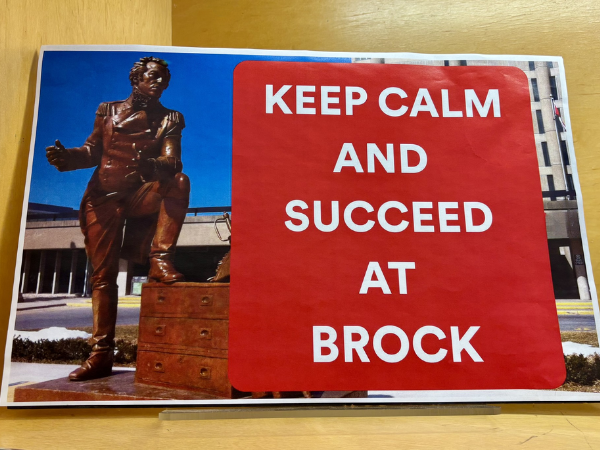
  • Display: Keep calm and succeed at Brock

    Brock Library thanks Kristina Saltarelli, Mohawk College Library Technician intern for this display and blog post. Visit the display in the Matheson Learning Commons through September. 

    University life is more than lectures…it’s about finding balance. Keep Calm and Succeed at Brock is a collection of books that offer tips and inspiration for managing stress, eating well on a budget, building strong friendships, improving study habits, and taking care of your mental and physical health. Whether you’re entering your first year or your last, these reads are here to help you feel your best!


    Tags: ,
    Categories: Featured Collections, Learning Commons

  • The Write Tools

    Whether you’re new to Brock or back for another term, this month’s Featured Collection is here to sharpen your writing and research game.

    Need help tackling essays, research papers, or thematic analyses? Find books on academic writing, research methods, and discipline-specific strategies on display near the Ask Us desk – plus a curated selection of eBooks.

    Looking for more tools? Check out LIB101: Library & Research Foundations on Brightspace, or the Omni Search Tips guide.

    And if you’re after program-specific help, explore Brock’s full set of Research Guides – including ones tailored to your courses.

    Tags: , ,
    Categories: Featured Collections, Learning Commons

  • Gettin’ outdoors

    In honor of the start of summer and the spirit of going outdoors during the warm days ahead, this month’s featured collection is all about nature and “The Great Outdoors”. Reconnect and rediscover nature by grabbing one of the books off of the Featured Collection shelf at the Matheson Learning Commons. From bird watching, foraging, plant identification and hiking, there is a little bit of something for everyone! The collection also features a series of eBooks and several film and video resources as well.

    We would also like to take this opportunity to highlight the NaturePlus Pass. The NaturePlus pass gives you access to a dozen conservation areas and parks across Niagara courtesy of the Niagara Peninsula Conservation Authority. NaturePlus passes are available at the Ask Us Desk!

    Tags: , ,
    Categories: Featured Collections, Learning Commons

  • Breaking down barriers through learning: accessibility in higher education

    Brock Library thanks Mark Castrodale, Student Accessibility Case Manager in the Student Wellness and Accessibility Centre for this exhibit and blog post. Visit the display in the Matheson Learning Commons until June 27. A featured collection of supporting literature is available through Omni.

    Access to education is a fundamental right for all persons. “Access is not just a word that indicates a lack of inclusion; it is also a way of perceiving, talking, and acting…As a perception, as talk and conduct, as a form of consciousness, access leads us to ask how access can be an interpretive move that puts people into different kinds of relations with their surroundings. Anything said about access can be read for how it reflects a host of questions: Who has access? Access to where? Access to what? When?” (Titchkosky, 2011, p.13). As such, access to higher education represents a collective responsibility, and ethical imperative. Considering issues of access can enhance the quality of education, deepen curriculum and pedagogy, and open paths for often marginalized persons to meaningfully participate and engage in teaching and learning opportunities. While there are advisable practices to improving access, accessibility in higher education represents an ongoing process, and a shared journey.

    Reference:
    Titchkosky, T. (2011). The Question of Access: Disability, Space, Meaning. U of Toronto Press.

    Tags: , , ,
    Categories: Learning Commons, Main

  • In the Garden

    This month the Library presents you with a seasonal selection of titles designed to give some garden inspiration.

    In the Garden includes books on growing and pruning plants and vegetables, soil science, and attracting birds, butterflies and bees to your garden. Titles on the history and economics of gardens, medicinal plants, insects, and fungi round out the collection.

    Browse and borrow the print items located next to the Ask Us desk and view online titles.


    Tags: , ,
    Categories: Featured Collections, Learning Commons