Articles tagged with: display

  • Exhibit: Community Organizing 101

    Brock Library thanks Dorothy Sierra-Gutierrez, Social Issues Researcher at Future Black Female, and fourth-year Sociology student for this display and blog post. Visit Dorothy’s exhibit at the Thistle entrance to the Matheson Learning Commons until May 9.

    Discovering the Heart of Organizing

    When I first heard the phrase “community organizing,” I wasn’t quite sure what it meant. I was completely unaware of the key foundations of labour studies and organizing. That changed when I took LABR 4P21: Social Justice Organizing instructed by Dr. Simon Black, that introduced me to the history and important work that is organizing.

    My introduction to organizing was both academic and personal. Through course readings, discussions, and reflections, I came to understand that community organizing is about building collective power to address systemic injustices. It’s about shifting from isolated frustration to strategic, people-powered change. Referencing the work of Marshall Ganz, organizing isn’t just about leading others—it’s about helping communities recognize the power they already have.

    Ganz’s concept of the “public narrative” resonated with me deeply. He encourages organizers to share their “story of self, story of us, and story of now.” This structure helped me articulate why I care about justice, connect with others over shared values, and envision how change can happen in the present. It’s a tool that turns personal experience into collective action—and it became a core inspiration for my project.

    What I Learned in the Classroom

    The class offered a strong foundation in both theory and practice. We explored frameworks from Progressive Community Organizing by Lori Pyles (2009), which emphasized the importance of intersectionality, long-term community commitment, and disrupting systems of oppression. Pyles explained that community can be built through shared identities or shared goals, but either way, the goal is the same: to dismantle oppressive power structures and uplift the voices of those most affected by them.

    We also examined key concepts of power through the work of scholars like Frances Fox Piven and Joan Kuyek. Piven’s theory of “disruptive power” was especially important to me—it reframes power not as something that’s held by the elite, but as something ordinary people can wield through collective action. Kuyek, meanwhile, introduced the distinctions between “power-over” and “power-with.” These terms helped me understand how organizing should always center empowerment and solidarity rather than hierarchy.

    Intersectionality at the Center

    A critical theme in my work is intersectionality—the idea that systems of oppression overlap, and that we need to address racism, sexism, colonialism, and other forces together. The Combahee River Collective Statement (1977) shaped my thinking here. Their Black feminist perspective emphasizes that liberation must be inclusive and that movements must be built by and for those most impacted by injustice. This intersectional lens isn’t just a framework—it’s a commitment to justice that informed every page of my booklet.

    Visit My Display!

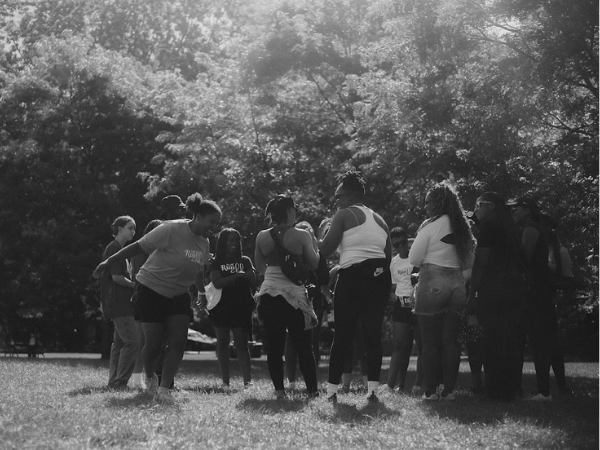
    For my final project, I created a photo booklet that explores community organizing through an intersectional lens, using visuals and text to highlight key theories and practices I engaged with during the course. The photographs—shot on 35mm film—were taken during a Black Lives Matter protest, capturing moments of resistance, solidarity, and collective action. The project was a way to combine my academic learning with creative expression, and to document a powerful moment in the fight for racial justice.

    If you’re at Brock, I invite you to visit my display at the Brock University Library and engage with the materials I’ve curated. Whether you’re new to organizing or already involved in social justice work, I hope it offers you new insights and inspiration. As Jane McAlevey (2016) and Astra Taylor (2016) argue, we must move beyond performative activism and into the slow, meaningful work of building movements from the ground up!

    Community organizing is not just an academic topic—it’s a way of building the world we want to live in.


    Tags: ,
    Categories: Learning Commons, Main

  • Comic(s) Relief

    As students scramble to complete assignments & prepare for exams, and instructors retreat into marking mode, we get it. There’s not a lot of free time to read. With this in mind, our April featured collection offers some ‘comic relief’.

    This selection of 31 graphic novels includes non-fiction titles like Direct Action Gets the Goods, a history of the Canadian labour movement, Won’t Get Fooled Again: a Graphic Guide to Fake News, and This Place: 150 Years Retold. For straight up relaxation, check out The Prince and the Dressmaker or a special 30th anniversary edition of the classic V for Vendetta.

    The Comic(s) Relief display features print-only titles. Find them on the display shelves next to the Ask Us desk until April 30.

    Tags: ,
    Categories: Featured Collections, Learning Commons

  • Know your Pride flags: celebrating Brock Pride Week

    Brock Library is joining in campus-wide celebrations of 2SLGBTQIA+ Pride this week with an exhibit focused on the dozens of flags representing the diversity of Pride. 

    From March 21 through 28, we invite you to view Know your Pride Flags, a display documenting the history and identities which are expressed and celebrated through Pride flags. This informative exhibit reflects on Pride’s colourful past, the changing present, and the need for future progress. View it adjacent to the Badger Books collection on the main floor. 

    Wishing everyone a very happy Pride! 

    Tags: , ,
    Categories: Learning Commons, Main

  • Sustainable Development Goals

    The 2030 Agenda for Sustainable Development, adopted by all United Nations Member States in 2015, provides a shared blueprint for peace and prosperity for people and the planet, now and into the future. At its heart are the 17 Sustainable Development Goals (SDGs), which are an urgent call for action by all countries – developed and developing – in a global partnership. They recognize that ending poverty and other deprivations must go hand-in-hand with strategies that improve health and education, reduce inequality, and spur economic growth – all while tackling climate change and working to preserve our oceans and forests.

    This month, the Library presents a range of titles – print and electronic, which provide context, food for thought, and a path forward for all 17 goals. Browse them online, and in-person on the Library main floor.

    Learn more about the Brock University commitment to the United Nations Sustainable Development Goals.

    Tags: , ,
    Categories: Featured Collections, Learning Commons

  • Freedom to Read Week 2025

    In celebration of the 41st Freedom to Read Week (February 23 – March 1), we’ve put together a list of challenged and banned titles for you to read in print and online.

    Many of these controversial titles were challenged and have become classics. This includes titles such as:

    It is widely regarded that book bans and challenges are a thing of the past, however the number of challenges continues to rise. The Canadian Federation of Library Associations’ (CFLA) Intellectual Freedom Committee, along with the Book and Periodical Council’s Freedom of Expression Committee, developed an annual survey to track challenges within Canadian public libraries. This survey began in 2007 and provides access to challenges libraries have faced to items in their collections, and to displays, programs, room usage, and computer access.

    Freedom to Read Week is an annual event which highlights intellectual freedom and encourages Canadians to defend their right to read, write, and publish freely. Browse all of the featured titles and more on the display next to the Ask Us desk in Matheson Learning Commons, or view eBooks online.

    Tags: , ,
    Categories: Featured Collections

  • Exhibit: Islamophobia Awareness Week

    Brock Library thanks the Muslim Students Association for this blog post.

    In recognition of Islamophobia Awareness Week, a new display in the Matheson Learning Commons highlights the tragic events of January 29, 2017, when a gunman attacked the Islamic Cultural Centre of Quebec City, taking the lives of six worshippers and injuring many others. This senseless act of hate continues to deeply affect Muslim communities across Canada.

    January 29th is both a day of mourning and a call to action—a reminder of the urgent need to combat Islamophobia and all forms of hate. Through education and awareness, we strive for a future where every Canadian, regardless of faith or background, feels safe and valued. Join us in standing against Islamophobia and supporting the Green Square Campaign in solidarity with the victims, survivors, and their families

    What is Islamophobia?

    Islamophobia is defined as the fear of, hostility towards, or hatred against Islam or Muslims. It is primarily a form of religious or cultural bigotry and those who harbour such sentiments often stereotype Muslims as a geopolitical threat or a ‘source of terrorism.’

    Learn more about the Green Square Campaign and view the display running until February 1.


    Tags:
    Categories: Learning Commons, Main

  • Exhibit: What does self-care mean to you?

    Brock Library thanks the Psychology and Beyond Club for this blog post. 

    Self care today means many things, such as taking the time to allow yourself to recharge, tending to your community ties and friendships, or cultivating your individual interests through hobbies or feel-good activities. It is also a powerful form of protest, choosing to reject a status quo that demands productivity and progress with no limits or pauses for wellbeing.

    This January, the Psychology and Beyond Club at Brock would like to promote and encourage self-care as the Brock community returns to campus for the winter semester. This display aims to educate our community on the value of self care and provides tips and inspiration through a colourful and cozy display. It is designed to be interactive so that anyone can scan the QR code and share their own tips and interpretations of the phrase, demonstrating the individual nature of self-care practices. The display also explores how the meaning of the phrase “self-care” has been changed or is often forgotten in today’s modern world, and has deep roots in social and political activism which stem from the writing of Audre Lorde.

    Genuine self care has wonderful benefits for the mind, body, and community!

    If you’d like to learn more about the Brock Psychology and Beyond Club, join us on Experience BU and follow us on Instagram (@brockpsychology_beyond).

    Tags: , ,
    Categories: Learning Commons, Main

  • Fresh Start

    Welcome to a new year, new term, new chapter!

    Embrace a fresh start and explore books in this featured collection that focus on overcoming burnout, getting organized, mindfulness, health eating, wellness, and more.

    Browse all of these titles and more on the display next to the Ask Us desk in Matheson Learning Commons, or view eBooks online.

    Tags: , ,
    Categories: Featured Collections

  • Crime and Consequence

    Do you have a curiosity for true crime? Are you interested in learning about justice and the legal system? Check out some of the mysterious and fascinating stories in December’s Featured Collection of books.

    You can browse the Crime and Consequence collection by visiting the book display next to the Ask Us desk in Matheson Learning Commons, or view the eBooks online.

    Tags: , ,
    Categories: Featured Collections

  • Exhibits: Voices of Remembrance, and Some Were Neighbors

    “To forget the dead would be akin to killing them a second time” (Elie Wiesel, Night, 1960). Wiesel’s words remind us that memory is a moral act, essential in preserving the past and preventing future hatred.

    Chabad at Brock presents “Voices of Remembrance,” an exhibit featured in the Thistle Corridor and the Learning Commons at Brock University Library. Organized under the lead of Chabad at Brock’s Holocaust Education Chair, Brooke Braverman, this display brings together the stories of Brock students who are descendants of Holocaust survivors. Through their narratives, we reflect on the antisemitism that led to the Holocaust and honour the resilience needed to carry these memories forward.

    In the Learning Commons, Some Were Neighbors, a traveling exhibit from the United States Holocaust Memorial Museum, further examines the actions and moral choices of ordinary people during the Holocaust, inviting us to consider our own responsibilities in confronting hate.

    Additionally, the library has curated a collection of books to support Holocaust Education Week, offering historical insights, survivor testimonies, and scholarly perspectives on antisemitism and resilience.

    We invite you to explore these stories and reflect deeply on their message. In bearing witness to this living history, we commit to fighting against antisemitism, hatred, ignorance, and indifference wherever they appear.

    Tags: ,
    Categories: Featured Collections, Learning Commons