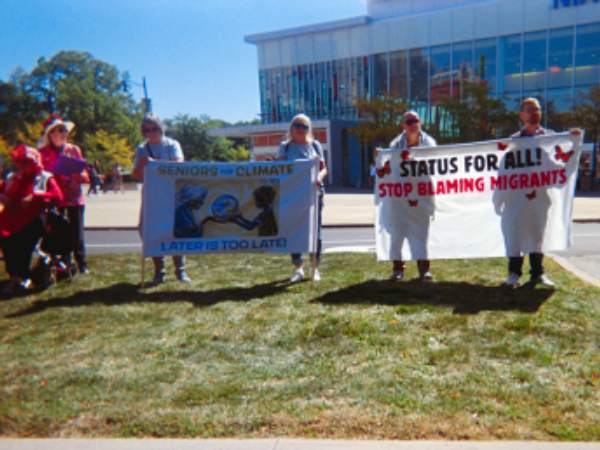
Brock Library thanks Dorothy Sierra-Gutierrez, recent graduate, Teaching Assistant, and Researcher for this display and blog post. Visit Dorothy’s exhibit in the Matheson Learning Commons and at the Thistle entrance until May 1.
This community display is named after my directed studies project, Exploring Law, Policy, and Migrant Justice, supervised by Dr. Julie Ham in the Department of Sociology and Criminology. This project examines the legal, social, and cultural dimensions of migrant farmworkers in Canada, with a focus on the Niagara Region. It emphasizes research ethics, reflexivity, and the student-researcher experience, guiding learners through the creation of a practical toolkit for ethical engagement, alongside recommendations for how Brock students can better recognize and support migrant workers in the region.
What began as an academic interest quickly became something much more personal, grounded in lived experiences, community relationships, and a deeper understanding of how essential yet underrepresented migrant workers are in Canada.
Through my studies, it became clear that migrant farmworkers play a critical role in sustaining our food systems. Across Canada, many workers from Mexico, the Caribbean, and Central America labour in agriculture through programs such as the Seasonal Agricultural Worker Program (SAWP). In regions like Niagara, their contributions include planting, harvesting, and pruning in agricultural sectors such as wineries. Yet despite their essential role, many face precarious working and living conditions, limited access to healthcare, and systemic barriers tied to their temporary immigration status.
My interest in this topic deepened through my involvement with the Migrant Farmworkers Project in Niagara. While volunteering at the community hub, I supported the distribution of food, clothing, and hygiene products, and connected with workers in Spanish. These experiences allowed me to better understand the needs of migrant workers in the region, as well as the important role that local organizations and community partners play in supporting them.
Through this directed studies project, I wanted to create something that was not only academic, but also accessible and practical. The result is an annotated bibliography and a Migrant Farmworker Justice Toolkit, now featured as part of the Brock University Library display. The annotated bibliography reviews key literature on migrant issues and policy developments, while also including prompts to encourage deeper student engagement. The Justice Toolkit brings together research, community knowledge, and practical resources to help students learn about migrant workers’ experiences and the broader systems that shape them.
The toolkit explores key questions: Who are migrant farmworkers in the Niagara context? What challenges do they face? How can student researchers ethically engage with and learn from migrant communities? It also highlights local organizations and initiatives that support migrant workers. Importantly, the project centers both academic research and experiential knowledge, recognizing that meaningful understanding requires listening to those directly affected.
One of my main goals was to challenge dominant narratives that portray migrant workers solely as vulnerable or passive. While vulnerability is an important part of the conversation, it is equally necessary to recognize migrant workers’ resilience, agency, and contributions. This project aims to move beyond simplified narratives and instead offer a more nuanced and humanizing perspective.
Creating this toolkit also pushed me to reflect critically on my own role as a researcher. How do we engage ethically with communities? How can research be mobilized in ways that extend beyond the classroom? These questions shaped both the content of the project and its presentation in this display, designed to invite reflection, learning, and action.
By sharing this work, I hope to contribute to a broader understanding of migrant justice and encourage others to think more critically about the systems that shape our agricultural food systems and immigration policies.
If you have the chance, I invite you to visit the display, engage with the toolkit and annotated bibliography, and reflect on how Brock University, as an institution, can contribute to advancing migrant justice in the Niagara Region.
Bio:
 Dorothy Sierra-Gutierrez
Teaching Assistant
NCLC Board Member
Brock University
Undergraduate Sociology (Honours) Co-op
Concentration in Criminology
Double Minors in French Studies and Women and Gender Studies