Articles from:September 2021

  • I spy, with both my eyes, something that is more sustainable: Two-eyed seeing

    Contributors: Liette Vasseur, Catherine Longboat and Jocelyn Baker.


    How do we see the world? This is a question of enigma and reflection: Do all of us see the world and the knowledge that we acquire in the same way?

    Throughout human civilization, the way to acquire knowledge has changed. For hunter-gatherers, most of their knowledge came from nature, including understanding seasonal changes, the tracks of animals, etc. When humans later became sedentary and started pursuing agriculture, they began to derive knowledge not only from nature, but from their own experience with crops, and gradually, with livestock.

    With this, in the Western world, humans began to take more control over nature, leading to devaluating the value of nature. Humans instead began to see themselves as the predominant force upon the Earth’s ecosystems. This period of human history also led to the development of many religions which viewed humans not as part of nature — but as superior to nature. With the development of new technologies and the transition to the industrialized world came the use of fossil fuels and the era of science. The sciences have brought benefits that were not imagined in times past. With modernization also came an increasing need for more resources, which lead to competition, instead of collaboration, between countries and corporations. Under such a system, trade and the economy have increased. The sciences also became a major focus in academic institutions and research centres and new “discoveries” and technologies have become a must in society, while simple things, such as a having a walk in nature, are becoming increasingly obsolete.

    This nonstop race for new knowledge has led to the belief that only scientists know the answers and can solve problems. This human hierarchy has pushed aside contributions from certain groups of peoples, as their knowledge was felt to be unfit for resolving issues. Indeed, some of their principles, values and beliefs may interfere with market production. This is how Indigenous knowledge became relegated to the margins of colonial living and the Western capitalist system. Indigenous knowledge was therefore not included as Western scientific knowledge.

    With a gradual acknowledgement that technology cannot fix everything, and the increasingly dire situation of the degraded Earth, humans have started to realize that other forms of knowledge may be better suited to solving the problems that humanity faces, such as biodiversity loss, land degradation, and climate change.

    This is where Indigenous knowledge becomes important to acknowledge and respect. Indigenous knowledge is based on a different worldview than modern Western society. In Indigenous cultures, humans have a strong relationship with nature and are thus one among many other species. There is no question that mutual respect and reciprocity is foundational for understanding relationships on Earth and beyond. The Indigenous traditional knowledge is based on the natural world and information that has been transmitted from generation to generation over millennia. What is wonderful is that in recent years, there has been an increased will to embrace these two types of knowledge — scientific and traditional knowledge — into what has now been called “Two-Eyed Seeing,” or Etuaptmumk in Mi’kmaw.

    This concept of Two-Eyed Seeing was introduced by Mi’kmaw First Nation (Cape Breton, Nova Scotia) Elders Albert and Murdena Marshall as a means to bridge Western science and Indigenous knowledge1. Two-eyed seeing promotes using one eye to see the strengths of Indigenous knowledge, the other eye to see the strengths of mainstream knowledge, and both eyes together when fully ‘seeing’ the world around us1. The goal is to create cross-cultural collaboration. Two-eyed seeing is underpinned by the belief that there are many ways of understanding the world, some of which are derived from Western sciences and others by various Indigenous knowledge systems. What is important is that both knowledges are seen as equitable, embracing the idea of having cultural respect for any action and not changing the other without agreement.

    The goal of two-eyed seeing is to bring awareness of alternative ways of knowing (where diverse perspectives can work together) with the aim of creating equity, where no one perspective has domination over the other 2.  Using both eyes together creates alternative ways of addressing solutions as afforded through different ways of seeing, by offering opportunity to look through a different lens and create solutions that may not be perfect or without flaws 2.  An important aspect of two-eyed seeing is the framework for a plural co-existence of worldviews 2. The important consideration, especially for the natural world, is remembering that all systems are interconnected, and human systems are to work in conjunction with the natural world in order to support and complete the whole ecosystem.


    1. Bartlett, C., Marshall, M., & Marshall, A. (2012). Two-eyed seeing and other lessons learned within a Co-learning journey of bringing together Indigenous and mainstream knowledges and ways of knowing. Journal of Environmental Studies and Sciences, 2(4), 331-340. doi:10.1007/s13412-012-0086-8

    2. Broadhead, L., & Howard, S. (2021). Confronting the contradictions between western and Indigenous science: A critical perspective on two-eyed seeing. AlterNative: An International Journal of Indigenous Peoples, 17(1), 111-119.
    Categories: Beyond Sustainability Blog

  • Parasitic Wasps: Unseen Vineyard Warriors

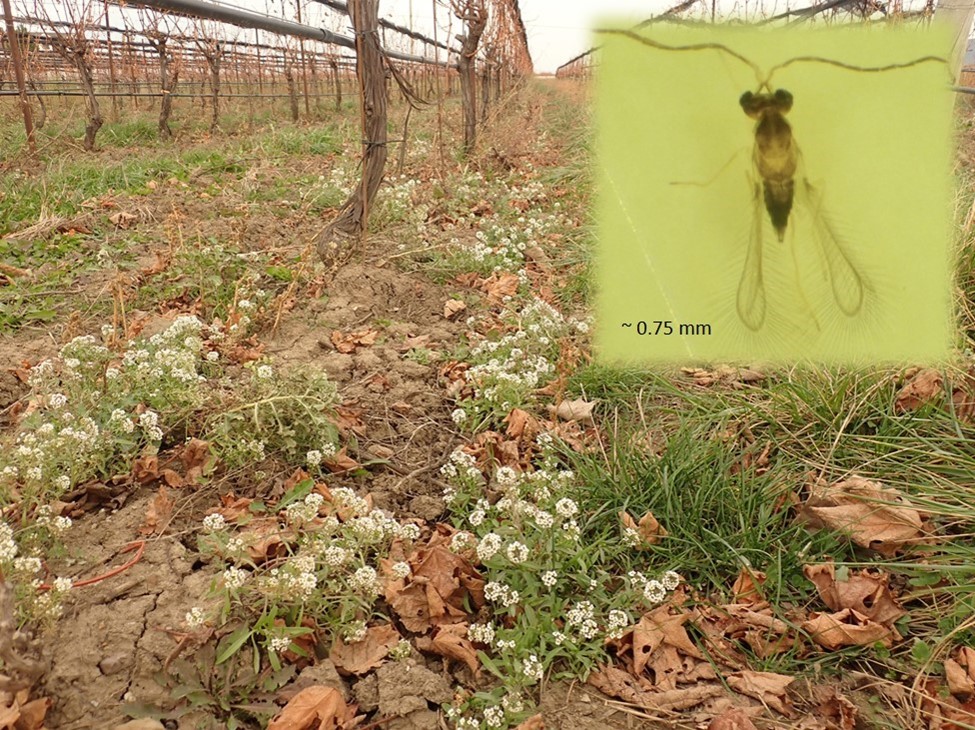
    Fairyfly (more formally from the wasp family Mymaridae, as seen in the photo inset) is a name given to some species of tiny wasps (mostly 0.5-1.0mm) that are thought to be important parasitoids of vineyard pests. They may also be attracted to cover crop plants such as sweet alyssum (Lobularia maritima), shown growing below the vines in a local vineyard in the photo above (photos by Kasia Zgurzynski and Heather VanVolkenburg).


    When grape growers consider using cover crops in their vineyards, they likely look at plants that can grow well between rows of vines, such as clover or rye. These, and other common cover crops, provide farmers with benefits such as the reduction of soil erosion, improved nutrient cycling and weed inhibition. It is also possible to grow cover crops that are attractive to beneficial insects, which can be achieved by planting directly under the vines. In doing so, farmers may encourage the presence of beneficial organisms, such as parasitoids (i.e., parasitic wasps), to target pests that feed on grapes and vines.

    Parasitoids are insects that lay eggs in the bodies of other insects, such as leafhoppers and moths. Although they vary in size, most parasitic wasps are smaller than one centimetre — some are even as tiny as a fraction of a millimetre. Mymaridae, the family of parasitic wasps also known as fairyflies, includes the smallest insects known to science. They are important to agriculture because members of this family parasitize pests, particularly leafhoppers. Another family of particular importance in viticulture includes wasps that parasitize the grape berry moth, which is a common grapevine pest. Parasitic wasps can also influence pest insect populations, but more research is still needed to fully assess their efficiency in that regard.

    It is easy to take these wasps for granted. They occur naturally throughout the landscape, but due to their small size, we are more likely to see the parasitized pests than the wasps themselves. Some grape growers choose to buy adult wasps and release them into their fields. The introduction of beneficial insects in this way is referred to as classical biological control and can be an important part of an effective and sustainable integrated pest management program. Conservation biological control, on the other hand, involves creating the right conditions in the landscape to attract naturally occurring beneficial insects, rather than manually releasing them in the area. Whether the population is natural or released, farmers can support and encourage the presence of beneficial insects by providing the adults with food sources such as nectar and pollen, i.e. flowers.

    Here at Brock University, we are currently testing cover crops that could be planted in vine rows. One of these is sweet alyssum, a popular horticultural plant that provides a floral display and sustenance for beneficial insects. Since it is the flowers of alyssum that attract parasitoids, the plant mainly serves its purpose while in bloom. The flowers on sweet alyssum are wide and shallow enough that parasitic wasps can feed on them effectively with their small mouthparts. More research is also needed to uncover other types of insects that feed on alyssum, and whether it also attracts pests. It grows as a hardy annual in Ontario, so it usually needs to be seeded every year (although it has been shown to be able to reseed itself) and does not provide the ideal winter habitat that is important to many beneficial insects.

    Alternatives to pesticides, based on conservation biological control, are expanding and gaining momentum. Research is needed to learn which plants can better attract beneficial insects (such as parasitic wasps) and to help farmers make more informed decisions about their approach to pest control. Farm management and climate change, especially extreme weather events such as flooding and droughts, may affect the performance of alyssum and other cover crops as well as populations of parasitic wasps. It is important to understand how these various factors may impact the performance of plants and parasitoids.

    This blog will be ongoing throughout the duration of the project with monthly updates provided by Liette Vasseur, Heather VanVolkenburg, Kasia Zgurzynski, Habib Ben Kalifa, and Diana Tosato (see research team). We will be providing research activity updates as well as informative pieces that delve into agricultural concepts and important global issues as they relate to agricultural sustainability and climate change. Stay tuned for regular updates!


    Categories: Organic Science Cluster 3 Blog

  • We can’t protect our planet without radically transforming our worldview — is it possible?

    Contributors: Liette Vasseur, Catherine Longboat, and Jocelyn Baker.


    Everyone has a worldview, a conception of what the world is like. Also referred to as a philosophy, a worldview is a collection of beliefs, values, attitudes, interpretations, and stories about the world around you. Worldviews inform your thoughts, behaviour, vision, relationships, knowledge, and actions. It is your picture of reality. Your worldview represents the reality of the world in which you live, your perception and your interconnectedness (on a physical, mental, emotional, and spiritual level).

    Throughout history, human populations have developed a multitude of diverse ways to view themselves and the world around them. Worldviews have different origins, stemming from various social, cultural, religious, political, and economical systems that have developed over millennia. These different origins can inform and create similar worldview realities shared by different groups of people and societies.

    As humans developed neo-liberal ideas and developed different systems, civilizations, religions, and economic and political structures, humans began to believe they possessed a superiority to all other organisms on the planet. Many of these systems operated with the worldview that all organisms and resources on this planet are to be used and exploited for the benefit of human societies. For example, one of the predominant worldviews in the western world today is neoliberal capitalism, which describes one’s desire for a free market, largely unregulated by governments, based on trade, stock market and infinite economic growth. The current utilitarian mentality is, however, causing the degradation and depletion of most of this planet’s vital resources — including water, mineral resources, and organisms.

    There are many cultural frameworks and worldviews practiced by Indigenous Peoples around the world that differ greatly from this current western worldview, and many of which respect the earth as a Mother upon which all beings are expected to co-exist for their on-going sustainability. They live according to a set of ethics that reflect their obligation toward their relations whether considered animate or inanimate. Thus, protocols and processes for co-existence are about acknowledgment of balance and harmony. Acknowledgment of sacrifices and willingness to support one another are complex and inter-relationships include others than human beings. Unlike the neoliberal capitalism worldview, this worldview is not based on the importance of accumulating wealth and material goods.

    Most Indigenous worldviews involve humans striving to live in co-existence with all other beings. This is rooted in their understandings of various Creation stories that are passed down from generation to generation. While these stories vary, they all explain, from the very outset, that there is an interconnection that exists between all life. Notions such as interdependency, balance, and harmony are prominent, and the duty to care does not hinge on the human as master, but rather, on the two-legged co-existing as an equal being amongst all others, aiming for peaceful coexistence. In North America, the Haudenosaunee Thanksgiving Address, for example, addresses 17 aspects of Creation to be recognized, including ‘the people’ as being given the duty to live in balance and harmony with each other and all living things.1.

    With the increasing urgency to advance reconciliation and find solutions for the survival and sustainability of our planet, accepting and respecting multiple knowledges, worldviews, and ways of knowing are crucial. We can, and should, learn from sources outside the dominant neoliberal-capitalist system. There is an urgency to review how such systems are destroying the environment necessary for human existence.

    There is an urgent need to change the current western worldview, which is unsustainable for the future of human existence. The continuous economic and population growth of human societies should not come at the expense of nature. We need to radically transform our relationships with the natural environment and the focus for that change must include knowledges that perceive nature and humans as inter-connected, inter-related, holistic, balanced, and in harmony.

    Transformation of the western worldview calls for rethinking humans as being the most important, superior, and dominant creatures on the planet, and the natural world as subservient to human benefit. Most Indigenous worldviews share commonalities, where humans are not the most important creatures, relationships and community are at the heart of decision making, and all life is seen as sacred and interconnected.2.  Indigenous worldviews are holistic and recognize the interconnections between all peoples and all other beings. They also look back to their ancestors for guidance while simultaneously looking, at a minimum, seven generations forward into the future.2.

    Re-embracing a worldview that genuinely reflects Indigenous ways of knowing may serve to transform our relationship with nature and bring about a more sustainable social-ecological system for all beings on Earth.


    1. Stokes, J., & Kanawahienton Benedict, D. (1993). Haudenosaunee Thanksgiving Address: Greetings to the natural world (english version). Retreived from: https://americanindian.si.edu/environment/pdf/01_02_Thanksgiving_Address.pdf

    2. Marshall, A., Beazley, K. F., Hum, J., Joudry, S., Papadopoulos, A., & Zurba, M. (2021). “Awakening the sleeping giant”: Re-indigenization principles for transforming biodiversity conservation in Canada and beyond. FACETS, 6, 839-869.

    Categories: Beyond Sustainability Blog