Articles from:February 2021

  • Climate data and trends in the Greater Niagara Region

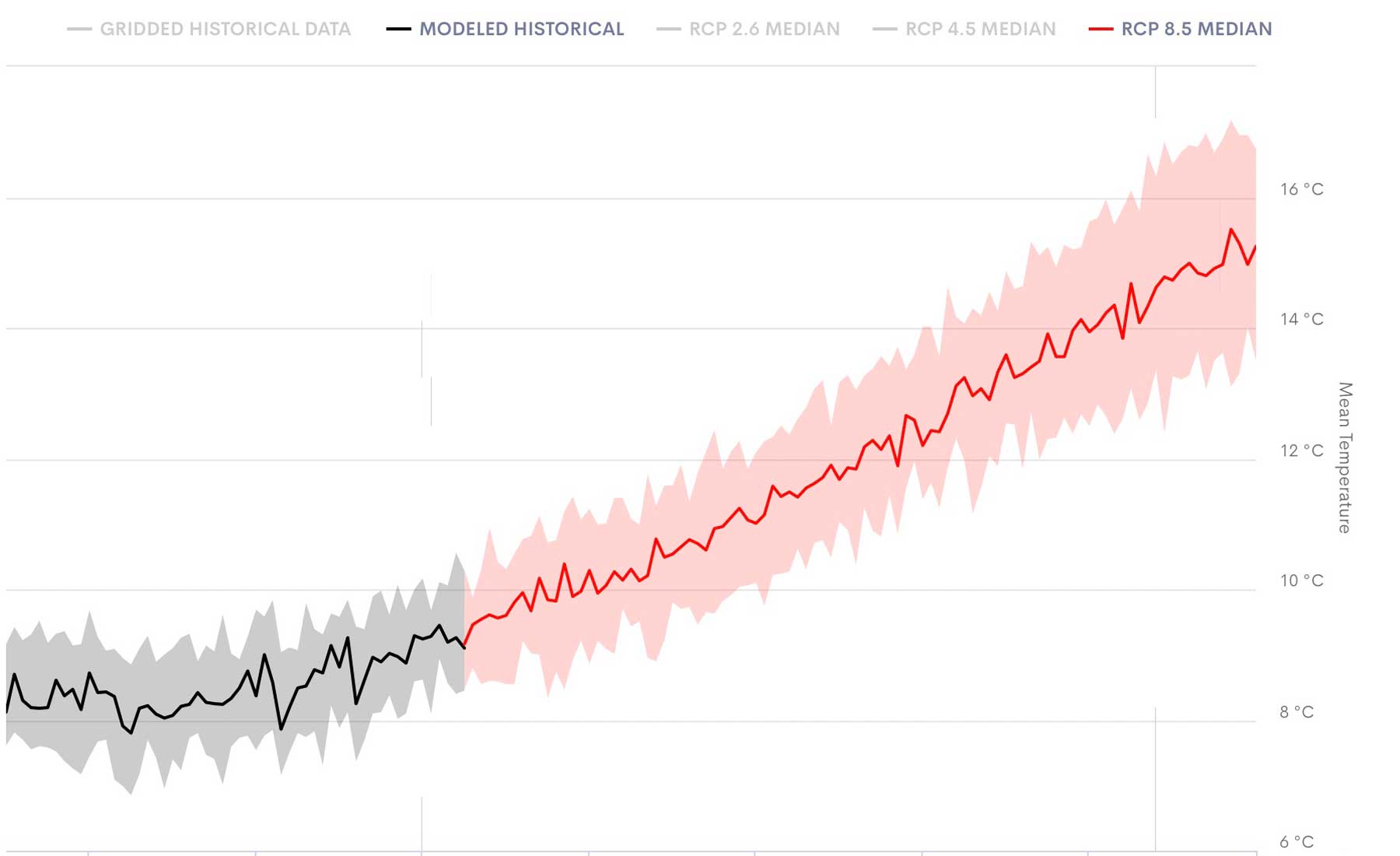
    A graph from climatedata.ca that illustrates the rising mean temperature from the years 1950-2100 under a high emissions scenario (RCP8.5). This increase in mean temperature can lead to negative impacts for agriculture, coastal communities and the overall health of individuals in the Niagara Region.


     In a previous blog post, we discussed how to take initiative towards adapting to and mitigating (reducing) the effects of climate change. However, before we can discuss specific methods of actually doing so, it is important to first understand the historical and predicted future climate trends in the Greater Niagara Region.

    A great tool for understanding climate trends across Canada is the publicly accessible website climatedata.ca. It provides climate data that helps individuals, communities and governments better understand historical climate data and make informed decisions for a more resilient Canada in the future. The website provides past, present and current climate trends for multiple locations in Canada. The data can be analysed on a broader provincial level or drilled down to look at specific municipalities or townships. Specific climate variables, such as temperature, precipitation, frost days and growing days, are also available. This information can be extremely valuable when trying to plan adaptation and mitigation measures in your community, for infrastructure, on farmland and even at your own personal residence. For example, frost days (number of days where the temperature drops below 0˚C) are particularly important in the Greater Niagara Region as the agricultural sector is a main economic driver for the area.

    The website generates graphs of climatic trends under three future greenhouse gas emission scenarios, also known as representative concentration pathways (RCPs). These RCPs were generated by the United Nations’ Intergovernmental Panel on Climate Change (IPCC). RCPs represent the degree of warming of an area or location (translated in watts per square meter) under different scenarios. Those scenarios range from acting rapidly to reduce greenhouse gas emissions to not acting at all and keeping a business-as-usual way of life. They include a low emission scenario (RCP2.6), moderate emissions scenario (RCP4.5) and high emissions scenario (RCP8.5). The RCP2.6 scenario leads to the least warming and reflects a future that uses immediate efforts to drastically reduce greenhouse gas emissions. RCP4.5 models a future in which some mitigation of emissions prevents the extreme warming of the high emissions scenario of RCP8.5. Analysing the high emissions scenario (RCP8.5) on the website allows you to understand and prepare for the worst-case scenario when dealing with climatic trends. Unfortunately, due to trends and behaviours we are currently seeing in Canada, such as increases in population, pollution, and deforestation (among others), the RCP8.5 scenario may become the most probable one.

    We used the website to find data about the Niagara Region under a high emission scenario (RCP8.5). Using the website, the climatic trends reported for this area show that the annual average temperature in the region was between 8.4 ºC and 9 ºC between 1951 and 2020. Under a high emissions scenario, annual average temperatures are projected to be 10.9 ºC by 2050, 12.9 ºC by 2080, and will continue to rise above 14.3 ºC by 2100. Average annual precipitation in the region was historically 866 mm. Under a high emissions scenario, this is projected to be 7% higher by 2050, 10% higher by 2080 and by 2100.

    Rising temperatures and precipitation rates can have a significant impact on agriculture, coastal communities and the overall health of individuals in the Niagara Region. Over time, climate change has become more severe and in order to take initiative and make change, we must adapt and mitigate so we can slow or stop these trends from climbing.

    It is important to note that these climatic trends are projections, meaning they are just a model and may not be 100% accurate. However, they do provide guidance as to what the future may hold for our region. With a proper understanding of the potential climatic changes Niagara could be facing, it allows us to be more prepared and create more efficient adaptation and mitigation plans. In upcoming blogs, we will discuss strategies that can be used to manage these projected climatic changes and how we can initiate change.

    The researchers involved with the MEOPAR project are working to raise awareness about the impacts of climate change and how communities can effectively adapt and increase resilience to these changes. Follow along with our blog every week (written by researchers Liette Vasseur, Meredith Caspell, Bradley May, Sam Gauthier & Jocelyn Baker) to learn more about the project and how you can get involved. You can also visit our website at brocku.ca/unesco-chair or email us at [email protected]


    Categories: MEOPAR-Lincoln Blog

  • Vineyards and Heavy Rainfall

    Standing pools of water in a local Niagara vineyard, days after heavy rainfall in October of 2020 in a local vineyard (Photo taken by Len Van Hoffen).


    A flooded vineyard is not a strange view for Niagara region inhabitants, particularly after a heavy rainfall event. In recent years, this has been seen more frequently in late winter and spring. Heavy rainfalls are considered extreme weather events that are projected to occur more frequently because of climate change. With more frequent torrential downpours, vineyards are often subjected to periods of waterlogging. The meteorological service of Canada defines a heavy rainfall event as 50 mm of rain in less than a 12-hour period. Soil type, volume of precipitation and management practices can all be determinant factors for how long water will remain in the field, as well as how much it will affect the soil and vines. Flood conditions in vineyards can cause both short and long-term challenges for vineyard managers.

    A flooded vineyard usually leads to relatively soft, muddy soil, making management activities difficult. In fact, soggy conditions often prevent mechanical management from happening as the soft vineyard soil cannot support heavy equipment without causing soil compaction. Soil compaction is when the soil gets compressed to a point where normal processes such as water movement or plant root growth through the soil becomes limited. In the spring, it is not uncommon for between-row sowing of cover crops in the vineyard to be delayed or skipped entirely depending on how long the vineyard is under water. Sometimes, standing water can even mean that growers may have to delay their harvest; thus leaving the berries on the vine for a longer period of time and potentially affecting wine quality.

    Soil runoff is another management challenge in vineyards during periods of heavy rainfalls that cause soil degradation and nutrient loss. Vineyards located on steep slopes can be more prone to this phenomenon, with water running faster and bringing soil sediments, as well. Managers will often plant a cover crop in an attempt to mitigate this challenge.

    A waterlogged soil can become what is known as anaerobic, which means that there is less oxygen available in the soil for plants and other important organisms to thrive. Less oxygen can result in root damage and even plant mortality, ultimately resulting in reduced berry quality and yield.

    Some wine growers have found that yields following a flooded year are drastically lower than years with less heavy rainfall. In flood conditions, vine plants tend to devote energy to bud formation and canopy growth rather than forming fruits, hence less berries and smaller clusters. Furthermore, heavy rains close to harvest can injure ripened berries through the force of drops hitting the outer skin and exposing the swollen fruit contents. This causes them to become more susceptible to rot and disease and will not only decrease the yield, but potentially the wine quality, as well.

    Heavy rainfall can have other indirect effects for vineyard managers. Too much moisture has the tendency to increase disease pressure in seasons following floods. Too much rain, combined with warm temperatures, can produce the perfect condition for fungal diseases like mildew, botrytis, and other rots to develop. High precipitation can also speed up the spread of fungus that has overwintered within vineyard soils in the form of spores. Fungal spores can be lifted from the ground all the way to the canopy, essentially hitchhiking on the splash of raindrops, or carried to other parts of the vineyard through runoff.

    During times of drought, rain can be good news for any crop — and vines are no exception. But, as we have seen, heavy rains and extended flood conditions can have numerous negative effects on vineyard management, plants and ultimately, the whole agroecosystem. To minimize the impact of waterlogging within vineyards, some management practices can be applied. These may include the installation of efficient draining systems, mechanical pump removal of water or deep tilling of the soil every 4 to 5 years. However, working with mother nature by introducing between-row cover crop varieties that respond well to flood conditions may be a grower’s best bet in mitigating these extreme weather events. Thinking back to the most recent blog on the effects of drought in vineyards, it becomes apparent that water management can be a delicate balancing act for managers. Researching how vineyard systems respond to extreme weather events can help growers adapt and choose optimal management strategies thereby enhancing their vineyards resilience and sustainability.

    This blog will be ongoing throughout the duration of the project with bi-weekly updates provided by Liette Vasseur, Heather VanVolkenburg, Kasia Zgurzynski, Habib Ben Kalifa, and Diana Tosato (See Research Team). We will be providing research activity updates as well as informative pieces that delve into agricultural concepts and important global issues as they relate to agricultural sustainability and climate change. Stay tuned for regular updates!


    Categories: Organic Science Cluster 3 Blog