Articles from:January 2022

  • My Experience as an Undergraduate OSCIII Summer Research Student

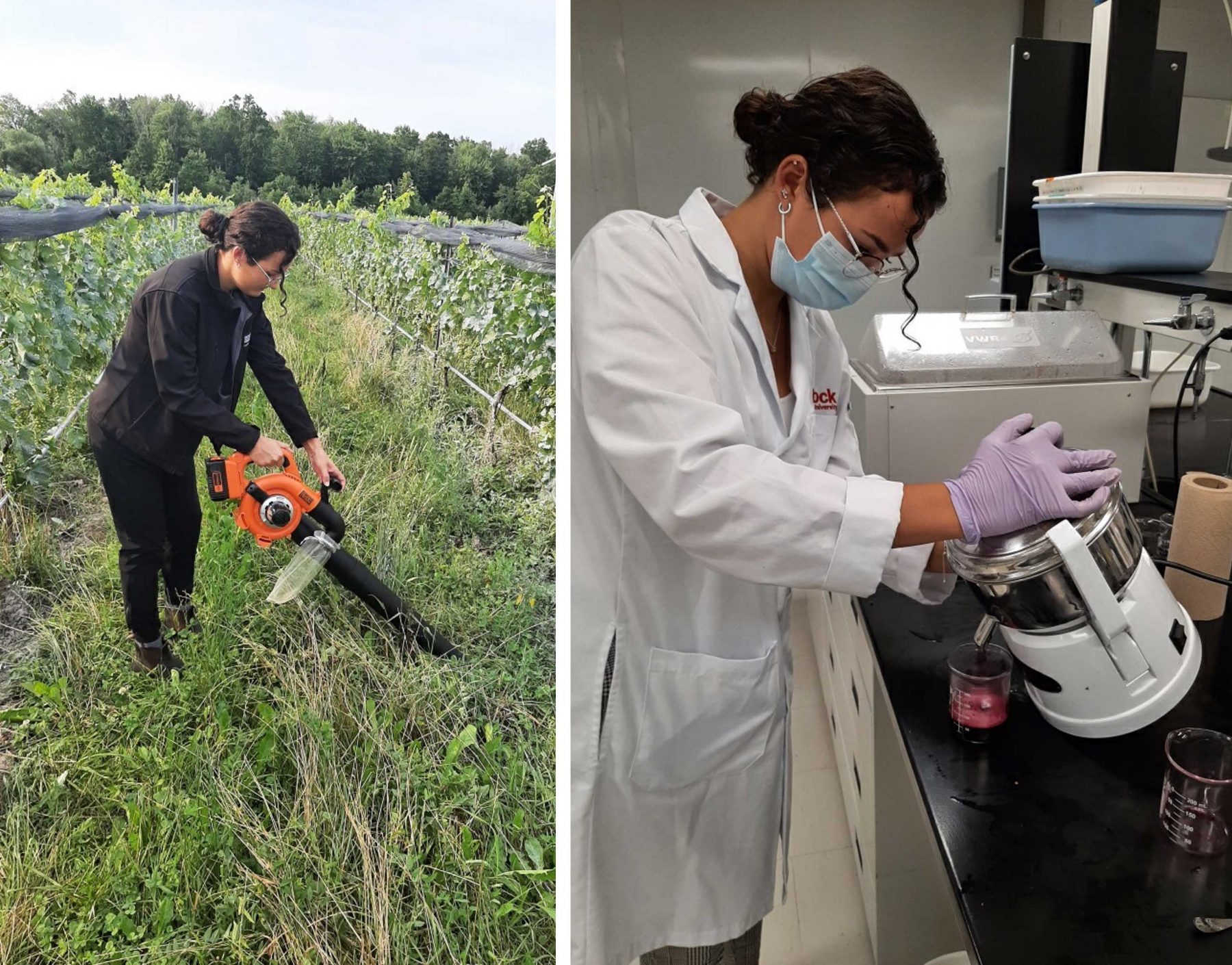
    Undergraduate summer research assistant Lindsay McConkey collecting invertebrates (left) and processing grape berry samples (right) for the lab’s Organic Cluster III project. (Photo credit: Diana Tosato)


    Submitted by Lindsay McConkey and the OSCIII team

    I do not think I ever pictured myself as an ecology research assistant when I first began at Brock.  I entered my third year of the Biological Sciences program this fall and was required to take an ecology course (BIOL 2Q04). Following completion of the course, I was lucky enough to be offered the chance to apply to the Match of Minds program this past spring, proving that hard work and developing good relationships with your TAs does make a difference! The program granted me a summer research assistant position in Dr. Liette Vasseur’s lab, which was a truly amazing experience.

    My biggest goal as an undergraduate student was to get involved in a biology lab to get real applicable experience and decide if research was something I wanted to do in my future. I was ecstatic to have the opportunity to be involved in the lab this summer. I have learned more than I could have imagined about ecosystems, vineyards and grape management, data collection and entry, insect identification and general research methods (e.g., snowballing research journal references). Now, whenever I walk anywhere outside and see weeds growing, I automatically try to see if I can identify the plant. Do I recognize it from our field or lab work? I even found myself doing the same with some insects that I come across, by identifying the invertebrate order that they belong to.

    Working with Liette’s team has broadened my knowledge about research, both in the field and lab, as well as the behind the scenes that you do not learn about in a classroom setting. Taking ecology online during the pandemic did not allow me to have the same experience that would normally be offered. With this position, I was able to get experience in the field that I missed out on, as well as extra experience that is not typically offered in class. I had never had the chance to work with graduate students in biology before, so it has been beneficial to hear about their experiences. I would like to do my Masters after finishing my Undergrad, so understanding how research projects really work and how much goes into them has been interesting to see and be a part of. I have learned a ton about myself as a learner, which has allowed me to become a better researcher and student.

    This position really pushed me out of my comfort zone to improve and learn about parts of research that I would not have otherwise experienced until later in my career. I am used to doing work that only myself and the marker sees, but a lot of what I have been working on is being used in the Organic Cluster project and shared with other researchers. Instead of my work only impacting my progress and grades in class, what I do or do not do in the lab impacts everyone else’s work, which is why it is so different, but also applicable to real life.

    I believe that I am very lucky to have been approached for this position. I am thankful that Brock is a smaller university as I may have not had this opportunity at another school, where it is harder to be noticed and make connections with your professors and TAs in larger settings.

    I would like to explore other areas of biology, explore my options, and figure out exactly which direction I would like to go in my studies and future career. Although ecology was not necessarily the direction I planned to go with my education at first, this position was a phenomenal start to my experience in a lab for which I could not be more thankful. I have a particular interest in cell biology; however, I think it’s valuable to be able to experience a variety of fields in biology.

    I’ve made great connections with the people that I have worked with and am thankful for everything that they have done for me and taught me. I am especially thankful for my research manager Heather, who has worked with me through many challenges this summer given  I had never worked in a lab and had limited knowledge in ecology and field work. She personally pushed me out of my comfort zone and was always encouraging. Working on the Organic Cluster project was another truly rewarding experience.

    I would encourage others to try something new because you never know where it might lead!


    This blog section will be ongoing throughout the duration of the project with bi-weekly updates provided by Liette Vasseur, Heather VanVolkenburg, Diana Tosato, Kasia Zgurzynski, and Alysha Gullion (see research team). We will be providing research activity updates as well as informative pieces that delve into agricultural concepts and important global issues as they relate to agricultural sustainability and climate change. Stay tuned for regular updates!


    Categories: Organic Science Cluster 3 Blog

  • Beyond sustainability – radical transformation: What does that mean and how do we do it?

    Contributors: Liette Vasseur and Jocelyn Baker

    Since the World Commission on Environment and Development released Our Common Future in 1987, all nations have been talking, at various degrees, about sustainable development.

    In 2000, for instance, the United Nations launched the Millennium Development Goals (MDGs), directed towards developing countries only. These focused on three areas: human capital, infrastructure, and human rights (social, economic and political) with the intent of increasing the standard of living for people around the world. These goals, however, made little progress to solve inequalities between developed countries and developing countries. It quickly became clear that much remained to be done. So, in 2015, the United Nations adopted the 2030 Agenda for Sustainable Development and its 17 Sustainable Development Goals (SDGs). The major difference from the Millennium Development goals was that these were designed to apply to all countries evenly, not just developing countries.

    But is this enough?

    The impact that the COVID-19 pandemic is having on the global economy suggests that, like the MDGs that came before, many of the SGDs will also not be achieved. This is especially true, once again, for developing countries. The pandemic has also underlined the strong dependence and focus that all countries place on the economy. The two other pillars of sustainable development – society and environment – are generally left out. This demonstrates that despite the efforts made to convince the world’s nations of the importance of integrating the three pillars, we still base all decisions on the economy.

    We do not link the pandemic, environmental crises, and societal challenges to this lack of integration — and this is now endangering human society. It may be time to think beyond sustainability because the way countries, corporations, and even individuals, operate and make decisions is unsustainable. The fixation on consumption is pushing the world to the limit — and resources are depleting faster than they can recover.

    These current patterns of production and consumption must be changed, for our own well-being and that of future generations. Despite the fact that human health and the environment are intrinsically linked, we carry on as business-as-usual, guided by unrealistic notions of infinite economic development and growth that ignores the reality that we live on a planet with finite resources1.

    We need a new path forward that goes beyond the traditional sustainability discourse. Defining sustainability as three separate pillars (economic, society, environment) has meant that the environment rarely receives equal weight or treatment. It is often seen as something to consider if there is time and money left over from dealing with issues pertaining to the other pillars.

    A radical change in the way societies function is required in order to avoid grave future predictions, such as those seen in the International Panel on Climate Change’s (IPCCs) recent report. This will require all 200+ countries, and thousands of corporations, around the world to work together and create the deep transformations necessary to avoid greater disasters. To create a safe operating space for all of humanity, we need to change direction in a radical way.

    Going beyond sustainability calls for radical transformation of the current system and its underlying defective worldview. There is growing awareness that the current worldview of capitalism and consumerism is one which supports resource overexploitation, the accumulation of profit and infinite economic growth, and viewing humans as dominant over nature and other living creatures. This human-driven exploitation of the environment is the root cause of our current planetary crisis.

    Transformation is understood as a profound change which requires a fundamental shift in mindset2. Radical transformation, on the other hand, looks at the root cause of problems and gets to the core of the issue. This usually requires a shift away from the type of thinking that created the problem(s) in the first place. Changing mindsets, although challenging, is possible. The status quo cannot effectively address the environmental challenges we face. What is required is a radical transformation of how we envision ourselves and the world in which we live.

    To move beyond sustainability and protect people and the planet, we envision a new conceptualization with the environment at the foundation for sustainability reforms. In contrast to the three pillars of sustainability, we propose a pyramid: the environment is the base with society and then the economy as subsequent levels. The environment needs to be healthy and robust for the next level (society) to flourish, and only when all levels below are thriving and resilient can the top of the pyramid (economy) be strong. It should also be noted that the economy is not only a vessel for profit, as it is right now, in this model. Instead, the economy would be circular and no longer strive for endless profits (beyond what’s needed for sustaining the businesses), or have its objectives developed in order to fulfill human greed.

    Communities are facing significant challenges due to climate and environmental changes caused by human activities. This has resulted in land degradation, water, soil, and air pollution, and biodiversity loss. Changing mindsets and increasing awareness, however, can create a new path for humans and the planet. Nobody can change the world on their own, but small groups of people, working together, can contribute positively to the goal of radical transformation. With every small change, the world will be forever altered for the better and, we can hope, bring us closer to a more sustainable world of all.


    1. Robinson, N. A. (2012). Beyond sustainability: Environmental management for the Anthropocene epoch. Journal of Public Affairs, 12(3), 181-194. doi:10.1002/pa.1432
    2. Massarella, K., Nygren, A., Fletcher, R., Büscher, B., Kiwango, W. A., Komi, S., … Percequillo, A. R. (2021). Transformation beyond conservation: How critical social science can contribute to a radical new agenda in biodiversity conservation. Current Opinion in Environmental Sustainability, 49, 79-87. doi:10.1016/j.cosust.2021.03.005
    Categories: Beyond Sustainability Blog

  • Sustainability Versus Sustainable Development: What’s the difference?

    Contributors: Liette Vasseur & Jocelyn Baker

    Sustainability is the process of living within the limits of available physical, natural, social, and cultural resources in ways that allow all living things —not just humans — to thrive long into the future.

    Sustainable development, on the other hand, aims to create growth and progress through the addition of physical, economic, environmental, and social components that can improve quality of life without depleting resources for the future.

    In the previous blog, we saw that sustainability comes from the practice of “nachhaltigkeit”, a German term coined in 1713. Except in technical articles, the word sustainability was rarely used until 1972, when a then-leading magazine published a series of articles entitled Blueprint for Survival. This series, which involved more than 30 scientists, recommended that we should live in small, de-industrialized communities to help prevent a breakdown of society. In this series, the meaning of sustainability was much broader than its original, 18th century usage: suggesting a change in lifestyle, the implementation of population controls. better management of natural resources, and the establishment of “no-growth” economies.

    Sustainable development first appeared in 1987, when the United Nations’ Brundtland Commission included a definition for the term in its Our Common Future publication. The author defined the concept of sustainable development as an approach designed to “meet the needs of the present [generation] without compromising the ability of future generations to meet their own needs.”

    In 2002, the report from the Earth Summit on Sustainable Development prescribes the need to “promote the integration of the three components of sustainable development—economic development, social development and environmental protection—as interdependent and mutually reinforcing pillars” (1 p.8)

    So where are we today?

    As part of the United Nations (UN) 2030 Agenda for Sustainable Development in 2015, all UN Member States adopted a 15-year plan to achieve the Sustainable Development Goals, or SDGs, for short. The 17 goals and 169 targets form the basis of a critical call to action to “end poverty, protect the planet and improve the lives and prospects of everyone, everywhere.”

    The SDGs have become a set of guiding principles used to ensure that development is environmentally low impact, socially just, and economically efficient and fair, as well as to justify interventions. These principles apply to development of all scales and in all locations, whether it is the construction of a hydroelectric dam in the Amazon or a plantation of trees in Africa. Even in these examples (and in many more), the economy still rests at the heart of all development.
    Even with environmental and societal considerations becoming part of the equation, is this model of development really sustainable in the long run? We only have one planet — and if we are to protect it, we must go even further to ensure sustainability for generations to come.


    1. Hens, L., & Nath, B. (2006). The world summit on sustainable development: The Johannesburg conference. Springer Science & Business Media.
    Categories: Beyond Sustainability Blog