The following is a blog related to the OMAFA PROJECT: Promoting the adoption of integrative landscape approaches in agriculture. Follow along with updates as the project progresses, and learn more about the research HERE.
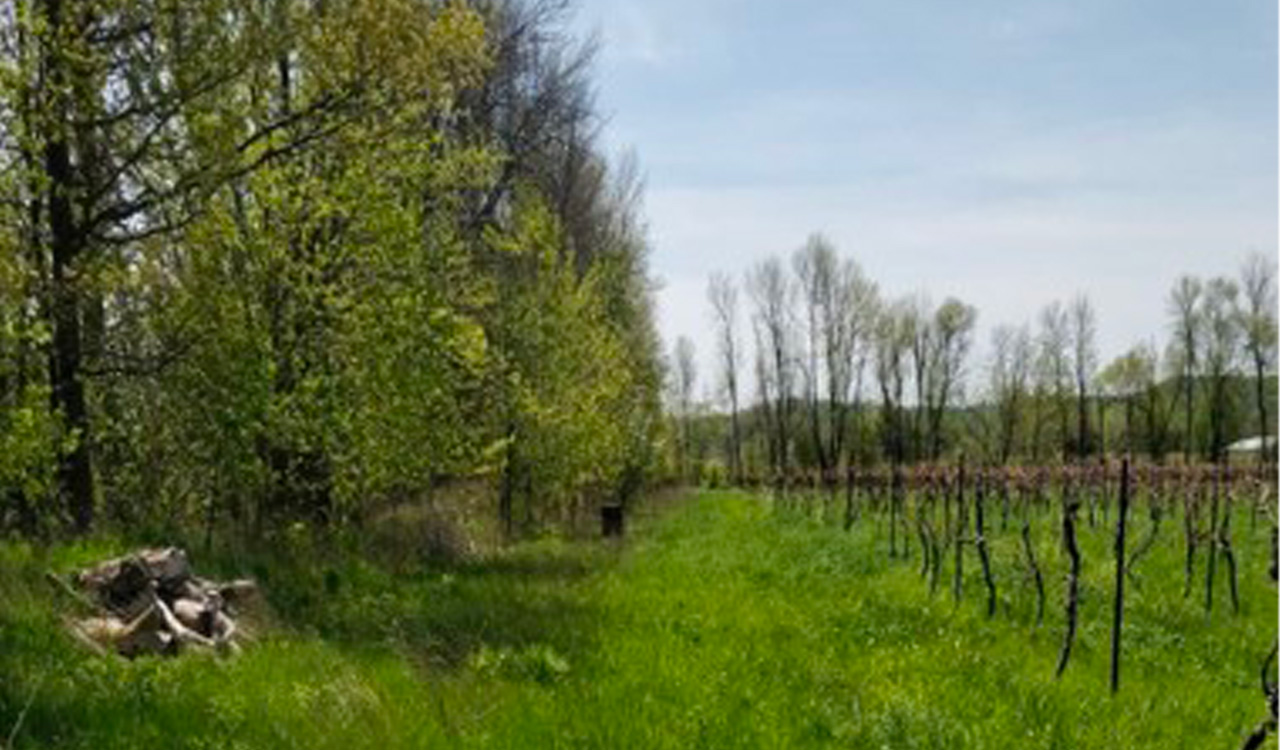
Perimeter plantings are patches of woody and herbaceous plants that border and intersect agricultural land. These perimeters are sometimes called hedgerows. In Niagara, hedgerows are often composed of plant species, like sumac or red-osier dogwood, that act as early successors on disturbed land from previous agricultural use or clearing of a forested area. Sometimes, these patches are composed of a mix of species, predating the disturbance or planted intentionally afterwards. A farmer might have an existing perimeter planting near an orchard, or plant one on purpose.
Maintaining perimeter plantings, like hedgerows, alongside orchards can provide significant ecological and agronomic benefits. Orchards are generally monocultures, with only one or a few species grown as commercial crops. Perimeter plantings have been shown to increase the overall biodiversity of plant and insect species in the farm landscape, which in turn increases the functional diversity and health of the orchard [1]. Functional diversity here refers to the range of ecosystem services that can be offered by the plant and insect species associated with perimeter plantings. The patches that parallel the orchard can help with services like the regulation of pests and the pollination of cultivated crops. They can contain food and habitats for beneficial predators, like spiders and parasitoid wasps, and pollen sources for native pollinators in early spring before fruit trees are flowering [2] [3] [4]. They can also act as migration corridors and overwintering habitats for these important actors in ecosystem regulation.
Hedgerows and other perimeter plantings have also been used to help control soil erosion and to buffer against high winds and spray drift from neighbouring orchards or croplands. As such, perimeter plantings are important patches of the farm landscape, particularly for organic operations, as they can reduce the risk of contamination while offering other ecosystem services.
While there are significant benefits to perimeter plantings, the quality and health of these patches matter. The plants growing in these hedgerows can offer benefits or risks if not properly maintained. Although they may appear wilder than the cultivated crops that make up the bulk of the orchard, they still require careful stewardship to reap the full benefits of pest management and pollination services. Studies have shown that perimeter plantings with native species, especially flowering trees and vegetation, offer the strongest benefits. Not only are these species more adapted and resilient to local climate and environmental conditions, but they are also better suited to attracting native pollinators and predators [3] [5] [6] [7].
Careful stewardship is also needed to mitigate the risks of perimeter plantings spreading invasive plant species and hosting invasive insects and pathogens. The spotted lanternfly is an invasive pest of particular concern for Niagara’s orchards and vineyards. Aside from wild and cultivated fruit crops, the spotted lanternfly also uses the following species as host and food plants: cedar, pine, walnut, oak, poplar, willow, maple, sycamore, tulip tree, and cork tree [8]. The risk of spotted lanternflies should not necessarily deter from the planting of the mentioned species. Rather, these species, if found in perimeter plantings, should be included in routine inspections for invasives as part of a farm pest management and prevention strategy.
Perimeter plantings, like hedgerows, are part of a landscape approach to orchard management that could offer significant benefits to the agronomic efforts of Niagara farmers. These plantings should be considered as an extension of the orchard, that if properly stewarded can act as sources of functional diversity that regulate pests, increase populations of beneficial predators and pollinators, and control erosion and spray drift.
This project is funded in part by the Governments of Canada and Ontario under the Sustainable Canadian Agricultural Partnership (Sustainable CAP), a five-year, federal-provincial-territorial initiative.
This project is funded in part by the Governments of Canada and Ontario under the Sustainable Canadian Agricultural Partnership (Sustainable CAP), a five-year, federal-provincial-territorial initiative.
References:
- Hughes, M. M. (2020). Characterization of plant, leafhopper, and spider communities in perimeter plantings and vineyards in the Niagara region. [Master’s thesis, Brock University]. Brock University Digital Repository. https://brocku.scholaris.ca/items/65a5f769-48c9-47fa-b28f-b6cbe27efd90
- Zgurzynski, K. (2025). Testing Northeastern North American Native and Introduced Plants as Cover Crops in an Organic Vineyard. [Master’s thesis, Brock University]. Brock University Digital Repository. https://brocku.scholaris.ca/items/ecc3250b-0e11-42e2-b891-c40cb7f8c455
- Bishop, G. A., Fijen, T. P. M., Desposato, B. N., Scheper, J., & Kleijn, D. (2023). Hedgerows have contrasting effects on pollinators and natural enemies and limited spillover effects on apple production. Agriculture, Ecosystems & Environment, 346, 108364. https://doi.org/10.1016/j.agee.2023.108364
- Peñalver-Cruz, A., Alvarez, D., & Lavandero, B. (2020). Do hedgerows influence the natural biological control of woolly apple aphids in orchards? Journal of Pest Science, 93(1), 219–234. https://doi.org/10.1007/s10340-019-01153-1
- Von Königslöw, V., Fornoff, F., & Klein, A. (2022a). Wild bee communities benefit from temporal complementarity of hedges and flower strips in apple orchards. Journal of Applied Ecology, 59(11), 2814–2824. https://doi.org/10.1111/1365-2664.14277
- Von Königslöw, V., Fornoff, F., & Klein, A.-M. (2022b). Pollinator enhancement in agriculture: Comparing sown flower strips, hedges and sown hedge herb layers in apple orchards. Biodiversity and Conservation, 31(2), 433–451. https://doi.org/10.1007/s10531-021-02338-w
- Dittman, T. H. (2023). Enhancing hedgerow systems in peach tree production to improve beneficial insect diversity and abundance (30692797). [Master’s thesis, University of Georgia]. ProQuest Dissertations & Theses Global. http://proquest.com/docview/2917435938/540898F9B1EF4B64PQ/1?accountid=9744&sourcetype=Dissertations%20&%20Theses
- Canada Food Inspection Agency. (2025). Scientific fact sheet: Lycorma delicatula. https://inspection.canada.ca/en/plant-health/invasive-pests-and-plants/insects/spotted-lanternfly/spotted-lanternfly