Articles from:June 2021

  • Is it time to move beyond sustainability and begin thinking about radical transformation?

    Contributors: Liette Vasseur and Jocelyn Baker

    Access to clean, healthy water is essential for all life on Earth. As the world population continues to rise, natural ecosystems are becoming increasingly vulnerable to the threats of land conversion, invasive species, and the consequences of accelerated climate change. This has resulted in the loss of biological diversity. When an ecosystem functions correctly, it can provide enough food, shelter, water, and other goods and services required for all of the species within it. As soon as an ecosystem is degraded, however, it can lose its integrity, reducing or stopping the provision of services — including clean water.

    The major and enduring impacts of ecosystem destruction can be seen most prominently in the planet’s wetland systems. The livelihoods and overall survival of most cultures on Earth depend on the functions and benefits of wetlands for the purposes of food provision. Rice, for example, is grown in wetland complexes and is the staple diet of nearly half of the people on Earth. Most commercial fish and invertebrates, including crabs, lobster, and shrimp, also depend on wetlands for all or part of their lifecycle. The long-term global loss of all wetland types is estimated to be between 54 to 57 per cent, with the rate of losses four times higher in the last century than in previous centuries 1,2.  Inland wetlands have seen a 35 per cent decline since 1970, with 87 per cent total loss since 1700 3. Despite comprising only 3 per cent of the Earth’s total surface area, wetlands are estimated to contribute more than 40 per cent of all global ecosystem services, providing an estimated US $55 trillion (in 2020) annually to global economies 1,2.

    The sustainability of these ecosystems is therefore of great concern, but what is it that we are trying to sustain? Are we simply aiming to stop further wetland losses, being satisfied with the status quo? Or is it time to move beyond sustainability and begin thinking about radical transformation? The continuous growth of human populations and economies should not come at the expense of nature. At some point, nature will not be able to sustain people and maintain its contributions to all of us. It is critical that we rethink and transform our relationships with one another and the natural world. We need to change the current worldview because our current capitalist-neoliberal way of life is unsustainable. Pursuing infinite economic growth and resource exploitation — when we have a finite planet — is simply not working.

    Societies must also think differently about themselves and their relations with the natural world that supports them. As an example, the Western Humanist (or western human way of thinking) views humans as the most important species on the planet. With this worldview (a set of beliefs and values about one’s reality) comes the idea that humans have dominion over the natural world with the right to exploit all of its resources (including plants and animals) as they wish. Does this make sense? What does adherence to this worldview mean for the generations to come? Any decision we make leads to consequences, and the children of the future will pay for the degradation and overexploitation of today. What will happen when the water stops flowing and all the fish in the oceans are gone?

    Radical transformation is needed in order to rethink the way that humans live within the natural world; we are part of it, not superior to it. Maybe when we embrace this way of thinking, a more sustainable future will be waiting for us.


    References:

    1. Baker, J., Dupont, D., & Vasseur, L. (2021). Exploring Canadian Ramsar Sites Ecosystem Governance and
    Sustainability. Wetlands, 41(1), 1-11.
    2. Davidson, N. C., Van Dam, A. A., Finlayson, C. M., & McInnes, R. J. (2019). Worth of wetlands: Revised global monetary values of coastal and inland wetland ecosystem services. Marine and Freshwater Research, 70(8), 1189.
    3. United Nations Environment Programme (2021). Becoming #GenerationRestoration: Ecosystem restoration for people, nature, and climate. Nairobi.
    Categories: Beyond Sustainability Blog

  • Saving paper does not “save trees” — but it still helps the environment  

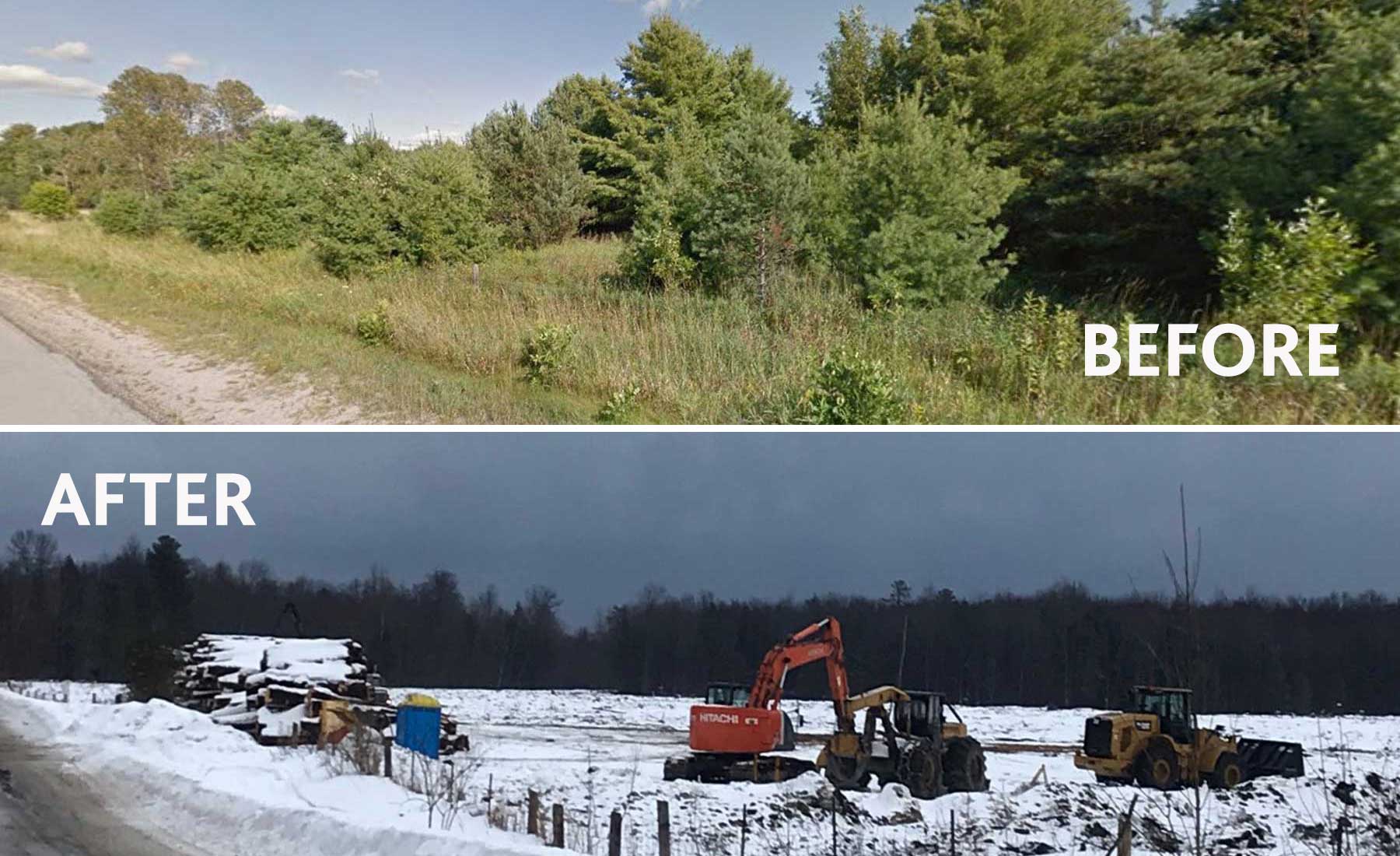
    A 92-acre plot of land on Lake Couchiching, in Orillia, Ontario, was recently cleared of trees to make way for the Lake Couchiching Residence project. The image above shows the same plot of land before and after the process began.


    If you are concerned about conservation, you have probably made a conscious effort to minimize the amount of paper you use in an effort to “save the trees.” Although using less paper is certainly a good thing for the environment overall, most Canadians would be surprised to learn that using less paper will not actually result in less tree harvesting.

    In Canada, the relationship between paper and forests is similar to the relationship between gravy and roast beef. Just as gravy is a by-product of cooking roast beef, paper is a by-product of producing lumber at a sawmill. Over 90 per cent of paper produced in Canada is made from the sawdust and woodchips left behind after the production of lumber, which is mainly used for building houses. Woodchip and sawdust residues are first used in the production of boxboard or paperboard (otherwise known as cardboard). Then, when that cardboard is recycled, the majority of it is made into paper products. In fact, most Canadians would be surprised to learn that almost all domestic paper comes from recycled cardboard, with the exception of remote communities with limited or no recycling capacity.

    In the Niagara Region, recycling processes are able to fully reuse and repurpose cardboard into other post-consumer paper products (including toilet paper). Even so, using less paper is still a worthwhile conservation goal for a number of reasons. Reducing your paper consumption will mitigate (reduce) the impacts of climate change by lowering the greenhouse gas emissions generated by processing pulp into paper. Paper is also a heavy and bulky product that uses considerable fossil fuel resources in the supply chain, from production through to shipping and receiving (transportation networks). Using less paper individually will reduce the amount of paper being transported overall, thereby reducing carbon emissions. An October 2019 waste management services report also found that most compost and recycle programs were being underutilized by Niagara residents, prompting a switch to a bi-weekly landfill collection cycle in order to encourage more recycling. Diverting that paper waste from landfills lessens the use of fossil fuels (by having fewer garbage trucks on the road for collection), reduces methane gas (a greenhouse gas produced by the decomposition of organic waste in landfills), and ensures a continuous cardboard supply for paper production.

    Aerial view of Lake Couchiching, where a 92-acre plot of land was recently cleared of trees to make way for a housing project.

    The paper industry in Canada has transformed considerably over the last 200 years, with a move away from environmentally unsustainable deforestation practices towards modern innovations, technologies, and the rise of sustainable forestry practices in the 1980’s. In fact, Canada was one of the first countries to support sustainable forestry management (SFM) at the United Nations Conference on the Environment in 1992. But what does all this really mean for Canadian forests?  Canada has 347 million hectares of forest that covers 38 per cent of its landscape and comprises 9 per cent of the world’s forest.  Canada is the world leader in sustainable forest management practices, as the majority of the country’s timber is certified as sustainably managed. Canada’s early adoption of SFM has also meant that Canadian forests have remained stable over the last two decades, with less than 0.5 per cent deforested since 1990.

    The United Nations defines deforestation as the permanent or long-term removal of forests from the landscape. It is the change of land-use from forest into something else, such as an urban area. Forest loss from forest fires, disease, and other natural disasters is temporary, with forests regenerating naturally as they always have. Logged forests are also not considered to be a permanent example of land-use change, as these forests are required to be replanted and regenerated under law. This is not to suggest that there are no issues in terms of loss of biodiversity or ecosystem function. The largest deforestation impacts to Canadian forests are from agriculture, urbanization, mining, oil and gas exploration, highways, hydro-electric infrastructure, and recreational uses such as ski hills and golf courses. These practices have resulted in the permanent loss of Canadian forests.

    So while conserving paper is still a great thing to do, remember that you are not technically saving trees by doing so. Rather, you are diverting waste from landfills, minimizing the use of chemicals used in the paper-making process, and reducing greenhouse gas emissions — all of which play an important part in mitigating the impacts of climate change.


    Categories: MEOPAR-Lincoln Blog

  • Online panel seeks to ensure equitable future for all academic talent

    Brock University faculty, staff, students and members of the broader community are invited to attend an interactive online session to learn more about the barriers women face in academic prize and award processes.

    The session takes place Wednesday, June 23 at 3 p.m. and will feature Liette Vasseur, Professor in Biological Sciences and UNESCO Chair on Community Sustainability: From Local to Global, as well as a panel of experts from universities across Canada.

    The panel seeks to raise awareness of the major issues surrounding STEM (science, technology, engineering and mathematics) prizes and awards, and to provide solutions for breaking down barriers in academic prize and award landscapes.

    The panel follows the publication of a report entitled “Prizes & Awards: closing the gender gap to ensure an equitable future for all academic talent,” authored by Vasseur and Jocelyn Baker, Research Assistant with Brock’s UNESCO Chair. The report, which is available in English and in French, highlights how women scholars statistically win fewer prizes than men, receive less financial compensation, and are denied the same access to the accolades and distinguishing benefits that awards bring.

    The paper reviewed 11 prestigious Canadian and global academic prizes and awards to highlight the barriers to awards that exist for women in STEM and then offer key considerations and good practices that can be implemented for calls for nominations and selection committees. The overarching goal is to ensure that future top prize winners are of the most deserving talent, regardless of gender.

    Deb Saucier, President and Vice-Chancellor of Vancouver Island University, will moderate the discussion, which will also feature Nicole Fenton, Université du Québec en Abitibi-Témiscamingue; Jeremy Kerr, University of Ottawa; Juliet Daniel, McMaster University; and Shohini Ghose, Wilfrid Laurier University.

    The panel will take place on Lifesize and is free and open to all members of the public. Pre-registration is not required and interested participants can join the discussion here.

    Categories: Activities & Events, Updates of the Chair