Articles from:September 2025

  • The land remembers.

    Contributors: Mike Hallé and Liette Vasseur

    The following is a blogs related to an ongoing Urban biodiversity project. 

    Long before we arrived, before property lines, before fences, before lawns — the land carried an ancient rhythm of biodiversity. Native plants grew interacting with pollinators, wildlife, and waterways. But decades of development and chemical-driven landscaping have disrupted these natural systems, leaving ecosystems fragmented and fragile.

    Now, we have a choice.

    We can remember what the land has always known: how to create thriving, living landscapes that nourish us, our communities, and the planet.

    This is the heart of UNESCO chair’s work in Niagara — connecting people to nature, one backyard at a time. And the good news is, change starts small. It starts with us, our garden, and the stories our soil remembers.

    Here are 10 practical, powerful ways to garden like the land remembers — steps anyone can take to restore native biodiversity and create living corridors of connection.

    1. Start with Native Plants

    Choose plants that belong here — species that evolved alongside Niagara’s pollinators, birds, and soil systems. Native plants require less water, fewer or no chemicals, and provide food and shelter for the species that need them most.

    Tip: Goldenrod, wild bergamot, and milkweed are pollinator favorites.

    1. Rethink Your Lawn

    Traditional lawns are biodiversity deserts. By replacing even 10–20% of turfgrass with native gardens or meadow patches, you create habitat, reduce mowing, and improve soil health.

    Small shift, big impact: One less hour of mowing per week = more pollinators, fewer emissions, and healthier soils.

    1. Plant in Layers, Like Nature

    Nature doesn’t grow in flat rows — it builds living layers: canopy, understory, shrubs, and groundcover. Recreate this natural structure to provide food and shelter for wildlife year-round.

    1. Choose Pesticide-Free Practices

    Synthetic pesticides harm pollinators and disrupt fragile ecosystems. Instead, work with nature: encourage beneficial insects, companion plants, and use natural solutions when needed.

    Reducing chemical use supports cleaner water systems and safer habitats for species at risk.

    1. Make Room for Pollinators

    Bees, butterflies, and moths are struggling globally — and Niagara is no exception. Include nectar-rich plants, leave some “wild edges,” and plant continuous blooms so pollinators always have food throughout the season.

    1. Capture & Keep Your Rainwater

    Healthy ecosystems start with healthy water cycles. Use rain barrels, bioswales, or permeable pathways to keep water on your property, reducing runoff and protecting local waterways.

    1. Let the Leaves Lie

    In the fall, leave some leaves on the ground. They feed the soil, shelter pollinators and other insects, and build living carbon banks. The simplest action can make your garden an healthy ecosystem.

    1. Create Micro-Habitats

    Even small spaces make a difference. A shallow water dish (make sure to change the water regularly!) for pollinators, a brush pile for birds, or a rock corner for native bees can transform a yard into a refuge.

    1. Connect with Your Neighbours

    One native garden is powerful. Ten connected gardens are unstoppable. When streets, schools, and communities plant together, we create living corridors where biodiversity thrives.

    1. Let Your Garden Be a teacher

    Gardening like the land remembers is about relationship. Watch, listen, and learn from your plants, pollinators, and soil. Over time, your garden will show you how life wants to thrive.

    Closing Call-to-Action: Restoring Niagara’s biodiversity isn’t just science — it’s storytelling. It’s the story of how we remember what the land already knows and choose to live in relationship with it.

    This is what it is all about:

    • Supporting homeowners and communities.
    • Restoring native ecosystems at scale.
    • Building living corridors where pollinators, wildlife, and people all thrive together.

    Your garden matters. Your choices ripple.
    Categories: Biodiversity in Urban Centres Blog

  • Wine, Native Plants and the Science Behind the Sip: Feet on Farms Tour

    Contributors: Kim Duffin

    The following is a blog related to an event as part of the organic science cluster 4 project: Promoting an Integrative Landscape Approach in Vineyards for Greater Resilience in the Face of Climatic and Environmental Changes. Follow along with updates as the project progresses, and learn more about the research HERE.

    On July 27, Dr. Liette Vasseur and members of her research team were thrilled to be a part of an event organized with the Organic Council of Ontario at Southbrook Vineyards in Niagara-on-the-Lake. Attendees were offered a guided tour by Len Van Hoffen, the vineyard manager, and Liette presented the innovative research which explores the use of native plants in pest management.

    As I reflect on my role as a knowledge mobilizer for the project, I am struck by the fact that this field visit highlights the importance of sharing research findings with a wider audience through various means. In essence, knowledge mobilization is about bridging the gap between research and practice, ensuring that research findings are not just accessible to all but also used to create positive change for the greater good in the world. In Dr. Vasseur’s case, we are moving research from her laboratory into the hands of people and organizations who can put it to practical use.

    As I participated in this event I was aware of the diversity of people gathered and curious about their circumstances and how they planned to utilize this new knowledge. Much to my delight, I found the participants more than willing to share their thoughts on what they perceived as ‘key takeaways’ and ‘food for thought’.

    I would like to start with Bill Redelmeirer, the owner of Southbrook Vineyards, who expressed to me his hopes for hosting the event was to grow the organic community. Redelmeirer states that “organic producers can feel as if they are on their own, with no support” and in his eyes the event was a success as it created a network of supporters.  Next, I would like to turn to a couple who attended the event in the hopes of learning more about Liette’s research on native plants and integrated pest control. These attendees told me that they learned practical ways to manage pests in their quest to develop a thriving organic garden in their backyard. Along these same lines, I interviewed an individual who is in the process of transitioning from using chemicals on their family farm with hopes of developing it into an organic agriculture operation. I also spoke to a representative of the Organic Council of Ontario who also shared valuable information with attendees and remarked on the importance of industry partners demonstrating the way that we can change our approach to vineyard management. These are only a few examples of the rich interactions and activities that promoted the awareness of native plants as there were numerous stories that individuals shared with me on how they intended to use the information that they received.

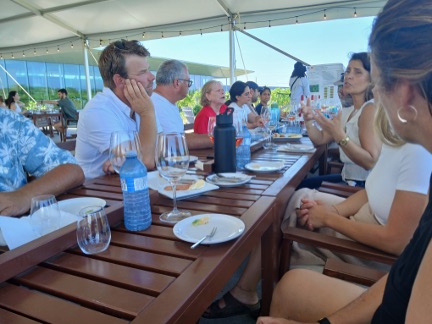
    During this event I took numerous pictures, but if I had to select one photo to share, it would be the one below where we all sat down and continued the conversation over food and wine. In my mind, this photo exemplifies the engagement of all attendees (researchers, farmers, industry partners, concerned citizens). I believe that these informal gatherings create a space where new ideas coming from different sources can lead to the development of innovative strategies for practical application and future research.

    I had the privilege of getting to know some of our ‘knowledge users’ by attending this event.  These are people who will use this research on native plants and pest management to make informed decisions and take action related to their own contexts while helping to spread the word on a much larger scale. It was a joy to witness the value and impact of Dr. Vasseur’s research — this delightful gathering paired with a glass of organic Chardonnay was knowledge mobilization in motion!

    Categories: Organic Science Cluster 4 Blog

  • Native species: Why not use our own local species?

    Contributors: Liette Vasseur

    The following is the first in a series of blogs related to the organic science cluster 4 project: Promoting an Integrative Landscape Approach in Vineyards for Greater Resilience in the Face of Climatic and Environmental Changes. Follow along with updates as the project progresses, and learn more about the research HERE.

    When you go for a walk in nature, do you look at the plant species along the trails? Have you realized that many species may have been here for a very long time: before the first humans coming to this land and since the last glaciation, in most cases.

    As plants don’t travel and migrate like most animals, they migrated since the last glaciation northward at a slow pace. This long period of time allowed them to adapt to the new climatic and environmental conditions. They are more resistant and resilient to variability than new plant species that we intentionally or accidentally introduced to our country. You may have tried to plant an exotic plant in your garden, only for it to be dead the following year due a cold winter.

    Native plants have co-evolved with the fungi, soil microorganism, and animals that are found in their ecosystem. For many species, this co-evolution has led to a strong mutual relationship for pollination, nutrient acquisition from the soil, etc. They also attract different insects that are predators of pests. For some insects, our native plant species (sometimes considered as weeds) are essential for their reproduction. For instance, the monarch butterfly in Canada relies on milkweed for its reproduction. Milkweed species used to be listed as a weed until researchers realized that the monarch needed milkweed for its reproduction in Canada. There are now efforts to reestablish the milkweed populations in Canada.

    Native species have many advantages as many of them are perennial, meaning that they live for many years or can reseed themselves. Because of this, the maintenance is less than that of many exotic species that are annual. While the initial costs of using native species may be slightly higher than commercial annual plants, in the long term, they are not more expensive.

    Another advantage of native perennial species is the variation in the flower blooms; some flower early summer while other not until the fall, like the goldenrod. They can also be planted in various conditions from full sun to shady conditions.

    In this project, we are planting native species either from regional locations or from North America to promote biodiversification in the vineyards. Biodiversification is when we add native species that should or could have been in this environment in the past. Vineyards, like most agricultural lands, are monoculture of one crop. But, by adding native species between rows as cover crops, it is possible to increase plant diversity, hopefully leading to a more functional ecosystem that can enhance soil health and diversity, buffer against weather extremes, prevent erosion, and attract predators of insect pests.

    While the project is relatively new, preliminary observations suggest that leafhoppers, a pest in vineyards, may be attracted to these native cover crops, reducing the pressure on the vines. With the variety of flowers these native species can also attract pest enemies such as parasitoid wasps.

    Native species can also be added in many other agroecosystems as buffer zones along the agricultural ditches or field edges. For crops that require pollinators (vine are self pollinated), this may be of a great advantage, especially when we think about fruit trees and many other corps requiring pollinators for fruit production.

    Categories: Organic Science Cluster 4 Blog

  • A bird’s view of the land

    Contributors: Liette Vasseur

    The following is the first in a series of blogs related to the organic science cluster 4 project: Promoting an Integrative Landscape Approach in Vineyards for Greater Resilience in the Face of Climatic and Environmental Changes. Follow along with updates as the project progresses, and learn more about the research HERE.

    If you have taken a plane and looked at the window, you have certainly seen the various blocks of lands with their different functions and ecosystems, such as an agricultural field, a forest or an industrial park. The composition of all the blocks, or ecosystems, is what forms a landscape. Landscape can be quite diverse (especially in regions such as southern Ontario) or quite uniform with the same type of ecosystem, such as in the prairies with field of monocultures of wheat or canola.

    What is interesting is that what is happening in one ecosystem can influence what is happening in another ecosystem. In some cases, even small ecosystems, like hedgerows, may have an impact on the adjacent agricultural land by bringing pests or pest enemies. The composition of plants and animals in each ecosystem can vary in terms of diversity and abundance. The patchwork of different types of land cover is called a mosaic.

    The landscape approach recognizes the importance of spatial heterogeneity in the environment and the organisms’ responses to that variation. It is looking at a larger scale than just an agricultural field at the time. So, the size, shape, and structure of ecologically distinct block or mosaic are all attributes to be looked at. It is possible to analyze the influence of the landscape on an ecosystem by assessing diversity of different groups of species, plants, animals, fungi or microorganisms. The first element to look at is the landform, which is the geology of the landscape including surface shape, elevation, and slope. Soil abiotic types and conditions as well as the climatic conditions also influence the landscape.

    Some elements or ecosystems within a landscape can be unique and include physical and biological factors that make a particular locale different from others in the landscape. Even within a forested landscape, it is possible that some communities are younger than others due to a forest fire or harvesting. Therefore, in this case, the mosaic can be quite diverse. Having a diverse patchwork of communities may also influence the movement or dispersal of species. Awide river will limit the dispersal of plants between each side of the river but not for birds.

    In this project, we are examining the role of the various patches around the organic vineyards to determine how they may affect the diversity and abundance of plants and insects (pest and pest enemies). With climate change and the greater movement of species northward, as well as intentional or accidental introduction of new species, understanding how these patches can reduce or promote new invasive species is important to ensure the sustainability of the vineyards.

    Categories: Organic Science Cluster 4 Blog

  • Gardening Like the Land Remembers: Native Plants and Urban Ecology

    Contributors: Mike Hallé and Liette Vasseur

    The following is the first in a series of blogs related to an ongoing Urban biodiversity project. 

    Biodiversity or biological diversity is the variety of organisms in a given location. We often think of biodiversity when we visit natural parks, protected areas or conservation areas. However, it is possible to enhance biodiversity even at home. This series of blogs aims to encourage reflection, bring forward ideas and explain why we can all be part of this movement to bring back biodiversity in our cities. Urban biodiversity is important for many reasons and it certainly helps to bring colour and live to our lives.


    As climate shifts intensify and biodiversity continues to decline, cities across Canada are being called to rethink how we relate to the land beneath our feet. Native planting — once viewed as a rural or conservationist practice — is now emerging as a powerful tool for healing the urban landscape.

    Urban gardens are not just decorative — they are ecosystems. Planting native species supports local pollinators, improves soil health, and reduces reliance on chemical inputs. By choosing plants that are adapted to local conditions, urban gardeners can create vibrant, low-maintenance habitats that regenerate biodiversity right in their own yards and balconies.

    This blog series will explore how native plant gardening supports mental well-being, food resilience, and ecological restoration. We begin with ten simple ways to start gardening like the land remembers, rooted in principles of observation, reciprocity, and respect. From composting and layering plant structures to creating pollinator corridors and talking with neighbours, every action becomes part of a wider community of care.

    We also spotlight inspiring models like Land Care Niagara, where woodworking programs, native nurseries, and community partnerships are bringing people back into relationship with the land. Their work reminds us that biodiversity begins at home, and that even the smallest garden can be a sanctuary for life.

    This journey starts with a single step.
    Continue to monitor this webpage to discover the Ten Ways to Begin Gardening, Like the Land Remembers, and let the land guide you.

    Categories: Biodiversity in Urban Centres Blog