Articles from:July 2020

  • OSCIII Blog: Food security in a time of uncertainty

    A word cloud depicting the important concepts surrounding food security, April 2020 (Photo: shutterstock.com).


    Farming is an essential service. It is also an industry with a great deal of volatility; farmers must continually rethink how they manage their crops in order to respond to changing weather patterns, depletion of resources, pests, diseases and markets . The current COVID-19 pandemic has also demonstrated how vulnerable agricultural systems can be when the number of workers who can be on site at a time is reduced or the farm has to be shut down entirely. A good first step to achieving total sustainability starts with the consumer. By better understanding where their food and materials come from, they can be more aware of the efforts that are needed to maintain food security.

    Food security is the ability for all individuals to have safe access to food that is nutritious and healthy — no matter their economic or social status. When thinking about our current situation, and the need for social distancing as well as economic shut down, we need to consider what it means to Canadian food security.

    So, where does our food come from? Many might think that we get a lot of our produce locally, especially those living in the Niagara region where fruit farms are plentiful and farmer’s markets are extremely popular. It might come as a surprise to learn that Canada actually imports most of its fruit and vegetable supplies from other countries. Outsourcing our produce means that the food has to travel long distances before ending up on our plates. The further that produce travels, the less secure it is and the more environmentally costly it becomes. One reason Canada relies on imports is that we have a relatively short growing season that limits the amount and variety of produce we can grow. Other factors, such as trade agreements, market demands, and the impossibility to grow some of the tropical produce that many people like in Canada, are also part of the equation.

    It’s important however, to not take our local farmers for granted. Many of our local farmers are developing innovative new greenhouse systems and working with new indoor growing technologies to maintain production during our Canadian winters and attempting to farm as sustainably as possible through organic farming practices. Ideally, more people would also attempt to garden at home, and choose produce that is considered to be more environmentally friendly (which usually translates to buying locally). While our urbanized way of life and potential lack of skills and knowledge might be used as excuses to not try growing our own food, it is indeed worth the effort and satisfaction.

    If growing your own food is not an option, changing your consumption habits to support local growers and suppliers is an impactful way to move toward food security. With borders being closed and food production factories shut down for weeks at a time, relying on Canadian farmers makes good sense. Choosing an Ontario tomato rather than one that has been shipped from as far away as the equator not only helps our farmers—who in turn help us—it also reduces the amount of carbon emissions that result from shipping produce over long distances. Bringing our food supply chain closer to home is one way in which we can help to implement sustainable agriculture and reduce the impacts of climate change. As consumers, we have the power to drive this change.

    This blog section will be ongoing throughout the duration of the project with bi-weekly updates provided by Liette Vasseur, Heather VanVolkenburg, Kasia Zgurzynski, Habib Ben Kalifa, and Diana Tosato (see research team). We will be providing research activity updates as well as informative pieces that delve into agricultural concepts and important global issues as they relate to agricultural sustainability and climate change. Stay tuned for regular updates!

    Categories: Organic Science Cluster 3 Blog, Updates of the Chair

  • MEOPAR BLOG: SUSTAINABILITY RATING SYSTEMS/CERTIFICATIONS FOR BUILDINGS 2.0

    The Grimsby Square Shopping Centre in the Niagara Region is BOMA BEST Silver certified.


    The buildings we live in have direct and indirect impacts on both our health and the health of our planet. There are numerous sustainability rating systems that have been developed to help us contruct and make our existing buildings more efficient and sustainable. We discussed a few of those in a past article (LEED and LBC), and we’ll examine a few more building sustainability certifications that are widely used in Canada below.

    1) BOMA BEST: Building Owners and Managers Association (BOMA) Building Environmental Standards (BEST)

    BOMA BEST is a voluntary national certification program for buildings in Canada that started in 2005. This certification aims to assess the environmental performance and management of buildings in ten key areas: energy, water, air, comfort, health & wellness, custodial, purchasing, waste, site and stakeholder engagement.

    Building owners complete an online assessment and have an on-site verification by a third-party to then qualify for one of five levels of certification: Certified (attained up to 19 per cent on the questionnaire), Bronze (attained between 20 to 49 per cent on the questionnaire), Silver (attained between 50 to 79 per cent on the questionnaire), Gold (attained between 80 to 89 per cent on the questionnaire) and Platinum (attained between 90 to 100 per cent on the questionnaire). The certification is valid for a three-year period.

    Since the BOMA BEST certification can be applied to buildings of all sizes, it is very popular among building owners and managers in the real estate sector. The certification also provides economic advantages as the operation and maintenance costs of the buildings can be reduced through the installation of high-efficiency systems. Obtaining a building BOMA BEST certifion can also help to attract and retain tenants are many renters are now prioritizing environmental efficiency.

    2) BREEAM: Building Research Establishment Environmental Assessment Method

    Developed by the Building Research Establishment (BRE) in 1990, BREEAM is the world’s first and oldest established sustainability rating system for buildings and is used in more than 90 countries. The BREEAM rating can also be obtained for community planning and other infrastructure projects, commercial buildings and homes that have been renovated. BREEAM asesses energy, health & well-being, innovation, land-use, materials, management, pollution, transport, waste, and water. There are five BREAAM ratings for buildings: Outstanding (85 per cent and above), Excellent (70 per cent and above), Very Good (55 per cent and above), Good (45 per cent and above) and Pass (30 per cent and above).

    3) Energy Star Certification for buildings

    The ENERGY STAR symbol is a well-known addition to many of our appliances. This energy efficiency rating was established by the United States Environmental Protection Agency in 1992 and is one of the most common rating systems for electrical and electronic appliances. But did you know that buildings can be ENERGY STAR-certified, too?

    Getting an ENERGY STAR certification for your building involves scoring well on these four benchmarks: energy use, water use, waste and materials. The ENERGY STAR certification uses a scoring system out of 100; a score of 50 is the median energy efficiency performance, and a score of 75 or more means top performance. The aim of this certification is to encourage homeowners to improve efficiency and save money. The certification is valid for one year.

    Buildings are increasingly being certified in the Niagara Region through these various sustainability rating systems and certifications—which is a good thing.  It shows the potential for property owners to make impactful contributions to boosting Niagara’s local economy and lend momentum to climate change mitigation and adaptation programs in the future.

    The researchers involved with the MEOPAR project are working to raise awareness about the impacts of climate change and how communities can effectively adapt, and increase resilience, to these changes. Follow along with our blog every week (written by researchers Liette Vasseur, Meredith DeCock, Bradley May, Pulkit Garg, Sam Gauthier and Jocelyn Baker) to learn more about the project and how you can get involved. You can also visit our website at brocku.ca/unesco-chair or email us at [email protected]

    Categories: MEOPAR-Lincoln Blog, Updates of the Chair

  • MEOPAR BLOG: The importance of restoration for enhancing resilience and adaptation to climate change

    A provincially significant wetland (PSW) in Niagara is being restored by digging out the invasive species phragmites (also known as common reed). The project is a partnership between the Niagara Restoration Council, Ducks Unlimited (DU), the Niagara Peninsula Conservation Authority (NPCA) and a private landowner.


    Ecosystems all over the world have undergone significant damage and stress due to human activities and extreme weather events. This has many adverse effects on biological diversity as well as peoples’ livelihoods and even their health. To bring back these ecosystems, it is crucial that we reverse these negative impacts and degradation. This can be done through a process called ecological restoration, described by the International Union for Conservation of Nature (IUCN) as the process of assisting the recovery of an ecosystem that has been degraded, damaged or destroyed.

    Restoration is considered a nature-based solution, involving the improvement of the relationship between nature and communities by re-establishing the goods and services that the ecosystem provides. Restoration projects are taking place all over the world in both terrestrial and aquatic environments, including the shorelines of the Great Lakes. There are many different restoration strategies: re-vegetation in areas that have lost their natural plants and trees, habitat enhancement through physical, chemical or biological changes in order to increase the suitability of an environment for native species living, removing invasive species and reintroducing native species that have been lost.

    Remediation is another restoration strategy which helps to reverse or stop environmental damage. This is achieved through the creation of a new ecosystem or by returning the ecosystem to its original state.

    There is a partnership project between the Niagara Restoration Council, Ducks Unlimited (DU), the Niagara Peninsula Conservation Authority (NPCA) and a private landowner for wetland restoration here in Niagara. Pictured, from left, are Stuart McPherson (NPCA), Jeff Krete (DU) and Steve Gillis (NPCA).

    To be successful, restoration projects require the participation of all stakeholders and sectors of society. In the Niagara Region, for example, the Niagara Restoration Council works in partnership with government and non-government groups to restore some of the natural environment in the Niagara Region through various projects. Some of those projects include: Trees for Niagara: Wildlife Corridor Enhancement of Watersheds, building stream buffers for Niagara’s rivers, Fish Barrier survey, and many others. These restoration projects are considered to be critical in bringing back the ecological processes and ecosystem services needed for the future sustainability of the planet. Many other organizations also aim to contribute to this endeavour in the region.

    Enhancing ecosystems through restoration allows native species to return and thrive in their natural environments, helps to mitigate and adapt to the impacts of climate change, and ultimately builds resilience for present and future generations.

    The researchers involved with the MEOPAR project are working to raise awareness about the impacts of climate change and how communities can effectively adapt, and increase resilience, to these changes. Follow along with our blog every week (written by researchers Liette Vasseur, Meredith DeCock, Bradley May, Pulkit Garg, Sam Gauthier and Jocelyn Baker) to learn more about the project and how you can get involved. You can also visit our website at brocku.ca/unesco-chair or email us at [email protected]


    Categories: MEOPAR-Lincoln Blog, Updates of the Chair

  • OSCIII Blog: Farming—an essential service

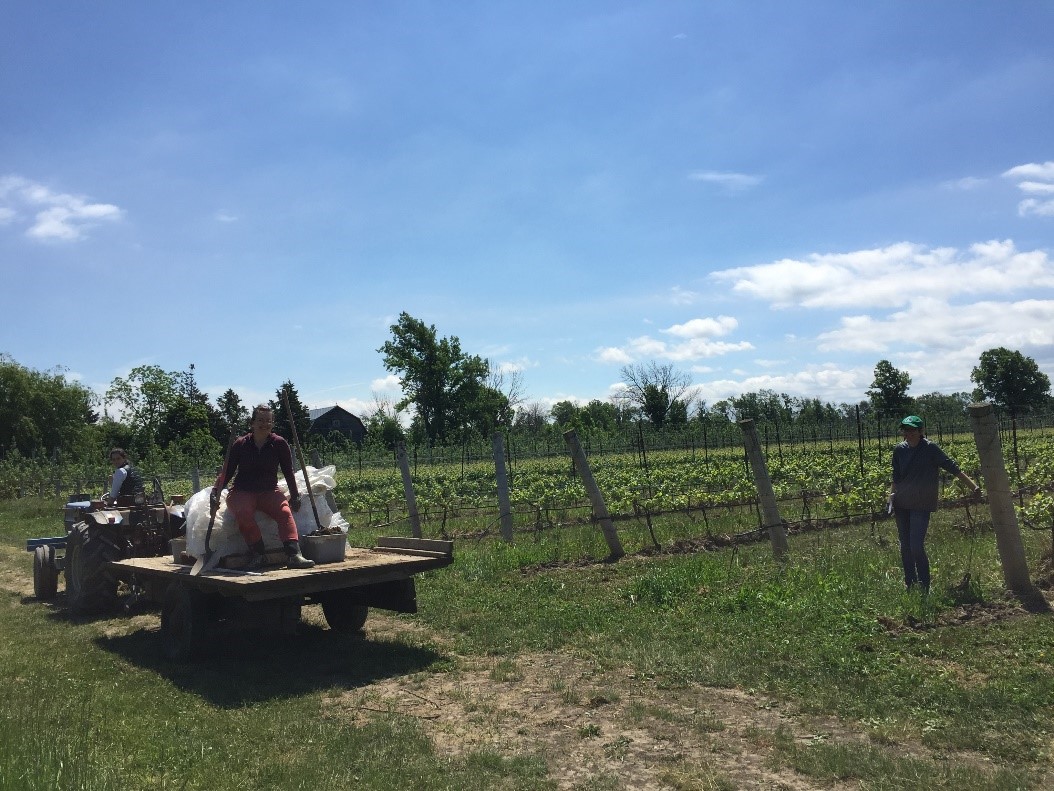
    Spring soil amendment application in a Niagara vineyard, May 2018 (Photo: Heather VanVolkenburg).


    The term “essential service” is one that most of us have become acutely aware of in the past few months. An essential service refers to an occupation that a government or governing body deems to be necessary for preserving life, health and basic societal functioning. These services are determined to be needed during an emergency as well as when job action is taken in a labour dispute (such as during strikes). Such services must maintain operations during a crisis in order to ensure that society can still function during and after that crisis. Services deemed essential usually include hospitals and healthcare, law enforcement, firefighting, garbage collection, utilities (i.e. water and electricity), and food services connected to the food supply chain.

    Determining what qualifies as an essential food service can be complicated. From a consumer’s perspective, we are often only concerned with the availability of food in the grocery store. Some may also think of food services as the prepared salad on the shelf at your local grocery store or a meal purchased from a fast food joint. While these businesses are indeed essential, there is one essential food service that is perhaps the most important: farming. Farming forms the foundation of all food services, providing us with the food and ingredients necessary to survive from day to day. Without farmers, the grocery store where you bought your salad or the fast food joint that served you a hamburger would not exist.

    So, before you finish unpacking those groceries or sitting down with that take-out container, take a moment to thank the farmers and those directly connected to agriculture. Also remember that thinking of terms like “farm” or “grocery store” is far too simplistic to truly understand the nature of being essential. Think not only of the farms, but also the workers, fuel providers, truckers, packaging suppliers, grocery clerks, and countless other people that have been involved in the food supply chain along the way. Without these essential food services, and the many intricate pieces involved, we would be a pretty hungry lot!

    This blog section will be ongoing throughout the duration of the project with bi-weekly updates provided by Liette Vasseur, Heather VanVolkenburg, Kasia Zgurzynski, Habib Ben Kalifa, and Diana Tosato (see research team). We will be providing research activity updates as well as informative pieces that delve into agricultural concepts and important global issues as they relate to agricultural sustainability and climate change. Stay tuned for regular updates!

    Categories: Organic Science Cluster 3 Blog, Updates of the Chair