Articles from:September 2021

  • Brock research teams awarded federal funding for community partnerships

    Three Brock University teams have received a boost in funding for projects that aim to help Niagara organizations meet the needs of women and children during the pandemic and provide opportunities for Indigenous communities in the region’s tourism industry.

    The Social Sciences and Humanities Research Council of Canada (SSHRC) has awarded the researchers a total of $57,477 through the Partnership Engage Grant (PEG) program, which provides short-term support for partnered research activities that respond to immediate needs and time constraints facing public, private or not-for-profit organizations in non-academic sectors.

    With the funding, Political Science Professor Charles Conteh and his Niagara Community Observatory (NCO) group are working with the YWCA Niagara Region to raise awareness of the need for safe and affordable housing for women locally and to identify systemic barriers facing under-represented women.

    Assistant Professor of Educational Studies Monique Somma and her team are partnering with the not-for-profit forest school Nature School and Education Centre in Lincoln to get a better understanding of how forest schools impact students’ mental health and well-being.

    Professor of Geography and Tourism Studies David Fennell and colleagues have teamed up with the Niagara Regional Native Centre to develop new tourism opportunities for Indigenous people through the Niagara Peninsula Aspiring Global Geopark, an initiative that explores how the region’s unique cultural and Indigenous heritage has been influenced by the peninsula’s underlying geology.

    Vice-President, Research Tim Kenyon says the PEG awards are a testament to Brock’s effectiveness in forming dynamic community research partnerships.

    “The projects headed by Dr. Conteh, Dr. Somma and Dr. Fennell are powerful examples of how researchers and community organizations can come together to create positive change,” he says. “Each partner brings valuable knowledge to the table that, when combined, can make a tremendous difference in the lives of those around us,” says Kenyon.

    “Brock has long seen success with the NSERC (Natural Sciences and Engineering Research Council of Canada) version of these grants, between science researchers and industry partners,” he says. “With the advent of PEG awards for social science and humanities research, we are seeing the breadth and intensity of Brock researchers’ engagement with the wider community.”

    The NCO and YWCA formed a partnership last year following an NCO presentation on research dealing with affordable housing. The YWCA executive director was a panelist at that event.

    “The co-applicants, Joanne Heritz, Kathy Moscou and myself determined that an NCO-YWCA partnership to advocate for affordable housing would provide an excellent opportunity for the YWCA to advance its goals for affordable housing set forth in its strategic plan for 2019-2024,” says Conteh.

    The team aims to produce evidence-based research that would bring about policy changes to ensure that vulnerable women — particularly those who are Indigenous, racialized, seniors and low-income, among others — have access to emergency, transitional and affordable housing.

    “Further, the YWCA-NCO partnership aims to provide policy options to address housing needs resulting from poverty and worsened by the economic disruption of COVID-19,” says Conteh.

    He says that in 2020, 607 women, 55 men and 51 children in Niagara found sanctuary in YWCA emergency shelters and 120 women, 10 men and 78 children accessed YWCA transitional housing programs.

    Somma’s work with the Nature School and Education Centre follows up on earlier research that the two pursued from the time their partnership formed in 2017. Those results revealed “an increasing need for more focused inquiries on mental health and well-being,” says Somma.

    Forest schools are full- or part-time educational programs conducted in a variety of outdoor contexts, environments, age groups and climates. The programs take a ‘learner-centred’ approach in which children learn through playing, exploring and experimenting in woods or other natural settings.

    “Given the strong connection between time in nature and mental health benefits, outdoor nature programming is touted as one possible way forward to address some of the mental health challenges coming from the COVID-19 pandemic,” says Somma.

    Past research has shown that children aged six and younger have shown improvements in their overall health and well-being, increased motivation, concentration, confidence, knowledge of the natural environment and compassion by participating in forest schools, she says.

    The Nature School and Education Centre is seeking research on the impact of forest schools on older children to help the organization shape its programs and plans, says Somma. The Centre plans to offer about 10 tuition-free spots one day a week to new students and parents who would find this education approach helpful.

    Fennell says his work with the Niagara Regional Native Centre is looking at ways Indigenous people can “build new, cutting-edge tourism economies” connected to the Niagara Peninsula Aspiring Global Geopark.

    A ‘geopark’ is defined by the Global Geopark Network as an area that has ‘exceptional geological heritage’ that has scientific value, is rare, good for education or is particularly attractive.

    Opportunities for Indigenous communities exist in ‘smart tourism,’ which is the application of information and communications technologies to enhance tourism experiences and increase competitiveness, says Fennell. One example could be “personalized, interactive real-time tours,” he says.

    “The development of these new economies provides an opportunity to strengthen Indigenous tangible and intangible cultural and ecological heritage, through the telling of stories and celebration of historical connections with the Niagara region.

    Fennell says the research is meant to support the Niagara Regional Native Centre’s goal for Indigenous Peoples’ economic growth through principles and practices of sustainable development and is an “initial step” in developing a longer-term smart tourism project.

    STORY REPOSTED FROM THE BROCK NEWS

    Tags: , , , , , , , , ,
    Categories: News

  • Symposium to highlight social justice research partnerships

    FROM THE BROCK NEWS | by 

    Researchers from Brock’s Social Justice Research Institute (SJRI), who have teamed up with community partners on funded projects, will have their work showcased at an upcoming free, public event.

    The virtual symposium, Social Justice and Community Collaboration, takes place online Tuesday, Sept. 28 from noon to 2 p.m. as part of the ongoing Faculty of Social Sciences Symposium Series. Everyone is welcome to take part, but advance registration is required.

    “Our affiliates have been doing innovative and compelling social justice-oriented projects in collaboration with community groups, both locally and internationally,” says Rebecca Raby, Director of SJRI and a Professor in the Department of Child and Youth Studies. “At this symposium, we want to share these projects, and to inspire other faculty and community members to think about the exciting range of collaborative projects that can be pursued.”

    The symposium will feature the following presentations:

    • “Reflections on the Key Principles of a Successful ‘Community-University’ Research Partnership,” presented by Andrea Doucet of the Department of Sociology, Canada Research Chair in Gender, Work and Care, with Evan Jewell of X University and Master of Arts Sociology Research Assistant Jessica Falk.
    • “Body/Land/Sovereignty through Photography: Reflecting on a workshop with young Haudenosaunee women,” presented by Sherri Vansickle of the Tecumseh Centre for Aboriginal Research and Education, with Margot Francis of the Centre for Women’s and Gender Studies and Department of Sociology.
    • “Road Construction, Mobility and Social Change in a Wakhi Village: Shimshali Perspectives in Words and Pictures,” presented by David Butz of the Department of Geography and Tourism Studies, with Nancy Cook of the Department of Sociology.
    • “Collaborating with community to explore social exclusion and inclusion experiences of immigrant women in Niagara,” presented by Joanne Crawford of the Department of Nursing.
    • “Children Reading and Writing Photographs — Critical Literacies and Collaborations,” presented by Diane Collier of the Department of Educational Studies, with Melissa McKinney-Leep of the District School Board of Niagara and graduate students Simranjeet Kaur and Zachary Rondinelli.

    Raby says that as public health restrictions have eased, greater opportunities for collaboration have begun to open up, so she is eager to introduce new Brock faculty members and SJRI affiliates to the research that is already taking place.

    “Community partnerships provide an opportunity to meet community needs, to inform decision-making, to connect with local participants, to try something new and to build relationships,” says Raby. “They encourage us to tackle social issues in a collaborative way that can transcend a specific disciplinary focus and to work with faculty from outside of our own disciplines in order to have comprehensive engagements with community needs. They can invite us to see our scholarly work a little differently.”

    SJRI funding grants have been part of the Institute from its creation and are designed to “include social justice and transdisciplinary components, creating a shared focus on positive community-oriented social change,” according to Raby. The grants provide opportunities for both junior and established researchers to develop community-based research programs, facilitate relationship-building and lay the groundwork for larger funding applications.

    There are currently 80 researchers affiliated with SJRI, and new researchers are always welcome to get involved

    “SJRI offers opportunities for faculty members who are concerned about social justice and interested in transdisciplinary scholarship to connect with each other across the university,” says Raby. “We also post regular information about projects that community organizations are interested in pursuing in collaboration with Brock.”

    Anyone interested in learning more about SJRI or the process for becoming an SJRI affiliate should contact Project Facilitator Julie Gregory via email, and attend next week’s symposium to explore possibilities.

    To register for the event or for more information, visit the symposium web page.

    STORY FROM THE BROCK NEWS

    Tags: , , , , , , , ,
    Categories: News

  • How can transit play a part in Canada’s pandemic recovery?

    Article reposted from TVO  |  By: Justin Chandler

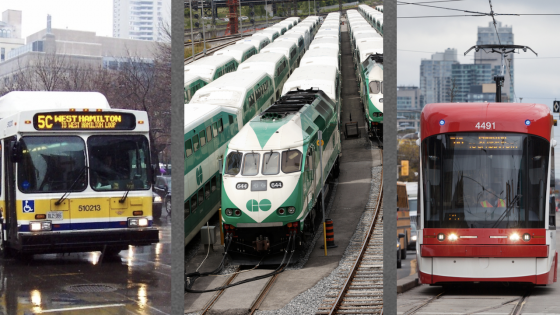
    From left to right: Hamilton Street Railway New Flyer C40LF bus (Adam E. Moreira/Wikipedia); GO trains (tirc83/iStock); TTC streetcar (BalkansCat/iStock).

    HAMILTON — During the election campaign, there’s been plenty of discussion about how Canada can recover from COVID-19, and some experts want to make sure that one topic in particular isn’t left out: transit.

    “Transit has come to be recognized as an important aspect of making major cities run better and as fundamental to issues of equity,” says Drew Fagan, professor at the University of Toronto’s Munk School of Global Affairs and Public Policy. “Building back better — to use what’s become a slogan — involves transit, and you’ve seen governments recognize that,” he adds, pointing to greater federal funding and provincial and federal support for transit projects in the Greater Toronto and Hamilton Area. “I think part of the issue is not just announcing the projects but ensuring that you get best use of that transit by developing intelligently along the lines.”

    So what would better post-pandemic transit look like, and how are the federal parties proposing to support it?

    What is a transit-oriented community?

    Building what people need along transit lines results in what researchers call “transit-oriented communities.” A recent policy paper Fagan cowrote with University of Toronto professor Matti Siemiatycki states that such communities “co-locate housing, jobs, public amenities and social services near high quality public transit. This maximizes the public benefits that come from major investments in public transit.”

    Experts say these sorts of communities can improve the quality of life for drivers and non-drivers alike. “The more people live within a fairly small activity space within their day-to-day lives, the more potentially useful transit could be to them to get around without a car,” says Chris Fullerton, a geography professor at Brock University. Fullerton notes that, while driving tends to be faster than public transit for longer trips — due to transfers, for example — public-transit travel times are often comparable for short distances. That means transit-oriented communities may also lure people out of their cars, something experts say should be a priority given that the pandemic seems to have led more people to drive.

    Public transit is about more than getting commuters from point A to B. “Public transit is a vital tool to promote our shared goals for social inclusion, public health, the climate emergency, and economic opportunity,” reads the Keep Transit Moving website. The national advocacy group points to a 2014 report by medical officers of health in the GTHA that found investments in transit and changes in land use (such as building transit-oriented communities) could increase physical activity and reduce air pollution, thereby preventing illness and deaths.

    “A major motivation we have is reducing greenhouse-gas emissions,” says Ian Borsuk, coordinator with Environment Hamilton and member of the Hamilton Transit Riders’ Union steering committee. According to Fullerton, reducing car travel and transitioning transit fleets to renewable energy are both effective approaches to this. “If you can develop a fleet of electric buses, and then you’ve got those filled with passengers that take 20, 30, or 40 cars off the road, the impacts, as far as emissions, will be incredible,” he says. Although replacing vehicles comes at a significant cost, he notes, upper levels of government can provide funding to help.

    How COVID-19 has affected transit

    The University of Toronto Transportation Research Institute published survey data in August suggesting that, during the second surge of COVID-19 in Toronto and Vancouver, commuting patterns were changing. About 32 per cent of respondents said they would ride transit less following the pandemic, while 56 per cent said they wouldn’t ride less, and 12 per cent were unsure; 58 per cent of respondents agreed that the pandemic made owning a car more appealing, and 26 per cent reported having looked into buying one. Among those surveyed, there was a 14 per cent increase in vehicle ownership between May 2020 and March 2021.

    Matthew Palm, lead author of the report and research coordinator with U of T Scarborough’s Mobilizing Justice Project, which studies inequities in Canadian transportation systems, is concerned about how such numbers may shape future policy: “My biggest fear from a social-policy standpoint is that people are going to overreact and just let the transit systems go without considering that there are certain people for whom transit is how they get their groceries.” He also notes that the phenomenon of the pandemic turning riders into drivers may be overstated. Based on other research and on his own analysis of the survey, Palm says a good portion of those turning away from transit seem to be young people and recent immigrants who might have bought cars anyway. Regardless, he says, the focus should be on the people who never stopped taking public transit.

    According to the 2021 Vital Signs report by the Hamilton Community Foundation, Hamilton public-transit ridership fell 46 per cent to 11.7 million rides in 2020, compared to 21.6 million rides in 2019. There were similar decreases in Kitchener-Waterloo, York Region, and Mississauga. In Toronto and Ottawa, ridership initially fell 90 per cent but had returned to 30 per cent of pre-pandemic levels by November 2020.

    Hamilton’s comparatively low decrease shows just how many people in the city need the transit system, says Borsuk: “Without that service, they wouldn’t have been able to get to their jobs.” Borsuk says he and other transit advocates have worried that the pandemic will result in less support for transit, so in the early stages of the public-health crisis, they formed the national Keep Transit Moving Coalition. “If you have municipalities needing to make cuts to service because of budgetary shortfalls and [lower] fare revenue, it’s going to make it harder to keep people on transit — but also harder for them to adopt it as a new form of transportation.”

    What can the federal government do?

    Fagan says that although it’s not immediately responsible for transit, the federal government is well-positioned to provide guidance and funding. The question for the feds is just how many strings they want to attach, he says: “The federal government is spending a lot more on infrastructure, and one can argue it has been reticent to apply policy expectations to its expenditures over time.”

    In Hamilton, for example, the federal and provincial governments recently announced $370 million in funding for the bus system — on the condition that Hamilton buy new buses that run on natural gas instead of diesel and that money go to building a bus barn to charge and store electric buses. (Director of Transit Maureen Cosyn Heath tells TVO.org via email that the city plans to replace its diesel buses  —currently 49 per cent of its fleet — with natural-gas buses over the next four years but did not say when the Hamilton Street Railway might start using electric buses.)

    Keep Transit Moving is calling on federal parties to commit to, among other things, providing permanent operational funding and reliable capital funding for transit and establishing a national intercity and highway-bus service plan. (Capital funding is money that builds or acquires new things, such as bus shelters and vehicles, whereas operating funding covers day-to-day expenses including fuel, maintenance, and salaries.)

    Election-platform points, such as the Conservative plan to link housing and transit funding, show parties are willing to take a more hands-on approach, Fagan adds: “I think all parties are thinking to some extent on these lines. Issues of equity, issues of climate, issues of accessibility, all the kinds of issues that make a city, especially the GTHA, a global-scale city that operates effectively.”

    Borsuk says that’s a good thing. “We definitely need to see the federal government — if they’re going to be providing these investments — flex their muscles and say, ‘If we are going to be giving you this money, we need to see X number of affordable housing units built.’” And, he says, the coalition also has accessibility-related demands: “What we want to see is an accessibility audit of all bus, train, and streetcar stations. We want to see accessibility planning put in; we want to see more funding go to local transit agencies to improve and expand paratransit service where it’s necessary.”

    How are Canada’s political parties responding?

    TVO.org asked the Liberal, Conservative, NDP, and Green campaigns if transit is part of their plans for pandemic recovery, and if so, how.

    Tim Grant, the Green Party of Canada’s municipal-affairs and transportation critic, says that, if elected, the party would invest in transit services and infrastructure, electrify buses, and improve intercity transit. “We should not be providing funding to cities for rapid transit projects unless those cities have developed plans to put enough housing density around each station, so that the new lines can pay for themselves within a few years,” he tells TVO.org via email.

    The NDP campaign did not respond to a request for comment. In its platform, however, the party promises it would expand public transit within and between communities and prioritize funding for low-carbon projects — “with the goal of electrifying transit and other municipal fleets by 2030.” It would also help provinces and municipalities create fare-free transit, if asked.

    A spokesperson for the Conservative Party of Canada did not answer TVO.org’s question but pointed to promises to fund and build public transit. The party platform says that a Conservative government would “require municipalities receiving federal funding for public transit to increase density near the funded transit.”

    A Liberal Party of Canada spokesperson sent TVO.org a statement touting the government’s recent transit investments and the creation of a permanent public-transit fund slated to begin in 2026. In Ontario, the statement says, the Liberal government would continue investments in the Toronto area. The party platform promises support for rural transit, zero-emission buses, and intercity transit.

    Moving forward

    Palm says that people who depend on transit need to be the focal point going forward. “Building a transit system in tandem with neighborhoods — with the land-use to support those folks — can also get the choice riders back, particularly the choice riders who prefer those urban environments.” “Choice riders” are those who can get around without public transit but may choose to use it. When more commuters — including choice riders — use a transit system, service generally improves, he says.

    While the pandemic has presented many challenges, it has also changed the conversations around public transit for the better, says Palm: “There was just this conceptual paradigm shift in a lot of people’s thinking about what transit really is at the most basic level, because people were asked to only use it if they really need it. What we found is there are a significant number of people who truly need it.”

    Ontario Hubs are made possible by the Barry and Laurie Green Family Charitable Trust & Goldie Feldman.

    Article reposted from TVO | By: Justin Chandler

    Tags: , , , , , , , , ,
    Categories: News

  • Authors explore contested monuments at workshop led by Brock researcher

    FROM THE BROCK NEWS | by 

    In the wake of the murder of George Floyd in the spring of 2020, a global movement led to the toppling of hundreds of monuments commemorating historical figures and events.

    The trend fascinated Professor Michael Ripmeester in Brock’s Department of Geography and Tourism Studies, who, along with Associate Professor Russell Johnston in the Department of Communication, Popular Culture and Film, has been studying memory and the ways in which people engage with the landscape since about 2003. Ripmeester says that while the act of removing or destroying monuments to affect public memory is nothing new, the wave of reckoning with landscapes that spread around the world last year was different.

    “People have been toppling monuments since ancient times, often related to regime changes — so, for example, statues of the former leader get destroyed and replaced with statues of the new leader,” says Ripmeester. “But over the last year, there has been a global recognition of the legacies of colonialism and racism, and that has sparked a massive reconsideration of monuments all over the globe.”

    To delve deeper into the movement, Ripmeester teamed up with colleague Matthew Rofe of the University of South Australia to collect essays that critically engaged with how landscapes are contested by individuals, groups and institutions for a future special issue of the journal Landscape Research.

    But when response to their call for papers quickly outsized the available space in the journal, Ripmeester and Rofe decided to explore the possibility of a book project.

    To that end, they hosted a virtual authors’ workshop in late July entitled “Global Iconoclasm: Contesting “Official” Mnemonic Landscapes.” Using funding from the Council for Research in the Social Sciences (CRISS) and Brock’s Social Justice Research Institute (SJRI) to support participants, they invited 10 authors to share their contributions and provide constructive feedback on each other’s essays.

    Some of the landscapes discussed during the workshop included monuments to fascism that remain standing in Italy, the contrast between monuments to British history and local usage of the heritage site at Victoria Falls in Africa and the Tsunami Museum in Banda Aceh, Indonesia, which doubles as an emergency shelter for future disasters while memorializing the 2004 tsunami that killed more than 200,000 people.

    “Something that came out in a number of papers is how we need to ensure that we don’t go back to what we did before,” says Ripmeester. “Moreover, the papers explore how we can help people understand structural and systemic racism in ways that both acknowledge the harm done and allow people to move forward with a sense of seeking justice for people who have been marginalized by collective memory.”

    He explains that monuments and other historic sites are places where memory is stored, just as memory is stored in archives, museums and school curricula. Their authoritative weight as well as the intertextuality of the narratives they represent tell a common story about identity — but historically, they are rarely inclusive.

    “Those with time and political, cultural, social and economic power determine what monuments are created, so when you look at a monument or you look at a historic site, you’re looking at a very specific manifestation of power,” he says. “Some groups have been completely left out of contributing to public identity, but we’re starting to see that change. For example, in Vancouver, Jim Deva Plaza was built and named in honour of one of the pioneers of LGBTQ rights in the city.”

    In addition to co-hosting the workshop, Ripmeester also presented a paper co-written with Johnston about the contested memorial to Pte. Alexander Watson at St. Catharines city hall.

    Ripmeester and Rofe were also recently awarded funding to support their research into a virtue-based approach to landscape management and their efforts to, as Ripmeester describes it, “build a network of scholars, artists and practitioners who have interests in thinking about collective memory, reconciliation and healing” — a theme that emerged in many of the workshop’s papers.

    He points to one author from Australia who wrote about a prison site where Indigenous men and boys had died and been buried in unmarked graves far from their home territories, violating their ancestral burial practices of being interred in one’s own country and a familiar landscape.

    “In trying to address this tragedy, the architects charged with designing the commemoration worked with Indigenous spokespersons and the communities of all the deceased to be respectful of not only local culture but also the cultures of the peoples to whom these men belonged,” Ripmeester says. “In the end, they built a site that includes a memorial garden that reflects the country. It’s a beautiful example of how Indigenous people and governments can work together to create a site that can lead to reconciliation through recognition of harm done and also toward overall healing.”

    STORY FROM THE BROCK NEWS

    Tags: , , , , , , , , ,
    Categories: News

  • New paper co-authored by Julia Baird: “Fostering ocean empathy through future scenarios”

    A new access paper co-authored by Geography and Tourism Studies Assistant Professor, Dr. Julia Baird, titled “Fostering ocean empathy through future scenarios” was published in People and Nature. This paper is open-access and is available to download here.

    Abstract:

    1. Empathy for nature is considered a prerequisite for sustainable interactions with the biosphere. Yet to date, empirical research on how to stimulate empathy remains scarce.
    2. Here, we investigate whether future scenarios can promote greater empathy for the oceans. Using a pre-post empathy questionnaire, participants (N = 269) were presented with an optimistic or a pessimistic future scenario for the high seas in a virtual reality (VR) or written format.
    3. Results showed that post-test empathy levels were significantly higher than pre-test levels, indicating that future scenarios fostered ocean empathy. We also find that the pessimistic scenario resulted in greater empathy levels compared to the optimistic scenario. Finally, we found no significant difference between the VR and written conditions and found that empathy scores significantly decreased 3 months after the initial intervention.
    4. As one of the first studies to empirically demonstrate the influence of a purposeful intervention to build ocean empathy, this article makes critical contributions to advancing research on future scenarios and offers a novel approach for supporting ocean sustainability.

    Video Abstract: “Fostering ocean empathy through future scenarios”

    Citation:

    Jessica Blythe, Julia Baird, Nathan Bennett, Gillian Dale, Kirsty L. Nash, Gary Pickering, Colette C. C. Wabnitz. (2021). Fostering ocean empathy through future scenarios. People and Nature. Online: https://doi.org/10.1002/pan3.10253

    Tags: , , , , , , ,
    Categories: News