Articles from:July 2022

  • Students to explore space, climate change in new science communication program

    A new Brock University program will see students combine their interest in topics such as space exploration, earthquakes, floods and climate change with a passion for storytelling and global communication.

    Welcoming its first cohort in fall 2023, Brock’s Bachelor of Arts and Sciences in Earth and Planetary Science Communication is a cross-disciplinary program forged through a partnership with the Departments of Earth Sciences; Geography and Tourism Studies; and Communication, Popular Culture and Film.

    “Students are welcome from diverse backgrounds, voices and academic pursuits, making it ideal for those with interests in science, arts or both,” said Frank Fueten, Chair of Earth Sciences. “It will appeal to those who value Greta Thunberg’s activism just as much as those who enjoy the science broadcasting of David Suzuki.”

    The program’s graduates will understand the science behind important modern issues, such as Earth’s resource distribution and the exploration of other planets.

    “Students will have the skills to participate effectively and successfully in discussions and debates surrounding science in a variety of fields and industries,” Fueten said.

    The program is the only one in Canada that combines knowledge of Earth Sciences with communication skills in a single four-year undergraduate degree.

    “On the communication side, students will learn cutting-edge theory and practical skills to help understand the needs and concerns of the public, gather science data and employ social media effectively,” said Duncan Koerber, Assistant Professor in the Department of Communication, Popular Culture and Film.

    The program presents innovative courses such as Citizen Science, where students crowdsource the public to create new knowledge and data sets.

    “Citizen Science will empower citizens and communities to tackle environmental and social injustices and has the potential to inform innovation as well as policy changes in Niagara and beyond,” said Ebru Ustundag, Associate Professor in the Department of Geography and Tourism Studies. “Data empowerment of citizens via participatory practices will honour and preserve local traditions and knowledge and provide mitigation strategies for future residents and policy-makers.”

    Upper-year projects may adopt novel approaches to communicating science to the masses. While one student may promote volcanology through TikTok, another may craft a miniseries on microplastics.

    “The variety and customizability of project options will appeal to students who enjoy blazing a new trail,” Fueten said.

    The program will enable graduates to pursue careers in communication roles for government agencies, non-governmental organizations, universities and private companies, as well as in journalism.

    “We see our graduates landing roles in well-known organizations like the Discovery Network and the World Wildlife Fund,” said Kevin Turner, Associate Professor, Department of Geography and Tourism. “There is also great opportunity to join firms in the resource industry and other companies in environmental fields or geologically sensitive areas.”

    More information is available on the program website or by contacting [email protected]
    Tags: , , , , , , , ,
    Categories: News

  • Brock geographer makes global connections during Fulbright Canada residency

    Almost two years after his Fulbright Canada Research Chair in Arctic Studies at the University of Washington was first announced, Kevin Turner is winding down his duties.

    The award normally involves a six-month residency, but the global pandemic prevented the Associate Professor in Brock University’s Departments of Geography and Tourism Studies and Earth Sciences from travelling to Seattle as expected.

    Instead, he virtually taught a fourth-year course in Arctic Landscape Change and Detection, conducted workshops for teachers and engaged in events hosted by the World Affairs Council, including a fireside chat with Chief Tizya-Tramm of the Vuntut Gwitchin Government through winter 2021.

    Earlier this spring, he was finally able to load his truck with his bikes and some field equipment and head west for his required in-person residency at the University of Washington.

    In spite of a hectic three-month schedule, Turner says the trip has created opportunities to meet up and collaborate with colleagues, sometimes in unexpected ways.

    In May, he travelled to Fairbanks, Alaska, for a meeting of NASA’s Arctic Boreal Vulnerability Experiment (ABoVE) Science Team. As a research affiliate of that program, he advises on airborne data acquisition and suggests key flyover locations from his main research site in Old Crow.

    “Being an affiliate of NASA ABoVE, I can help guide where they fly in northern Yukon and then utilize the data they collect within my research program, as can many others,” says Turner. “We also learn the latest on some of the cool things that colleagues are doing with the data to assess landscape conditions across the north, as well as share our own findings.”

    He attended a meeting of the International Circumpolar Remote Sensing Symposium in Fairbanks, which attracted top scholars from around the world, and was also involved in fieldwork being done by colleagues from University of Alaska, Fairbanks and the NASA Jet Propulsion Lab.

    “I was able to use some equipment I brought with me because I didn’t want it sitting in the truck at the airport while I travelled,” Turner says. “When I took it out for a little bit of show and tell, they invited me to visit one of their research sites to try it out.”

    Upon his return to Seattle, the University of Washington hosted Turner, Tram Nguyen, the 2021-22 Fulbright Canada Chair in Arctic Studies, and others for a roundtable discussion in late May on “Holistic Approaches to Health and Wellbeing in Arctic Communities and Beyond.”

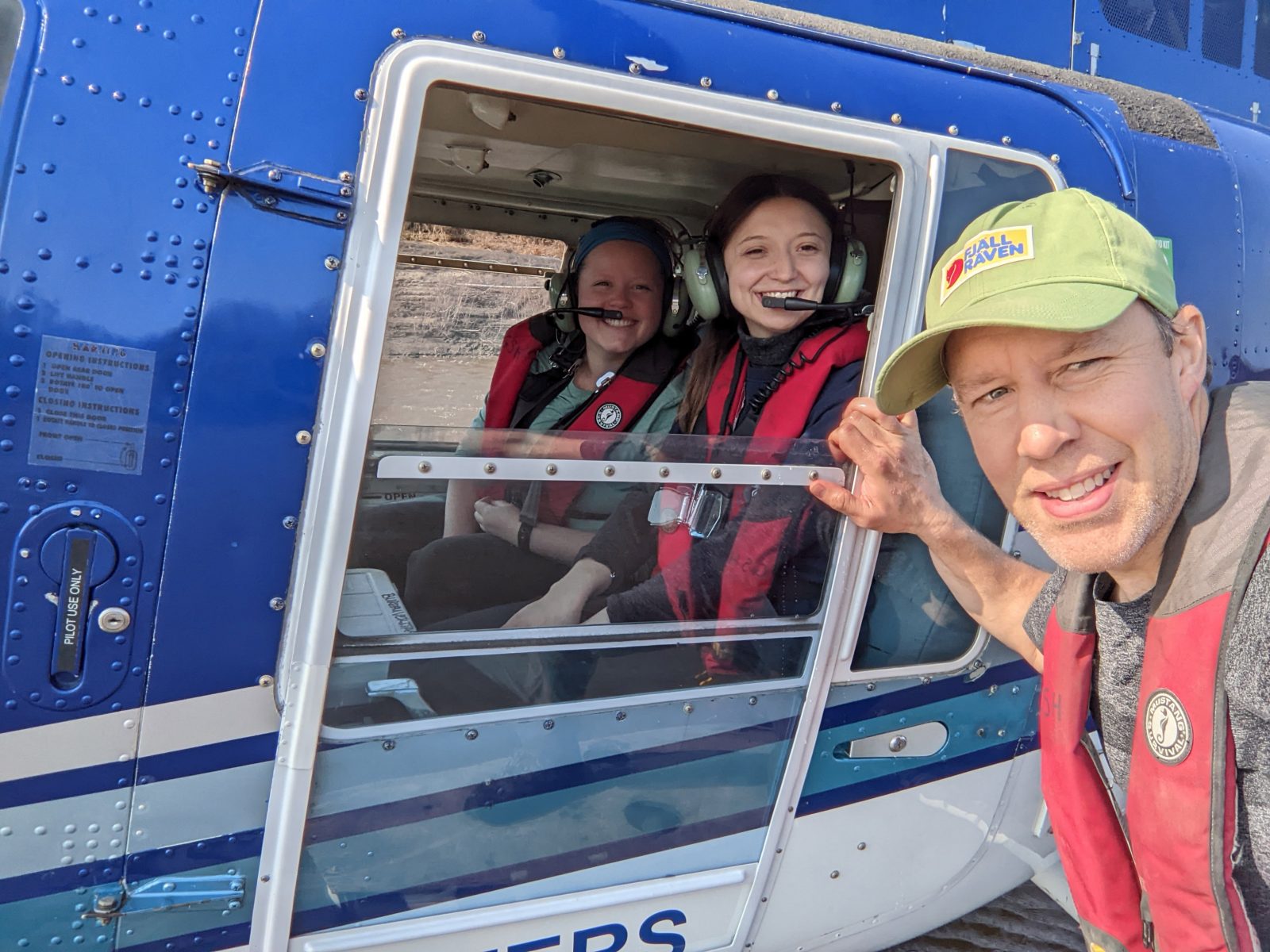
    In June, Turner flew north again for fieldwork in Old Crow, Yukon. The strict parameters of his VISA required him to travel on specific dates — which can be hard to commit to when research excursions are delayed by Arctic weather.

    Turner counted on Brock Earth Sciences graduate student Michelle Pearce (BSc ’20) and undergraduate student Marley Tessier to help him meet the logistical challenges of the research trip and collaborated with colleagues from Polar Knowledge Canada and Parks Canada, along with local Indigenous community members, including photographer and drone pilot, Caleb Charlie, to collect data. Turner also credits helicopter pilot Ruth Hardy with being able to work wonders in small time frames.

    In addition to gathering water samples and aerial survey photography, Turner also used a LiDAR sensor — “a Ghostbuster-looking sensor that shoots out 300,000 pulses of light per second” — to collect data for fine-grained 3D imaging of the landscape.

    His use of the LiDAR device was of particular interest to a documentary film crew from France and Germany working on a four-part series on climate change, who accompanied the researchers and interviewed Turner in the midst of the data collection.

    Turner has now returned to Seattle for the rest of July to crunch some data and collaborate with colleagues at the University of Washington.

    Though it hasn’t been without its challenges, he says that he has enjoyed the “shake-up” of the Seattle residency and the Fulbright Chair overall. And he looks forward to soon welcoming his family for a quick holiday in a nearby mountain cabin.

    “If I didn’t have the support of my family, this would be impossible,” he says. “My wife, Jen, is amazing, and my two boys have really stepped up to fill in the gaps of getting things done around the house in my absence. Their ability to carry on with me somewhere else for an extended period has made this smooth, but I really miss them.”

    Tags: , , , , , , , , , , , ,
    Categories: News