Blog Posts

  • Brock University Seed Library community engagement events!

    Participants selected from a variety of seeds they wanted to plant.

    By: Sanjida Amin

    Brock University’s Seed Library celebrated its second season by hosting two events aimed at educating the community about sustainable gardening practices. The Seed Library, a partnership between the Brock University Library and the Brock University Project Charter, provides the Brock and Niagara community with free seeds to “borrow” and plant in the spring and summer. Staff, students, and community members can “borrow” free seeds from the Seed Library to use in their own gardens. The cycle works like a library where participants can take seeds free of cost and are asked to return some from their harvest, so they can be given out to other community members. This Seed Library aims to protect the genetic variety in our food system and encourage open access to seeds. 

    This spring, the Seed Library hosted a seed packing event and a seed planting event to spread awareness of the Seed Library project and educate the community on the importance of biodiversity and healthy ecosystems, promoting pollinator populations, and preserving rare, endangered, native, and culturally significant seeds.    

    The Seed Packing Party was held on March 31 in the Matheson Learning Commons. Anyone who wanted to help pack seeds for the Seed Library’s stock was welcome to participate in the volunteer event, which was designed for students earning credits towards their campus-wide co-curriculum (CWC) activities. Moreover, students could also use these volunteer hours towards the completion of The World Wildlife Fund Living Planet Leader certification. It was wonderful to see students from various departments as well as staff, faculty, and community members participate in the seed packing event by counting seeds and placing them in envelopes. 

    Participants helped label envelopes and pack seeds to restock the Seed Library.

    The Seed Planting Party was held on April 13. The main purpose of this event was to inspire the Brock community to grow and take care of plants with seeds given to them from the Seed Library. Each participant was allowed to plant up to six different varieties of herbs, flowers, and vegetables. Soil and necessary supplies were offered, including egg cartons donated by Dining Services. Additionally, educational materials were provided, which included details on the germination process and growth patterns for some of the popular seeds offered at the Seed Library. Participants could take their newly planted seeds home with them to later plant out in their gardens. It was an enjoyable and relaxing event for everyone who participated, especially students looking to de-stress during exam season!  

    Participants used egg cartons donated by Dining Services to plant their seeds in.

    The Brock University Seed Library hopes to organize more events in the future to help preserve ecological balance, encourage home gardening, and enhance community involvement. To learn more about the Seed Library and how to participate, please visit our website here. 
    Categories: Community, Events, Student Contributor, Sustainability

  • Students show environmental stewardship at campus clean-up!

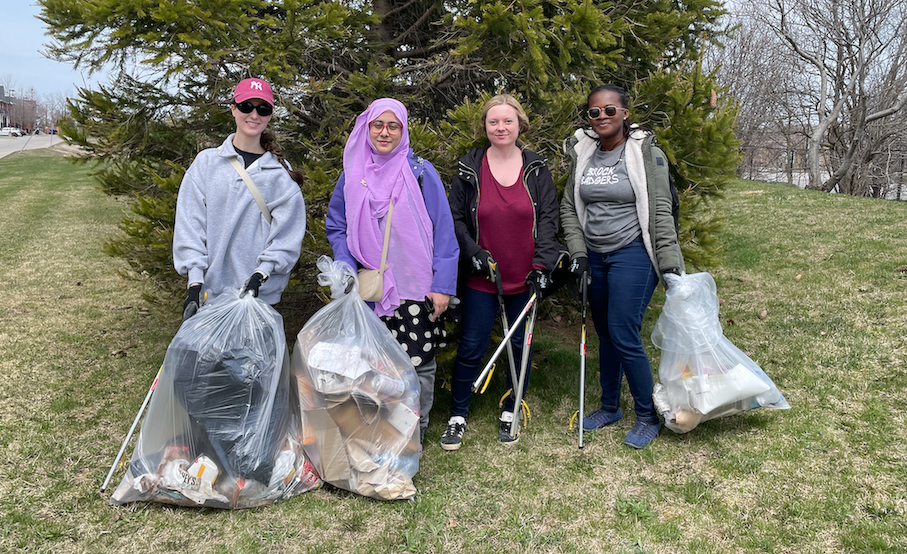
    Students helped volunteer by cleaning garbage from Quarry View area. Left to right: Alexandra Cotrufo, Sanjida Amin, Kassie Burns, and Janet Marley.

    By: Kassie Burns

    Last Tuesday, on April 11, Brock students helped clean up the area behind Quarry View Residence, as part of the first clean-up event on campus this year! Volunteer students demonstrated their commitment to environmental stewardship by collecting garbage and recycling around the area. Picking up waste makes a difference in our community and creates positive impacts for the environment by removing waste from streets, rivers, parks, and other public areas.  

    Once the students reached Quarry View, trash was evidently seen covering the ground. It was clear that some scattered items had been there for a while and had become buried in the dirt. Places most affected were along the fences and in corners where the wind had collected items.  

    Together, students were able to collect 2.5 bags of waste in just one hour! It was a beautiful and successful day, and we would like to thank Facilities Management for providing all the necessary supplies. We would also like to recognize the important work of FM staff in always keeping our campus clean. 

    Garbage and recycling collected during the clean-up.

    Janet Marley, a Child and Youth Studies student, commented on her experience participating in her first clean-up event. “It was my first time joining a clean-up walk and it felt productive. I am glad to partake in such a worthy cause. It was a plus that I got some exercise while at it. Thanks!” 

    We were delighted to see familiar faces and create new experiences for the students to engage in sustainable initiatives on campus! It was also wonderful to see other members of the community noticing our effort and giving thanks for our work in keeping the neighbouring trails clean. This event highlighted the positive differences that can be made when working together to take proactive action.  

    While some waste may have been intentionally littered, we also recognize that litter can also be due to unintentional circumstances, such as wind blowing items out of garbage bins. To help prevent garbage from being dispersed into the environment by the wind, it is important to tie bags tightly and ensure lids are properly secured on bins. Here are some of the most common items collected at the clean-up. 

    Common items found:  
    • Coffee cups and lids 
    • Masks 
    • Take out containers and bags 
    • Plastic cutlery  
    • Hygiene products 
    • Notes/paper 
    • Cardboard boxes 
    • Food wrappers 

    Thank you to everyone who participated in our Campus Clean-up, we look forward to hosting more clean-ups soon! If you are interested in participating in more Sustainability at Brock events, we are also hosting an Earth Day Sustainability Challenge and co-hosting a BioBlitz event this month!  

    Interested in hosting your own clean-up? Visit our toolkit created in partnership with Niagara College for more resources and steps! 

    This event helps support SDG 11, SDG 13, and SDG 15. 

    Categories: Community, Events, Outdoors, Student Contributor

  • Upcoming BioBlitz: We Need Your Help!

    By: Kassie Burns

    BioBlitz events are growing in popularity and seek to bring people together to identify as many species as possible in a specific area (Parker et al., 2018). A BioBlitz serves to be a rapid survey of biological organisms and a community outreach event (Lundmark, 2003). It helps encourage people of all backgrounds and levels of expertise to enjoy a day in nature while making an impact in contributing to important ecological work. Volunteers participating in BioBlitzes do not need to have any science background to be involved, and often these events seek to engage with new audiences of varying ages to encourage learning more about the importance of this type of event. BioBlitz events (and other community science projects) can create powerful experiences that unite people and connect them to nature.  

    Having species inventories is extremely valuable for multiple reasons. For example, an inventory can help determine the range of species present and identify endangered or invasive species in a specific area. It can also help indicate the biodiversity in an area, or lack thereof. We depend on many species to give us sources of food, medicine, construction materials, and income through recreation and tourism (Mace et al., 2012). Based on the current inventory, management plans can be developed to help establish biological sustainability that allows the environment to thrive. A BioBlitz can help form baselines or updates to these inventories while empowering community members to be better informed and protect biodiversity to improve their local natural area.  

    BioBlitz at Dufferin Islands  

    Brock is so excited to be hosting its first ever BioBlitz in partnership with The Niagara Park Commission! The purpose of this BioBlitz, taking place at Dufferin Islands on April 21, is to log and identify the eleven most threatening invasive plant species for inventory management. The work done here will directly benefit the invasive species program with The Niagara Park Commission. We will use the platform iNaturalist to capture invasive species images, record their geographic location, and other characteristics. This will give participants the ability to have an in-depth look at invasive species here and elsewhere in the Niagara region. To register for the BioBlitz, please visit ExperienceBU. There are a limited number of spots available, so be sure to register early! A bus will take all Brock participants from Theal House to Dufferin Islands. 

    Navigating iNaturalist (Shannon Heaney, 2023) 

    To participate in the BioBlitz event, we are asking all participants to have iNaturalist downloaded on their phone or other electronic device to record and map species. Here are some suggestions on how to use the platform and be prepared! 

    Top Invasive Plant Species of Concern in Niagara 

    If you are unable to make it to the BioBlitz event, you can still keep an eye out for the most threatening invasive species in your area! Here is a list of species that can be found in the invasive species guide:

     The information here helps support SDG 4, SDG 11, SDG 15, and SDG 17. 

    References 

    Lundmark, C. (2003). BioBlitz: Getting into Backyard Biodiversity. Bioscience, 53(4), 329–329 

    Mace, G. M., Norris, K., & Fitter, A. H. (2012). Biodiversity and ecosystem services: a multilayered relationship. Trends in Ecology & Evolution (Amsterdam), 27(1), 24–31.  

    Parker, S. S., Pauly, G. B., Moore, J., Fraga, N. S., Knapp, J. J., Principe, Z., Brown, B. V., Randall, J. M., Cohen, B. S., & Wake, T. A. (2018). Adapting the bioblitz to meet conservation needs. Conservation Biology, 32(5), 1007–1019.  

    Image reference: Sidekick Images  

    Categories: Events, Outdoors, Student Contributor

  • The Race to Meet Net Zero by 2050

    By: Kassie Burns

    Greenhouse gases (GHGs) and the use of fossil fuels are the primary contributors to climate change and one of the largest global hurdles we are facing in our attempt to meet Net Zero carbon emissions by 2050. Achieving Net Zero would mean Canada does not emit GHG emissions and/or offsets its emissions to ensure there is no overall increase (Government of Canada, 2023). The transportation industry accounts for 25% of Canada’s total domestic GHGs, where passenger cars and light trucks account for half of these emissions (Government of Canada, 2022). To address this issue, the Government of Canada has proposed Regulations Amending the Passenger Automobile and Light Truck Greenhouse Gas Emission Regulations to introduce new requirements for manufacturers of vehicles for sale in Canada.  

    The requirements will work towards decarbonizing the transport industry by requesting that vehicles produce zero emissions. These zero emission vehicles (ZEVs) can be battery electric, plug-in hybrid electric, and hydrogen fuel cell operated, ensuring they do not produce tailpipe emissions (Transport Canada, 2021). The new regulations are being phased out so that 20% of passenger car and light truck sales will be ZEV by 2026, at least 60% by 2030, and 100% by 2035. This plan hopes to have all GHG emitting vehicles phased out by 2050, given a car life expectancy of 15 years.  

    To help encourage the transition to this new set of vehicles, the government has developed the Incentive for Zero-Emission Vehicles (iZEV) Program. This program will allow people to receive up to $5,000 when purchasing or leasing eligible zero-emission vehicles, and it is continuing until March 31, 2025.  

    Brock is happy to help offer accessible charging stations for electric vehicles (EVs) and Plug-in Hybrid Electric Vehicles (PHEVs), with 22 ports across 13 charging stations on campus!  

    The news shared here helps contribute to the following Sustainable Development Goals: SDG 11 and SDG 13. 

    References 

    Government of Canada. (2022). Canada Gazette, Part I, Volume 156, Number 53: Regulations Amending the Passenger Automobile and Light Truck Greenhouse Gas Emission Regulations. Retrieved from, https://www.gazette.gc.ca/rp-pr/p1/2022/2022-12-31/html/reg1-eng.html  

    Government of Canada. (2023). Net-Zero Emissions by 2050. Retrieved from, https://www.canada.ca/en/services/environment/weather/climatechange/climate-plan/net-zero-emissions-2050.html 

    Transport Canada. (2021). Zero Emission Vehicles. Retrieved from, https://tc.canada.ca/en/corporate-services/transparency/briefing-documents-transport-canada/20191120/20191120/zero-emission-vehicles 

    Categories: Net-Zero, Student Contributor

  • Interview with Jay Ismailovic: Brock’s Green Cleaning Program

    Image courtesy of Floortje from Getty Images Signature

    By: Kassie Burns

    Behind the scenes, many individuals take initiative to incorporate sustainability on Brock University’s campus. Often, these acts of stewardship are implemented everyday without people realizing it. We wanted to highlight one of these initiatives by discussing Brock’s Green Cleaning Program, which runs through custodial services. Jay Ismailovic, Manager of Custodial Services, took some time to share with us his thoughts about the program and green cleaning products on campus. 

    1. Why do you think it is important to incorporate environmentally conscious and green cleaning products on campus? 

    Green cleaning is the process of selecting cleaning products that are safer for people and the planet. Using green cleaning products is good for the health and wellbeing of all of us on campus. Many benefits can be identified by using green cleaning products from preventing unnecessary chemicals from being released into the environment, to improving the quality of indoor air, protecting the health of custodians who use chemicals daily, protecting the health of the entire Brock community, reducing the exposure to allergy-causing substances, preventing the environmental damage, etc.

    2. How do you determine what constitutes an environmentally conscious cleaning product? Are there any requirements to meet a standard? (i.e., no phosphates or fragrance, recyclable/compostable packaging, etc.) 

    For cleaning chemical to be considered environmentally friendly it has to have a third-party certification for cleaning chemicals such as Green Seal, EcoLogo, Greenguard, etc. and it has to be effective while minimizing wasted chemicals, water, energy and time to clean and not harm human health or the environment. Third-party certification means that product has undergone rigorous scientific testing and strict auditing, to prove its compliance with stringent environmental performance standards. It is also important to know that producers of green cleaning products incorporate recycled content and reduce the amount of material in packaging, and they make sure that every shipping box and all empty containers are recyclable. And one other significant benefit is also achieved by producers delivering “super concentrated” chemicals in closed-loop dispensers. For example: super concentrated product reduces up to 98.5% in packaging materials compared to non-green products. Cleaning chemical dispensers also eliminate over-use of cleaning chemicals.

    3. How did the transition process work when switching from artificial chemical-based products to more environmentally conscious products? How long has Brock been using green products?

    Custodial Services at Brock University has been using green cleaning products for over 15 years. The idea to switch to green cleaning products was a result of our ongoing commitment to health & safety, innovation and a greener future. Transition process included number of important steps such as: review of all products and practices being in place at the time, action plan, testing and evaluation of various certified green cleaning products, selection of products, custodians training, implementation, etc. That was a joint effort of all stakeholders on campus which resulted in implementation of Green Cleaning Program.

    4. What are you hoping to achieve by using these products? 

    By using green cleaning products at Brock University our goal is to reduce the exposure of students, custodians, faculty, staff members and visitors to potentially harmful cleaning chemicals which negatively affect air quality, human health, building finishes, and the environment we study and work in. Every single one of us has the responsibility to do everything we can at work, or outside work, to reduce our environmental footprint and leave our planet unharmed for future generations and every step, and every action, counts. And Custodial Services definitely is one of the leaders on campus in doing its part by using environmentally friendly, green, cleaning products and supporting all sustainability initiatives.

    5. How do you think this initiative will create a positive impact on campus?  

    Sustainability is a global challenge facing all and certainly Brock University is dealing with those challenges. All our activities on campus have a direct impact on the environment. Every day thousands of us are on the campus working and studying, as well as many students are living in our beautiful student residences. All this activity requires joint effort of many employees to ensure things are running smoothly and safely. And definitely keeping things safe and clean for campus community requires use of many cleaning products daily. And with embracing green cleaning products on campus we are creating a positive impact by protecting health and safety of Brock community and ensuring that cleanliness and sustainability go hand in hand.

    This initiative contributes to the following Sustainable Development Goals (SDG), which you can read more about here: SDG 3, SDG 12, SDG 13

    Many thanks are given to Jay for taking the time and consideration to share his insight into the Green Cleaning Program at Brock, which has helped form this remarkable good news story!

    Categories: Student Contributor, Sustainability at Brock

  • Understanding Organic Food Consumption

    By: Sanjida Amin

    Our food choices have a significant impact on our health and the health of the planet. Buying organic and locally grown produce, when possible, is a great way to reduce the impact our food choices can have on the environment.  According to research, support for organic food has grown recently not only for its perceived health advantages over conventional agriculture, but also for the ethical production process, which considers the sustainable usage of resources and integrates techniques that preserve the ecological balance of natural systems. Let us explore what organically grown produce is, what the benefits are, and how we can identify organic products. 

    What is organic? 

    Since the 1970s, intensive agricultural production techniques and unsustainable consumption habits have been increasing at an unprecedented rate, causing pollution of the air, water, and soil, as well as significantly accelerating climate change and the extinction of species (IPCC, 2022). The current overuse of fertilisers, herbicides, and antibiotics in livestock and aquaculture threatens the environment and human health and has significant socioeconomic consequences. In contrast to this, organic food practices, restricts the use of synthetic pesticides, herbicides, and chemical fertilisers and adheres to high standards for animal care to reduce the suffering of livestock due to their detrimental effects on the environment. Canada organic standards requires that organic food meets a specific set of requirements, such as avoidance of genetic engineering, minimum use of chemicals in pesticides and soil management techniques, and regulated livestock diet and care. Any agricultural product with an organic label is subject to these standards, such as fruits, vegetables, dairy, eggs, meat, fish, rice, cereals, and even some natural fabrics.  

    Benefits of having organic produce in your diet 

    • Foods that are organic are often fresher that non-organic produce, especially if purchased from a local produce stand or farmer’s market. Organic options will also often provide a better cooking and dining experience, as they tend to have more flavour. Check out this post to learn more about buying locally. 
    • Organic foods contain lower levels of potentially toxic substances. When you choose organic, you are opting out of using chemical pesticides and mineral fertilizers for your food, which is harmful both for the environment and your health. It depletes the soil nutrition required for fruits and vegetables.  
    • Organic produce may even be healthier, since it carries more of certain antioxidants and nutritional properties. Certain nutrients may be more abundant in some organic food items, like organic meat and milk. According to the findings of this study, the amounts of several nutrients, such as omega-3 fatty acids, were up to 50% higher in organic meat and milk than in conventionally farmed versions. 

    Recognizing the right product 

    Unfortunately, certified organic produce may not be readily available in all areas and stores, and they also tend to be more expensive. To be certified as organic in Canada, the food must include 95% or more, organic ingredients. Organic items are regulated under the Safe Food for Canadians Regulations (SFCR). Therefore, when you want to buy organic, you can look for the Canada organic logo and know that your food has been regulated properly and all organic standards have been met. Additionally, you can check out the shopper’s guide to pesticides in produce to learn which produces contains the highest or lowest level of pesticides. Lastly, if organic food is not readily available, look for foods with additional labels that indicate sustainability and/or ethical production.   

    By taking steps to improve our food choices, we can not only enhance our personal health, but also play a significant role in influencing our agricultural practices towards greater sustainability. It is important to recognize that not everyone may have access or the means to purchase organic foods. While it is beneficial to support practices that improve the sustainability of our food systems, it is more important to know that even taking small steps such as informing yourself about these practices makes a difference! No matter how big or small your actions may seem, every action towards greater sustainability is a step in the right direction.

    Categories: Food, Student Contributor

  • Sustainable Agriculture 

    By: Kassie Burns

    ChrisHepburn / Getty Images

    Agriculture is a dominate industry in the Niagara Region, which is prominently known for its wine sector. In 2016 there were 1,827 farms that spanned 218,251 acres of land across the Region (Niagara Region, 2016). Farming provides an extensive source of economic income, with the area in the Region generating a totaled $838.1 million in revenue (Niagara Region, 2016). However, with global population on the rise, it is estimated we will need to increase food production by 70% in the next 30 years to ensure there is enough food for everyone and to limit food insecurity (ECO Canada, 2022). Considering this severe projection and the consequences of current agricultural practices, more sustainable farming methods will be required. 

    Sustainable agriculture incorporates social, environmental, and economic interests. It strives to reduce dependence on fossil fuels, increase biodiversity, and promote soil health (ECO Canada, 2022). These practices can bring communities out of poverty and provide an enhanced quality of life for farming families. Reducing the use of pesticides, planting hedgerows along field edges, and planting cover crops or implementing crop rotation are all methods to promote sustainable agriculture. These methods are sometimes referred to as Agroecology, which is the name of techniques that minimize environmental impact when farming (ECO Canada, 2022). Additional benefits can arise when consideration is given to biodiversity of crops and other vegetation that can help promote crop growth and prevent pests or disease. Organic farming practices are most optimal as they do not use synthetic pesticides or fertilizers, which can have devastating impacts on the environment (ECO Canada, 2022). 

    However, there are several challenges that come with creating transformative change within sustainable agriculture practices. It is not easy to simply switch to new customs that may be more sustainable. There are always risks associated when any sort of change is brought into action to affect crop growth, and when an annual salary depends on the viability of crop production in one summer period, the associated risk can be overwhelming and discourage changes in practice. Although numerous studies have shown that many of the methods mentioned above create positive changes for both a farmer’s income and the health of the environment, there are also risks (Isaac et al., 2021). For example, not using pesticides may result in damaged crops due to increased pests, and therefore, a farmer may experience a smaller yield of crops, which could put their livelihood in jeopardy. An additional challenge that exists includes finding the funds to make these sustainable changes, if funding is not easily available. Given these important considerations, it can be difficult for farmers to adopt more sustainable agriculture practices. 

    Despite these challenges, an increasing awareness of the need to adopt sustainable agriculture practices are being recognized, and more and more farmers are willing to make the necessary changes to ensure our planet and small-scale farms are regarded with high priority. More groups and government funding opportunities have been formulated in recent years, such as the Organic Council of Ontario (OCO), which to helps establish a better future for farming in the province. With growing awareness of this topic and stronger financial support for farmers, a more sustainable future for the agricultural industry is possible!  

    References 

    ECO Canada. (2022). What is sustainable agriculture? Retrieved January 26, 2023, from https://eco.ca/blog/what-is-sustainable-agriculture/ 

    Isaac, M. E., Nyantakyi-Frimpong, H., Matous, P., Dawoe, E., & Anglaaere, L. C. N. (2021). Farmer networks and agrobiodiversity interventions: the unintended outcomes of intended change. Ecology and Society, 26(4), 12–. https://doi.org/10.5751/ES-12734-260412 

    Niagara Region. (2016). Niagara Agriculture Profile. Retrieved January 26, 2023, from https://www.niagararegion.ca/living/ap/pdf/niagara-agricultural-profile.pdf 

    Categories: Agriculture, Student Contributor

  • Tour of Brock’s District Energy System – Experiential Education for SSAS Students

    Blog by: Sanjida Amin

    Theoretical knowledge gives us profound comprehension of a concept through observing it in the context of a greater whole and understanding the reason behind practically. In line with this, Brock University Students enrolled in the Master of Sustainability program, fall 2022, participated in a Brock tour as part of their experiential education for the course SSAS 5P01.  

    The students were taken on a tour of the Facilities Management (FM) department and Brock’s energy systems, where they were able to learn and see what is happening on campus to manage the Brock campus from all perspectives, such as planning, operations, reporting and managing energy efficiency.  As SSAS 5P01 instructor Dr. Jessica Blythe explained, “The objective of this class was to engage graduate students in a direct experience with the Facilities Management department at Brock University in order to develop knowledge, skills, and capacity for enacting sustainability.” She added, “I am grateful to our partners in FM, who hosted us in the Brock tunnels and described their approach for advancing sustainability on campus. Seeing, for example, the central station, where the FM team can monitor and control all energy use, heating, and cooling on campus, offers a unique window into how this can happen at scale.” 

    The day began with a visit to the Facilities Management department where students got to know about how utilities are managed, how facilities are maintained, and how the co-generation plant is designed within a 2km tunnel. Through exploring and seeing the whole tunnel in-person, participants from both the thesis and co-op schemes were surprised to know how the District Energy System (DES) is maintained to increase efficiency, reduce carbon footprint, and save money for the university. After the tour, students enjoyed a cheerful and interactive presentation session by Amanda Smits, Centre Administrator, ESRC, Mary Quintana, Director of Asset Management and Utilities, and Drew Cullen, Manager of District Energy.  Throughout the presentation, students learned about the domains of Sustainability at Brock, including the Project Charter with Facilities Management, the Partnership Scope, Sustainability Planning, Sustainability in Operations, Sustainability Reporting & Assessment, and diversified initiatives of Sustainability at Brock to a greater extent.  

    This experience was incredibly valuable for all students, as it provided them with the opportunity to not only meet many of the resource personnel of the university, but also because they got to visit various campus facilities to gain a better understanding of how the campus is run behind-the-scenes. Erin Marie Isaac, who is currently pursuing her Master of Sustainability and is working as a Teaching Assistant at Brock, said that “Learning about the various types of environmental jobs through the co-op program and especially through experiential learning opportunities such as the tour of Brock’s energy facilities has been extremely helpful and inspiring. These experiences have provided me with the knowledge and skills to confidently start my professional journey in the environmental field”. 

    Another SSAS student, Zaara Momin, shared that “It’s truly remarkable to see the effort Brock is doing in terms of sustainability in collaboration with facilities management. The real-world strategies that have been employed throughout the project to lessen its impact on the environment are motivating, and they helped me remember why I chose to enrol in the Sustainability program at the first place”. 

    Check out the photos below for some highlights from the memorable trip of Facilities Management at Brock! Please visit the following websites to know more about FM and Sustainability at Brock.

    Sustainability at Brock  

    Facilities Management 

    Tags: , , ,
    Categories: Education, Student Contributor, Sustainability at Brock

  • Exploring Sustainable Fashion Practices

    By: Sanjida Amin

    With every purchase you make, you may have the ability to choose a sustainably sourced and produced item. Unfortunately, many products are made in ways that deplete natural resources and harm ecosystems, however, some products are made in more socially, ethically, and environmentally responsible ways. According to The United Nation Environment Programme, the garment industry contributes between 2% and 8% of the world’s carbon emissions, and textile dyeing is a major water polluter. To ensure the garment industry is more sustainable, all actors must get involved, including designers, manufacturers, fashion critics, and consumers. Individuals can make efforts to ensure that their purchasing decisions do not support the exploitation of people or the environment by learning about sustainable shopping practices.  

    How can fashion become more sustainable and what can you do? 

    There are various methods you can employ when shopping for clothing, which can help reduce the impact of fashion on the environment! While you can consider sustainability for large products you purchase, such as technology and furniture for your home, you can also make ethical decisions for everyday purchases, such as clothing, food, beauty products, and more. Since the fashion industry is one of the largest contributors to growing greenhouse gasses, it’s important to question how our clothing is made and where it is coming from. Check out these simple tips to be more sustainable when choosing your fashion products. 

    Be cautious and think before your purchase:  

    Before you purchase a garment, think about if you really need it. Buying fewer clothes is one of the main things we can do to reduce the impact of fashion on the environment. If we all try to buy less, manufacturers will be compelled to produce clothing at a more sustainable level, resulting in a drop in emissions, textile waste, and runoff chemicals. The faster pace of garment production has also accelerated the consumption rate, and according to sources, an average person now purchases 60% more clothing than they did in 2000. The Ellen MacArthur Foundation  estimates that every year, $500 billion USD is lost due to clothing that is hardly used, not donated, recycled, or ends up in a landfill. As quoted, “Rather than impulsively buying a pair of boots, ask yourself: what do you really need, and do you want to follow trends or set them?” – Garrette Clark, United Nations Environment Programme (UNEP). 

    Consider gently used items and shop local: 

    Purchasing gently used items benefits society and the environment. It not only lowers carbon emissions and your carbon footprint, but it also helps save resources like water and energy. Additionally, you generally have to pay less money when buying gently used  items. Most significantly, by choosing gently used goods, you’re preventing them from being thrown away and keeping them out of landfills. You may also consider shopping locally and supporting small businesses that support fair wages and ethical production.  

    Be a smart laundry manager: 

    When it comes to taking care of your clothes, washing them at a cooler temperature and less frequently is key to improving your own fashion sustainability, and you’ll also save money on your utility bills. Try to only wash full loads of laundry and spot clean items, when possible, rather than giving them a full wash. You may also choose to air-dry clothing, rather than use a tumble dryer, which tends to use more energy. 

    Consider the materials used in your clothing: 

    Another approach to lessen the impact of your wardrobe is to choose garments made with natural materials with fewer synthetic dyes, such as wool and linen and clothing dyed with plant-based materials. The UN Alliance for Sustainable Fashion estimates that the textile industry is responsible for about 9% of the annual micro plastics in oceans. In addition, a lot of fibres are comprised of polyester, a material that tends to release far more carbon emissions than cotton. Lots of synthetics are made from plastics, which re-release micro plastics into water streams during washing, are almost impossible to recycle, and can take centuries to decompose. 

    Repair, reuse, and repurpose garments when possible: 

    It is always a great idea to commit to wearing clothing to their maximum lifecycle before discarding any garments. Instead of throwing out unwanted clothing and contributing to textile waste, you can donate unwanted items to charities, repurpose them as rags, or even repair or alter them into something new. A garment you intend to throw away may make a difference for someone else! Every year, the Brock University Faith and Life centre organizes a Winter Clothing Drive for International Students, which not only enhances the donation behaviour of the community, but also nurtures a practice towards greater sustainability. For more information on the clothing drive, please visit the ExperienceBU event page.

    Summary 

    Although the fast fashion industry has significant negative social and environmental effects, the future of sustainability in the fashion industry is promising, and sustainable production methods are expanding. Starting with small actions and making changes in daily lifestyle choices, like reducing your fashion consumption, will not only benefit your bank account but also the health of our planet. If possible, try to keep your garments for as long as possible to minimize their impact on the environment as well as reduce the quantity of new items you need to purchase. Before purchasing clothing, doing some background research on the practices of the brand and the fabrics used can allow you to make a more informed decision on the sustainability and longevity of a product. 

    Categories: Clothing, Student Contributor

  • World Wetlands Day

    Blog by: Kassie Burns

    Happy World Wetlands Day! The theme for this year is wetland restoration, to help bring attention to the horrendous loss of ecosystems and the need to prioritize their restoration (International Coral Reef Initiative, 2023); but what is a wetland, and why should we care about them?  

    A wetland is an area where the primary element is water that helps dictate the environment, plant, and animal life (United Nations, 2023). They can range from large bodies of water like lake shorelines or rivers, to smaller areas like ponds or wet grasslands. They also diversify in marine or freshwater systems. The general requirement for a location to be established as a wetland is for the site to be saturated with water for varying periods of the year, so that area may dry but is known to become flooded again (United States Environmental Protection Agency, 2022).  

    The unique nature of wetlands to connect both aquatic and terrestrial environments provides an optimal and necessary habitat for many organisms which makes ecosystems rich in biodiversity. Although they only account for 6% of the earth’s land surface, wetlands are required for 40% of all plant and animal life to live or reproduce (United Nations, 2023). Not only are they vital components to maintain biodiversity, but they also provide a variety of benefits that directly improve human quality of life. These benefits or ecosystem services are ones that occur naturally through different processes undertaken in the environment, with some listed below.  

    Ecosystem Services and Benefits 
    • Water regulation 
    • Flood and storm prevention 
    • Water purification 
    • Food production 
    • Tourism 
    • Job growth 
    • Recreational activities
    • Educational opportunities
    • Enhances health and well-being

    Despite the vital importance of wetlands and the many roles they play, their value is not always recognized. Wetlands continue to get drained for agricultural and urban development. Climate change and invasive species threaten ecosystems further, as well as pollution and the overexploitation of resources. In the last 50 years, wetlands have declined by 35%, which is a rate that is three times faster than that of forest decline (United Nations, 2023).  

    That is why this year’s World Wetlands Day theme reflects on reviving and restoring degraded wetlands. There is an urgent need to take action to bring back what has been lost, and that can start with you! Help spread awareness of these valuable ecosystems so they can get the restoration needed! 

    What Can You Do? 
    • Educate yourself on wetlands and share knowledge with others 
    • Become a wetland champion by advocating for their protection and restoration (ICRI, 2023) 
    • Be conscious of the amount of water used and aware of toxins in products migrating to water sources (ICRF, 2023) 
    • Do not litter and help to clean-up a wetland site  
    • Volunteer directly to a wetland restoration project! Visit the Niagara Peninsula Conservation Authority (NPCA) to see their list of volunteer opportunities. 

    References  

    International Coral Reef Initiative. (2023). World Wetlands Day 2023 materials are now available online. Retrieved January 18, 2023, from https://icriforum.org/world-wetlands-day-2023-materials/ 

    United Nations. (2023). World Wetland Day February 2. Retrieved January 18, 2023, from https://www.un.org/en/observances/world-wetlands-day#:~:text=Wetlands%20are%20a%20natural%20solution,all%20the%20world’s%20forests%20combined. 

    United States Environmental Protection Agency. (2022). What is a Wetland? Retrieved January 18, 2023, from https://www.epa.gov/wetlands/what-wetland

    Categories: Events, Student Contributor