Articles from:December 2022

  • Let’s incorporate sustainability into our food choices!

    By: Sanjida Amin

    Fresh produce displayed in reusable bags.

    Worldwide food production and consumption are related to major ecological impacts and environmental degradation that we are facing, such as severe water pollution, air pollution, greenhouse gas (GHG) emissions, loss of biodiversity and natural resources.  Sustainable food and agriculture is one of the significant elements required to achieve certain United Nations Sustainable Development Goals  (SDGs). Several of the SDGs are directly being connected to consumption and food systems, including SDG 1- No Poverty, SDG 2 – Zero Hunger, SDG 3 – Good Health and Well-Being, and SDG 12- Responsible production and consumption.

    Since we all consume food every day multiple times each day, the foods we choose to eat may create opportunities for us to promote sustainability! Sustainable food consumption reflects our lifestyle by showing how as an individual can consume more responsibly, eat healthy, prevent food waste, encourage local buying and support community-oriented farming to help lower carbon footprint and contribute to the healthily eco-systems. Here is the list of few things that you may consider while shopping at the grocery store to consume sustainably:

    Buying seasonal foods: Purchase food items that are in-season which means eating the fruits, vegetables, and seeds that are naturally grown in abundance during a particular time of every year. Check this post to learn more about how you can buy local and sustainably.

    Opt for locally-produced items: Always check the Foodland Ontario guide for logos before purchasing and check out your local farmers market.

    Looking for sustainable alternatives: Try to choose a plant-based protein option instead of having an animal-based food for all of your dishes you enjoy or look for options with sustainable certifications. When you can, search for products which are organic, green and eco-friendly in nature.

    Reducing food waste: Take your immediate steps to reduce waste at home like having a leftover meal, shopping consciously (with a grocery list), storing food appropriately, and reminding yourself to utilize fresh produce before it spoils. Also don’t forget to compost your food scraps!

    Checking for eco label: Always look for the eco-labels or packaging information to understand the ingredients in the food you are consuming and see if the and if the food criteria such as Certified Organic or Fair Trade. Check this page to see how Brock University embraces Fair trade policy and to know where to find fair trade products at Brock University.

    Engage in gardening and share with your community: Nothing is fresher than picking your own garden produce. So engage yourself with harvesting and gardening. Visit here to learn more about Brock University seed library and information regarding seed availability, planting, and growing.

    Finally, we understand that achieving sustainable food systems are complex problem however, there are many innovative ways you can take action in your daily life to ensure you are eating a bit more sustainability. Keep in mind that that all the small actions we’re able to take individually add up to bigger changes, as our collective efforts in these different avenues are crucial for making an impact overall.

    Categories: Food, Student Contributor

  • Students in ADST 5P70 Participate in Sustainability Challenge

    By: Kassie Burns

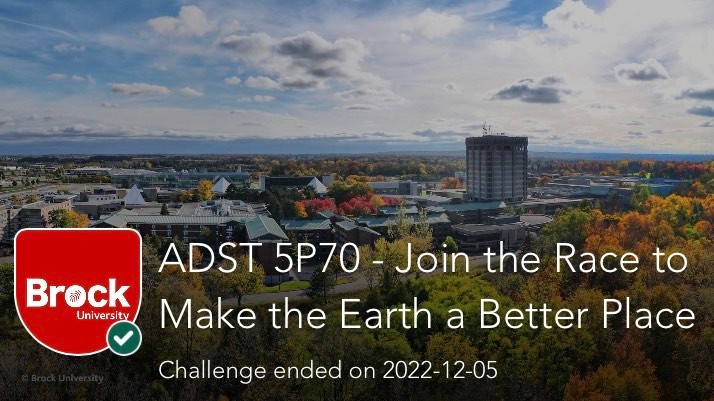
    Screenshot containing challenge information (date range and course code).

    Students in ADST 5P70: Applied Behaviour Analysis Measurement, Research and Evaluation, have found themselves busy competing in the Blackstone Energy App Sustainability Challenge. The class has been logging sustainable actions for the last two months! Course instructor, Dr. Kendra Thomson, described the course as “a first-year course in our Masters of Applied Disability Studies (MADS) and MA in the Applied Behaviour Analysis (ABA) specialization in our Applied Disability Studies Department. One of the main course objectives is to give students an overview of and be informed consumers of applied and clinical research, especially in ABA”.

    When asked “why did you decide hosting a Sustainability Challenge was important to incorporate into your class”?  She replied “I have been passionate about the environment since a child of the 80s & 90s, about a decade after the first Earth Day in 1971. I was a proud member of Kids for Saving Earth and used to pick up garbage in my small town with friends in the evening for fun. I have continuously tried to be a more environmentally conscious citizen and feel that I have a responsibility as an educator to inspire interest in this topic and encourage reflection and behaviour change in students. For the last few years, I have tried to incorporate a sustainability challenge into my classes. This stemmed from observing the large amount of waste produced in our all-day weekend model classes.  In the weekend model for our part-time classes, we are in class all day, after which I noticed the garbage bins were overflowing. I challenged the students in one of my classed about 5 or so years ago to see if we could reduce the amount of waste in the bin the next class by encouraging reusable coffee mugs and lunch containers. The successful outcome was visible to all students. This grew into it becoming a self-monitoring task built into all of my courses in which students are asked to report on their sustainable behaviours between classes for bonus points. The addition of the app is a bonus!”.

    While conversing with Kendra, it was amazing to see her enthusiasm towards promoting more sustainable lifestyles and was a wonderful example of it in practice. Her class has just finished the challenge and congratulations goes to all involved with the top three leaders Thomasy You, Mikhaela Fernandez, and Arwen Hunter!

    Reflecting on the experience Arwen Hunter, Masters of Applied Disability Studies (M.ADS) student, comments “using the Blackstone app was an excellent way to digitize the drive toward sustainability. Not only did it make it easier to record our sustainability actions, it also highlighted how many ways there are to make change in your day to day life. I was excited to see how many my family had already incorporated behavioural changes and was able to adjust with relative ease. The bonus marks were a great motivator to drive change”.

    Emily Houston, Masters of Applied Disability Studies (M.ADS) student, shared “I have really enjoyed using the app to not only keep me on the right track towards sustainability, but I found it very helpful to see all the different ways to live sustainably that I wasn’t aware of. It has definitely made me more aware of my behaviour and has encouraged me to do better for our planet”.

    Overall, the challenge showed great success and promoted sustainable lifestyles for students and family. Some of the most common actions the students logged can be seen listed below!

    Sustainability Challenge actions included:

    • Using a reusable shopping bag
    • Air-dried laundry
    • Washing with cold water
    • Turning off the lights
    • Using a reusable mug
    • Turning the tap off while brushing teeth
    • Ensuring full dishwasher loads, prior to running
    • Eating local produce
    • Using a reusable lunchbox
    • Recycling/composting
    • Shuting off computer monitors
    • Skipping meat
    • Dressing for the season
    • Taking public transit
    • Eating leftovers


    Categories: Challenge/Contest, Student Contributor, Sustainability at Brock