Opening Remarks
Good morning, everyone,
It is such an honour to help open Pride Month here at Brock.
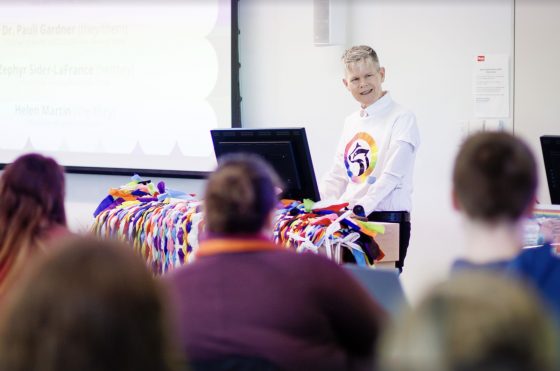
I’m here today in a few roles – as a faculty member, as someone who is queer and nonbinary, and as Co-Chair with Cathy Van lngen of the 25LGBTQIA+ Working Group on Brock’s Advisory Committee for Human Rights, Equity and Decolonization.
And in all of these roles, I recognize – as many of you do – that Pride is personal. It is political. And it is profoundly communal.
That understanding shapes the work we do.
Our working group exists to improve the lives of Two-Spirit, lesbian, gay, bisexual, transgender, queer, intersex, and asexual members of the Brock community through programming, resources, and support. Key to this work are initiatives like the community weaving project we co-hosted this fall – which served to celebrate and bring awareness to the queer community here at Brock. We are also co-hosting a panel later this month for Trans Day of Visibility, which Helen will speak more about later.
At the heart of our working group mandate is serving as a centralized campus hub for 25 LGBTQ+ conversations and information. That’s why this fall we launched QCommons – our online resource hub for the community. It has an adorable logo. There are t-shirts – just $20. You can check it out at QCommons.ca!

Pride began as protest. And it remains, in many ways, an act of courage.
Across Canada, we are seeing renewed challenges to LGBTQIA+ rights – from policy debates about trans youth in provinces like Alberta and Saskatchewan, to rising public hostility and organized opposition to inclusive education and gender diversity.
For many queer and trans people – especially young people – these are not abstract headlines. They shape daily life. And yet – here we are.
We gather anyway. We celebrate anyway.
Because Pride is more than reaction. Pride is declaration.
This spirit of courage and declaration is also at the heart of the Brock Advisory Committee for Human Rights, Equity and Decolonization. One of its most important commitments is intersectionality as we work to foreground the layered, braided interconnectedness of our lives.
We in the 2SLGBTQIA+ community know at our core; Pride is not singular – I mean, just look at how many letters we have … 2SLGBT… and we continue to add and grow.
Pride is racial justice. Black queer and trans communities have long led movements for liberation, often without recognition. Anti-Black racism continues to shape who feels safe to be visible – even within queer spaces.
Pride is Indigenous sovereignty. Two-Spirit people have always existed, even as colonialism has attempted to erase gender and sexual diversity as part of its broader project of control. To celebrate Pride on this land is also to commit to decolonization and to honour Indigenous leadership.
Pride is disability justice. Disabled queer and trans people navigate barriers that are too often overlooked. Accessibility is not an add -on to inclusion- it is central to it.
Pride is also connected to the work of other advisory committee groups – including those focused on international students and sexual violence prevention. Our struggles are linked. Our work is shared.
Indeed, our liberation is collective – or it is incomplete.
And that is precisely why Pride matters so much on university campuses.
Universities are places of becoming. Places where students try out names, pronouns, ideas, futures. Places where chosen family is formed.
It was during my undergraduate years that I came out to my family. It was at university that I met my life partner, who later became my spouse. And it is at this university – not so long ago – that I changed my name, recognized I am non-binary, and began using the pronouns they/them.
Universities should be places where we expand – intellectually and personally – not places that demand conformity in exchange for belonging.
And belonging does not happen by accident. It is built – through policy, through practice, through leadership, and through space.
At Brock, we have seen meaningful support and important change. And there is still so much to do – including securing a physical space where our community can gather, organize, and simply be together. We are working on this, and we hope the Provost and President will work alongside us. Because place is powerful. Place makes belonging visible. Place makes community possible.
And while institutional change matters – deeply – it is not the only way belonging takes shape.
Every Pride sticker on an office door. Every inclusive syllabus.
Every moment a student hears their identity affirmed in a classroom. Every gathering like this – these are not small things. They are acts of resilience. They are how we build the world we want.
So today – and throughout this month – we celebrate. We celebrate survival.
We celebrate community.
We celebrate the brilliance, creativity, and courage of LGBTQIA+ people across race, across ability, across gender, across generations.
To the queer and trans students – and to all of us in the 2SLGBTQIA+ community: you belong here. Your identities are your freedom. Your lives are not up for debate. Your futures are expansive.
To our allies: thank you for standing with us. Pride is not a spectator event and we acknowledge your commitment.
And to all of us – may this Pride remind us that belonging is something we build together. That justice is interconnected. That joy is powerful.
Happy Pride!
Dr. Pauli Gardner