Multiple-choice questions (MCQs) are ubiquitous across education – known for the ability to assess a broad range of content, and for how efficiently they can be graded. However, poorly-constructed MCQs may confuse students, limit performance to factual recall, unintentionally assess irrelevant information, and leave you wondering about what your students have actually learned. Our tips and principles below will help you more meaningfully assess your students using MCQs, and learn more about your students in the process.
As you go through the resource, remember that students are already anxious, and test anxiety can have a detrimental effect for even the most prepared students. Our goal is to meaningfully assess their learning, not their ability to perform on a stressful, high-stakes, time-limited test.

Foundations of Multiple-Choice Questions
1. Don’t solely rely on a (publisher) test/question bank.
- Many of these question banks are available online, presenting issues for academic integrity. Even if you can’t readily find it, motivated students often will – sometimes for a price.
- If/when you do use test bank questions, consider how you might revise them, use them for inspiration, or insert your own questions throughout the test to mix it up. You can start small and work your way toward developing a complete question bank of your own.
- By creating your own questions, your assessments will be more relevant to your students’ experience in your class. The Anatomy of MCQs and Item Design below will guide you through creating sound items to effectively assess student learning.
2. Distribute Your Work.
- Write questions throughout the term, as you go through different topics, so you aren’t stuck coming up with 100 items right before an exam. You will likely create better questions with the content and class activities in recent memory.
3. Have a friend, colleague, or TA review your questions ahead of test time.
- Both expertise bias and working on something very deeply can impact our ability to identify jargon, redundancies, and gaps in our work.
- Colleagues and TAs can help identify logical or grammatical errors and help you determine how much time the questions/test might take to complete.
- You can also try completing the test questions yourself, putting yourself in the mindset of your students, who are just learning the topics in which you are an expert. It will inevitably take students longer to complete a given activity or assessment than it would take for you to complete the same.
- Check out this post/podcast by Jennifer Gonzalez, 2015 for more information on this idea
4. In writing or presenting the instructions for the test, instruct students to select the “best answer” rather than the “correct answer”
- This acknowledges that many of the distractors may have some element of truth, but that there will be one most correct answer.
- You can also consider incorporating exam wrappers to help facilitate students’ metacognitive development, and glean some insight into students’ thoughts, experiences, and study practices.
MCQs are made up of two components: the stem and the options (one answer, and multiple distractors).
Fill-in-the blank and true-false (T/F) questions can also be incorporated into MCQ assessments. However, you should note that because T/F items have a 50% chance of guessing correctly, you would want to make the question high-level, requiring a depth of thought into whether the statement is accurate.
Some instructors also choose to incorporate multiple select items, where students must select multiple options that meet the item criteria. You must, though, decide how such items would be scored, and if partial credit would be given partially correct responses. This can complicate automatic scantron grading processes.
Importantly, effective MCQs will include all the following:
- clear stems
- plausible distractors (in addition to one correct answer)
- clear alignment with stated learning outcomes
The stem is the question or prompt that provides students with all necessary information to select the appropriate response. These can be phrased as questions, partial statements, or complete problems needing to be solved.
Design Clear and Complete Stems
The stems should be complete with all necessary information, such that your students could answer the question without looking at the responses. Think of it like asking an open-ended question with one correct response, but instead you are listing potential responses from which they can choose – functionally switching the cognitive task from recall to recognition.
Avoid excess or irrelevant information
Stems should not be excessively wordy or intentionally confusing. Include only the information that is relevant to the learning being assessed. Extra context and information takes students longer to read and process, and can mislead them into thinking about the wrong part of the question.
This is especially the case when teaching students for whom English is an additional language (Raji, 2025).
Identify the scope of expected performance
To properly align with your learning outcomes, consider the type of knowledge you want to assess, and at what level you expect your students to perform. Using Bloom’s taxonomy (or another learning assessment framework of your choice) consider the following:
- Do you expect your students to remember, understand, apply, analyze, evaluate, or create?
-
- Which of these are appropriate and achievable with MCQs?
-
- Which of these align with your course learning outcomes?
- Are you testing factual, conceptual, or procedural knowledge?
-
- Which types of questions lend themselves to different types of knowledge?
-
- It is possible that you will be testing all three types of knowledge within one assessment, so make sure your stems are designed with this in mind.
- Explore the CPI resource on Assessing Higher-Order Thinking with MCQs.
Ensure Plausibility
When developing the answers and distractors for your stem, you want all options to seem reasonable, and be rooted in common misconceptions, rather than being obviously wrong. Review your stem and options for logical cues that may give away the answer for test-savvy students. This helps in two ways:
- students are forced to think about the plausibility of all options, enhancing their critical thinking and reasoning skills; and
- test results provide insight into what students know or think they know, and where to focus instructional efforts on common errors.
How many?
Research shows that 3 is generally the optimal number of options for multiple choice tests, where the risk of guessing correctly is limited, the reliability and validity of the tests remain good, and the quality of distractors remains high. There is also some evidence that 4 options works, but very limited support for 5 or more.
Offering 2 well-structured distractors is just as or more useful than creating many. The reason for this is that as you try to come up with more and more reasonable alternatives, they tend to become more obviously wrong – rendering them ineffective. Plus, it takes more of your time to write and review them, and it takes students more time to read and think about them on the test.
Stick with distractors rooted in common student misconceptions, and you should only need 3 options.
Example:
- Learning outcomes are defined as:
a. The ideal outcomes of major assessment projects completed for a given lesson, unit, or course
b. The ideal knowledge, skills, abilities, and values students should have upon successful completion of a given lesson, unit, or course
c. The goals instructors wish to achieve through a given lesson, unit, or course
The answer is ‘b’ but both of the distractors are common misconceptions when beginning to learn about lesson planning, course design, and curriculum development. If I added one or two more, it is likely that the test taker would perceive them as obviously wrong, reducing their effectiveness, and adding unnecessary noise.
Of course there are always exceptions to this rule, and you should use your judgement to determine if using more than 2 distractors is reasonable (e.g., when using pairs of opposites as the alternatives).
Grammatical Consistency
Make sure all options, including all distractors, flow grammatically from the stem, especially when the item is phrased as a sentence completion, or indicates a certain part of speech. You want students to choose the correct answer because they know it, not because the alternatives don’t make grammatical sense.
Things to check for:
- a/an
- verbs/nouns
- singular/plural
Length and Detail
Keep all options similar in length and detail, so as not to give extra clues about the correct response. If the answer is a complete sentence, the distractors should also be complete sentences – same for single word, or short phrase options.
Randomize Location of Correct Answers
There is some evidence that the “when in doubt, pick C” advice works – tests are commonly constructed with most answers listed as C or D. Give a high-level review of the test to make sure correct responses are evenly distributed.
Avoid Absolutes
Words such as always, never, all, and none, indicate universality. Very few things in the world are universally true, leading students to automatically dismiss such distractors, rendering them ineffective.
Avoid “All/None of the above”
A correct “none of the above” response only tests that students know the distractors are wrong, but not if they actually know the correct answer. Although knowing why some responses are wrong can be important for learning, it cannot be adequately assessed using MCQs.
“All of the above” can be misleading to many students, and will confuse students if, for example, one option is correct, one is partially correct, and one is probably incorrect. They may choose it if they think more than one response could potentially be the answer, and may not choose it if they think only one response is “most correct”.
Don’t try to trick your students
- Misleading phrasing or emphasizing unimportant details often lead students to an incorrect answer, even if they know the material.
Avoid Negative Wording
- Negative wording (e.g., including the word NOT) can be confusing or overlooked. If you choose to use negative wording, either in the stem or the options, use ALL CAPS AND BOLD FONT to make it clear to students who might otherwise overlook it.
Amp up the complexity
- MCQs are often designed (intentionally or unintentionally) to assess surface-level understanding of a large amount of information – more questions, more content. But this often leads students to cram a lot of information into their minds through studying, only to forget soon after the test or exam. Designing a test with fewer, more complex items can help reinforce the most important learning outcomes.
- Especially important for online tests is that most people will be able to easily find an answer by entering the question into a search engine or GenAI tool. When facilitating online tests, assume students will treat it like an open-book, and create more complex questions to facilitate thought and reasoning. [see resource on Assessing Higher Order Thinking with MCQs]
Allow ample time for completion
- MCQ tests have often been constructed to allow between 30 and 90 seconds per question (e.g., 150 questions in a 3-hour exam). However, this does not account for question complexity, the level of thinking or calculation needed to accurately respond, or differences in student processing and test-taking approaches.
- When preparing an in-class test or exam, only present as many questions as can be reasonably completed within the scheduled timeframe. Consider at least 1.5 to 2 minutes per question, or longer, depending on what is being asked of them.
- There is a commonly held belief that decreasing the amount of time given for online tests minimizes students’ ability to search for the answers. This does not tend to work, and can have negative impacts on students’ test anxiety. Consider untimed or generously-timed online tests and exams, and focus on the complexity of the questions to emphasize higher-order thinking rather than searching for or recalling facts [See resource on Assessing Higher-Order Thinking with Multiple-Choice Questions (MCQs)].
- Less is more. Fewer, more complex questions, problems, and scenario-based items will take longer to complete, but they will better assess students’ learning.
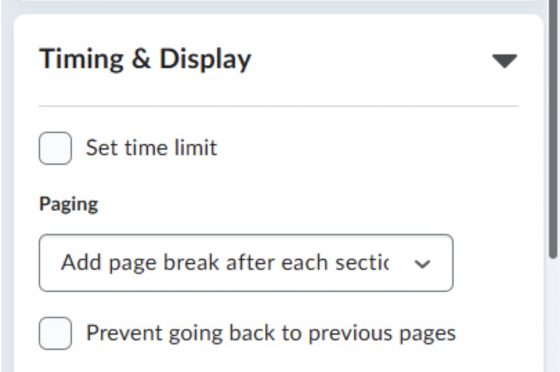
- When developing online tests within Brightspace, we strongly recommend you allow the options for students to navigate backwards and forwards through the test. This is a common approach to test taking, which is easily accomplished during in-person tests, and should also translate to the online environment. Under Timing and Display in your test settings, choosing anything other than “all questions displayed together” will bring up the option to prevent backtracking. Although there are good reasons to split exam questions or sections across pages, students should always have the ability to go back to previous questions or review their responses before submitting.
- MCQs can really only assess the cognitive domain of learning, leaving any affective or psychomotor learning outcomes needing to be assessed using alternative methods. If this is the case for your program or course, reach out to CPI [email protected] to discuss assessment options.
- There is a widely held belief that MCQ testing can solve the problem of academic integrity presented by Generative Artificial Intelligence (GenAI). Although closed-book, in-class testing conditions may provide a more controlled environment less prone to academic dishonesty, there are many ways to foster a culture of academic integrity and to build authentic assessments in open and flexible ways, mitigating many worries about “cheating”. Review CPI resources on alternative assessments and mitigating the use of AI tools to find out more.
License for this resource
This resource is available for use and adaptation under the CC BY-NC-SA license, and should be referenced as:
Centre for Pedagogical Innovation, Brock University. (2025). Developing more meaningful multiple-choice questions. Retrieved on XXXX. Available under CC BY-NC-SA license.
Adapted from
Centre for Teaching Excellence, University of Waterloo. (n.d.). Designing Multiple-Choice Questions. Retrieved on November 10, 2025. Available under CC BY-NC 4.0 International license.
Zimmaro, Dawn M. (2016). Writing Good Multiple-Choice Exams. Faculty Innovation Center, University of Texas at Austin. Available under CC BY-NC-SA license.
References & Additional Resources
Center for Teaching Excellence, University of Waterloo (n.d). Bloom’s Taxonomy. Retrieved on November 14, 2025. Available under CC BY-NC 4.0 International license.
Gonzalez, Jennifer. (2015). Dogfooding: How often do you do your own assignments? Cult of Pedagogy Podcast.
NMBE National Board of Medical Examiners. (2024). NBME Item-Writing Guide: Constructing Written Test Questions for the Health Sciences. Accessed on November 19, 2025.
Raji, Monsurat. (2025). Designing Multiple Choice Questions with EAL in Mind. Faculty Learning Hub, Conestoga College. Accessed on November 27, 2025.
Raymond, Mark R., Craig Stevens, & S. Deniz Bucak. (2018). The optimal number of options for multiple-choice questions on high-stakes tests: application of a revised index for detecting nonfunctional distractors. Advances in Health Science Education, 24, 141-150.
Rodriguez, Michael C. (2005). Three Options are Optimal for Multiple-Choice Items: A Meta-Analysis of 80 Years of Research. https://doi.org/10.1111/j.1745-3992.2005.00006.x
Sibley, Jim. (2014). Seven Mistakes to Avoid When Writing Multiple-Choice Questions. Faculty Focus.
Smith, Philip.(n.d.) Designing Meaningful Multiple Choice Questions. In An Open Guide to Teaching and Learning in Higher Education. Available under CC BY-NC-SA 4.0 International license.
Sridharan, Kannan & Gowrie Sivaramakrishnan. (2025). Less is more? A systematic review and network meta-analysis on MCQ option numbers. BMC Medical Education, 25, 1430, https://doi.org/10.1186/s12909-025-08026-5. Available under CC BY-NC-ND 4.0 license.