Associate Professor, Kinesiology and Graduate Program Director, Applied Health Sciences PhD Program

Dr. Shawn Beaudette is an Associate Professor of Kinesiology at Brock University, Director of the Spine Biomechanics and Neuromuscular Control Laboratory, and Graduate Program Director for the Applied Health Sciences PhD program. His research examines how people control movement, with a particular focus on the muscles that support and move the spine. He combines biomechanics, neurophysiology and data science to understand how sensory feedback, fatigue and pain influence muscle activation and movement strategies. This work aims to inform approaches to musculoskeletal rehabilitation, workplace injury prevention and athletic performance.
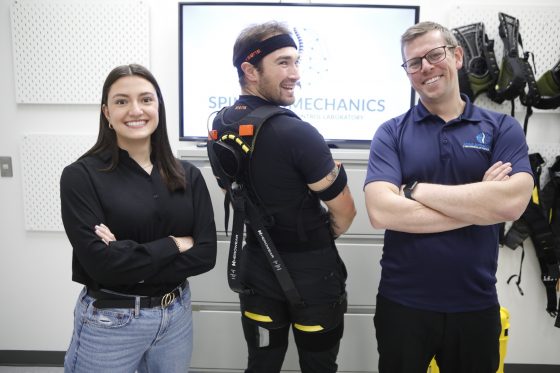
His laboratory uses high-density electromyography, motion capture and wearable sensors, while developing computer-vision tools that make movement assessment possible using everyday video recordings. Through industry collaborations and mentorship of student and alumni entrepreneurs, he helps translate research into practical technologies for movement assessment. His contributions have been recognized through Brock University’s Innovator of the Year Award and Chancellor’s Chair for Teaching Excellence.
- Spine biomechanics and trunk neuromuscular control.
- Muscle activation, fatigue and sensorimotor adaptation.
- Markerless motion capture, wearable sensing and computational movement assessment.
- Occupational biomechanics and assistive technologies.
- Movement coordination and athletic performance.
- Canadian Society for Biomechanics — Member; elected Member at Large.
- International Society of Biomechanics — Member.
- International Society of Electrophysiology and Kinesiology — Member.
- International Society of Biomechanics in Sports — Member.
- Centre of Research Expertise for the Prevention of Musculoskeletal Disorders — Member.
- Canadian Musculoskeletal Rehab Research Network — Member.
- Brock University — Member, Centre for Neuroscience and Centre for Bone and Muscle Health; Associate Member, Department of Engineering.
Selected honours
- Brock University Innovator of the Year Award, 2026 — Recognition of research innovation and the translation of movement science into accessible technologies.
- Brock University Chancellor’s Chair for Teaching Excellence, 2021–2024 — Research supporting effective and engaging approaches to human anatomy education.
Selected research funding
His research has received support through the following programs:
- NSERC Discovery Grant — Spine neuromuscular function and movement control.
- Canada Foundation for Innovation, John R. Evans Leaders Fund — Markerless motion capture infrastructure for field-based research.
- NSERC Research Tools and Instruments — High-density surface electromyography equipment.
- Mitacs — Industry collaborations in movement assessment and sport performance.
Selected publications in accessible movement assessment, spine function, ergonomics and sport:
Vellucci, C. L., Ratke, E. J., Guleria, A., & Beaudette, S. M. (2026). A deep-learning pipeline to extract clinical gait metrics from single-camera recordings. Journal of Biomechanics, 207, 113573.
Alano, C. J., Holmes, M. W. R., & Beaudette, S. M. (2026). Videos of common activities reveal movement patterns associated with biopsychosocial low back function in a worldwide cohort. Digital Health, 12, 20552076261477543.
Ratke, E. J., McMaster, H., Vellucci, C. L., Larson, D. J., Holmes, M. W. R., & Beaudette, S. M. (2025). Ability of a passive back support exoskeleton to mitigate fatigue related adaptations in a complex repetitive lifting task. Journal of Biomechanics, 181, 112553.
Ratke, E. J., Larson, D. J., Holmes, M. W. R., & Beaudette, S. M. (2025). Adaptations to fatigue during a repetitive multiplanar lifting task. Applied Ergonomics, 129, 104587.
Vellucci, C. L., & Beaudette, S. M. (2025). Multijoint coordination contributes to the minimization of frontal plane center-of-mass displacement in maximal velocity sprinting. Journal of Applied Biomechanics, 41, 561–570.
Battis, A., Norrie, J. P., McMaster, H., & Beaudette, S. M. (2024). Wearable technology mediated biofeedback to modulate spine motor control: a scoping review. BMC Musculoskeletal Disorders, 25, 770.
Further publications and research updates: Spine Biomechanics and Neuromuscular Control Laboratory
Dr. Beaudette teaches human anatomy and biomechanics, including musculoskeletal anatomy, functional anatomy, foundations of human anatomy and research methods in biomechanics. His educational research examines student engagement, peer-assisted learning and hybrid anatomy instruction.
His academic and professional service includes:
- Graduate Program Director, Applied Health Sciences PhD Program.
- Co-Director, Human Anatomy Volunteer Peer-Leader Program.
- Neuromotor Stream Coordinator, Centre for Neuroscience.
- Elected Member at Large, Canadian Society for Biomechanics.
- Associate Editor, Isokinetics and Exercise Science.
He also supports student entrepreneurship and research translation through mentorship and collaboration with industry partners.
The laboratory welcomes inquiries from undergraduate students interested in thesis projects, directed studies and research experience. Students can contribute to projects in muscle function, spine biomechanics, wearable technology, movement analysis, ergonomics and athletic performance, while developing skills in data collection, analysis and scientific communication.
Students from kinesiology, neuroscience, engineering, computer science and related disciplines are encouraged to contact [email protected] with a brief introduction, their research interests and a curriculum vitae or résumé.
Dr. Beaudette welcomes inquiries from prospective MSc and PhD students interested in biomechanics, neuromuscular control and computational movement science. Projects connect fundamental questions about muscle function and movement coordination with applications in rehabilitation, ergonomics and sport.
Depending on the project, graduate students develop skills in:
- Experimental design, motion capture, electromyography and wearable sensing.
- Programming, signal processing and quantitative movement analysis.
- Scientific writing, conference presentations and knowledge translation.
- Interdisciplinary research, industry collaboration and research commercialization.
Applicants from kinesiology, biomechanics, neuroscience, engineering, computer science and related fields should email [email protected] with a brief statement of research interests and a curriculum vitae. Available projects depend on research alignment, supervisory capacity and funding.


Recent Comments