Blog Posts

  • Tips for Sustainable Holiday Season

    Blog Contributor: Mikellena Nettos

    It’s that time of year again – time to shop until you drop for the people that you love! Unfortunately, the holidays generate a lot of waste from unused gifts, to wrapping paper that you cannot recycle, to having lights on 24/7. So, how can you celebrate the holiday season sustainably? Well, here are some tips on how to be more sustainable during this holiday season:  

    Gifts 
    • Choose a gift that will last for years to come instead of single use items or clothes that can go in and out of fashion quickly.  
    • Shop local and support small businesses –  most small businesses have smaller carbon footprints and therefore are more sustainable.  
    • Handmake/regift instead of buying new items – thoughtful gifts often time have the most impact. 
    • Use sustainable wrapping paper like brown papermaterial, or even newspaper! It’s a great way to save money and the planet at the same time. You can add red yarn to tie it up for a more holiday feel.
    Décor 
    • Handcraft the decorations you can – knitting stockings or making your own wreath can be a fun way to spend time together while caring for the planet and saving money.  
    • Reuse tree decorations year after year instead of buying new ones. 
    • Use a real holiday tree (and compost it after use) to avoid plastic trees that take years to break down or decorate a house plant! 
    Holiday Cards 
    • E-cards are a sustainable way to spread holiday. 
    • Handcrafted cards are a great alternative to buying cards that are not recyclable. It also adds a touch of personality to show your loved ones how much they really mean to you.  
    Food  
    • Try using sustainably sourced food when deciding what to cook for holiday dinners. 
    • Cut down on the meat options, to reduce your carbon footprint, instead of having a turkey, ham, and meatloaf. 
    • Cut food waste – avoid overcooking if you can. Additionally, you can use leftovers to create new meals instead of tossing them in the compost.  
    Lights 
    • Switch to LED lights this holiday to cut down on energy usage for the lights. 
    • Additionally, use a holiday light timer to avoid having to remember to turn the lights off and on constantly. 

    Good luck on your exams and have a safe holiday, Badgers! If you are going home for the holidays, don’t forget to self-isolate for 2 weeks prior to avoid the spreading of COVID. While this holiday season may be different than the ones prior, try and enjoy this time with your loved ones. See you all (virtually) January 11th for the start of winter term! Happy Holidays!  

    References 

    Cornish, N. (2019, December 8). 17 tips for a more sustainable Christmas this year. House Beautiful. https://www.housebeautiful.com/uk/lifestyle/shopping/g25616166/sustainable-christmas/?slide=17 

    Cowan, S. (n.d.). How to Have a ‘Green’ ChristmasEartheasy Guides & Articles. Retrieved December 14, 2020, from https://learn.eartheasy.com/guides/how-to-have-a-green-christmas/ 

    Categories: Student Contributor, Sustainability

  • Bob Davis and Gym 2 LED Lighting & Control System Upgrade  

    Blog Contributor: Elenore Breslow

    Brock University continues tdemonstrate its commitment to increase energy efficiency and sustainability on campus through energy savings projects. A recent project completed in April 2020 was the LED lighting and control system upgrade in Bob Davis and Gym 2. The Bob Davis Gymnasium is located on the lower level of the Walker Complex and is home to Badger basketball and volleyball teams and is where convocation and exams are held. Gym 2 is a multi-purpose gymnasium that is also located in the Walker Complex and is the main facility for the Universities PEKN Children’s Movement Program and where a number of intramurals are held. 

    This energy efficiency project aligns with Brock’s Energy Conservation & Demand Management Plan goal to continue the replacement of T12, T8 and CFL lights and fixtures with LED tubes and fixtures. Both facilities were illuminated with 4 lamp and 2 lamp T8 fluorescent lighting fixtures with a total fixture count of 356 and a total lamp count of 1,424. The aging T8 fixtures were replaced with new LED high bay luminaires. A total of 140 new LED fixtures were installed in the two gyms. In addition to the lighting upgrades the two gyms also received a new Lutron control system that installed dimming capabilities as well as occupancy sensors to curtail energy usage when the gyms are not in use. The lighting portion of the project resulted in electrical savings of 157,228 kWh and the controls portion contributes an additional savings of 62,772 kWh for a total electrical savings of 220,000 kWh per year. This represents savings of $42,900 annually. These savings are enough to power 7.8 homes for 1 year and is equivalent to 40.88 t CO2e reduction or taking about 16 cars off the road! 


    Project Details: 

    Project Cost: $96,500.00 

    Incentives/Grants: $7,000 for fixtures, $6,272 for controls (total $13,272) 

    Simple Payback: 1.7 years 

    Energy Savings: 220,000 kWh/year ($42,900) 

    CO2 Reduction: 40.88 eton 

    Project Completion: April 2020. 

    Categories: Energy, Student Contributor, Sustainability at Brock

  • How to Reduce Waste During Online School

    Blog Contributor: Mikellena Nettos

    Waste reduction is difficult and becomes increasingly more difficult when paired with a global pandemic. Being home all day without routine can bring out old and unsustainable habits. Therefore, here are five tips on how to reduce waste during online school or even working from home. Keep in mind these are only suggestions, and it’s okay if you are unable to follow them. Don’t be too hard on yourself, everyone is only doing what they can in hard times like these.  

    Invest in reusables  

    If you don’t already have one, invest in a coffee maker instead of ordering delivery Starbucks delivery every day. This will not only save you money long term, you can help reduce the amount of non-reusable coffee cups that go into the landfill because they can be difficult to recycle. 

     Did you know that it takes 17 trees and 20,000 gallons of water to make one ton of paper towels?. Instead of buying paper towels, buy reusable/washable cloths. Since you are home more often, you might use more paper towels than you used to. However, since you have the extra time why not invest in cloths that you can wash instead?! If you want to go the extra mile, just you can make cloths out of old tattered clothing, or if you don’t want to do the extra laundry, try to only buy paper towel made from 100% recycled paper!   

    Try and reduce food waste  

    Bulking buying can save money, but it can also waste money if the food isn’t eaten before it expires. A way to combat this is to buy more non-perishables or freezer items; examples are canned foods, dried meats, or grains. Additionally, you can put the food that is close to expiry at the front of your fridge to remind yourself to eat it first! Another food saving tip is learning how to properly store fresh produce. Also, don’t forget to compost when you are done with food scraps! 

    Unplug 

    Leaving your phone or laptop chargers plugged in all the time can end up using a lot of energy over time. Additionally, it can be a safety hazard in the case of power surges. A quick solution to this is a power-bar with an on/off switch if you don’t want to go through the trouble of unplugging all the time.  

    Additionally, not only does unplugging save energy, it can also increase mental health. Instead of watching Netflix or mindlessly scrolling through social media between classes, go on a walk or bike ride! Research shows that exercise (especially exercise within/around nature) increases perceived mental well-being, so don’t skip the walk!  

    Go for walks instead of drives 

    As previously mentioned, walks outside can significantly increase mental well-being. So, when you need a change of scenery from being stuck in your house, opt for a walk instead of aimlessly driving around. It’s better for your body and the planet because walks thankfully don’t require the combustion of greenhouse gases.  

    Make food with loved ones instead of ordering take-out 

    Making food can be particularly hard as a student, especially if you share the kitchen with multiple people. Instead of all creating individual meals, or all ordering takeout, try and cook meals together. This can increase well-being because you are spending quality time with roommates or family and creating a dish for you all to share. Eating together can also reduce the sense of isolation that some can feel due to this new virtual world. If you do order takeout, remember to opt out of receiving plastic cutlery, and use utensils from home instead!  

    Don’t forget little changes go a long way! We hope everyone if adjusting well and staying safe during this difficult time.  

    References 

    Canadian Produce Marketing Association. (2020, June 30). How to Store Fruits and Veggies. Half Your Plate. https://www.halfyourplate.ca/fruits-and-veggies/store-fruits-veggies/ 

    Kender, D. U. T. (2020, January 29). Myth vs. fact: Unplugging devices when you leave the house. USA TODAY. https://eu.usatoday.com/story/money/columnist/2019/11/27/unplugging-devices-when-not-use/4192100002/ 

    Hasselberger, L. (2015, January 6). 13 Facts about Home Paper Products that May Inspire You to Hug a Tree. DrGreene.Com. https://www.drgreene.com/perspectives/13-facts-about-home-paper-products-that-may-inspire-you-to-hug-a-tree 

    Maas, J. (2006). Green space, urbanity, and health: how strong is the relation? Journal of Epidemiology & Community Health60(7), 587–592. https://doi.org/10.1136/jech.2005.043125 

    Reducing Waste: What You Can Do. (2020, September 4). US EPA. https://www.epa.gov/recycle/reducing-waste-what-you-can-do 

    Categories: Electricity, Student Contributor, Waste

  • 5 Netflix Documentaries for the Eco-Conscious

    Blog Contributor: Shannon Ruzgys

    Documentaries are a great way to educate and inspire yourself and there is no shortage of wonderful documentaries about the environmentThese 5 Netflix documentaries are a must watch for anyone who has hope for a better future.  

    Kiss the Ground  


    Modern day industrial agriculture is degrading our environment through tillage, heavy pesticide use, and mono-cropping (just to name a few). These practices lead to soil erosion, which not only immediately threatens global food security, but is also irreversible. This documentary proposes a solution, regenerative farming, an ethical practice that prioritizes animal health, restoring degrading lands, and drawing down carbon. Told from the perspective of scientists, farmers, activists, and politiciansthis documentary provides hope for a better farming system that can heal the soil, balance our climate, and feed people all at the same time. 

    Our Planet  


    This documentary contains all the things we’ve grown to love from nature docs such as Planet Earth and Blue Planet, while also choosing to focus more on how humans are altering the natural world around us and the impact that we’re having on biodiversity worldwide. There are 8 episodes that each focus on a different ecosystem, while highlighting how climate change uniquely impacts each of these environments. In David Attenborough’s words “[This] series will explore the Earth’s most important habitats and celebrate the life they still support. We will reveal what must be preserved if we are to ensure a future where humans and nature can thrive” 

    Rotten


    While this is not explicitly an environmental documentary, this Netflix show, which currently has two seasons, focuses on the problems in our food supply chain. Each episode focuses on a different food product, exposing the corruption, waste, and social impacts of the foods we choose to eat. The issues with our global food supply chain run deep but as consumers we have the power to choose what we want to support by what we put on our plates three times a day. This series is a great tool for educating yourself on how to be a more ethical grocery shopper (even if that means leaving avocados off your morning toast).  

    The Biggest Little Farm

    This documentary follows a couple and their dog on their journey to restore 200 acres of dry, nutrient depleted farmland into a healthy farmable ecosystem using nature-based regenerative solutions. Viewers follow them on their journey as they turn 200 acres of desert into a utopia that utilizes the power of a healthy ecosystem to farm with nature. Throughout almost a decade of work they plant 10,000 orchard trees, over 200 crops, and bring in animals of every kind. It is an inspirational documentary that demonstrates how farming can be done in a way that benefits animals, people, and the environment.  

    David Attenborough: A Life on Our Planet


     This documentary is David Attenborough’s witness statement where he states his concern for the state of our planet and his hopes for a better future. Throughout the documentary he narrates key moments in his life all the while showing human population growth, carbon in the atmosphere, and the percentage of intact wilderness within the scale of his own lifetime. He emphasizes that nature currently faces two great challenges: climate change and massive loss of biodiversity. This documentary is not only a testament of Attenborough’s life’s work but also carries a dire warning for the future and a hopeful way forward through the restoration of the natural world.  


    Categories: Film, Student Contributor, Sustainability

  • Brock Cares Event with WWF-Canada Showcases the Impact of Student Action

    Blog Contributor: Shannon Ruzgys

    On October 27th Brock Cares hosted an event called Conserving our Environment and Increasing Biodiversity Through Student Action” where viewers were joined by Kathy Nguyen, Specialist of Engagement at WWFCanada and Connor Thompson,  graduate of Brock’s Master of Sustainability program.  

    The presentation started with an overview of the current state of the environment and wildlife in Canada, which is unsurprisingly grim. Canada is currently warming at a rate 2x faster than the rest of the world, and that rate rises to 3x faster in Canada’s arctic. However, there were hopeful notes about Canada’s vast amount of untouched wildness and our duty to ensure it stays that way.  

    From there, Kathy and Connor launched into Brock’s exciting new partnership with WWF-Canada called the “Living Planet @ Campus Program”, where through volunteering and academics, students can earn the Living Planet Leader certification. This is a nationally recognized self-guided certification that includes 4 requirements to receive the certification: personal application of sustainability, volunteerism, application of sustainability in academics, and leadership and teamwork. 

    Brock graduate Connor Thompson was one of the first students to receive the Living Planet Leader certification in Canada. He explained that when he was entering the job force, he was looking for something that would differentiate himself from other candidates and that being a Living Planet Leader was extremely useful in doing so. He also talked about how completing the certification was an enriching experience that provided him with useful skills and experiences.  

    This certification is meant to enrich your overall academic experience and you have up to three months after graduation to complete it. If you want to learn more about WWF-Canada and how to get involved in the Living Planet @ Campus Program through the Living Planet Leader certification, click here.

    Categories: Community, Student Contributor, Sustainability at Brock

  • Five Tips On How to Have a Sustainable At-Home Halloween

    Blog Contributor: Mikellena Nettos

    Halloween is just around the corner and even though we are unable to celebrate together, we can still celebrate at home! Brock is working with the Niagara community to encourage a safe Halloween and we thought we might add to that conversation by taking about sustainability. Holiday celebrations can lead to a lot of waste, from tacky plastic dollar store decorations to millions of pumpkins simply discarded incorrectly. That being said there, are a lot of ways we can have more sustainable at-home celebrations! Here are five tips on how to incorporate sustainability into your Halloween celebrations:

    1. Decorations: Instead of buying decor, create them using old clothes, or decorate using compostable items
      • Use old stockings with runs for spider webs (WWF, 2020).
      • Decorate with pumpkins, gourds, leaves and other compostable or edible items (Recyclebank, 2017).
      • Ifyou do buy non-compostable/non-recyclable items, be sure to keep them as decorations for every year! #ReuseReduceRecycle
      • Make your own scarecrow on your front lawn instead of blow-up decor which consumes a lot of energy.
    2. Purchase locally grown pumpkins or grow your own!
      • Don’t forget to compost them or use them to make pumpkin pie or bread (Harvard, 2015)!
      • Save the seeds for a tasty treat, you can find easy recipes all over the internet or even create your own!
      • Painted pumpkins are unfortunately not compostable, so if you don’t want to carve it, dress it up with a fun hat or scarf (Recyclebank, 2017)!
    3. Buy organic treats without plastic wrappers if possible!
      • Because we are not encouraging trick or treating this year, try making your own treats!
      • Try to avoid buying boxed candy sets as they are each individually wrapped with plastic that is not recyclable!
    4. Watch Halloween movies online with friends by using streaming platforms like Netflix Party or sharing your screen on Teams!
      • This is a great way to celebrate the Halloween spirit while staying safe!
      • Some great Halloween movies can be found here.
    5. Make your own costume!
      • Instead of buying a costume you are only going to wear one time, make your own by hand or thrifting (WWF, 2020).
      • Another idea is to use/buy clothing you know you will wear again in the future!
      • You can also rent costumes where available or participate in a costume swap with family or friends (be sure to maintain social distancing when doing so, and don’t forget your masks!)

    If you engage with these tips, we encourage you to share the ways you implemented a more sustainable Halloween and tag #BUSustainableHalloween and @BUSustainable to be featured on our story! Have a happy and safe Halloween, Badgers!


    References:

    Harvard Green Team. (2015, June 22). 6 tips for a greener Halloween. Retrieved October 27, 2020, from https://green.harvard.edu/tools-resources/green-tip/6-tips-greener-halloween

    Recyclebank. (2017, October 23). 29 Fun Ways To Have A Happy, Sustainable Halloween. Retrieved October 27, 2020, from https://livegreen.recyclebank.com/29-fun-ways-to-have-a-happy-sustainable-halloween

    Staff, C. (2020, September 20). Your Guide to the Best Halloween Movies of All Time. Retrieved October 27, 2020, from https://www.countryliving.com/life/entertainment/g3624/best-halloween-movies/?slide=1

    WWF. (2020). 10 Green Halloween Tips. Retrieved October 27, 2020, from https://www.worldwildlife.org/pages/10-green-halloween-tips

    Categories: Student Contributor, Sustainability

  • Brock and WWF-Canada Care About Conservation, Biodiversity, and Student Action

    Plastic Pollution In Ocean – Turtle Eat Plastic Bag – Environmental Problem

    Blog Contributor: Erica Harper 

    On October 27th from 11-12:15pm EST, Sustainability at Brock and WWF-Canada will be hosting a Brock Cares event to engage students in conservation, biodiversity, and student actions that make a positive difference on the Brock campus and the environment. This event will highlight the new Living Planet @ Campus partnership between Brock and WWF-Canada that provides students with the opportunity to address issues relating to the crises of biodiversity loss and climate change.  

     The speakers for the event include Kathy Nguyen, Specialist of Engagement at World Wildlife Fund-Canada (WWF-Canada) and Connor Thompson, Brock Master of Sustainability graduate.  

     Kathy will explain how WWF-Canada engages in conservation, biodiversity, and habitat protection initiatives that align with the organization’s long-term vision of “creating a world where people and nature thrive”. Kathy will also discuss Living Planet @ Campus, which allows students to be leaders in conservation efforts on campus and earn WWF-Canada’s nationally recognized Living Planet Leader self-guided certification. 

     As one of the first people in Canada to receive WWF-Canada’s Living Planet Leader certificate and a recent Brock graduate, Connor will provide a unique student perspective on his experience completing the certification and how engaging in conservation activities impacted him. This will help other students further understand how they can get involved in conservation initiatives too through volunteerism, academic work, and leadership to name a few. 

     All students are welcome to the event to learn more about how they can make a positive environmental impact at Brock, in the community, and even globally. Click this ExperienceBU link to register for this great event!  

    Categories: Community, Student Contributor, Sustainability at Brock

  • Update to the Niagara Region Garbage Retrieval Schedule 

    Blog Contributor: Mikellena Nettos

    In case you missed itNiagara Region will be updating their garbage retrieval schedule effective October 19th, 2020. Instead of putting your garbage out once per week, you will now only be able to set out two bags or cans once every other week. The region will still collect recycling bins and compost bins weekly, which allows people to shift their waste towards recycling and compost bins instead of the garbageAccording to the regional website, more than half of the average garbage bag in Niagara contains materials that could have been recycled or composted.  

    What can you do to reduce your waste?  

    • Order less take out. Most containers and plastic bags used to deliver food end up in the garbage instead of being properly disposed of. 
    • Make sure to rinse recyclable materials before placing them in the bin. Did you know that greasestained carboard goes into the compost, not the recycling bin? 
    • Know which bin it belongs in – if you are unsure which bin an item belongs in click here  
    • Put all food waste in the compost to avoid rotting garbage. No one wants to deal with smelly garbage for two weeks. 
    • Follow zero waste pages on Instagram or twitter for helpful tips! 

    Additionally, here is a link to a previous post that shares tips on how to “Recycle Like a Pro” in Niagara.  

    Do the right thing – reduce, reuse, and recycle.  

    Together we can make the world a cleaner place. 

    Categories: Niagara, Student Contributor, Waste

  • Summer Wrap Up – Sustainability Coordinator Co-Op

    Blog Contributor: Elenore Breslow

    There is a long list of reasons why summer 2020 was unlike any other. The pandemic surely impacted everyone’s lives in different ways and like many of you, I spent my summer working remotely at my home office instead of working in-person 

    Even with the widespread shift to mainly remote work this summer, I still had an incredible opportunity to work as a Sustainability Coordinator co-op student from my home over 4 hours away from St. Catharines. And yes, my work-from-home setup on most days did include the traditional attire of a dress shirt, sweatpants, and no shoes. Enough about my wardrobe though…  

    The Sustainability Coordinator position was made available through the Brock University Charter Agreement with Facilities Management and the Environmental Sustainability Research Centre. Through the Charter Agreement I worked for two exceedingly knowledgeable supervisors – Mary Quintana, Director, Asset Management & Utilities for Facilities Management and Amanda Smits, Centre Administrator for the Environmental Sustainability Research Centre. 

    The pandemic may have impacted where I completed my work this summer, but the actual work I did would have been the same regardless of location. And I was fortunate enough to visit the campus at the end of the co-op term to meet everyone (in-person) on the Brock team that I worked with throughout the summer –  check out my video below from my visit, Day in the Life as a Sustainability Coordinator 

    The overall goal of the summer was to increase our knowledge of sustainability at Brock and determine baseline numbers in areas such as, GHG emissions, water use, and wasteOur team wanted to determine where does Brock do well in terms of sustainability and where are areas of improvement. To do this, we began by working on the completion of Brock’s first Sustainability, Tracking, Assessment & Rating System (STARS)This was a comprehensive process that involved coordination with several different internal and external stakeholders to collect data and information regarding the 4 main categories of STARS  academics, engagement, operations, and planning & administration. The key aspect about STARS is that it is a holistic approach to measuring sustainability on campus, and then decision makers can use that information to generate new ideas in terms of strategic planning and engaging the community. Making real progress towards sustainability can be a difficult task but starting by measuring all sustainability performance on campus is a great place to start.  

    Throughout the summer I also had the opportunity to help with many other sustainability related projects including being involved more on the operations and project management side of things. I helped with projects that examined ways to adapt current infrastructure to be more sustainable and I learned about how sustainability is incorporated into current operational practices, including the District Energy System. As many of you know, Brock recently celebrated the completion of Brock’s District Energy Efficiency Project (DEEP). It is through innovative projects like DEEP that Brock continues to demonstrate its commitment to environmental sustainabilitywith the hopes of continuing to be leaders amongst universities in reducing carbon emissions.  

    I am excited to continue my journey with the Brock team until 2021 and I am eager to part of the new initiatives and projects that are beginning this fall. Keep a lookout on Sustainability at Brock’s social media accounts (@BUsustainable) to stay up to date with all things sustainability here at Brock! 

    Categories: Student Contributor, Sustainability, Sustainability at Brock, Uncategorised

  • Taking an Active Role in Environmental Stewardship

    Blog Contributor: Elenore Breslow

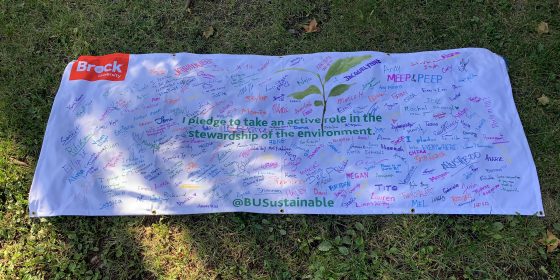
    The Brock University community has come together to pledge to take an active role in the stewardship of the environment. During the 2019-2020 academic year a sustainability pledge banner was brought to various events across campus, including the Vendor Fair during Orientation Week, Training Events, and the Sustainable Development Goals Training Day, to provide the opportunity for the Brock community to sign and support the stewardship of the environment.

    During these events, Brock University President Gervan Fearon, several Directors from Departments across campus, and students came together to sign and pledge to take an active role in taking care of the environment. The sustainability pledge was signed on an eco-friendly banner that was made from 100% post-consumer waste from recycled plastic water bottles. Everyone who signed the banner pledged to do their part for the environment, whether that be biking to school, using a reusable water bottle, or even trying to adopt a zero-waste lifestyle.

    Categories: Student Contributor, Study Sustainability at Brock, Sustainability, Sustainability at Brock