Blog Posts

  • Green thumbs needed to grow Brock Community Garden

    In addition to plants, the University is hopeful interest will grow in the Brock Community Garden.

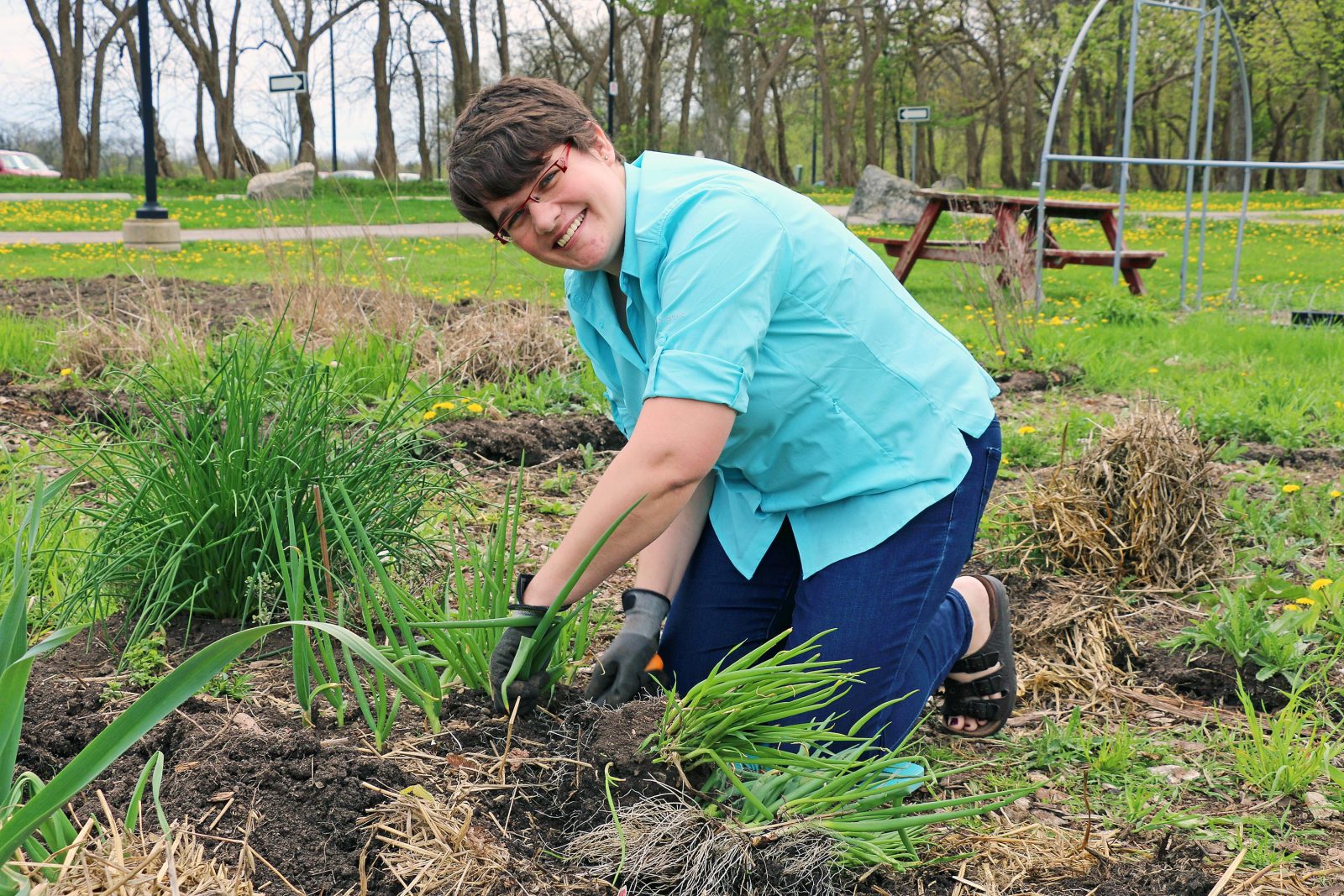
    Brock’s grounds crew is busy tilling the soil, creating new grass aisles and enlarging the 12 garden plots located beside the entrance of the Zone 2 parking lot near Theal House.

    University staff, faculty and students looking to cultivate their green thumb are invited to use one of several free garden plots, assigned on a first-come, first-served basis.

    Six plots are available, with six already claimed. The Rosalind Blauer Centre for Child Care will use two plots for experiential learning; Biological Sciences Professor Liette Vasseur’s research team will use three plots to test different cover crops — plants grown for the protection and enrichment of the soil; and Brock employee Alison Innes (MA ’13) plans to tend one plot for her personal vegetable garden.

    Before learning about the community plots last year, Innes, the social media co-ordinator for the Faculty of Humanities, considered herself a ‘gardener without a garden’ and often resorted to container gardening in her apartment complex.

    “It’s just wonderful to have space to grow things,” she said of the University’s communal greenspace. “It’s easy to stop by the plot at the end of the day and pick some fresh veggies to take home for supper.”

    Last year, Innes grew radishes, lettuce, carrots, chard, cucumber, zucchini, onions, beans and garlic. This year, she looks forward to adding potatoes and trying some heirloom varieties of vegetables such as purple beans. She also has an assortment of herbs and pollinator plants.

    Unfortunately, butterflies and bees aren’t the only animals the plants attract.

    “I joke that the deer and bunnies on campus are really well fed,” she said. “They got all my sunflowers and most of my beans last year. It takes a little creativity to discourage them from munching, but that’s the case wherever you garden.”

    Garden plots are expected to be ready for use after Tuesday, May 22. Water will be available near the garden as well as some tools for sharing. Pesticides are not permitted and annual and non-invasive plants are preferred.

    “I can’t wait to get started,” said Innes. “I find working in the garden really calming and meditative. I like to garden in the evening when it’s a bit cooler and will sometimes see wildlife and birds.”

    Innes encourages first-time gardeners to consider getting a plot.

    “Try it. It’s not as difficult as it might seem, although your garden will need regular care like weeding and watering,” she said. “There are lots of easy-to-grow vegetable like potatoes, beans or summer squash, and lots of great online resources on how to layout your garden. Growing plants from seeds keeps costs down, too.”

    Staff, faculty and students interested in claiming a garden plot are asked to contact Grounds Manager John Dick at [email protected]

    Story originally published in The Brock News.

    Categories: Community, Outdoors, Sustainability

  • $7.9 million in provincial funding means green light for Brock’s green energy project

    The second phase of a massive project to upgrade Brock University’s co-generation power facility is moving forward after an Ontario government funding announcement made Tuesday, March 27 in Toronto.

    The Ministry of Advanced Education and Skills Development (MAESD) announced $85.2 million in funding for eight Ontario universities through its Greenhouse Gas Campus Retrofits Program (GGCRP) Innovation Grant Fund. The GGCRP is designed to help post-secondary institutions reduce their greenhouse gas emissions and improve energy efficiency.

    Brock will receive $7.9 million to complete Phase 2 of its District Energy Efficiency Project (DEEP), which will upgrade and modernize the University’s co-generation facility, a reliable and energy-efficient source of electricity, cooling and heating on campus.

    The first, $10.8-million phase of the DEEP project started 18 months ago and is replacing half of the existing natural gas-powered co-gen engines with state-of-the-art, high efficiency, electronically controlled units. That project is expected to be completed this summer.

    DEEP Phase 2, which is being funded entirely through the Ontario government’s $7.9-million investment, will replace the remaining co-gen engines and install a new high-efficiency electric chiller unit. Work got started earlier this month and will be wrapped up by March 2019. No power interruptions are anticipated on campus as a result of the work.

    “Phase 2 is fully focused on carbon reduction and efficiency,” said Scott Johnstone, Associate Vice-President of Facilities Management. “The existing plant is about 25 years old. We’re replacing it with the latest technology that will make the entire co-gen facility more efficient.”

    The completed DEEP project will result in Brock’s annual NOx (nitrogen oxide) gas emissions dropping from 55 tonnes to just 8 tonnes and non-methane hydrocarbons reducing from 15 tonnes to four. The new co-generation engines will also consume 26 per cent less fuel and result in hundreds of thousands of dollars in utility cost saving each year.

    “This project isn’t just about saving money, it’s about making Brock University more environmentally friendly and reducing our carbon footprint,” said Johnstone.

    St. Catharines MPP Jim Bradley said the province and Brock University share a common goal of significant carbon reduction.

    “This investment by the Ontario government reaffirms its commitment to reducing greenhouse gas emissions on university campuses. This will allow the province of Ontario and its post-secondary institutions to lead by example when it comes to being energy efficient,” said Bradley.

    Brian Hutchings, Brock’s Vice-President, Administration, said the government’s investment in the co-generation facility will have a positive effect elsewhere in the University.

    “What’s unprecedented for Brock with this project is that it’s 100 per cent funded by the province,” Hutchings said. “The upgrades will result in significant utility cost savings, which will allow us to keep those costs flat during a period of inflation.”

    With the completion of the second phase of the DEEP project, all of the equipment in the co-generation facility will be new, which Johnstone said “will set the University up for another 25 or 30 years of service.”

    Story originally published in The Brock News

    Categories: Energy, Net-Zero, Sustainability, Sustainability at Brock

  • Brock unveils a new showcase and a new era for environmental sustainability

    It was built nearly two centuries ago, but the oldest structure on Brock’s campus has been given new life and a new purpose as a focal point for the University’s sustainability efforts.

    Theal House, an original farm cottage that dates to 1837, has been transformed into the home of Brock’s Environmental Sustainability Research Centre (ESRC), which produces world-class research and educates students in topics relating to environmental sustainability.

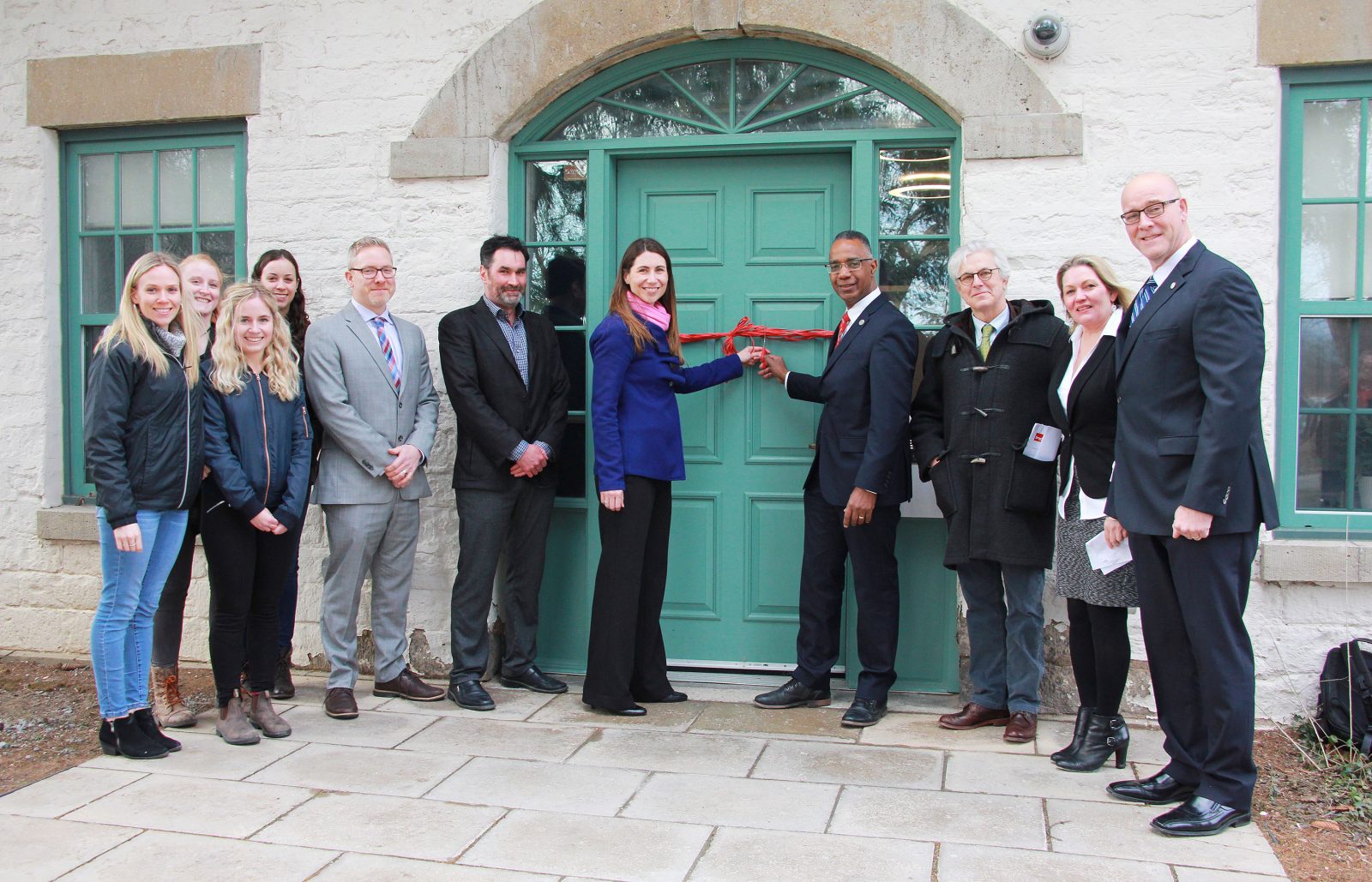
    Unveiled during a ribbon-cutting ceremony Wednesday, Feb. 28, the revamped space features sustainable flooring and furniture, as well as an integrated system that controls heating, cooling and lighting, and monitors real-time energy use for the entire campus.

    Environmental Sustainability Research Centre Director Ryan Plummer, left, reads over a new project charter with Tom Dunk, Interim Provost and Vice-President, Academic, and Brian Hutchings, Vice-President, Administration. The agreement will see the ESRC work with Brock’s Facilities Management team on upcoming sustainability initiatives.

    LED lighting has also been installed throughout the heritage building, with dimmer and daylight harvesting switches in place to reduce energy consumption.

    In addition to highlighting the space, Wednesday’s ceremony was an opportunity to solidify a new collaboration between the ESRC and Brock’s Facilities Management team. The collaboration is enshrined in a formal charter that brings together the academic and operations units on various sustainability initiatives on campus. It is also an important step forward for Brock’s new integrative approach to environmental sustainability, and deepens the University’s commitment to sustainability — one of the seven core values listed within its strategic plan.

    Also announced Wednesday was $5,000 in new scholarship funding provided by Toromont CAT that will support students studying sustainability.

    Professor and ESRC Director Ryan Plummer said the partnership signals a new era in the University’s journey to be a national leader in sustainability.

    “The charter enables rich opportunities for experiential education relating to environmental sustainability, and the scholarships recognize as well as support excellence in this area of study,” said Plummer. “They will have a profound and positive impact by enhancing student experience, promoting innovative approaches for learning excellence and furthering engagement with sustainability.”

    Brock has been dedicated to improving energy and operational efficiency on campus with dozens of energy projects and green initiatives completed over the years, said Scott Johnstone, the University’s Associate Vice-President, Facilities Management.

    “Moving forward, we want to further our partnership with staff, students, faculty members and the larger Brock community to enhance, challenge and maintain a campus culture of sustainability.”

    Sean Goodman and Ron Cocking, of Toromont CAT, presented Scott Johnstone, Brock’s Associate Vice-President, Facilities Management, and Ingrid Makus, interim Dean of the Faculty of Social Sciences, with $5,000 to support students in sustainability programming at Brock.

    Hands-on experiential learning opportunities that contribute to sustainability at the University will be made available to students through co-op placements, research assistant opportunities, independent research and course-based projects.

    This week’s announcements reinforce the University’s values around sustainability, while also taking into consideration Brock’s role in a global context, said President Gervan Fearon. “We’re part of the broader ecosystem and as such, we need to think about the impact our footprint has and what our actions in support of sustainability mean.”

    Brock recognizes its distinction as one of only a few universities within a UNESCO World Biosphere Reserve and intends to continue pushing forward with its environmental sustainability initiatives, he said.

    Brock’s programs concentrating on sustainability are growing quickly. The Master of Sustainability program was introduced in 2014 and continues to receive considerable uptake from across Canada and around the world. In 2017, the ESRC launched the Minor in Environmental Sustainability and early signs suggest it is following a similar positive trajectory.

    Theal House is now the home of Brock’s Environmental Sustainability Research Centre.


    Story originally published in The Brock News

    Categories: Sustainability, Sustainability at Brock

  • A greener Brock taking shape

    You may have noticed them buzzing about campus over the past few months.

    Two new Brock-branded electric Smart cars have been added to the Facilities Management fleet, contributing to the University’s efforts to reduce carbon emissions.

    Brock has a number of initiatives on the go as work continues to achieve a goal of reducing carbon emissions by 20 per cent between 2013 and 2023.

    Scott Johnstone

    Scott Johnstone, Interim Associate Vice-President of Facilities Management, stands in front of Brock’s cooling system.


    The Smart cars replaced supervisor vehicles — one van and one SUV — previously driven around campus. The two-year-old electric cars, each with minimal kilometres, were purchased for $10,000 each. In comparison, vans previously added to the fleet were each more than double that cost.

    “We get about a week and a half on one charge just moving around campus, avoiding fill-ups at the gas pumps,” said Scott Johnstone, Interim Associate Vice-President of Facilities Management.

    “It means significant carbon savings.”

    The University sought out green options when replacing the fleet vehicles and the cars have proven to be a benefit since their introduction two months ago.

    “Our goal is to work toward carbon neutrality over time,” Johnstone said, calling the Smart vehicles a step in the right direction. “We’re trying to cut down on burning fossil fuels as much as we can.”

    The University is also midway through its $10.8-million District Energy Efficiency Project (DEEP), which is scheduled for completion by the end of April 2018.

    The project is funded by the federal and provincial governments, through the Strategic Investment Fund and Facilities Renewal Program respectively.

    The DEEP project includes an upgrade to Brock’s co-generation plant and satellite utility areas that will allow the University to reduce its carbon emissions by 15 per cent. The plant produces electricity, heating and cooling for main campus research laboratories, teaching spaces and supporting infrastructure.

    That reduction is a “huge step” toward Brock’s 20 per cent reduction goal, Johnstone said.

    The DEEP project will replace more than 50 per cent of the natural gas power co-generation engines and controls with state-of-the-art, high efficiency, electronically controlled units.

    Also replaced with a high-efficiency model will be the University’s 25-year-old absorption chiller, which will increase cooling capacity and save more energy.

    The new technology will significantly reduce Brock’s greenhouse gas emissions, while saving utility costs and reducing maintenance costs.

    It’s also expected to free up funds that can be put toward other energy saving initiatives and deferred maintenance projects.

    Brock is currently exploring solar and wind power options for the future.

    Story from The Brock News

    Categories: Sustainability, Sustainability at Brock

  • Grand opening set for new cycling path near Brock

    Travelling to Brock by bike or on foot just got a bit easier — and a lot safer.

    Work on the new Decew and Merrittville multi-use pathway has been completed, providing a safe route to get to the University from one of the most popular off-campus residential neighbourhoods.

    Last year, the Government of Ontario, City of Thorold, Niagara Region and Brock University announced a partnership to build a network of bike lanes and paths that would stretch from the Confederation Heights neighbourhood to the Brock campus.

    The announcement followed lobbying efforts by the Brock University Students’ Union for improved cycling infrastructure near campus.

    The first phase of the project began in 2016 with Decew Road reconstructed from Richmond Street to Merrittville Highway. Work continued this past April with a multi-use path and improved lighting installed on the highway between Decew Road and Sir Isaac Brock Way.

    An officially opening for the new pathway will be held Wednesday, July 19 at 3 p.m. outside of Niagara Region headquarters — on the southeast corner of Sir Isaac Brock Way and Merrittville Highway. The ceremony will be followed by a bike ride for cyclists of all ages. All are welcome to attend.

    Active transportation, such as walking or cycling, is a healthy way for the large population of Brock students and employees living in Thorold to commute to campus, said Elizabeth Yates, a liaison librarian at Brock, who is also a member of the Thorold Active Transportation Advisory Committeethat advocated for the path project.

    “Before this pathway was built, walking or riding along Decew and Merrittville felt unsafe due to large volumes of traffic, with vehicles sometimes travelling over the speed limits,” she said. “Poor nighttime lighting was another concern.”

    As a cyclist and advocate for active transportation in the community, Yates was impressed to see so many partners come together to show their support for an initiative that “promotes healthy commuting and makes our area safer for everyone.”

    Story from The Brock News

    Categories: Sustainability, Sustainability at Brock

  • Brock launches Green 2 Go re-usable container program

    Brock Hospitality Services is, quite literally, going green.

    A new program aimed at diverting waste and making the food services at Brock more environmentally friendly launched Monday.

    Through the new Green 2 Go program, anyone purchasing food from Guernsey Market, The Hungry Badger in Walker Complex or either the DeCew or Lowenberger residence dining halls will have the option of using a re-usable plastic container.

    Initially, customers will have the option of having food servers put their food into one of the green 6”x9” containers. When they go to a cashier to pay, they’ll be charged an extra $5 fee for the container, which can then be taken anywhere by the customer. When they’re finished with it, the container can be returned dirty to any of the four participating dining areas, where they’ll receive a Green-2-Go card, which can be handed to a food server to get a new container.

    “In the past, we couldn’t do this because people had to clean the containers themselves,” said Iain Glass, Director of Hospitality Services. “Now, we can put these containers into our industrial dishwashers to be cleaned an sanitized.”

    The containers seal tightly so they won’t spill, and they keep food warm longer than a typical take-out container.

    Glass said they can be washed about 800 times before needing to be recycled and replaced with a new one.

    For now, only one type of container is being offered, but a screw-top soup container is also being developed and will be added if the program takes off.

    For more information on Brock’s sustainability initiatives or the Green 2 Go program, visit brocku.ca/hospitality-services

    Story from The Brock News

    Categories: Food, Sustainability, Sustainability at Brock, Waste

  • Keeping Brock green makes for a busy tree planting program

    From The Brock News

    It was hard not to notice the row of honey locust trees in front of Taro Hall being removed in October to make way for the $24-million expansion of Brock’s Goodman School of Business.

    Less obvious, however, is the plan that had long been in place to replace them with even more new trees around campus.

    In the past two years about 155 new trees have been planted by the Brock grounds crew, an initiative that can be traced to the construction of the Cairns Family Health and Biosciences Complex, said John Dick, Manager, Ground Services.

    “When Cairns came along, we had to remove trees, but we planted way more trees than we removed,” said Dick. “They haven’t necessarily gone back in the same spot, but we’re planting mostly native trees and placing them in locations where they will thrive well into the future.”

    One of the challenges for Grounds Services is finding appropriate spots that will allow the trees to mature properly. Many areas have pipes and other obstructions that complicate the issue of digging and planting.

    “Sometimes you wonder why there’s a spot that doesn’t have trees, but there are a lot of underground services that prevent them being planted there,” said Dick, who added that maintaining a balance with wide open areas on campus is also important.

    Another issue crews have been dealing with for the past year or more is removal of dead or dying ash trees, as the relentless emerald ash borer insect continues to devastate those native hardwoods.

    “All of Niagara is affected. There are some treatments but they’ll only work for the short term. Most of (Brock’s ash trees) are showing signs of having the insect. There are a number of young trees that haven’t been affected yet, so the hope is they may outlive the insect,” said Dick, adding that most of Brock’s ash trees were fortunately not of significant size or age.

    As ash trees are removed, they’re replaced with a wider variety of species.

    “We try to add tree species to keep our diversity going,” said Dick, “so that we don’t have the same problem in the future.”

    Categories: Sustainability, Sustainability at Brock

  • Brock biologist featured in book on influential environmentalists

    From The Brock News

    Brock University biologist Liette Vasseur is featured in a recently published book profiling women environmentalists around the globe.

    “I was honoured, almost scared; I was so surprised,” Vasseur says of appearing in the book Citoyennes de la Terre (Women Citizens of the Earth), a collection of profiles complied by Florence Piron, a professor in the Department of Information and Communication at Laval University in Quebec.

    Vasseur was noted for a variety of accomplishments, including her work with the International Union for Conservation of Nature (IUCN)’s Commission on Ecosystem Management, being President of the Canadian Coalition of Women in Engineering, Science, Trades and Technology (CCWESTT) and president-elect of the International Network of Women Engineers and Scientists.

    She also holds a UNESCO Chair in Environmental Sustainability and is a member of Brock’s Environmental Sustainability Research Centre. She has research partnerships with a variety of Canadian and international governments and organizations.

    Vasseur is noted for her research on communities’ responses to climate change impacts and managing ecosystems in coastal and forested areas, taking her to such places as Burkina Faso and China.

    “Who would have thought that this little country girl, who loved to draw animals and help out her florist father, would one day become this accomplished woman who has contributed so much to research on climate change and sustainable development?” writes profile author Vincent Leboeuf Gadreau.

    “Who would have thought that her passion for the environment and communities would one day lead her to work with leading scientists on the other side of the planet and influence changes to environmental policies?”

    In the book, Vasseur joins such notables as Jane Goodall, Rachel Carson, Nobel Peace Prize winner Wangari Maathai and Canadian politician Elizabeth May.

    Categories: Sustainability, Sustainability at Brock

  • Brock, Australian university sign agreement on sustainability research

    Story from The Brock News

    Brock University has signed an agreement with the University of the Sunshine Coast (USC) in Australia that will enable Brock students to pursue a PhD in sustainability at USC.

    The memorandum of understanding (MOU), signed March 14 by Brock Professor and Environmental Sustainability Research Centre (ESRC) member Gary Pickering and the Director of USC’s Sustainability Research Centre Tim Smith, formalizes a long-running research relationship between Brock and USC in the areas of global change, sustainability and resilience.

    For several years, USC has offered a transdisciplinary PhD program in sustainability that synthesizes research in the social, economic and behavioural sciences to address environmental and societal concerns.

    This new agreement will allow researchers from Brock’s ESRC to supervise students in the sustainability PhD program, and give students the opportunity to study in Australia and Canada.

    “The ESRC is tremendously excited to sign this MOU with USC. It will allow for deeper research partnerships between Brock and USC and it will bring doctoral students into the Centre who can contribute to its burgeoning research culture. This is a great step forward in the development of the ESRC,” says ESRC director Tim Heinmiller.

    “This MOU builds on existing, high impact research collaborations between the Sustainability Research Centre at USC and the ESRC at Brock. All involved intend this to be a very active MOU, and together help build the capacity in our young researchers and scholars to meet the global challenges in sustainability that we face,” adds Pickering.

    To strengthen this new partnership even further, USC has established a new PhD scholarship in Social Dimensions of Global Change. Under the MOU, Brock students can apply for this scholarship, which will cover tuition, living, and travel expenses.

    USC is offering one scholarship for this program. The deadline is April 29. For more information click here.

    To learn more about the PhD program click here.

    Categories: Sustainability, Sustainability at Brock

  • Brock University commemorates Earth Hour through words and action

    From The Brock News

    In the lead-up to this weekend’s Earth Hour, Brock University is actively promoting the concept of environmental conservation to our youth – by word and example.

    Biology professor and UNESCO Chair on Community Sustainability Liette Vasseur is fresh off the heels of a live stream session that she delivered to high school students across Canada. Her lesson explored the inter-relationship between climate change and agriculture sustainability.

    Vasseur also supervises graduate students’ research on teaching environmental concepts to children in homeschools and elementary and secondary schools.

    “High schools need to have a course – or at least a half-course – on protecting the environment and sustainability,” says Vasseur, adding that this basic education can lead to more awareness and action down the road.

    At the university level, Brock has increased its “diversion rate” to 68.5 per cent in 2015.

    “That means that 68.5 per cent of materials we generated ended up not going to the landfill because of our Blue Bin recycling and organic waste collections,” says Domenic Maniccia, director of Custodial and Grounds Services.

    “It’s a collective effort between staff, faculty, students, food services, residence; everybody has a stake in it,” he says, adding that Brock University is among the Top Five environmentally sustainable universities in Ontario with respect to waste diversion.

    In addition, Brock University will be taking a number of measures to commemorate Earth Hour, which this year will take place from 8:30 p.m. to 9:30 p.m. March 19. These include:

    • Parking Lots T, U, V in Zone 2: lights out (Zone 2 permit holders will be able to park in Zone 1 from 4 p.m. on March 19 as a result of lights out in Zone 2)
    • …. click here to continue reading this story.
    Categories: Sustainability, Sustainability at Brock