The Goodman School of Business is a globally oriented and community dedicated business school. Our school provides a conduit between the local and global community, generating opportunities which bring together Niagara and the world.
The Business School Impact System (BSIS) is an assessment process that is designed to determine the extent and nature of a business school’s impact upon its local environment. The process is well established in the French higher education sector and is now offered through a joint venture between the French National Foundation for Management Education (FNEGE) and European Foundation for Management Development (EFMD) Global Network. Goodman is the third Canadian business school to undertake this analysis.
As part of receiving the BSIS label, the Goodman School of Business:
- Defined the primary impact zone for the purposes of this analysis. Goodman’s primary zone is the Niagara region and the extended impact zone is the Golden Horseshoe region of Ontario, although the School’s impact and influence spreads across Ontario and beyond.
- Hosted a three-day virtual visit by a team of experts. The team interviewed key individuals from across the Faculty and University as well as external stakeholders.
- Has committed to a formal three-year development plan that will act on areas of future development to further increase the school’s impact both locally and globally.
During the process, the School’s internal perceptions are compared to external expectations and the gap between the two is assessed. BSIS experts then draft a report setting out the findings related to the assessment framework, the School’s input, as well as input from the interviews undertaken. The report highlights areas where the impact of the Goodman School of Business is strong, while also helping the School identify areas where it may be enhanced or expanded in the three-year development plan.
Financial Impact

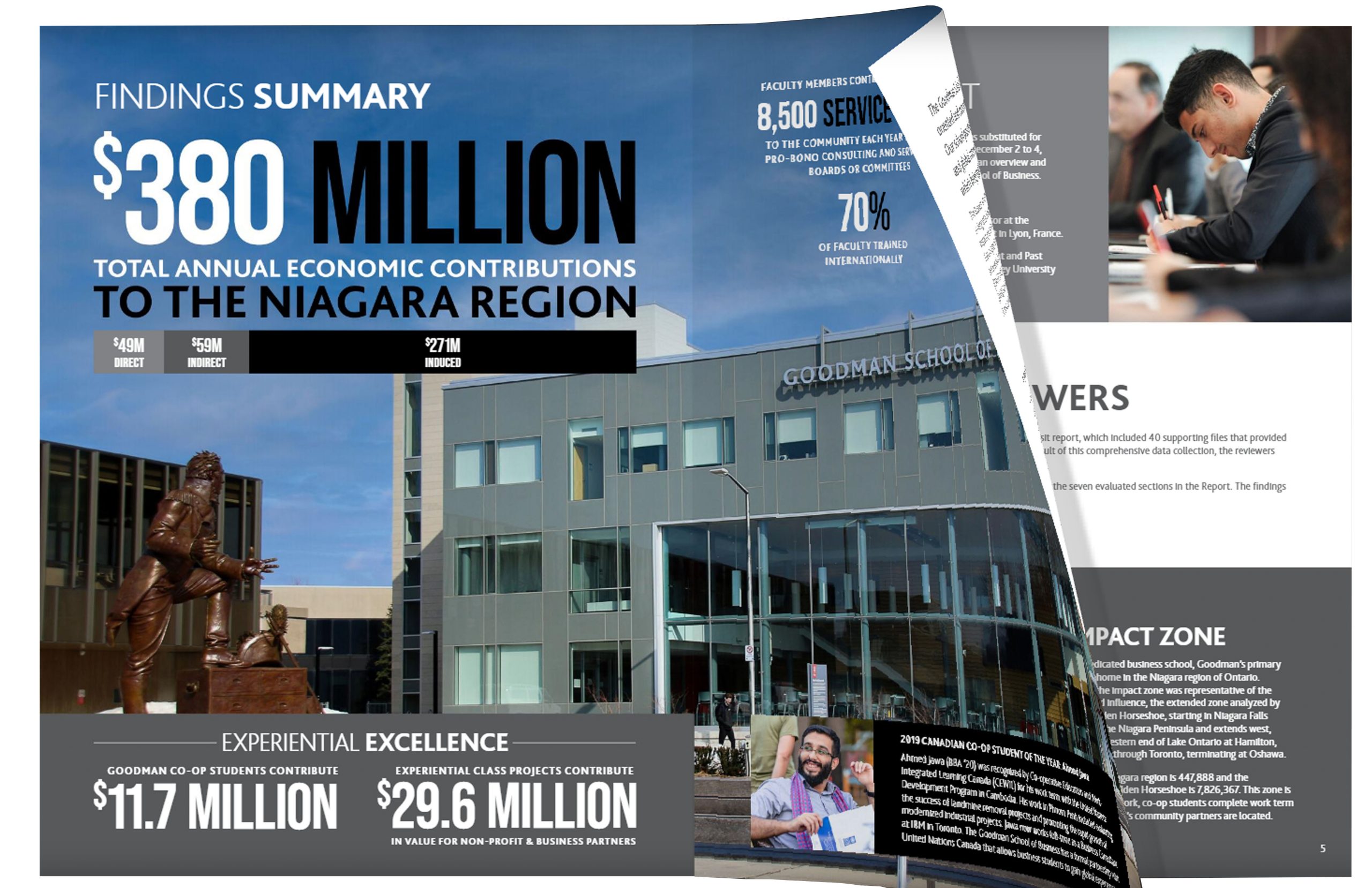
The review process used quantifiable statistical data to calculate both the direct and indirect impact on the region by looking at the money spent in the region by the School, by its salaried employees, by its students and all the people who come to the campus in relation with the School’s activities.
The impact was calculated based on data for the period of May 1, 2019 to April 30, 2020 and examined the impact on the Niagara economy (primary impact zone).
To assess the induced financial impact of the School, the evaluators used “the multiplier effect”. The multiplier depends on the proportion of expenditures that involve local agents. In BSIS reporting, the expert evaluators considered the multiplier effect for the School to be around 2.5 which is the average multiplier used for business schools in different countries. It supposes that around 70 per cent of the expenses are re-injected into the local economy.
The BSIS evaluators have used the same process of calculating economic impact to evaluate more than 50 business schools around the world.

Our Impact Zone

As a community dedicated business school, Goodman’s primary area of impact is its home in the Niagara region of Ontario. However, to ensure the impact zone was representative of the School’s activities and influence, the extended zone analyzed by BSIS includes the Golden Horseshoe, starting in Niagara Falls at the eastern end of the Niagara Peninsula and extends west, wrapping around the western end of Lake Ontario at Hamilton, then heading northeast through Toronto, terminating at Oshawa.
The population of the Niagara region is 447,888 and the population of the core Golden Horseshoe is 7,826,367. This zone is where Goodman alumni work, co-op students complete work term placements and the School’s community partners are located.
The Goodman School of Business at Brock affirms its place among world’s best business programs with accreditations and designations conferred by many prestigious domestic and international business associations.

