The following is a blog related to the organic science cluster 4 project: Promoting an Integrative Landscape Approach in Vineyards for Greater Resilience in the Face of Climatic and Environmental Changes. Follow along with updates as the project progresses, and learn more about the research HERE.
By: Matt Summerville
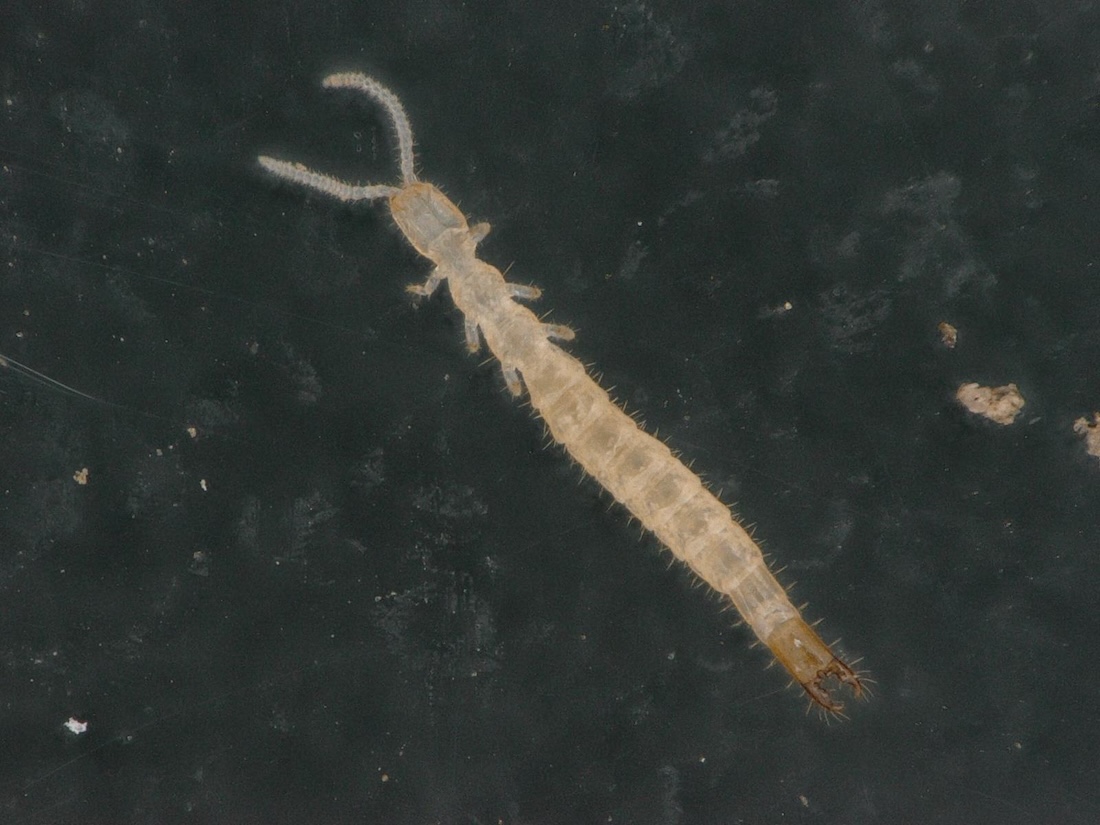
Have you ever wondered what scientific discoveries lie right under our feet, just waiting to be found? Researchers at Brock University believe they have rediscovered an organism that hasn’t been seen in almost 50 years in soil from Niagara organic vineyards. The organism, which has yet to be assigned to a species, is an arthropod, meaning it has a segmented, external skeleton and is related to other arthropods such as insects, spiders, and centipedes. Japygidae is an understudied clade comprised of organisms that are not quite insects that are classified separately due to their mouthparts being tucked inside their head (whereas insects have them externally).
Japygids look like they could be from a sci-fi film, generally elongated, pale, and eyeless. They also sport a pair of pincer-like appendages at the end of their body which they utilize for catching prey. That trait that lends them their common name: the forcepstails. The main reason you won’t see japygids hit the big screen any time soon is because of their small size; they are generally only between three to 60 millimetres in length.
Master’s student Matthew Summerville (under the supervision of Dr. Liette Vasseur) was counting arthropods in the soil as part of his thesis project on vineyard ecosystems, when he noticed a near microscopic piece of the unknown organism floating around in the petri dish. At first, all that could be found was just the end of the abdomen, with hallmark claspers (formally referred to as cerci). Since it was unlike anything Matthew had seen previously, he uploaded a photo of the segment to the citizen science app iNaturalist. The app allows users to upload photos of living organisms they observe to be identified, with the added caveat that scientists such as ecologists and taxonomists can utilize data from the app for their research. In less than an hour, a student at Universite de Montreal, who studies soil organisms like japygids, had added an identification to the photo.
They commented: “Incredible. This is the unidentified japygoid dipluran species reported from southern Ontario in 1979 and still unidentified since then. Do you have any material in better condition? This is a very valuable record.”
Matthew was hooked, and quickly got to work in the lab looking for an entire specimen. It wasn’t until three days later, after looking through multiple soil samples, that he finally found an intact specimen. Then another. Then another. Since then, more than twenty specimens have been obtained from three organic vineyards in the Niagara Region (two in Lincoln and one in Niagara-on-the-Lake).
In 1978, two researchers, Tomlin and Nagy, published in the Proceedings of the Entomological Society of Ontario that they had discovered a japygid in soil at two sites in the province, Essex County and Jordan Harbor. It is believed that the japygid rediscovered by Matthew Summerville in Dr. Vasseur’s lab may be the same species as the specimens found by Tomlin and Nagy. The weird part of the story is that Tomlin and Nagy never ended up following up on their scientific footnote about what they believed to be a new species of japygid.
Stay tuned for the confirmation!
Tomlin, A. D., & Nagy, B. (1978). First report of Japygidae (Insecta: Diplura) for Ontario.