Contributors: Kim Duffin
The following is a blog related to an event as part of the organic science cluster 4 project: Promoting an Integrative Landscape Approach in Vineyards for Greater Resilience in the Face of Climatic and Environmental Changes. Follow along with updates as the project progresses, and learn more about the research HERE.
Knowledge mobilization is the movement of knowledge into active use (Green, 2008). It is our goal to ensure that our research is useful to community partners, policy makers, governments, institutions, and individuals and families. The transfer of knowledge to these users is an important component of our research. Knowledge mobilization is a means rather than end. The goal is not to only distribute the knowledge, but to share it is such a way that it is easily accessible, useful and ultimately used.
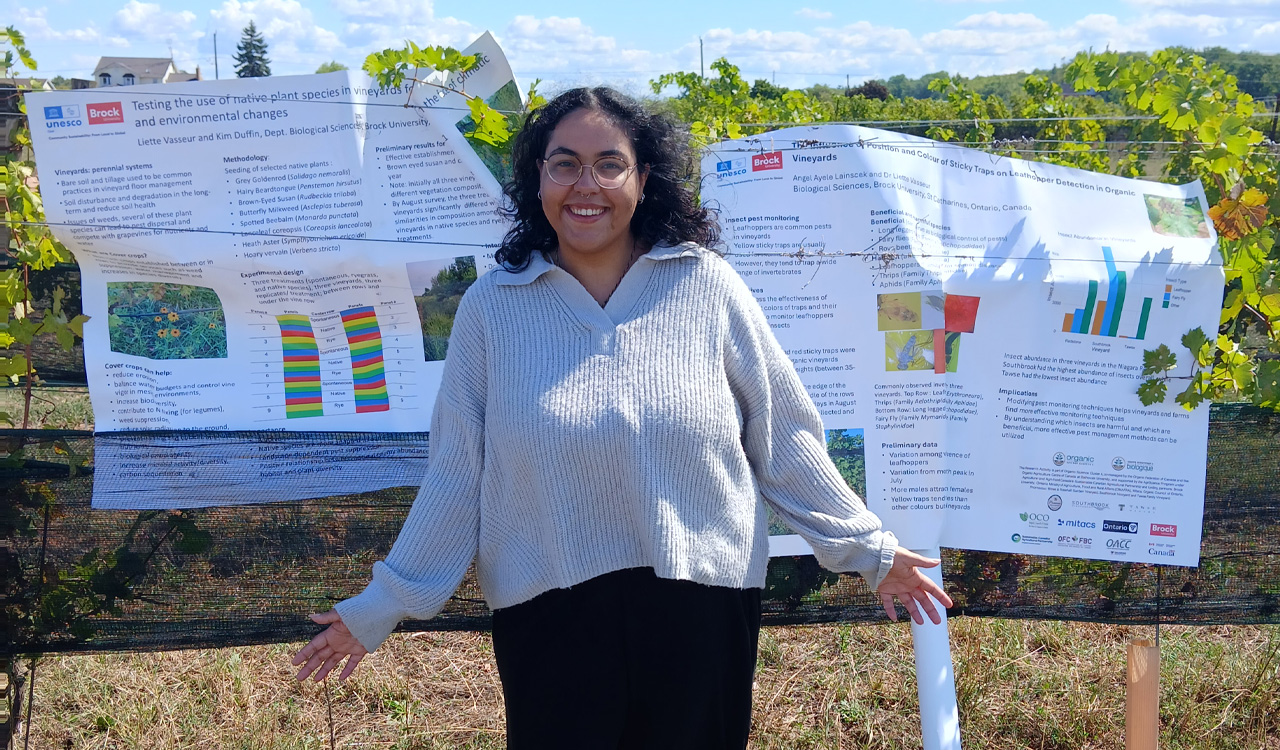
For these reasons, we were excited to be part of the Grape Tailgate Tour led by Dr. Wendy McFadden-Smith from OMAFA this past summer where attendees got the chance to learn about the latest viticultural research in Niagara. Dr. Liette Vasseur’s team was on hand at Redstone Winery to share updates on the ongoing research on native plant species as cover crops in vineyards. Angel Lainscek, a research assistant in Dr. Vasseur’s lab shared with farmers how native species have been found to help increase beneficial invertebrate populations as a means of biocontrol and how this theory is currently being tested in three vineyards in the Niagara Region. Coloured pieces of sticky traps are placed in the vineyards over the past two summers at different positions and using different colours.
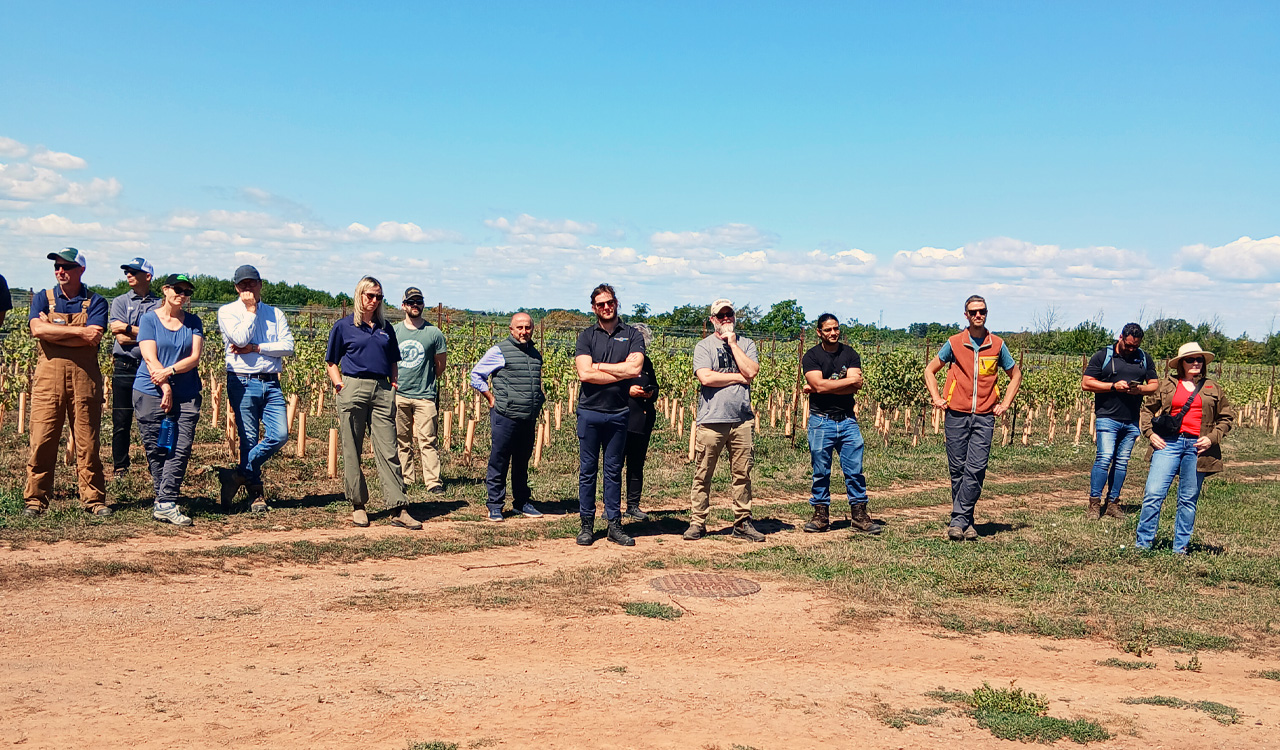
Dr. Liette Vasseur’s research team was on hand at Redstone Winery to share updates on the ongoing research on native plant species as cover crops in vineyards.
The experiment highlights the importance of specialized monitoring approaches. Differences were observed when analyzing each vineyard as a whole compared to analyzing the two sampled rows within each vineyard separately. Each assessed parameter revealed significant differences in leafhopper populations at least once. The 2025 summer data are currently being analyzed. Participants of the Grape Tailgate Tour got the opportunity to ask questions regarding this research and all seemed to agree that this new and useful research on pest management has the potential to make a big impact on grape production. A robust discussion of the environmental benefits of this type of pest management ensued with many farmers contributing their own experiences and how they might use this information in their vineyards. As part of the knowledge mobilization team, I was delighted to witness the collaborative efforts of the research team and all of the attendees to develop ways in which this research will be put into action.
A sincere thank you to Dr. Wendy McFadden Smith for providing this opportunity for researchers and end users to connect and collaborate. This “in the field” event where researchers hear from farmers and other community members/partners goes a long way to not only ensuring the research addresses issues that are relevant to the end users but will provide a clearer path to ensure implementation of research findings and recommendations.
*Green, L.W. (2008). Making research relevant: if it is an evidence based practice, where’s the practice-based evidence? Family Practice, 25.
