The following is a blog related to the organic science cluster 4 project: Promoting an Integrative Landscape Approach in Vineyards for Greater Resilience in the Face of Climatic and Environmental Changes. Follow along with updates as the project progresses, and learn more about the research HERE.
By: Andrea Hebert
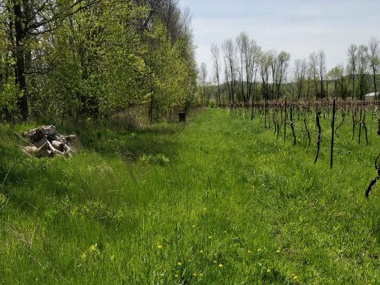
Niagara is the largest grape growing jurisdiction in Ontario, making it no surprise that land use in the region is dominated by viticulture. Driving through Niagara’s wine country, you are likely to see many vineyards in close proximity to one another, with properties often separated by fence-like rows of vegetation known as perimeter plantings.
Wine country is a crucial part of the local community and economy, but vineyards remain vulnerable to extreme weather events and pest pressures. As monocultures, vineyards are poor in local plant diversity and lack the resilience of naturally occurring ecosystems. Landscape features, together with chemical use practices, are known to influence the structure of ecological communities in agricultural systems. Landscape simplification of industrial agriculture has been a major contributor to biodiversity loss on a global scale.
This lack or diversity leads to reduced ecosystem services. Which brings challenges such as pest control, water quantity and quality, soil compaction and erosion, and weed competition. Many agricultural pest species have evolved to feed on a narrow range of plant species and have adapted to locate and colonize crops in simplified habitats rather than complex ones. This has led farmers to rely heavily on the use of synthetic pesticides to protect their livelihoods, but this approach comes with its own pitfalls.
As climate change persists, these agricultural systems struggle with pest resistance and further biodiversity loss, bringing into question their long-term viability. Organic vineyards (a less popular management system in the region) rely on a sustainable approach, focusing on enhancing biodiversity and avoiding the use of synthetic chemicals for pest control and soil management. This approach while minimizing environmental harm, requires innovative management techniques to safeguard its vines. Potential for this innovation lies in the perimeter plantings of the surrounding landscape.
The use of perimeter plantings in agriculture has existed in multiple countries for thousands of years, Notable examples include in Ireland, England, and Portugal, the latter of which has actually had historic practice of integrating vineyards into perimeter forests. Perimeter plantings are often remnants of previous forests, or in many cases, a farmers deliberate choice to plant a vegetative border with an understanding that they have the potential to be valuable elements of the agricultural landscape. Perimeter plantings typically contain greater plant diversity than surrounding crop fields and therefore provide a variety of ecosystem services.
At the landscape-scale, greater proportions of natural vegetation, non-crop land and landscape variety surrounding rural farms have proven to promote the biological control of pests. Increased plant diversity and habitat complexity can regulate pests and pathogens, as well as increasing resistance to invasion. Perimeter plantings support a wider range of primary and secondary consumers, providing food and overwintering habitat for parasitic wasps, predatory beetles, and spiders which all contribute to pest control. These effects can extend several kilometres from a focal field, with plantings containing native species such as flowering trees and shrubs providing the strongest ecological benefit. Managing perimeter plantings can help maintain a functional mix of plant species that can potentially attract beneficial insects while simultaneously minimizing the attraction of pest species.
Beyond pest control, perimeter plantings provide several additional benefits for vineyards. They can serve as protective barriers between properties, filtering the airborne seeds of vagrant species from neighbouring farms and reducing drifting snow during winter storms. They also act as natural buffers that help reduce nutrient and water runoff. The above-ground density of perimeter plantings can also reduce wind damage to grapevines and limit wind-driven soil erosion. Because wind is a major driver of moisture loss, these plantings can also help vineyards retain soil moisture during dry conditions.
While perimeter plantings offer significant benefits, the vegetation within these hedgerows can also present risks if not properly maintained. For instance, protecting and expanding certain landscape elements, targeting specific weeds which may provide habitat for pest species or removing wild grapevines as they can attract the grape berry moth, a common vineyard pest. Understanding which plant species dominate local perimeter plantings and how they influence insect communities is essential. Insights like these can help guide management strategies.
Many factors still need to be explored about the influence of the landscape structure to determine its influence on vineyards and their insect communities. Such as the diversity of land use, spatial arrangement and connectivity between ecosystems can play a major role in our landscape. By putting these pieces together, we aim to support Ontario grape growers in the stewardship of their land, in a way that minimizes harm, promotes a resilient landscape, and offers economic and environmental benefit.
