Articles tagged with: Social Sciences and Humanities Research Council

  • Public showcase to celebrate acclaimed artist Ann-Marie MacDonald’s Brock residency

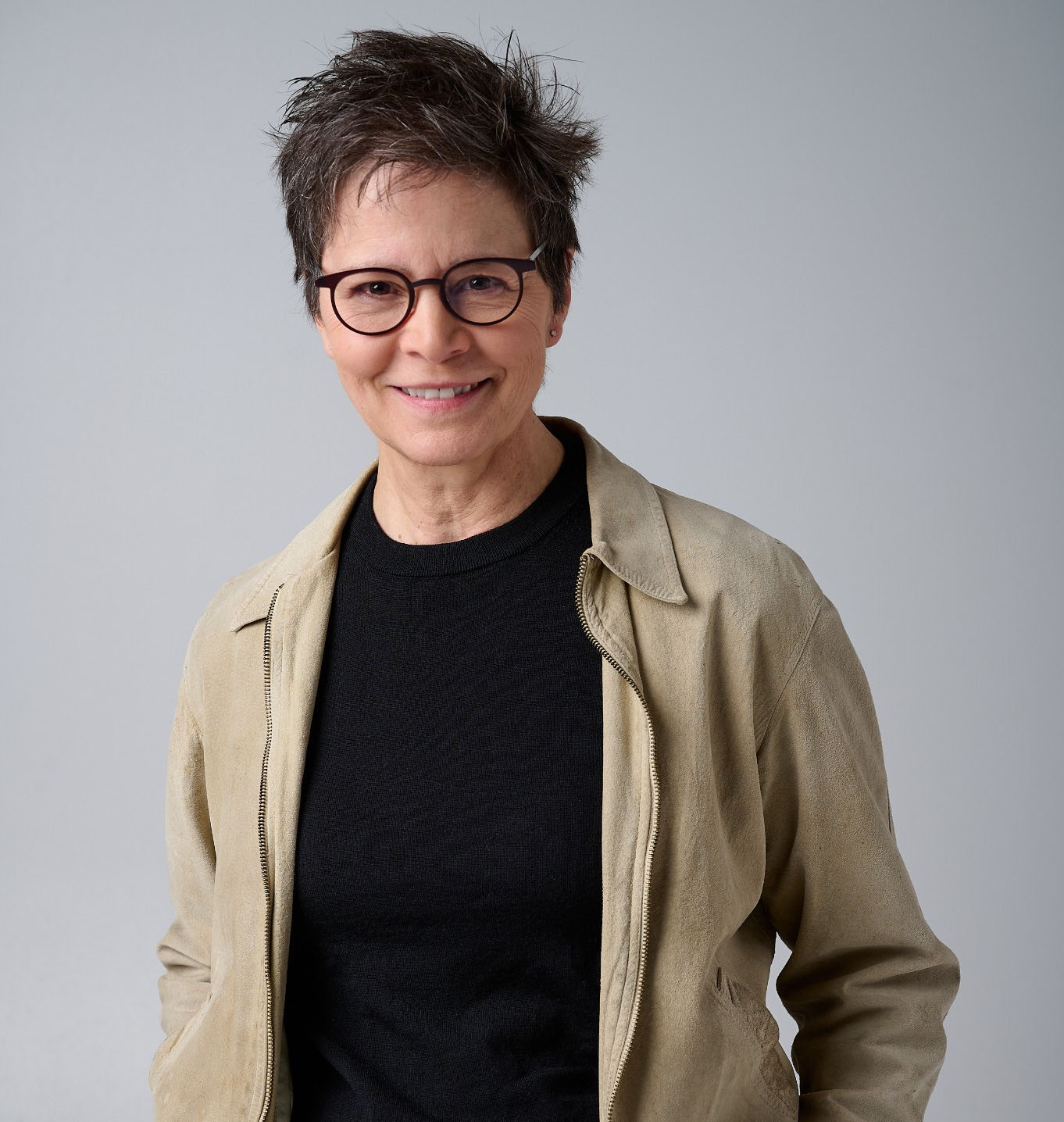
    An upcoming public event will highlight Brock University’s collaboration with celebrated Canadian author, actor and playwright Ann-Marie MacDonald. (Photo Credit: Travis Silverman)

    published Friday, June 5, 2026 in The Brock News | by 

    New Brock University research conducted in collaboration with beloved Canadian author, actor and playwright Ann-Marie MacDonald is poised to change the way readers experience and engage with literature.

    The findings of the Mapping Ann-Marie MacDonald (MAMM) project will be unveiled at a public symposium on Saturday, June 20 that will also give guests a sneak peek of the critically acclaimed Fall on Your Knees novelist’s latest play, Best Soldier, which she’s been developing during her residency with the University.

    Held at the Marilyn I. Walker School of Fine and Performing Arts (MIWSFPA) in St. Catharines, the event will highlight innovative Brock literary learning and theatre creation research while also offering a rare behind-the-scenes glimpse into MacDonald’s creative process.

    MacDonald will perform a reading from Best Soldier, which is still in development.

    MAMM was designed to advance scholarly research on MacDonald’s influential body of work, explore new types of humanities research and promote collaborative student learning across academic disciplines.
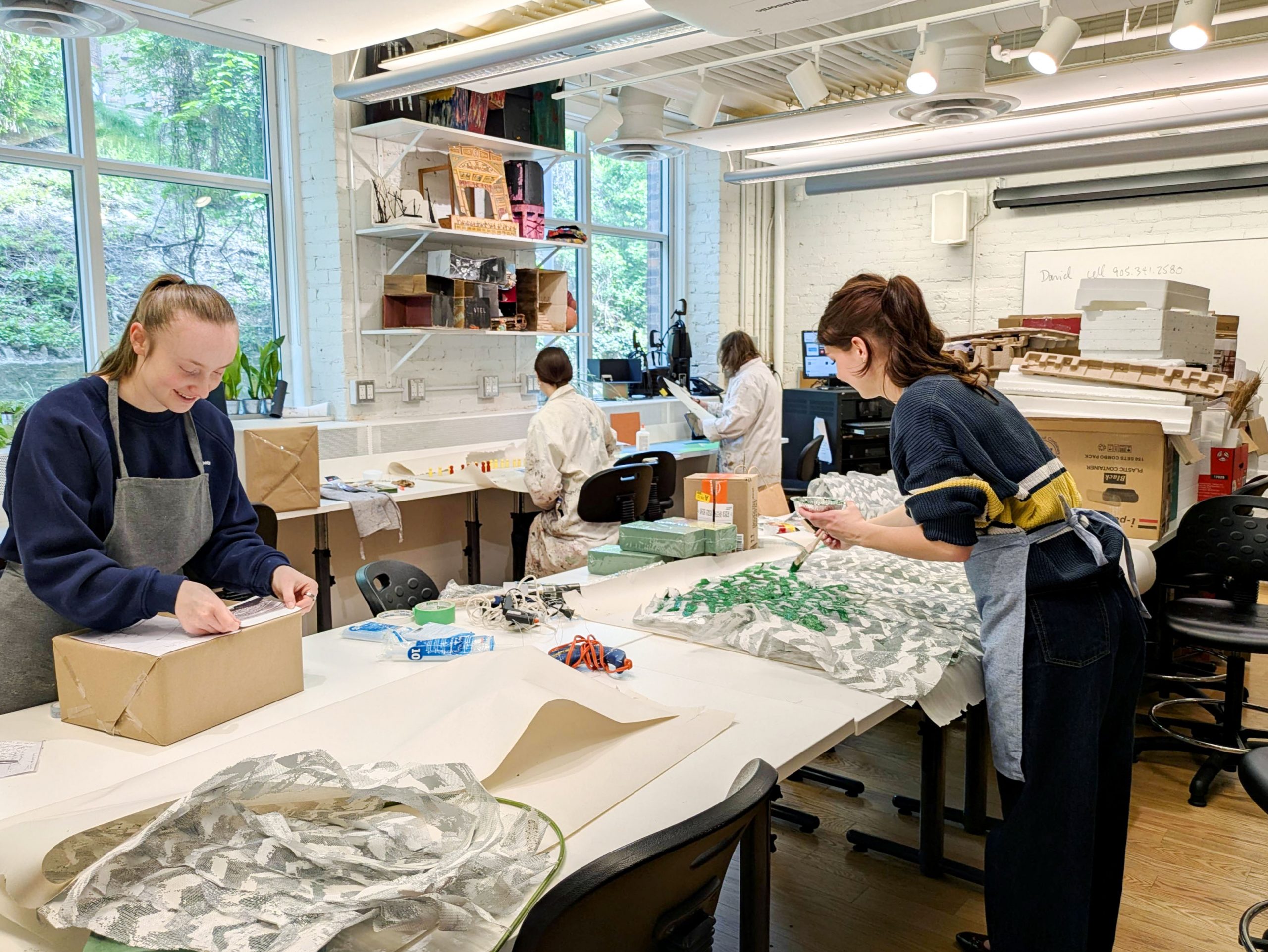
    Brock University research assistants working on the Mapping Ann-Marie MacDonald (MAMM) project put finishing touches on a 3D map for the upcoming MAMM Symposium. From left are third-year English Language and Literature student Riley Campbell, Brock Digital Humanities graduate Paige Wolf (BA ’25), third-year English Language and Literature student Sloane Gray and Social Justice and Equity Studies master’s student Emily Mills.

    Co-led by Neta Gordon, Professor of English Language and Literature, and Aaron Mauro, Chair and Associate Professor of Digital Humanities, the interdisciplinary team also includes Ebru Ustundag, Associate Professor of Geography and Tourism Studies, and Tim Ribaric, Scholarly Publishing and Platforms Librarian, as well as student research assistants.

    The team was driven to explore how MacDonald’s work helps people understand their connections to places, communities and other people.

    Gordon is thrilled to share insights gained during MacDonald’s three-year research involvement at Brock, especially on how the author’s accessible way of questioning political and cultural ideas can inspire new approaches to academic research.

    “In putting together an interdisciplinary team of senior and junior researchers and working collaboratively to make decisions, the MAMM project highlights how new ways of thinking can emerge out of relationships and community building,” she said.

    MacDonald said the project “represents something new. A synthesis. A tool for critical analysis, and a portal to the mysteries of imagination and creative process.”

    The symposium will also celebrate MacDonald’s tenure as Brock’s 2026 Walker Cultural Leader, which launched in January with an excerpt reading of Best Soldier by the playwright.

    Over the past six months, MacDonald has worked with the Department of Dramatic Arts (DART) to deliver student workshops offering valuable insight and perspective on developing artistry and creative voice in relation to theatre creation.

    “DART students have had an exceptionally rare opportunity to apply techniques Ann-Marie has taught them in their own play development projects, while observing how Ann-Marie’s own work on Best Soldier has evolved during her residency as Walker Cultural Leader,” said DART Chair and Professor Jennifer Roberts-Smith. “It’s been an inspiring few months.”

    The MAMM symposium program will feature research poster presentations, a 3D map in the MIWSFPA lobby, digital exhibitions showcasing virtual literary maps and live demonstrations run by the research team.

    Faculty and student researchers will formally present their findings to the public from 11 a.m. to noon. MacDonald’s reading from Best Soldier will take place from 1:30 to 3:30 p.m., including time for audience questions. Following the reading, Roberts-Smith will facilitate a discussion with MacDonald and Canadian theatre artists Alisa Palmer and Rebecca Harper.

    The public symposium is free to attend, but tickets must be reserved ahead of time on Brock University Tickets.

    The MAMM project was supported by a Government of Canada Social Sciences and Humanities Research Council Insight Development Grant.
    Tags: , , , , , , , , , , , , , ,
    Categories: Announcements, Current Students, Events, Faculty & Instructors, Future students, In the Media, Media Releases, News, Plays, Uncategorised, Visiting Artists

  • Brock co-led team awarded $2.5M for project giving minoritized voices centre stage in transforming theatre education

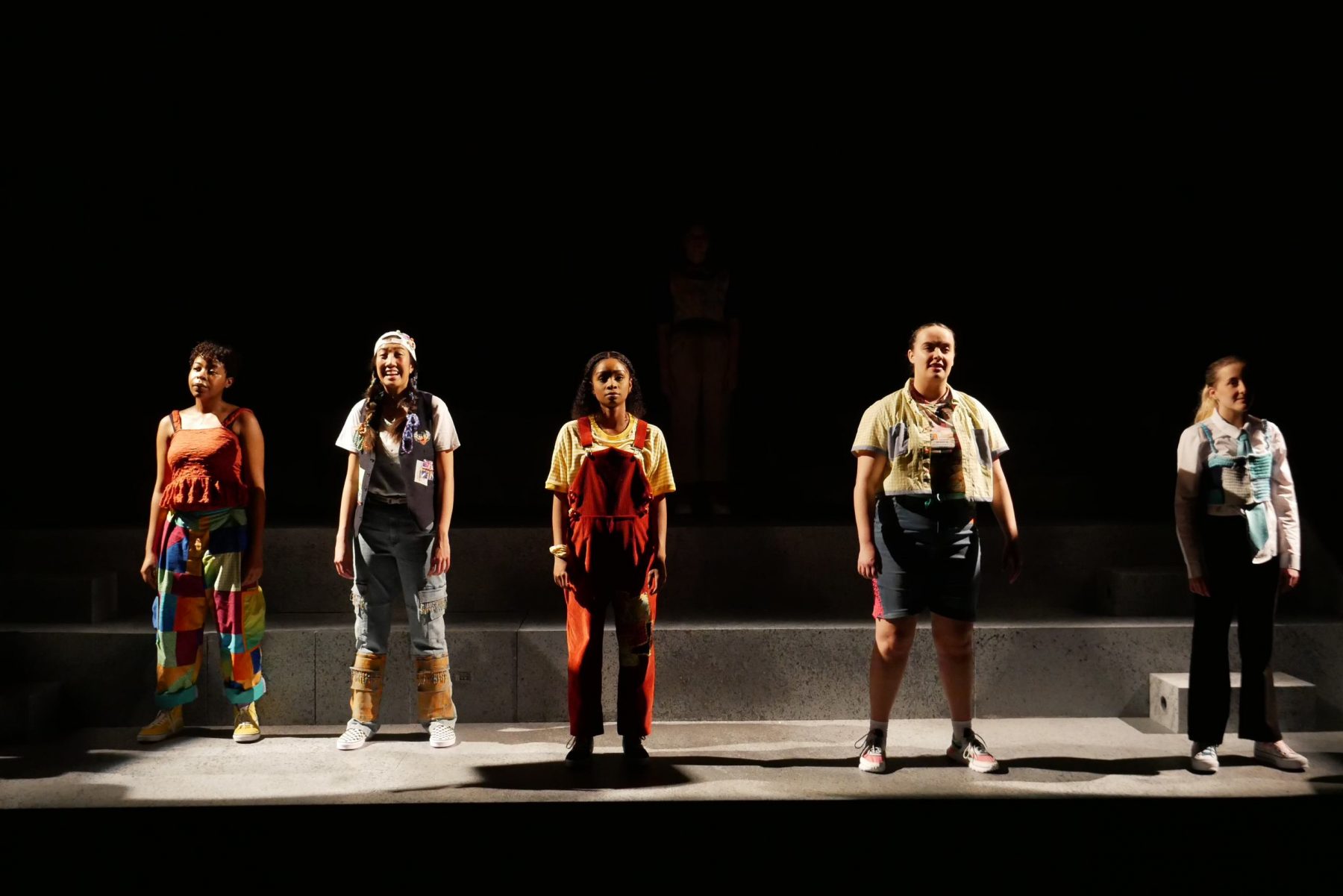
    Pictured above: The cast of Brock’s 2022 Mainstage production ‘Red Bike’ by Caridad Svich, directed by Mike Griffin. Mainstage productions will be among the focus of Brock Dramatic Arts faculty, including Griffin, as they develop more inclusive approaches to teaching theatre as part of the new partnership project, Staging Better Futures/ Mettre en scène de meilleurs avenirs (SBF/MSMA).

    Red Bike, production principale (Mainstage) de l’Université Brock en 2022, écrite par Caridad Svich, mise en scène par Mike Griffin au Marilyn I. Walker Theatre. 

    MONDAY, SEPTEMBER 04, 2023

    Deneh’Cho Thompson, a displaced and dispossessed member of the Pehdzeh ki Nation, became an academic because he wanted others to have a better experience with theatre education than he did.

    Responding to experiences such as Thompson’s, a Brock University co-led research project is putting the spotlight on minoritized voices.

    Staging Better Futures/Mettre en scène de meilleurs avenirs (SBF/MSMA) is the first national, cross-sectoral partnership approach to decolonizing, anti-racist, equitable, diverse and inclusive systemic change ever undertaken in post-secondary theatre education in Canada.

    On Tuesday, Aug. 29, it was announced the project has been awarded a $2.5-million Social Sciences and Humanities Research Council (SSHRC) Partnership Grant. Contributions from partner organizations bring the project budget to more than $5.5 million, with Brock making the largest partner organization contribution of $1.57 million in cash and in-kind contributions over seven years.

    The funding announcement — made by Randy Boissonnault, Minister of Employment, Workforce Development and Official Languages, on behalf of François-Philippe Champagne, Minister of Innovation, Science and Industry, and Mark Holland, Minister of Health — included more than $960 million supporting more than 4,700 researchers and research projects across Canada.

    Jennifer Roberts-Smith, Professor and Chair of Dramatic Arts (DART) at Brock, is co-leader of SBF/MSMA along with Nicole Nolette, University of Waterloo Associate Professor of French Studies and Canada Research Chair in Minority Studies. They observed that while Canadian universities and colleges have been working on local equity initiatives, there is no platform yet for sharing valuable information on providing an equitable and welcoming environment for minoritized theatre students and educators.

    Thompson dropped out of high school and college and took more than 10 years to finish his undergraduate degree because of the systemic racism he experienced. He is now a member of the governance committee on the project.

    Even while he was a student, as interest increased in Indigenous theatre, Thompson found people, including faculty and mentors, looked to him to provide Indigenous expertise.

    But “I was alone,” he said of his time studying in Vancouver. “I didn’t have supports in the university or in my program. I didn’t have anyone I could look up to.” Thompson has since become an Assistant Professor and co-ordinator of the wîcêhtowin Theatre Program at the University of Saskatchewan’s Department of Drama.

    SBF/MSMA’s key areas of focus are racialization; Indigeneity; gender diversity; disability; and linguistic minoritization. The project’s guiding principle is that it centres the voices of students and educators with lived experiences of exclusion, such as Thompson.

    Brock DART students Hayley King and Benoit St-Aubin echo Thompson’s calls for greater representation of faculty from historically under-represented backgrounds in theatre departments.

    “In attempts to sympathize with and accurately represent the experience of Black, Indigenous and People of Colour (BIPOC) students onstage, non-BIPOC individuals fall prone to tokenism and misrepresentation,” said King, who is of biracial Black and South Asian descent. “Having someone in the department with the same lived experiences as these students can serve as a voice for them when injustices are committed.”

    For St-Aubin, who is from the Niagara region and whose first language is French, it’s also important to decolonize curriculum and repertoire.

    “Historically, Canadian theatre has subscribed to Eurocentric ideologies, which has skewed the education we receive,” they said. “By introducing non-Western, non-European theatre practices to students, our department can shape us into well-rounded theatre practitioners and academics.”

    Roberts-Smith said there needs to be a transition “from small-scale solutions within our own institutions to thinking collaboratively about how we do post-secondary theatre education more equitably across Canada.”

    In the course of preparing the grant, the project leaders developed a wide network of collaborators with lived experience of systemic inequity and expertise in combating it. The fully bilingual project now involves more than 90 participants across Canada, with representation from colleges, universities, theatre companies, arts services organizations, a student caucus and a freelance artist-educator consultancy. There are seven Brock faculty members involved in the project, mostly from Dramatic Arts.

    “Receiving this prestigious, highly competitive award is an outstanding achievement,” said Brock University Vice-President, Research Tim Kenyon.

    “The research team’s success demonstrates the need for systemic practices and structures in dramatic arts education to be transformed so that knowledge and expertise from minoritized artist-educators form a core part of the education,” he said.

    The Partnership Grant covers a period of seven years.

    Partnership Grants are the largest that SSHRC offers, supporting formal partnerships between academic researchers, businesses and other partners that will advance knowledge and understanding on critical issues of intellectual, social, economic and cultural significance.

    In addition to the Partnership Grants, SSHRC announced Tuesday that seven Brock researchers were awarded a total $965,636 in Insight Grants, which support research judged worthy of funding by fellow researchers and/or other experts. The University also received more than $4.8 million in funding from the Natural Sciences and Engineering Research Council of Canada for a variety of projects.

    Une équipe codirigée par l’Université Brock reçoit 2,5 millions de dollars pour un projet visant à placer les personnes minorisées au cœur de la transformation de l’enseignement du théâtre

    Deneh’Cho Thompson, membre déplacé et dépossédé de la Nation Pehdzeh ki, est devenu universitaire afin que d’autres vivent une meilleure expérience de l’enseignement du théâtre que la sienne.

    En réponse à des vécus comme celui de Thompson, le projet de recherche, mené conjointement par l’Université Brock, souhaite mettre en lumière les voix des personnes minorisées.

    Staging Better Futures/Mettre en scène de meilleurs avenirs (SBF/MSMA) se veut le premier projet partenarial national et intersectoriel visant un changement systémique à des fins de décolonisation, d’antiracisme, d’équité, de diversité et d’inclusion dans l’enseignement postsecondaire du théâtre au Canada.

    Le mardi 29 août, l’octroi d’une subvention de partenariat de 2,5 millions de dollars du Conseil de recherches en sciences humaines (CRSH) pour ce projet a été annoncé. Les contributions des organismes partenaires portent son budget à plus de 5,5 millions de dollars. La contribution de l’Université Brock est la plus importante, soit 1,57 million de dollars en espèces et en nature sur une période de sept ans.

    L’annonce officiellement a été faite aujourd’hui par Randy Boissonnault, ministre de l’Emploi, du Développement de la main-d’œuvre et des Langues officielles, au nom du ministre de l’Innovation, des Sciences et de l’Industrie, François-Philippe Champagne, et du ministre de la Santé, Mark Holland. Ce financement fait partie d’une enveloppe dépassant les 960 millions de dollars pour soutenir plus de 4 700 projets et équipes de recherche à travers le pays.

    Jennifer Roberts-Smith, professeure et directrice du Département d’art dramatique (DART) de l’Université Brock, codirige SBF/MSMA avec Nicole Nolette, professeure agrégée en Études françaises à l’Université de Waterloo et titulaire de la Chaire de recherche du Canada en études des minorités. Toutes deux ont remarqué les efforts des universités et des collèges canadiens pour mettre en œuvre des initiatives locales en matière d’équité. Cependant, aucune plateforme ne permet de partager des informations précieuses sur la création d’un environnement équitable et accueillant pour le corps étudiant et les pédagogues en théâtre issu·e·s de minorités.

    Thompson a abandonné ses études secondaires et supérieures et a mis plus de dix ans à obtenir son diplôme de premier cycle en raison du racisme systémique. Aujourd’hui, il est membre du comité de gouvernance du projet.

    Ce dernier était aux études à l’époque de l’engouement grandissant pour le théâtre autochtone. M. Thompson a alors constaté que certaines personnes, y compris des professeur·e·s et des mentor·e·s, se tournaient vers lui pour son expertise à titre de personne autochtone.

    Mais « j’étais seul, » dit-il à propos de son séjour à Vancouver. « Je ne recevais pas de soutien de mon université ou de mon programme. Je n’avais personne vers qui me tourner. » Depuis, M. Thompson est devenu professeur adjoint et coordinateur du programme de théâtre wîcêhtowin au Département d’art dramatique de l’Université de Saskatchewan.

    Les principaux domaines d’intérêt de SBF/MSMA concernent la racisation, l’autochtonie, la diversité des genres, le handicap et la minorisation linguistique. Le projet a pour principe directeur de faire entendre les voix d’étudiant·e·s et de pédagogues ayant vécu l’exclusion, comme M. Thompson.

    Hayley King et Benoit St-Aubin, étudiant·e·s à l’Université Brock, font écho aux appels de Thompson en faveur d’une plus grande représentation de professeur·e·s issu·e·s de milieux historiquement sous-représentés dans les départements de théâtre.

    « En essayant de sympathiser avec les personnes noir·e·s, autochtones et de couleur (PANDC) et de représenter fidèlement leur expérience sur scène, les personnes non-PANDC sont sujettes à une représentation symbolique et erronée, » a déclaré King, d’origine biraciale noire et sud-asiatique. « Le fait d’avoir au sein du département quelqu’un avec les mêmes expériences que ces étudiant·e·s leur assurent d’être entendu·e·s lorsque des injustices sont commises. »

    Pour St-Aubin, qui est originaire de la région de Niagara et dont la langue maternelle est le français, la décolonisation du programme d’études et du répertoire s’avère tout aussi importante.

    « Historiquement, le théâtre canadien a souscrit à des idéologies eurocentriques, ce qui a faussé notre éducation, » a-t-iel déclaré. « En présentant aux étudiant·e·s des pratiques théâtrales non occidentales et non européennes, notre département peut former des praticien·ne·s du théâtre et des universitaires bien équilibré·e·s.

    Selon Mme Roberts-Smith, il faut passer « de solutions à petite échelle au sein de nos propres institutions à une réflexion commune sur la manière de dispenser l’enseignement postsecondaire du théâtre de manière plus équitable dans l’ensemble du Canada. »

    Au cours de la préparation de la subvention, les responsables du projet ont développé un vaste réseau de collaborateur·trice·s avec une expérience vécue de l’iniquité systémique et une expertise dans la lutte contre celle-ci. Le projet entièrement bilingue compte aujourd’hui plus de 90 participant·e·s à travers le Canada, dont des collèges, des universités, des compagnies de théâtre, des organismes professionnels, un caucus d’étudiant·e·s et un groupe d’artistes pédagogues indépendant·e·s. Sept membres du personnel de l’Université Brock participent au projet, notamment dans le domaine de l’art dramatique.

    « Recevoir ce prix prestigieux et hautement compétitif est une réussite exceptionnelle, » a déclaré Tim Kenyon, vice-président chargé de la recherche à l’Université Brock.

    « Le succès de l’équipe de recherche démontre la nécessité de transformer les pratiques et les structures systémiques de l’enseignement de l’art dramatique afin que les connaissances et l’expertise des artistes pédagogues minorisé·e·s fassent partie intégrante de l’enseignement, » a-t-il déclaré.

    La subvention de partenariat couvre une période de sept ans.

    Les subventions de partenariat, les plus importantes offertes par le CRSH, favorisent la collaboration entre les chercheur·euse·s universitaires, les entreprises et d’autres partenaires afin d’approfondir les connaissances sur d’importantes questions d’ordre intellectuel, social, économique et culturel.

    De plus, le CRSH a annoncé ce mardi l’octroi d’un total de 965 636 $ en subventions Savoir à sept chercheur·euse·s de l’Université Brock, pour soutenir des projets proposés par des pair·e·s et/ou d’autres expert·e·s. L’Université a également obtenu plus de 4,8 millions de dollars du Conseil de recherches en sciences naturelles et en génie du Canada pour financer divers projets.


    Tags: , , , , , , , , , , , , , , , , ,
    Categories: Alumni, Announcements, Events, Faculty & Instructors, Future students, In the Media, Media Releases, News