(contribution by F. Dolansky)
The 2025-26 academic year has seen three majors in the Department of Classics and Archaeology share their passion for the ancient Mediterranean world with diverse audiences beyond the university through unique projects in the Engaged Leadership in Classics course (CLAS 3P98). Last month, Amelia Jackson completed her final blog post in a series titled When in Rome, Lift Heavy that explores ancient athletic practices and applies them to her own involvement in competitive powerlifting. Two other exciting outreach projects have also been taking place: Brianne Bousfield’s lead organization of the upcoming Heritage and Culture Networking Fair to be held on March 12, and Teagan Ross-Johnson’s monthly lessons at a Beamsville elementary school where she teaches students about different aspects of ancient Roman life.
Over the last few months, Bousfield has been busy planning the second annual BUAS (Brock University Archaeology Society) Heritage and Culture Networking Fair which will be held in the atrium of the Rankin Family Pavilion. The event is an opportunity for students to meet with industry professionals from over a dozen companies to learn about summer employment and volunteer experiences, as well as future career paths. After taking a leadership role in planning the event last year, Bousfield has relished the chance to build on that experience, especially to make changes and improvements with the goal of turning the fair into the club’s flagship event. Planning and hosting a successful event involves a significant commitment of time and learning how to juggle many small tasks at once. Bousfield notes how the supportive environment of the department and the BUAS community has given her more confidence in her abilities and encouraged her to try again when she hasn’t succeeded at first. She takes pride in being able to contribute positively to current Brock students’ experiences, commenting “I feel good that I can help other students advance their careers and network.” And since part of Bousfield’s project includes writing a guide so that future BUAS executives can plan the fair as an annual event, it’s clear that Bousfield’s leadership will make a lasting contribution.

Ross-Johnson’s efforts have been directed at a much younger group of learners with the hopes of showing them the value – and pleasure – of learning about the past. Each month, Ross-Johnson has taught a lesson on a different aspect of Roman life to students in grades three through five. Topics have included gods and heroes, families and households, Roman cities, and the Latin language and Roman numerals. She follows each formal lesson with interactive activities that allow students to demonstrate what they have learned while practicing skills related to the curriculum and also reflecting on the similarities and differences between Roman society and their own. Students have created their own Roman gods, heroes, or superheroes; designed their own cities complete with essential infrastructure; and “minted” their own coins, inscribing the date in Roman numerals. Doing the research for her lessons has enabled Ross-Johnson to delve more deeply into topics of interest she hasn’t been able to explore as fully in her classes. Preparing age-appropriate content and designing activities that will be educational but also engaging has helped her appreciate the challenges of adapting to students’ learning levels and individual needs. The course has also helped her think further about plans after graduation and has ultimately highlighted her interest in sharing historical information with others. She remarks that, “seeing how much the students enjoy the activities has been the most rewarding,” along with fielding questions, some of which have been particularly interesting and impressed her for the depth of the students’ thinking.
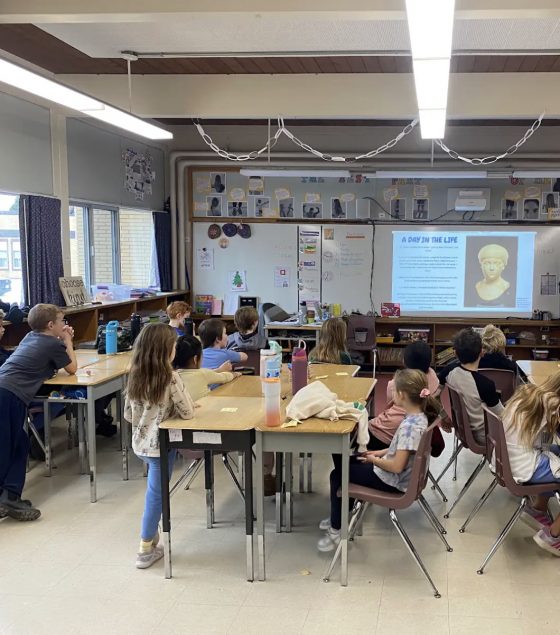
According to Prof. Michael Carter, Chair of the Department of Classics and Archaeology, the Engaged Leadership courses “offer students a unique opportunity to explore topics relating to the ancient world that they are passionate about. The point is to bring this passion to the wider community somehow. In doing so, the students learn so much more than they might in traditional classroom settings.” Students largely work independently but their projects are guided by faculty mentors. Carter has served as faculty mentor (with Nadine Brundrett) for Jackson’s blog and Bousfield’s organization of the heritage fair, while Ross-Johnson has been working with Dr. Fanny Dolansky.
Introduced in 2022-23, the Engaged Leadership courses reflect the diverse learning experiences available to students in Classics and Archaeology. “The department is proud of the range of courses and formats that we offer,” Carter stresses, “which include traditional classroom-based learning, online courses, but also field courses and unique opportunities, such as those offered by the Engaged Leadership course.”