News

  • Tami Friedman analyze US-Canadian relations post-9/11

    In September 2026, Niagara Falls Review ran a series of stories commemorating the 25th anniversary of the September 11, 2001, terrorist attacks in the United States. History Department chair and associate professor Dr. Tami J. Friedman commented on the U.S.-Canada relationship in the post-9/11 era.

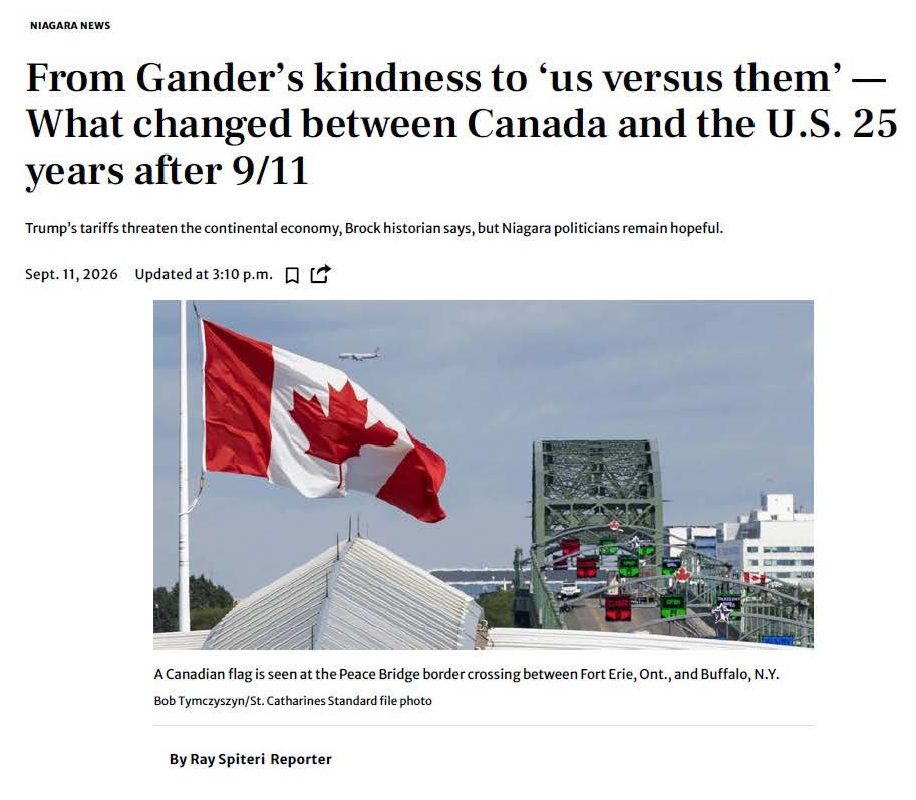
    Ray Spiteri, “From Gander’s kindness to ‘us versus them’ — What changed between Canada and the U.S. 25 years after 9/11”
    Niagara Falls Review, Sept. 11, 2026

    From solidarity and co-operation to economic tensions and annexation provocations.

    Right after the Sept. 11, 2001 terrorist attacks in the United States, Canada offered massive assistance to its southern neighbour.

    It safely landed more than 200 diverted international flights at airports across the country after U.S. airspace closed. Nearly 33,000 travellers and crew members were stranded on Canadian soil.

    Most famously, the small town of Gander, Newfoundland, with its population at the time just under 10,000, welcomed 38 planes and nearly 7,000 passengers.

    Residents opened their homes, schools and community halls. They fed, clothed and comforted strangers for days until U.S. airspace reopened.

    Their response inspired a hit musical called “Come from Away.”

    From solidarity to standoff

    Blayne Haggart, a professor of political science at Brock University, said 9/11 inspired him to study Canada-U.S. relations.

    What “always stuck out” for him from that day is what occurred at the Canada-U.S. border, which was immediately closed.

    “It was quasi-reopened very quickly because the U.S. automakers went to the president and said, ‘You’ve got to open the border because we’re an integrated economy and if it stays closed, this key pillar of the continental economy is going to collapse,’” said Haggart.

    “And so, (then-) president George W. Bush did open it. This, at a moment where everyone was traumatized and they weren’t quite sure what was going on, and the immediate reaction was, ‘close the border,’ but they opened it because they recognized that we’re in this kind of integrated space.”

    Haggart said he’s thought a lot about that story recently, with current President Donald Trump exacerbating his trade war with Canada, claiming the U.S. doesn’t need anything from its northern neighbour.

    Trump has been needling Canada since he returned to the White House last year, suggesting the ally with whom the U.S. once had warm relations should instead be absorbed as its 51st state.

    Haggart said Trump’s tariffs targeting various Canadian sectors are “aimed, in large part, at destroying that integrated economy.

    “The idea that there was a ‘we’ in North America — that idea is gone now. It really is an ‘us versus them,’ ” he said. “They’re directly attacking the idea of a continental economy.”

    While sharing a border and a strong historic alliance, Canada and the U.S. have faced several major policy and trade disagreements over the years.

    But, for the most part, Haggart said those disagreements remained civil.

    Not so much nowadays amid a trade war that has seen Ontario Premier Doug Ford go on radio and tell Trump to “kiss my a—,” and Trump signing an order to rename Lake Ontario as “Lake America,” while labelling Canadian officials as “nasty people” and the country as the “worst” in the world to deal with on trade.

    “We’ve seen a real sea change in Canada-U.S. relations,” said Haggart. “United States has always been the senior partner, but the relationship has always been based on a respect for sovereignty, a respect for the rule of law and, very importantly, a commitment to recognize that when the two countries have policy disagreements, the policy disagreements stay linked to that.”

    He said the relationship has become much more “hierarchal” and “authoritarian” under Trump.

    “Whatever happens with respect to the trade negotiations, fundamentally, we can’t trust the United States to keep their word,” said Haggart.

    “They’re not interested in a good economic deal. That’s the big difference between then and now. Then, the United States was looking for a stronger deal for its economy and for its companies, but under the idea of, we’re going to be co-operating on trade. Here, what’s happening is all about domination — it’s all about making Canada subservient for rules to be set on the U.S.’s terms. That’s, 25 years on, the big difference.”

    What history shows

    Tami Friedman, an associate professor of history at Brock, said what’s being seen now is the “heightening of tensions” that have always been present, in one way or another, since at least the end of the Second World War.

    “The tension is between Canada’s alliance with the United States on the one hand, and the desire by many Canadians to exercise national sovereignty on the other hand,” she said.

    “I think at certain times in history, the interests converge between the two governments and its people. That makes this (relationship) complicated.”

    Friedman, who is a dual U.S.-Canadian citizen, said she believes Trump sees Canadian leaders “struggling to preserve a measure of sovereignty and he’s pouncing on that, in a way.”

    “Trump goes after people he thinks are weak and I think he thinks Canada’s weak because Canada historically has been the junior partner in this relationship.”

    Friedman said much of what Trump’s pushing for has a long history in U.S. foreign policy.

    “Invading other countries, trying to annex, etc. — none of that was new. It was just the openness and talking about it in a kind of brutal way that was different,” she said.

    Friedman said it’s been “really interesting” to see ordinary people taking action that sometimes pushes leaders to respond.

    “I’m thinking here about boycotts of U.S. goods, decisions not to travel to the States, etc., but not just negative actions, because many regular citizens are also thinking about how to support Canadian producers, travelling within Canada and to other countries that are allies, etc.,” she said.

    “Some politicians, I think, are not necessarily out front leading the charge but are responding to their constituencies’ demands. That’s a powerful dynamic we don’t always get to see.

    How trade tensions affect Niagarans

    High-level political standoffs between Washington and Ottawa, however, frequently don’t resemble the reality of integrated border communities such as Niagara.

    When leaders in the federal capitals engage in sweeping trade wars, threat rhetoric and diplomatic disputes, they often overlook how tightly intertwined these regional economies and social fabrics are.

    With four international land border crossings in Niagara connecting Ontario and New York state, the region handles more than $110 billion in annual cross-border freight movement, making it one of North America’s most vital trade gateways.

    The binational region also sees residents regularly cross the border for daily life, such as visiting family and friends, to shop, or to catch professional sports games.

    “For more than 200 years, we’ve been friends, allies, family,” said Niagara Falls Mayor Jim Diodati, whose first child was born on Sept. 11, 2001.

    “For more than 200 years, we’ve hosted the world’s longest unmilitarized border, and we’ve had nothing but peace. I think that Americans love Canadians and Canadians love Americans.”

    He said the current tensions between Canada and the U.S. are a “bump in the road,” adding the political disagreement is because of “one man in Washington.”

    “We need to see past it and understand that we’re greater together than we are apart.”

    Bart Maves, who was Niagara Falls MPP when 9/11 occurred, said he believes the current relationship between the two countries is a “snapshot in time” that will not last.

    Maves said he recalls being “really nervous” going to a Buffalo Sabres home game after fans in Montreal booed the U.S. anthem following Trump’s initial remarks suggesting Canada become a 51st state.

    “They sang the Canadian national anthem just as loud as they always did and Canadians that were there sang the American national anthem just as loud as they always did,” he said of his experience at the game in Buffalo.

    “I think for people who spend our lives on the border going back and forth, we have a healthier regard and respect for each other than maybe people that are a lot further away from the border and don’t engage with Americans a lot.”

    He said when the “rhetoric ramps up” between Washington and Ottawa, he often hears from people he knows in Western New York and “almost the first thing they say is sorry.”

    “I say it’s not your fault. It’s just the White House’s really unusual way of doing business these days, which is kind of unprecedented. But the whole world is facing the same unprecedented personality, so I don’t hold it against the rest of the Americans.”

    Categories: News

  • History MA students win prestigious graduate scholarships

    Congratulations to four MA candidates in History who received 2026 Ontario Graduate Scholarships! The OGS is a competitive, merit-based scholarship awarded to those demonstrating academic excellence. This is a well-deserved honour, reflecting the tremendous potential of these students’ four original research projects. Very well done, all!

    Emma Craib studies Holocaust testimonies collected by Miriam Novitch (1908-1990). Novitch was a resistance fighter, Holocaust survivor, testimony and document collector, and Israeli Holocaust historian. The testimonies studied in this project were collected in France from 1944 to 1946 while Novitch was in Vittel camp and Bourboule displaced persons camp. This project offers significant insights into questions of gender and women’s experiences during and after the Holocaust.

    Ethan Moncion focuses on the food history of a little-known colonial military unit called the Provincial Marine that served to both protect and provision Canada in the early British colonial era. In the War of 1812, they functioned primarily as a transport service for the military. This project explores what they were eating themselves, what they provided to the army, and how this contributes to our understanding of how people have historically fed themselves in the context of wars of attrition.

    Ivan Rimac focuses on Yugoslav general Arso Jovanović and the Tito-Stalin split (1948). The project’s key intervention is to present Jovanović as an active agent who shaped unfolding events in postwar Yugoslavia, and in particular served as a military counterweight to Tito’s ideo-political legitimacy, rather than as a passive victim. It utilizes microhistorical methodologies to examine how civil-military relations functioned through a single individual actor. In doing so, it analyzes subsequent state-directed historiography that erased Jovanović, alongside his lasting contested legacy as a “Cominformist victim.”

    Kyle Timmins explores how intersections of identity, class, and gender shaped the experiences of volunteer militia officers between 1835 and 1885. The Canadian Militia refers to pre-1940 semi-professional defence forces in British North America. Born out of the War of 1812, the militia became an important part of life in Upper Canada. Much like the modern reserves, service was voluntary and often part-time. This project explores the role of the Canadian Militia as a social institution and particularly how volunteer service corresponded with dominant Victorian ideals of masculinity and duty.

    Categories: News

  • Brock News showcases Behnaz Mirzai’s slavery research

    Research explores slavery’s lasting global impact

    Categories: News

  • Two Days of Canada Conference call for papers: deadline Dec. 2026

    CALL FOR PAPERS
    Annual Two Days of Canada Conference
    Brock University / March 11 and 12, 2027
    ____
    Two Days of Canada: Food For Thought
    DEADLINE to submit – December 11, 2026

    The Centre for Canadian Studies at Brock University invites submissions for Two Days of Canada: Food for Thought, to be held on Thursday, March 11 and Friday, March 12, 2027.

    This transdisciplinary conference, part of the Centre’s annual Two Days of Canada conference series, will bring together students, scholars, and researchers from a wide range of fields to deliver presentations, take part in workshops and roundtables, and attend events in an inclusive and collaborative atmosphere. This year’s conference addresses the issue of Canadian food culture in all its permutations, including wine and drink.

    For more information: https://brocku.ca/humanities/canadian-studies/two-days-of-canada-conference/

    Categories: News

  • History faculty garner significant federal research funding

    We are delighted to announce that several History Department faculty members have received generous support through the Canadian government’s Social Sciences and Humanities Research Council (SSHRC).

    Dr. Behnaz Mirzai has received a SSHRC Connection Grant in the amount of $45,336, covering the period 2026-2027, for her project, “Entangled Histories: Slavery and Its Legacies in the Indian Ocean, Mediterranean, and Middle Eastern Worlds.”

    Dr. Colin Rose has been awarded a SSHRC Insight Grant (Stream A) in the amount of $115,096, coverinig the period 2025-2031, for his project, “Mapping Crime and Conflict in Early Modern Italy.”

    Project description: “The grant will support a research program around justice, conflict resolution and civil society as ideas and as practices in early modern Florence and Bologna. These cities represent two different forms of judicial governance and social organization. In each, individuals and communities practiced conflict, negotiation and peacemaking in their own socioeconomic, institutional, and spatial contexts. How did differing political forms shape local conflict resolution practices? How did local understandings of space and place manifest in justice-seeking processes? Investigating the social practices of ordinary and elite conflict resolution in this thickly-archived region will advance our understanding of how communities in the past negotiated a variety of problems and challenges. By doing so, I aim to help people understand modern social conflict through lenses of social trust, civil society and justice.”

    Dr. Mark Spencer and his co-applicant Dr. Marc Hanvelt (Carleton University) are recipients of a SSHRC Insight Grant (Stream B) in the amount of $315,365, covering the period 2025-2031, for their project, “David Hume’s History of England: The Critical Edition and New Methods of Historical Editing.”

    Project description: “David Hume (1711-1776) is widely regarded as one of the leading European philosophers, political thinkers, and historians of the eighteenth century. And yet, there exists no critical edition of his capstone work, The History of England. This SSHRC Insight Grant will support our work to produce one, contracted with Oxford University Press for inclusion in their Clarendon Hume Edition Series. Together with our collaborator (Mikko Tolonen, University of Helsinki), we are developing a new approach to editing a critical edition that blends traditional methods of historical research and text editing with digital tools and techniques that were unavailable to earlier generations of scholars.”

    Congratulations, all!

    Categories: News

  • Renée Girard wins prestigious history journal prize

    The Brock Department of History is delighted to congratulate Dr. Renée Girard for receiving the Canadian Historical Review Best Article Prize for 2025.

    The prize is awarded annually to the author of the article appearing in the CHR who “best demonstrates the finest qualities of advanced historical scholarship: an original and compelling argument that engages and contributes to the historiography, deep research and analysis usually engaging with primary sources, and well-crafted writing.”

    The article, entitled “Un mode par excellence de resurrection des noyés: la fumée du tabac et la persistence des pratiques autochtones dans la France du XVIIIsiècle,” appears in the December 2025 issue of the CHR (vol. 106, no. 4).

    Dr. Girard holds adjunct faculty status in the History Department. She earned her MA in the Department and her Ph.D. at McGill University and has taught several history courses at Brock. Kudos for this well deserved honour!

    From the journal’s editorial board: “In 1748 a physician wrote a pamphlet promoting tobacco enemas as a new way to revive people who had drowned or suffocated and by the mid-nineteenth century it had become a widely accepted method. In this intriguing and surprising article, Girard traces the origins of this medical practice to North American Indigenous ceremonial and diplomatic uses of tobacco. This article is an original and innovative examination of the intersections between western European medicine and Indigenous knowledge. Introduced to Europe by soldiers, the popular use of tobacco enemas demonstrates European fascination with the plant’s supposedly mysterious properties. Cartesian medicine, based in experimentation, distanced medical theories about tobacco’s ability to reanimate from its Indigenous origins, and similarly, historians looking to understand the medicinal use of tobacco through European sources have also erased the connections to Indigenous spiritual and medical practices. Girard’s research demonstrates the complexity of the circulation of knowledge systems in the Atlantic World and the integration of Indigenous epistemologies into European medicine” (CHR vol. 107, no. 2 [June 2026]).

    Categories: News

  • Proud History grads walk the stage in June 2026

    Heartfelt congratulations to all the Brock History students who earned their undergraduate degrees in June 2026. We are so proud of your accomplishments and excited for you as you embark on the next stage in your journeys. It is an honour to have been part of the process. Best wishes to you all!

    Just a few of our graduates appear in the photo above, from left to right: Joey Sanders, Erin Miller, Olivia Hall, and Jack Evans with Dr. Andrew McDonald (second from left). All received their History BAs and B.Eds.

    Categories: News

  • Students share insights gleaned from study-abroad trip to Florence

    Read the full story here: https://brocku.ca/brock-news/2026/06/brock-students-step-into-the-world-of-renaissance-florence/

    Read more about students’ expectations as they prepared for the trip here: https://brocku.ca/humanities/history/2026/05/16/students-head-to-florence-to-discover-history-first-hand/

    Categories: News

  • Students head to Florence to discover history first-hand

    The History Department’s Colin Rose is shepherding a group of students around Florence, Italy, in a new course introducing them first-hand to the social history of the Renaissance.

    The course, MARS/HIST 3F52, is housed in the Centre for Medieval and Renaissance Studies and cross-listed by the History Department. Before heading overseas, the students met daily with Dr. Rose to immerse themselves in the city’s past and work with primary sources from the period. Once in Italy, they will learn more about the social, political, and cultural history of Florence and the daily lives of its inhabitants, while also visiting important cultural sites as well as Siena and Bologna.

    Students embarking on the trip bring diverse interests and perspectives to the course. Nick Kester, a History major finishing his fourth year of study, says, “I have wanted to visit Florence since I was 12 years old playing video games set in that city and am so excited to see it with my own eyes.” This won’t be his first hands-on experience: “The History Department and Brock have provided me with several opportunities for experiential learning,” he adds, “and every single one of them have been incredible chances to expand my knowledge base far beyond the classroom.”

    Another enthusiastic participant, Harry Mavromichalis, has just completed his first year as a MARS and Classics & Archaeology major. He points out, “The course presents a really unique opportunity to bring my studies to life and experience the culture and history and see how it has affected modern Italy.”

    Brooke Nolan, a Concurrent Education student majoring in Visual Arts and completing her fourth year at Brock, shares her classmates’ excitement. “I’ve been really interested in the Renaissance since I took a Renaissance art history class, and it focused a lot on Florence,” she reports. “I was really inspired by a lot of the art and how influential it was for its time. I’m excited to see it in person, especially the Ufizzi Gallery and other art institutions, and the architecture as well.”

    Learn more about the Ufizzi Gallery’s holdings here.

    Buon viaggio! We wish you marvelous adventures and lots of learning along the way.

    Categories: News

  • History Department celebrates journal launch, student award winners

    On April 6, we had the great pleasure of celebrating the remarkable achievements of our award-winning History majors along with the stellar students who co-edited and contributed to Volume 11 of The General, our undergraduate History journal.

    Congratulations to these talented scholars for their passionate commitment to making sense of the past and sharing their knowledge with the rest of us.

    You can read the new edition of The General here: https://journals.library.brocku.ca/…/bujh/issue/view/274

    Read the full story about the event here: https://brocku.ca/…/young-historians-make-their-mark…/

    Categories: News