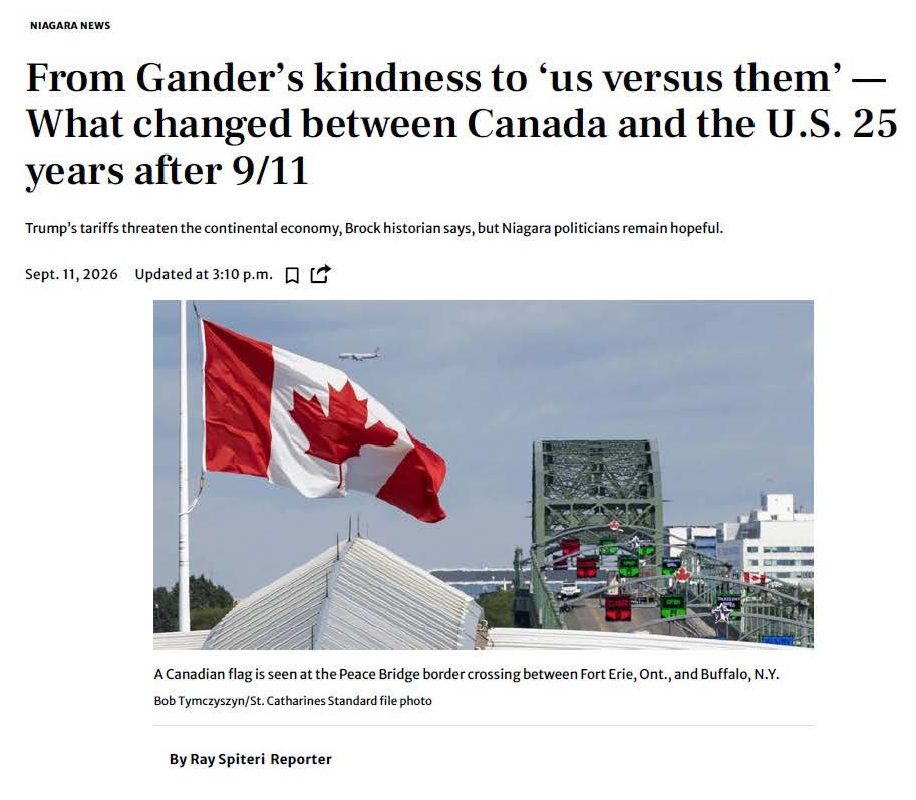
In September 2026, Niagara Falls Review ran a series of stories commemorating the 25th anniversary of the September 11, 2001, terrorist attacks in the United States. History Department chair and associate professor Dr. Tami J. Friedman commented on the U.S.-Canada relationship in the post-9/11 era.
Ray Spiteri, “From Gander’s kindness to ‘us versus them’ — What changed between Canada and the U.S. 25 years after 9/11”
Niagara Falls Review, Sept. 11, 2026
From solidarity and co-operation to economic tensions and annexation provocations.
Right after the Sept. 11, 2001 terrorist attacks in the United States, Canada offered massive assistance to its southern neighbour.
It safely landed more than 200 diverted international flights at airports across the country after U.S. airspace closed. Nearly 33,000 travellers and crew members were stranded on Canadian soil.
Most famously, the small town of Gander, Newfoundland, with its population at the time just under 10,000, welcomed 38 planes and nearly 7,000 passengers.
Residents opened their homes, schools and community halls. They fed, clothed and comforted strangers for days until U.S. airspace reopened.
Their response inspired a hit musical called “Come from Away.”
From solidarity to standoff
Blayne Haggart, a professor of political science at Brock University, said 9/11 inspired him to study Canada-U.S. relations.
What “always stuck out” for him from that day is what occurred at the Canada-U.S. border, which was immediately closed.
“It was quasi-reopened very quickly because the U.S. automakers went to the president and said, ‘You’ve got to open the border because we’re an integrated economy and if it stays closed, this key pillar of the continental economy is going to collapse,’” said Haggart.
“And so, (then-) president George W. Bush did open it. This, at a moment where everyone was traumatized and they weren’t quite sure what was going on, and the immediate reaction was, ‘close the border,’ but they opened it because they recognized that we’re in this kind of integrated space.”
Haggart said he’s thought a lot about that story recently, with current President Donald Trump exacerbating his trade war with Canada, claiming the U.S. doesn’t need anything from its northern neighbour.
Trump has been needling Canada since he returned to the White House last year, suggesting the ally with whom the U.S. once had warm relations should instead be absorbed as its 51st state.
Haggart said Trump’s tariffs targeting various Canadian sectors are “aimed, in large part, at destroying that integrated economy.
“The idea that there was a ‘we’ in North America — that idea is gone now. It really is an ‘us versus them,’ ” he said. “They’re directly attacking the idea of a continental economy.”
While sharing a border and a strong historic alliance, Canada and the U.S. have faced several major policy and trade disagreements over the years.
But, for the most part, Haggart said those disagreements remained civil.
Not so much nowadays amid a trade war that has seen Ontario Premier Doug Ford go on radio and tell Trump to “kiss my a—,” and Trump signing an order to rename Lake Ontario as “Lake America,” while labelling Canadian officials as “nasty people” and the country as the “worst” in the world to deal with on trade.
“We’ve seen a real sea change in Canada-U.S. relations,” said Haggart. “United States has always been the senior partner, but the relationship has always been based on a respect for sovereignty, a respect for the rule of law and, very importantly, a commitment to recognize that when the two countries have policy disagreements, the policy disagreements stay linked to that.”
He said the relationship has become much more “hierarchal” and “authoritarian” under Trump.
“Whatever happens with respect to the trade negotiations, fundamentally, we can’t trust the United States to keep their word,” said Haggart.
“They’re not interested in a good economic deal. That’s the big difference between then and now. Then, the United States was looking for a stronger deal for its economy and for its companies, but under the idea of, we’re going to be co-operating on trade. Here, what’s happening is all about domination — it’s all about making Canada subservient for rules to be set on the U.S.’s terms. That’s, 25 years on, the big difference.”
What history shows
Tami Friedman, an associate professor of history at Brock, said what’s being seen now is the “heightening of tensions” that have always been present, in one way or another, since at least the end of the Second World War.
“The tension is between Canada’s alliance with the United States on the one hand, and the desire by many Canadians to exercise national sovereignty on the other hand,” she said.
“I think at certain times in history, the interests converge between the two governments and its people. That makes this (relationship) complicated.”
Friedman, who is a dual U.S.-Canadian citizen, said she believes Trump sees Canadian leaders “struggling to preserve a measure of sovereignty and he’s pouncing on that, in a way.”
“Trump goes after people he thinks are weak and I think he thinks Canada’s weak because Canada historically has been the junior partner in this relationship.”
Friedman said much of what Trump’s pushing for has a long history in U.S. foreign policy.
“Invading other countries, trying to annex, etc. — none of that was new. It was just the openness and talking about it in a kind of brutal way that was different,” she said.
Friedman said it’s been “really interesting” to see ordinary people taking action that sometimes pushes leaders to respond.
“I’m thinking here about boycotts of U.S. goods, decisions not to travel to the States, etc., but not just negative actions, because many regular citizens are also thinking about how to support Canadian producers, travelling within Canada and to other countries that are allies, etc.,” she said.
“Some politicians, I think, are not necessarily out front leading the charge but are responding to their constituencies’ demands. That’s a powerful dynamic we don’t always get to see.
How trade tensions affect Niagarans
High-level political standoffs between Washington and Ottawa, however, frequently don’t resemble the reality of integrated border communities such as Niagara.
When leaders in the federal capitals engage in sweeping trade wars, threat rhetoric and diplomatic disputes, they often overlook how tightly intertwined these regional economies and social fabrics are.
With four international land border crossings in Niagara connecting Ontario and New York state, the region handles more than $110 billion in annual cross-border freight movement, making it one of North America’s most vital trade gateways.
The binational region also sees residents regularly cross the border for daily life, such as visiting family and friends, to shop, or to catch professional sports games.
“For more than 200 years, we’ve been friends, allies, family,” said Niagara Falls Mayor Jim Diodati, whose first child was born on Sept. 11, 2001.
“For more than 200 years, we’ve hosted the world’s longest unmilitarized border, and we’ve had nothing but peace. I think that Americans love Canadians and Canadians love Americans.”
He said the current tensions between Canada and the U.S. are a “bump in the road,” adding the political disagreement is because of “one man in Washington.”
“We need to see past it and understand that we’re greater together than we are apart.”
Bart Maves, who was Niagara Falls MPP when 9/11 occurred, said he believes the current relationship between the two countries is a “snapshot in time” that will not last.
Maves said he recalls being “really nervous” going to a Buffalo Sabres home game after fans in Montreal booed the U.S. anthem following Trump’s initial remarks suggesting Canada become a 51st state.
“They sang the Canadian national anthem just as loud as they always did and Canadians that were there sang the American national anthem just as loud as they always did,” he said of his experience at the game in Buffalo.
“I think for people who spend our lives on the border going back and forth, we have a healthier regard and respect for each other than maybe people that are a lot further away from the border and don’t engage with Americans a lot.”
He said when the “rhetoric ramps up” between Washington and Ottawa, he often hears from people he knows in Western New York and “almost the first thing they say is sorry.”
“I say it’s not your fault. It’s just the White House’s really unusual way of doing business these days, which is kind of unprecedented. But the whole world is facing the same unprecedented personality, so I don’t hold it against the rest of the Americans.”