Further to my last three budget-focused communications, I will now turn to some of the themes that are future-focused and aligned to actions identified in the University’s Strategic Action Plan.
This week’s update will focus on the Spring/Summer term.
Many universities, Brock included, have been thinking about how to run a fully-realized third semester for years. Having many parts of the university closed, or operating in a reduced capacity, for a third of the calendar year is not sustainable for an institution of our size. As I noted previously in my remarks to Senate, no other business runs this way (setting aside the debate about whether universities are a business or not for the moment; our finances are not that different).
What is important about all our discussions on Spring/Summer is that we’re not creating something new. We already have a third term that consists of two sessions, and these discussions are about how to continue to develop them in such a way that makes opportunities for students.
Having a thriving Spring/Summer term presents opportunities for students, faculty, staff, and community members to engage in campus life year-round. And with that comes important ancillary functions, such as having dining options available during the summer months, and services for students.
Getting to that critical mass of individuals on campus to make this possible means expanding Spring/Summer term and growing enrolment. This goal was identified in the Academic Plan as “expand the number of courses offered in the Spring/Summer term” and Spring/Summer was proposed as a “new registration entry point” in our University Action Plan.
We also held a recent generative discussion on the topic at Senate, followed by an open session which I will share more details on below.
For now, I would like to share some insights on Spring/Summer from a few different perspectives.
Student perspective
During the 2014-2018 period, the topic of Spring/Summer was being discussed at Brock in a similar vein to now, and the Office of Office of Institutional Planning, Analysis, and Performance undertook four Spring/Summer student surveys. The questions asked, and responses received from students, are still relevant today as Brock’s offerings have not changed substantially since.
The purpose of the surveys was to learn why students took courses in the Spring/Summer and to ask them how their experience could be improved. The chart below reflects temporal trends over a four-year period for the question: “Why did you take Spring/Summer courses?”
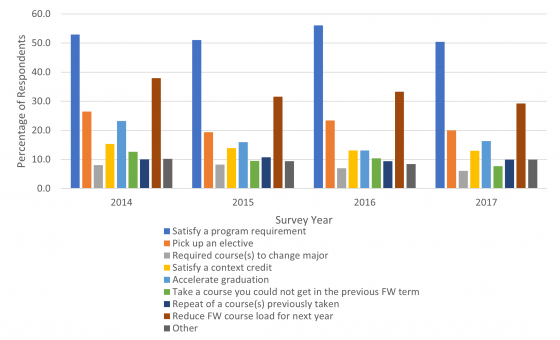
Temporal trends for the question “Why did you take Spring/Summer?” in the Spring/Summer survey from 2014 – 2017. Student responses varied annually between 1,500 to 2,300. Measurements are in percentage of respondents, with respondents choosing any reasons applicable (sum of percentage responses for each year >100 %).
What is striking about this survey is the second-highest response is that students look to Spring/Summer as a way to reduce their Fall and Winter course loads. What I think this tell us is that our students have more than just summer jobs, they have jobs and/or other commitments that occupy their time all year round.
Another question on the survey was: “If you had one recommendation to improve your Spring/Summer experience at Brock what would it be?” The three most suggested topics were: “Better Course Selection,” “More Online Courses,” and “Change Duration Times.”
Other important topics which appeared frequently included “Improve Exam Structure” and “Improve Class Times.” Frequent mention was also made to the availability of services such as food options, improved transportation, and longer library hours.
Here is the full list:
- Better Course Selection
- More Online Courses
- Change Duration Times
- Improve Exam Structure
- Improve Class Times
- Better Communication with Students
- Shorter Duration
- Longer Duration
- Improve Transportation
- More Food Options
- Make More Affordable
- Have Earlier Course List/Registration
- Cheaper Parking
- Longer Library Hours
- Change Course Delivery Method
Some of these pieces of feedback we’re in the process of addressing, through things like the new degree architecture and standardizing Spring/Summer durations. While students have a myriad of reasons for taking courses in Spring/Summer, what was consistent in their feedback was a desire for better (more) course selection options.
Faculty and staff perspective
Following Senate’s generative discussion on February 10, 2026, the Provost’s Office organized an open session to continue the discussion on the Spring/Summer term. These roundtable discussions were focused to five specific questions:
- Flexibility vs. Standardization
On this question, feedback noted that the strengths of standardization included ability for students to:
- Catch-up and/or accelerate their degrees
- Spread their normal course load over three terms
- Expand opportunities for co-op placement
- Predictably know what courses might be offered
- Have the option to live in residence and study 12 months of the year
Concerns were also raised related to:
- Brock’s fee structure vis-a-vis Ontario Student Assistance Program (OSAP) eligibility
- The disciplinary depth for accelerated course
- The need for advanced course planning across three terms
It was also suggested to explore establishing a singular, normalized Spring/Summer session that would be aligned to the Fall and Winter terms.
- What Student Experience goals should guide scheduling?
On this question, several considerations were identified that should guide scheduling. These included:
- Student service availability (busing, food services, smart start amenities, etc.)
- Residence options (details online here)
- Duration scheduling, so students can take more than one course
- A broad array of course-mix options, from Year 1 to Year 4 of both required and electives
- Scholarship limitations
- Faculty Handbook regulations restricting course load
On the topic of scheduling and duration, it was suggested that a full term be developed and rationalized into blocks of three, six, nine, and twelve weeks.
- Are innovations like modular or block teaching worth exploring?
Overall, there was support for the idea of modular or block teaching durations. It was noted that accelerated courses should not be taught concurrently, as they reduce student choice, and delivery modes should also be coordinated to balance between in-person delivery and online. It was also observed that if the Spring/Summer were to be considered a full term, the probationary period for students could be effectively reduced from twelve to eight months.
- Would it make sense to align undergraduate Spring/Summer to the existing graduate trimester?
On this question, there was general agreement that an aligned Spring/Summer term would benefit graduate students and could be aligned with the existing graduate trimester model. Course sequencing and student financial aid timelines were raised as importance considerations in aligning the trimesters, as well as ensuring adequate resources throughout the full year.
- Should Spring/Summer be merged into one session?
A few possible durations were discussed, including three, six, nine, and twelve weeks options, as well as reducing the number of course start dates and scheduling blocks for exams and a reading week. Some advantages noted were enhanced choice and predictability for undergraduate students, opportunities for graduate student teaching assistantships, and greater opportunity for co-op placements. It was noted that faculty availability would be an important consideration here, i.e., faculty opting to teach in the summer and choosing to take either the fall or winter term for research instead.
Ontario Student Assistance Program (OSAP) Perspective
One of the recurring concerns around our current Spring/Summer model at Brock is how the varied duration lengths and start dates makes it very challenging for students to understand the impact on their OSAP funding. OSAP regulations tie financial assistance to course load by semester, i.e., the number of credits in which students are registered.
To be eligible for funding, a new or continuing student must have a minimum 12-week study period with a 60% full-time course load, with no gaps in study. If a student registers in courses that belong to durations with different start and stop dates, they run a very high risk of dropping in and out of OSAP eligibility. A 60% course load is required throughout the entire 12-week study period to receive OSAP.
There are two interrelated solutions that could address the problem. First, the establishment of set durations with prescribed start and end dates would allow for multiple courses to be taken and thereby avoid the gap concern. Second, changing the full-time course load eligibility for students in a combined Spring Summer term to 2.5, rather than 2.0 in Spring and 1.0 in Summer, would facilitate a course load balance across all three terms—2.5 courses in the Fall, Winter, and Spring/Summer.
Planning Perspective
As we look forward, there are still conversations to be had on the Spring/Summer. Some of them we’ve begun already, and others will be happening in the near future. These include:
- More detailed Spring/Summer budget discussions and planning at the Faculty and Department level
- Workload planning that more directly includes the Spring/Summer term
- How best to position our resources and courses in the Spring/Summer term for students in a way that supports successful pathways to graduation
- As the Spring/Summer term becomes a more viable entrance point for beginning studies, this will prompt questions around college transfers and part-time learners, which may necessitate some changes to our academic regulations in the Faculty Handbook
- Our scholarship regulations and admissions protocols may also need to be reviewed, reconsidered, and adapted to better support a Spring/Summer term
- A growing Spring/Summer term will also necessitate increased administrative student support services in areas such as the library, residence, food services, and transportation to accommodate increasing demand
- Lastly, our flat-rate tuition framework may also need to be reconsidered, as we move to a more robust trimester model, to better align fees with when the studies are taking place
We know that the Spring/Summer term that Brock currently operates is unstructured and challenging for students—particularly due to the OSAP requirements. In addition, our Spring/Summer enrolments over the past decade have been flat. A robust Spring/Summer model offers the opportunity for us to reimagine the full academic year in three equally integral parts. The measure of our success will be enrolment growth, as students are at the core of what we do. And a structured, well-run, and meaningful Spring/Summer option will attract students.
Next month, the multi-year planning process will be launching again as we start to look at 2027-28 and beyond. One of the key changes we will be making to the process this year is robust planning for all three terms in the academic year—fall, winter, and spring/summer. We’ll be sharing more information about this, and its relation to the budget cycle, in the coming weeks with the launch of the planning process.
I look forward to a shared, and increasingly lively, campus life in the summer.
Recent Comments