Dear Brock Community,
In last week’s update, I focused on our financial context in the areas of budget development, provincial funding, and revenue opportunities. The theme for this budget update will be to provide a “deeper dive” into the University’s expenditure profile.
Budget Framework
The University’s budget framework is based upon the relationship between our revenue and our operating costs. Our financial health, and those of all Ontario universities, is assessed by the Province’s Financial Accountability Framework according to three key indicators: liquidity, sustainability, and performance. This means that if we experience declining reserve balances due to ongoing deficits (Liquidity), and/or if we reach our maximum level of debt (Sustainability), and/or if we have growing deficits due to expenses that grow at a faster pace than revenues (Performance), we will be considered “high risk.”
Brock University’s performance indicator has registered as financially “high-risk” for a couple of fiscal years. We entered the high-risk category because our expenses have been growing at a faster rate than revenues. This trend has worsened following the 10 per cent tuition cut and subsequent rate freeze in 2019. The “high risk” rating triggered the Efficiency and Accountability Fund (EAF) review that Brock was required to undertake in September 2024. Brock University was one of many Ontario Universities that were subsequently required to comply with this sustainability review.
That same year (2024-2025), the Council of Ontario Universities (COU) predicted at least 13 Ontario universities were heading toward combined operating deficits of $338 million. The Feb. 12, 2026 MCURES funding announcement, following the submission of many university EAF reports to the Ministry, clearly attested to the fact that even with the implementation of recommended operational “efficiencies,” deepening university deficits could not be entirely remediated.
As I indicated in my last Provost’s update, there are many reasons why Brock has experienced increasing fiscal pressures over the last decade. I identified these contextual conditions in terms of Provincial funding frameworks (cap and freeze on tuition), declining student enrolments, rising inflation, and international policy that severely restricted student recruitment. Over the past four years, we have kept expenses flat despite increases in personnel and operating costs. This was done via cuts to administrative support services, many of which resulted in reduced capacity in critical areas such as advancement, classroom technology, international recruitment and student support services to name a few. In addition, we significantly restricted personnel replacement on new hiring. Early retirement incentives were also offered to faculty to reduce the overall impact of rising personnel costs. Since 2017, the university has cut over $200 million from operations. We have all seen the impacts of these cuts across campus.
Despite these measures, and just prior to the Feb. 12 funding announcement by MCURES, Brock University faced a projected $31 million deficit for the upcoming 2026-27 fiscal year. At this rate, within less than three-years our reserves would be depleted. In short, prior to Feb. 12, our financial crisis, which was the reality of many in our sector, was real and imminent.
MCURES Funding Announcement and Revised Fiscal Outlook
The Ministry’s funding announcement provides Brock with a welcome but temporary reprieve. The ability to raise tuition by two per cent over the next three years, and the one-time adjustments to grants through the Strategic Mandate Agreement (SMA) and “re-setting” our Weighted Grant Unit (WGU) framework has bought us some time. If you recall, Ontario’s university funding model allocates operating grants based on Weighted Grant Units, where the weight assigned to a given student reflects both their program of study and their level of study. These funding changes will add an additional $25 million toward the $31 million deficit anticipated prior to the announcement.
Although this will help to close a significant portion of our deficit gap, it does not address the reality that if expenses continue to grow at historical rates, even with the nominal two per cent increase in domestic tuition, our revenues will not match the rate of expense growth. This means the remaining $6.1 million deficit in 2026-27 will continue to widen without further action.
Furthermore, government grants are now re-weighted to a higher level for Brock and are indexed to inflation going forward. These grants constitute 30 per cent of our revenue. Considering our ongoing personnel expenses, this $6.1 million deficit will continue to grow over time, unless we find ways to both grow revenue and continue to flatten and/or moderate the growth in our ongoing operating expenses.
Operating Expenses
Our operating expenses are divided into non-personnel expenses and personnel expenses.
Non-personnel Expenses
As a comprehensive university, our strategic priority is to engage our student, faculty and staff community in the pursuit of research, discovery, and knowledge. With a budget now exceeding $400 million, we must continue to provide the personnel, resources, and physical spaces to enable us to continue this work. Roughly 30 per cent of our operating budget is dedicated to costs that support the physical spaces and resources we need to run the university. The university operates like a city, 24 hrs a day, year-round: we support three campus footprints (our main campus, Marilyn I. Walker, and Burlington); we provide residence, meal and support services for thousands of undergraduate and graduate students; we keep the lights on through operating our own energy-efficient power plants; and we ensure our research and medical facilities remain safe, compliant and fully functional.
Examples of non-personnel operating expenses include:
- purchased services (contracts, professional fees, rental/leases, insurance)
- utilities and travel
- financial expenditures (external debt payment)
- repair, maintenance, and capital replacement
- scholarships, bursaries, & fellowships
- library acquisitions
- travel and professional development and many other operating costs
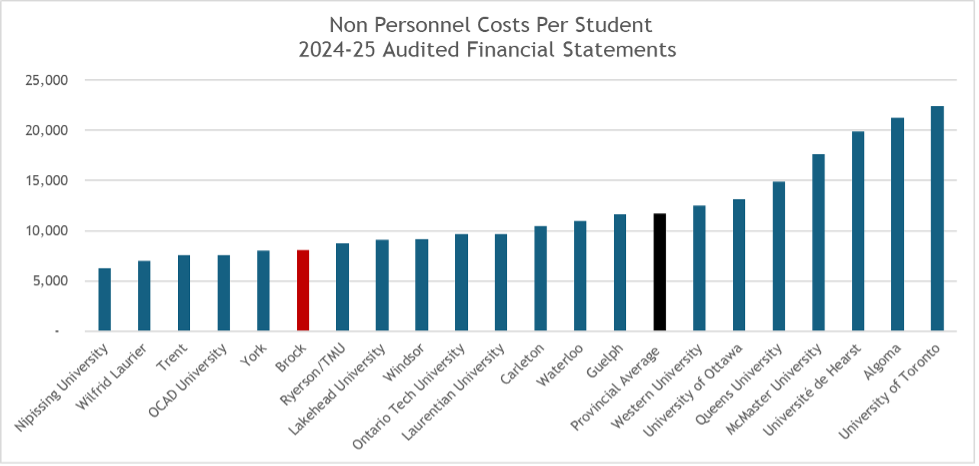
As mentioned, to maintain fiscal balance historically we have reduced our spending on these items and can be seen when comparing Brock’s non-personnel costs to the Ontario average.
 Personnel Expenses
As an institution dedicated to research, discovery, and knowledge transfer, it is not surprising that our major expenditure comes in terms of our people costs. Approximately 70 per cent of our operating expenses are invested in personnel. The University’s employee groups include unionized staff covered by 10 negotiated collective agreements with varying salary and benefit provisions, non-union administrative and professional employees (including exempt roles), research personnel (such as postdoctoral fellows and research assistants), part-time and student employees, and members of the Senior Administrative Council. These costs go up due to compensation increases and require additional revenue to fund the increases or in the absence of additional revenue reductions in costs from other areas. The graph below shows the impact of compensation increases over the last decade for the various employee groups.
 The Future: A Time-sensitive Imperative
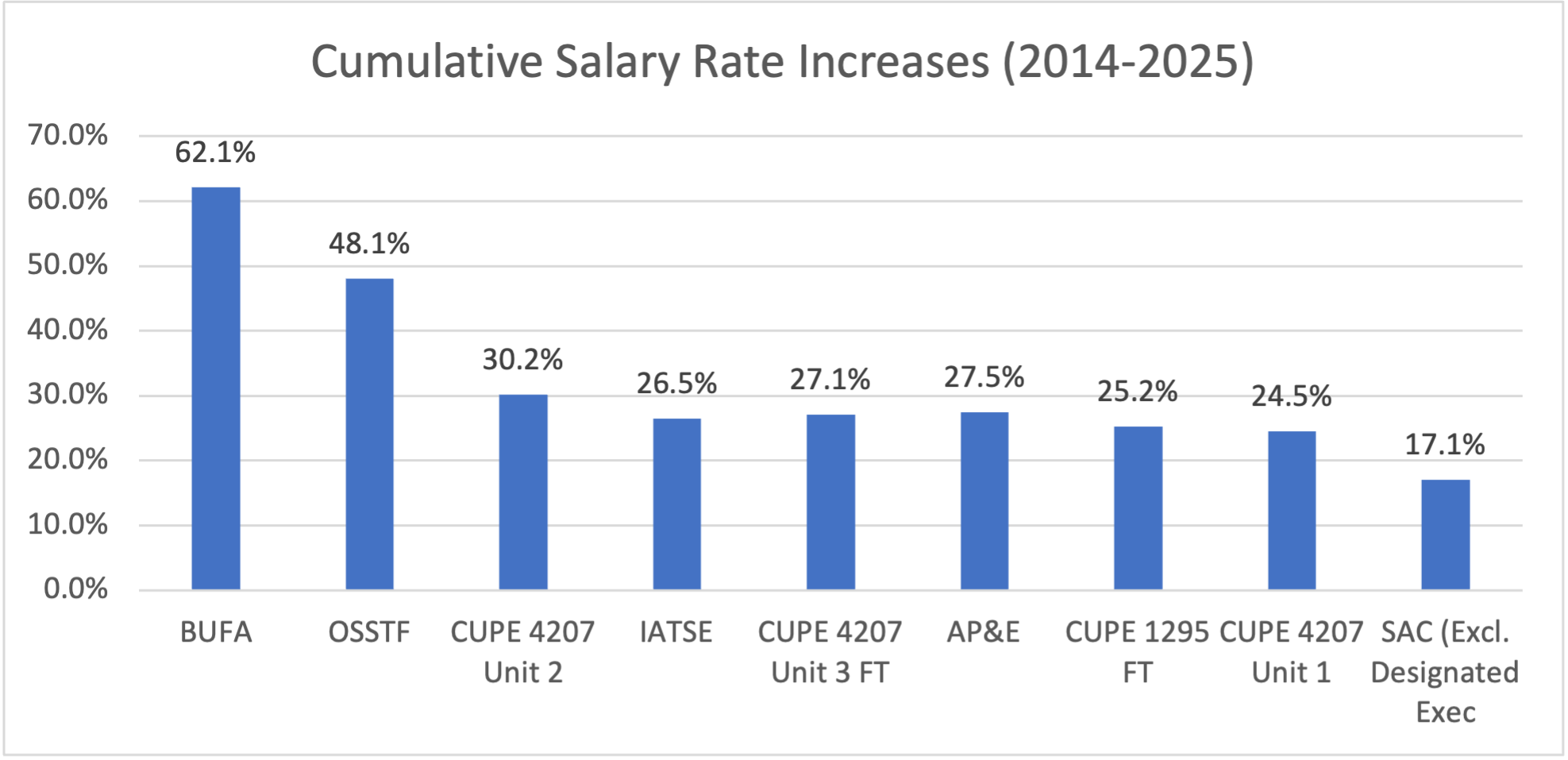
What does this expenditure profile tell us?
This tells us that we have no choice other than to contain our personnel increases, moderate our non-personnel increases, and redouble our efforts to increase our sources of revenue as we leverage the government’s new funding. Fortunately, our University’s Strategic Plan, and the University Action Plan that identifies specific strategies and actions, holds the potential to guide us in this direction. However, as many have observed about universities in general, we are often slow to enact change. It is my belief that we have a time-sensitive opportunity to work collaboratively, collectively, and decisively to chart a sustainable academic course that aligns academic excellence and fiscal health.
Next week, on April 9, we will host a Community Update in which we will speak further to the specific steps we can all take to move the university in this direction.
We look forward to seeing you there.
Recent Comments