an interdisciplinary virtual symposium
Tuesday, April 14, 2026
9:30 a.m. to 12:30 p.m.
Watch a video of this event.
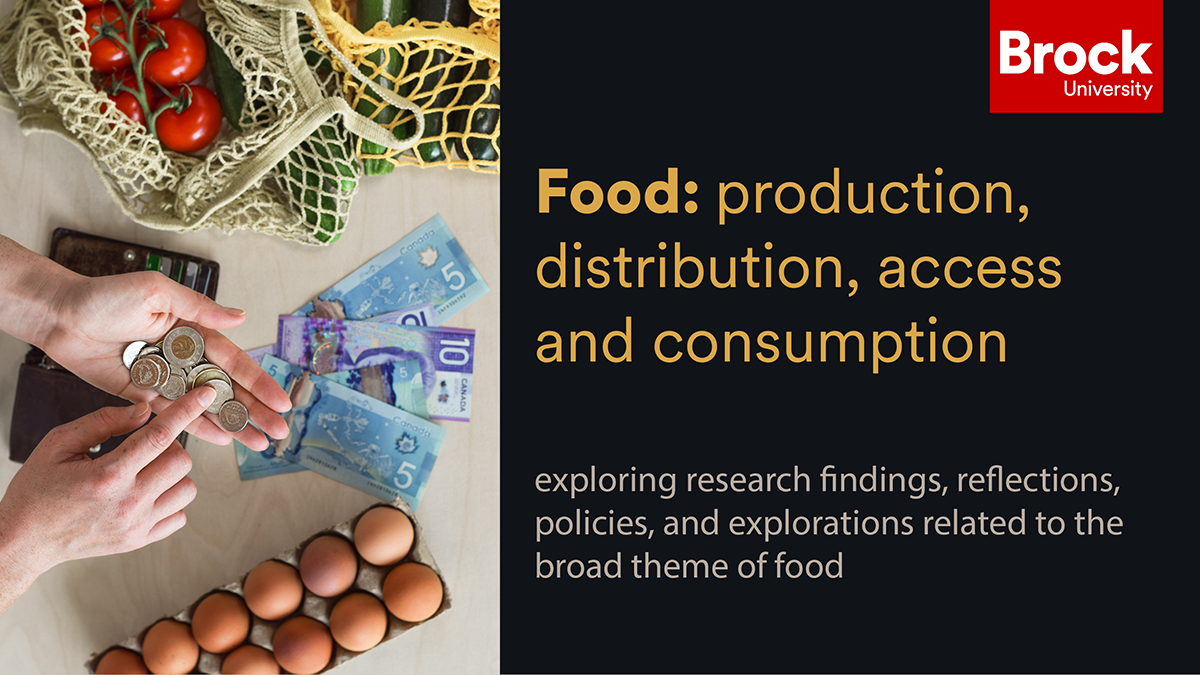
Presenters at this virtual event shared research findings, reflections, policies, and explorations representing a range of perspectives related to the broad theme of food.
Click on the titles below to reveal presenter information, abstracts, and links to additional resources related to the featured projects.
04:10 – Panel 1: Setting the Table
57:16 – Panel 2: Food for Thought
1:45:48 – Panel 3: Appetite for Change
Presenters and Abstracts
Below is a list of sessions and presentations. Click on each title to reveal details. Session times are approximate.
Setting the table
(9:40 to 10:25 a.m.)
Ethan Moncion, History, Brock University
The Provincial Marine was a little known British Canadian military unit. They emerged as a separate navy for North America’s inland waterways during the Seven Years War (1756-1763). In both that war and the American Revolution they saw combat, and in wartime and peacetime they supplied the army. During peacetime, they fell into disorder and by the War of 1812 they were in no shape to face the American invasion on the inland seas. In this conflict, war of attrition tactics used by both sides wreaked havoc with military and civilian society. The Americans especially pursued genocidal designs against the sovereign Indigenous Nations. To help counter this, the Provincial Marine transported provisions and protected civilian vessels. Though maligned as a fighting force, they supported the army as a transport service of both personnel and provisions ensuring that freedom of allied British and Indigenous maritime communications across the Great Lakes remained intact.
This study explores these developments by focusing on the foodways of Provincial Marine sailors and the ground troops they supplied. I devote careful attention to both food shipments and supplies such as firewood and utensils needed for cooking. I rely on a wide variety of sources including personal papers, official records, and archaeological research. This reveals, for example, the connections between the Provincial Marine and civilian suppliers of the military such as Robert Hamilton, especially through the bonds of Freemasonry. In doing so, this research elucidates how people fed themselves in a war of attrition and how people adapted to the unique circumstances of provisioning on the inland seas.
View a PDF of Ethan Moncion’s presentation
Phillip Gordon Mackintosh, Geography and Tourism Studies, Brock University
The economic turmoil of the 1890s embedded heartbreaking hardship in Toronto for decades, engendering privations that included food precarity for thousands of underpaid workers. This layered atop the already appalling austerity attending the hegemony of laissez-faire capitalism in a survival-of-the-fittest city constructed to abet “stony capitalists who gave no quarter to the powerless and beleaguered workers who populated” it (Mackintosh 2025, 2). Companies and bosses freely abused their working-class employees, especially through the use of minimal wages: compensation calculated “to see how much … A man can live on Without starvin’ to death” (Cincinnati Enquirer 1899). Imagine, then, that mental ill-health stalked one specific, impecunious demographic: women garment workers, who laboured long hours for meagre pay in a time of unaffordable food and rent. Their consequent psychic and somatic trauma—emulating that of overburdened workers across the Western world at the turn of the twentieth century—was universally diagnosed as “neurasthenia.” The strangely named malady was stress: anxiety, depression, and a litany of corporeal complaints (Beard 1881, 7-8) likely caused by freely flowing cortisol in tormented bodies (Lundberg 2005). I argue—but in fact must, and can only, speculate—that the working conditions and shameful remuneration of lowly women garment workers, forced to turn their own food-scarce homes into sweatshops, produced undiagnosed mental and physical ill-health recognizable as neurasthenia, doubtless worsened by costly nutrition.
Visit Professor Mackintosh’s FACULTY PAGE
ADDITIONAL RESOURCES:
Mackintosh, P. G. (2025). Neurasthenia and the Modern City: Genealogical Speculations on Capitalism-Urged Anxiety, Stress, and Suicide in North America, 1890–1920. Journal of Urban History. https://journals.sagepub.com/doi/10.1177/00961442251325201
View a PDF of Professor Mackintosh’s presentation
Emma Craib, History, Brock University
In its first decade, the state of Israel was under the policy of Tzena (austerity), which involved government regulation of goods including food. The Tzena policy served an economic function and a state-building purpose. Notably, as Israel was primarily established through immigration, rationing served to universalize what would become the national cuisine by constraining what food was distributed and in what quantities. In this way, it encouraged new immigrants to abandon or alter the cuisines of their previous homelands in favor of ‘Israeli’ food. Additionally, rationing also sought to overcome barriers to identity construction that were associated with a country based on new immigrants and on the Tishuv, Jews who had immigrated before or during the mandate period. Finally, rationing served to overcome the issues of the diverse population through the creation of a mutual cultural identity of sacrifice. These processes can be seen by tracing the development of rationing laws from 1949-1953 and the subsequent rejection of these regulations in the 1954-1959 period. As this presentation will demonstrate, rationing had a homogenizing effect which aided in nation-building through the regulated development of a national cuisine.
View a PDF of Emma Craib’s presentation
Food for thought
(10:25 to 11:10 a.m.)
Gary Pickering, Biological Sciences/Psychology, Brock University
In response to the climate and environmental crises due in part to the unsustainable activities of the industrialised agri-food sector, interest has grown in the role of consumers in promoting system change through everyday dietary decisions and demand behaviour. Foodies are individuals with high involvement in and knowledge of food, and the recent development of The Foodie Index has enabled researchers to objectively delineate foodies from non-foodies and determine attitudinal and behavioral differences between them. We describe two recent studies that seek to determine the sustainable dietary behaviours of foodies and non-foodies. In the first study we measured the saliency of sustainability when making food choices, concern about food sustainability and protecting the environment, pro-environmental values, and sustainable food literacy in a sample of 617 youth. We also determined their action stage for 15 behaviours associated with environmental, social and economic dimensions of sustainable dietary behaviour. In the second study, we assessed the same variables and the level of engagement with these dietary behaviours in 824 adults from four countries in the Global North. Results show that foodies have higher food sustainability concern and literacy, and are much more engaged in sustainable dietary behaviors. This greater sustainability-mindedness and behaviour of foodies is discussed with regard to potential to help shape consumer attitudes and actions toward more sustainable diets.
Visit Professor Pickering’s FACULTY PAGE
View a PDF of Professor Pickering’s presentation
Jacqueline Botterill, Communication, Popular Culture and Film, Brock University
In extended open-ended interviews, 25 young Southern Ontario adults described valuing smartphone-free commensality while experiencing hectic, fragmented lifestyles that made solo eating common. Yet eating alone without a phone was unthinkable to participants: “What am I going to do, stare at the wall?”
Following Innis’s medium theory, I argue the phone’s space-biased affordances restructure what eating alone is, transforming unmediated moments from neutral to intolerable. This deep cultural assumption operates below conscious awareness, rendering alternatives cognitively unavailable.
Applying Warde’s practice theory, I examine what I call “foodprints”; smartphone-food entanglements that contradict participants’ descriptions of “seamless” use by revealing constant unrecognized work: managing screen smears, fearing drops, adjusting bodies. What felt effortless involved continuous friction.
Seamless design ideology conceals these material frictions while making supply chains invisible. It’s not reasonable to expect individuals to trace global extraction while eating their lunch. This naturalization matters because you cannot question what you cannot see. Making invisible practices visible reveals how biological necessities become colonized by platform interests while structural barriers prevent the commensality participants actually value.
Visit Dr. Botterill’s FACULTY PAGE
View a PDF of Dr. Botterill’s Presentation
Tochi Omah, Health Sciences, Brock University
What we eat is often talked about as being important for mental health, especially for university students. However, less attention is paid to the everyday reasons behind students’ food choices and how these experiences shape how they feel. This presentation shares findings from a qualitative study exploring how undergraduate students at Brock University understand the relationship between their eating habits and their mental well-being.
View a PDF of Tochi Omah’s presentation
Appetite for change
(11:20 a.m. to 12:25 p.m.)
Kerrie Pickering, Public Health, Geography, University of Alberta
Indigenous Peoples’ food systems are complex, place-based systems that link food production, distribution, and consumption with health, culture, and relationships to land and water. This presentation examines how climate change is reshaping Indigenous food systems across diverse global contexts, with cascading implications for nutrition, wellbeing, and community health.
Drawing on qualitative and participatory research, the presentation explores how environmental change—through altered seasons, extreme weather events, and ecological degradation—disrupts everyday food practices such as harvesting, preparation, storage, and sharing. These disruptions affect food availability and dietary quality, while also reshaping access to healthcare, the transmission of food knowledge, and the organization of care within households and communities.
Rather than framing Indigenous food systems solely through vulnerability, the presentation highlights adaptive capacities embedded within them, including adjustments to food practices, knowledge maintenance, and community-led responses to environmental change. These responses challenge dominant food systems frameworks that prioritize productivity and efficiency over relationships, care, and long-term sustainability.
By situating Indigenous food systems at the climate–food–health nexus, this presentation invites reflection on equity, knowledge, and governance in contemporary food systems. It concludes by discussing implications for food policy and climate adaptation, emphasizing the need to recognize Indigenous food systems as central to resilience, wellbeing, and self-determination.
View a PDF of Kerrie Pickering’s presentation
Charles Conteh, Political Science, Director, Niagara Community Observatory Research Associate, Brock University
Martha Barnes, Recreation and Leisure Studies, Niagara Community Observatory Research Associate, Brock University, Brock University
Carole Phillips, Research Coordinator, Niagara Community Observatory, Brock University
Our project maps the ecosystem of greenhouse technology service delivery, ultimately focusing on agricultural intermediaries as public service/program delivery entities. Our research questions ask: How do intermediary organizations support greenhouse agribusinesses and promote the uptake of innovation? How do they create value for their end-users? Who do they include in their network to achieve their goal of promoting innovation in the agri-food industry?
We will undertake the following:
- A macro-level analysis of longitudinal trends in Canada’s agriculture sector, with a focus on the greenhouse industry.
- A meso-level mapping of the network of greenhouse innovation program delivery entities and their inter-organizational constellations of partners and service/program end-users.
- A micro-level analysis of individual perceptions/perspectives of key actors (including service providers and end-users) about the structure, process and outcomes of value co-creation. This level will also explore individual values, beliefs, and related perspectives on the appropriate role of government in the industry.
The anticipated outcomes of the project are to shed light on statistical trends in the greenhouse industry, the structure of the industry’s program-delivery network, and the perceptions of key actors (service providers and end-users) regarding the structure, processes, and outcomes of value co-creation in the greenhouse industry.
Visit Professor Conteh’s FACULTY PAGE
Visit Dr. Barne’s FACULTY PAGE
Learn more about the Niagara Community Observatory
View a PDF of Professor Conteh’s Presentation
George Mackintosh, Geography and Tourism Studies, Brock University
In 2026, the crisis of affordability has become the dominant political conundrum. Decades of short-sighted policy decisions have led to an epidemic of food insecurity and chronic malnutrition affecting populations at both the macro and micro scale, in countries and cities across the globe. For nearly 35 years, research into these concerns has centred around the existence of “food deserts”. This presentation will provide a brief history of the conceptual utility of the food desert and its impact on urban quality-of-life, focusing specifically on identifying their presence and impact in the city of St. Catharines, Ontario, with the accompanying digital map providing both a visual representation of the presence of food deserts across the city’s six electoral wards as well as a means of geospatial analysis.
View a PDF of George Mackintosh’s presentation
Joanne Heritz, Political Science, Brock University
Are policy makers fully aware of the increasing number of people who face hunger in their community? The increasing dependency of households on food banks and community meals is an indicator of a bigger policy problem: poverty in Niagara.
Meal programs act somewhat in isolation from each other, to provide a neighbourhood or a community need. It is only when we aggregate the number of congregate-meal programs that take place in Niagara that we can see, not only how many meals are served, but how the number of meals served is increasing over time. In 2024, over 350,000 meals were served by community meal programs across Niagara. In addition to community meals the 10 Feed Niagara food banks experienced unprecedented increases in food bank visits between 2022 and 2024 with four of them experiencing 100 per cent increases in visits.
Hunger is a strong indicator of poverty, yet its pervasiveness in our community remains relatively unknown to policy makers. Working in collaboration with local community meal providers, this case study will investigate the impact of hunger in Niagara. The research question asks, does the relationship between hunger and poverty makes a strong argument for a basic income?
Visit Dr. Heritz’s FACULTY PAGE
Additional Resources:
Heritz, Joanne. (2025). Increasing Hunger in Niagara. Niagara Community Observatory Policy Brief #62 October 2025 https://brocku.ca/niagara-community-observatory/wp-content/uploads/sites/117/Brock-NCO-Policy-Brief-62-HERITZ-Increasing-Hunger-in-Niagara-Final-October-2025.pdf
Heritz, Joanne. (2024). Sustaining Food Security in Niagara. Niagara Community Observatory Policy Brief #58 April 2024 https://brocku.ca/niagara-community-observatory/wp-content/uploads/sites/117/NCO-Policy-Brief-58-Sustaining-Food-Security-in-Niagara-April-2024-FINAL.pdf
View a PDF of Dr. Heritz’s presentation
About the series
Hosted by the Faculty of Social Sciences, this series aims to showcase the variety of work being conducted by faculty and student researchers across Brock University, to uncover an array of perspectives, and to foster potential synergies and collaborations.
Cross-disciplinary and cross-Faculty participation is encouraged.
Learn how to participate in this Symposium Series.
