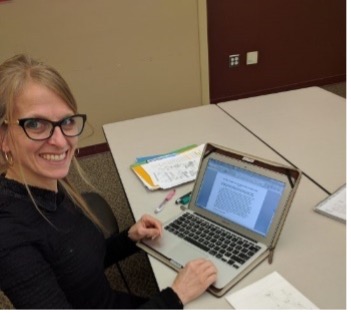
The Brock Department of History is pleased to announce that Trudy Tattersall, will defend her Ph.D. dissertation in Interdisciplinary Humanities on Tuesday, July 14.
The defence will be held in Room 600F of the Plaza building on the Brock University campus from 12 noon to 3 p.m. Interested members of the public are welcome to attend.
Trudy is a long-time teaching assistant and part-time instructor in the History Department. Her Ph.D. supervisor is Dr. Daniel Samson, a faculty member in the Department
The thesis is entitled, “A Mingled Yarn”: Needlework, Emotional Communities, and Affective Experience in Settler-Colonial Maritime Canada.”
Dissertation abstract
This dissertation examines 18th- and 19th-century needlework – particularly schoolgirl samplers – as material and affective practices through which women’s emotional lives, identities, and social values were shaped in settler-colonial societies. Focusing on Maritime Canada, it places samplers and other forms of needlework in dialogue with women’s diaries, letters, school advertisements, and prescriptive educational literature to explore how emotion, discipline, and belonging were produced through tactile, bodily engagement with and reflection on material objects.
The dissertation intervenes in a field dominated by British and New England scholarship that tends to frame samplers primarily as decorative, genealogical, or completed pedagogical texts. It reframes needlework as emotional practice, material literacy, and historical evidence. It approach needlework as a proprioceptive and embodied knowledge practice that required intimate encounters between body, tool, and textile.
The study brings together feminist material culture theory, gender history, affect theory, and the history of emotions, drawing on the theoretical frameworks of Barbara Rosenwein, Sara Ahmed, Laurel Thatcher Ulrich, and Iris Marion Young to demonstrate that needlework functioned as a form of emotional governance. Across its chapters, the thesis analyzes samplers as pedagogical exercises, visual and textual compositions, sensory objects, and intergenerational heirlooms. It demonstrates how the embodied act of stitching and the material qualities of textiles shaped emotional regulation, self-understanding, and community affiliation. The final chapter considers the preservation of samplers as family heirlooms and museum artefacts, arguing that female preservation practices constituted vital cultural and affective labor shaping family memory and institutional collections.
Needlework produced shared ways of feeling and behaving that marked girls as properly socialized members of settler communities, linking emotional discipline and technical skill to respectability, legitimacy, and identity. By treating needlework as both historical evidence and emotional practice, this thesis challenges the idea that the domestic sphere was insignificant or apolitical. It demonstrates that everyday forms of making and preserving textiles played an important role in shaping women’s lives and sustaining colonial social values, and it places women’s material and emotional experiences at the center of the history of early Atlantic Canada. It reveals that the emotional worlds of girls and women, so often dismissed as private or apolitical, were in fact deeply constitutive of the social, moral, and ideological fabric of early Maritime Canada.