The Brock Department of History is delighted to congratulate Dr. Renée Girard for receiving the Canadian Historical Review Best Article Prize for 2025.
The prize is awarded annually to the author of the article appearing in the CHR who “best demonstrates the finest qualities of advanced historical scholarship: an original and compelling argument that engages and contributes to the historiography, deep research and analysis usually engaging with primary sources, and well-crafted writing.”
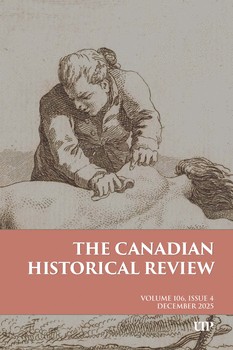
The article, entitled “Un mode par excellence de resurrection des noyés: la fumée du tabac et la persistence des pratiques autochtones dans la France du XVIIIe siècle,” appears in the December 2025 issue of the CHR (vol. 106, no. 4).
Dr. Girard holds adjunct faculty status in the History Department. She earned her MA in the Department and her Ph.D. at McGill University and has taught several history courses at Brock. Kudos for this well deserved honour!
From the journal’s editorial board: “In 1748 a physician wrote a pamphlet promoting tobacco enemas as a new way to revive people who had drowned or suffocated and by the mid-nineteenth century it had become a widely accepted method. In this intriguing and surprising article, Girard traces the origins of this medical practice to North American Indigenous ceremonial and diplomatic uses of tobacco. This article is an original and innovative examination of the intersections between western European medicine and Indigenous knowledge. Introduced to Europe by soldiers, the popular use of tobacco enemas demonstrates European fascination with the plant’s supposedly mysterious properties. Cartesian medicine, based in experimentation, distanced medical theories about tobacco’s ability to reanimate from its Indigenous origins, and similarly, historians looking to understand the medicinal use of tobacco through European sources have also erased the connections to Indigenous spiritual and medical practices. Girard’s research demonstrates the complexity of the circulation of knowledge systems in the Atlantic World and the integration of Indigenous epistemologies into European medicine” (CHR vol. 107, no. 2 [June 2026]).