News

  • Talented SSAS students recognised with prestigious scholarships

    By: Lydia Collas

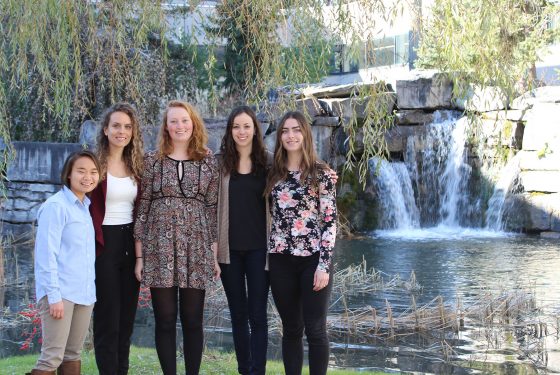
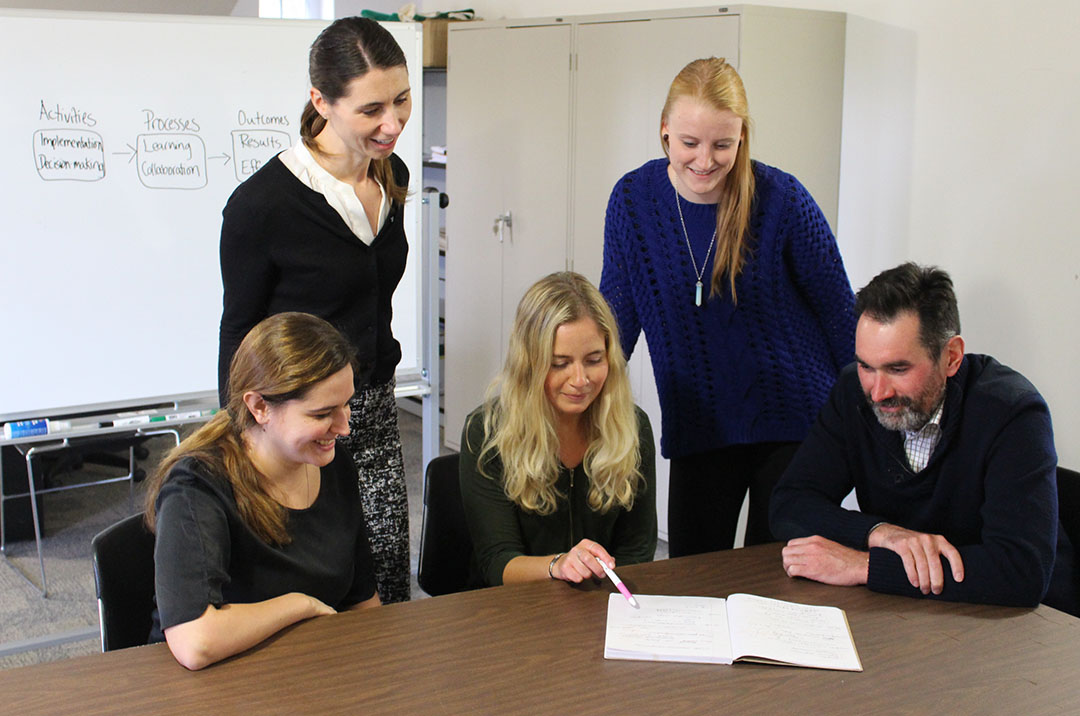
    2017 Scholarship Award Winners

    In photo (from left to right): Lyn Brown, Emilie Jobin Poirier, Lydia Collas, Alison Feist, and Dana Harris

    As we near the end of the calendar year, we would like to highlight the success of our students in the Sustainability: Science and Society program and bring attention to the awards and scholarships that they have received. Francine McCarthy, acting Graduate Program Director, is tremendously proud of the students, “We have a terrific group of talented young people interested in a wide variety of projects related to sustainable development. It is great to see that formally recognized with these awards”.

    First year student, Lyn Brown, received the Ontario Paper Thorold Foundation Graduate Award which is awarded to a student at Brock University who is pursuing a degree with a focus on environmental studies. Lyn said “This award has allowed me to be able to focus on my studies, and not have to have a part-time job during my schooling. This extra time has let me get fieldwork experience volunteering for different local conservation groups like going electrofishing with the Ministry of Natural Resources, and doing water analysis with the Niagara Peninsular Conservation Authority.”

    Lydia Collas, a second year student, was awarded the Brock University Guernsey Postgraduate Scholarship which provides full coverage of fees. Lydia explained, “This scholarship is awarded annually to a resident of Guernsey, in tribute to the island being the birthplace of Sir Isaac Brock. This scholarship has enabled me to have the unforgettable experience of pursuing my Master’s degree in Canada! I was also awarded the Dean of Graduate Studies Spring Fellowship for the Faculty of Social Sciences which is awarded to support research completed in the Spring semester. During this time, I researched and wrote a review paper which I have submitted to a peer-reviewed journal.”

    The Ontario Graduate Scholarship is a merit-based award that provides funding for Master’s and doctoral level students at a number of institutions across Ontario. Alison Feist was one of the recipients of this award, “This year 52 students at Brock University received this scholarship based on academic excellence, communication and leadership ability, and research potential. Receiving this scholarship has enabled me to enhance my thesis research in the SSAS program and have the wonderful opportunity of conducting fieldwork outside the province, learning more about collaborative climate change adaptation on the ground.”

    Dana Harris’ hometown is Yellowknife, NWT, where she lived before moving to Brock University for the duration of her university studies. Now a second year student in the SSAS program, awards from the Association of Canadian Universities for Northern Studies (ACUNS) have enabled her to conduct research closer to home. Dana explains, “I was awarded the ACUNS Scholarship which serves to promote and assist in the continuation of northern research by northern graduate students. In 2016, I was awarded the Northern Resident award to support the fieldwork I completed that summer. And in 2017, I was awarded a grant by the Northern Scientific Training Program to assist with the transportation expenses I faced travelling to and from my research site. These awards have allowed me to pursue academic research and promote scientific knowledge in my hometown, Yellowknife.”

    Emilie Jobin Poirier was awarded the Joseph-Armand Bombardier Canada Graduate Scholarship by the Social Science and Humanities Research Council. Emilie said, “This 12-month funding enables me to entirely focus on my transdisciplinary research on climate change adaptation in the Canadian wine industry. Through SSHRC’s support, I have also traveled to other provinces to promote my research and gain a better understanding of the impacts climate change has on grape and wine production in Canada.”

    The Environmental Sustainability Research Centre (ESRC) at Brock University launched the SSAS program in September 2014. The program has consistently attracted exceptional students, with an increasing number coming from other provinces and other countries. The ESRC’s Director, Ryan Plummer, reflects on the impact and importance of such scholarships, “Graduate school is about pursuing academic excellence and these scholarships enable opportunities for the recipients to enrich their experience and catalyze their research. The high number and diversity of awards and external scholarship bodes extremely well for the calibre of our relatively young program and I have every confidence this trajectory will continue for years to come”.

    The SSAS program is now accepting applications for 2018 entry. For more information and  to apply please visit https://brocku.ca/esrc/ssas/.

  • New ESRC research examines environmental governance

    Experience, process and both social and ecological outcomes are at the heart of new research out of the Environmental Sustainability Research Centre (ESRC) on effective environmental governance.

    The study, funded by the Swedish Research Council, looked at individuals involved with environmental governance in two UNESCO Biosphere Reserves in Canada and two in Sweden.

    The subjects came from different backgrounds including government and non-government organizations, private businesses and landowners, but all were active within their local Biosphere Reserve.

    “We found the experiences that individuals have when they engage in stewardship matter,” says researcher Julia Baird, Assistant Professor in ESRC and Tier 2 Canada Research Chair on Water Resilience.

    “There’s an important relationship between how engaged they are, their perceptions of the social processes that occur when they participate in stewardship activities and to what extent they believe outcomes — both ecological and social or well-being — are being realized.”

    By assessing participation, learning and collaboration as factors in how these individual stakeholders viewed the results of their stewardship efforts, the study provides statistical evidence of their importance — something which, as the study authors point out, is “often presumed, but rarely proven.”

    Co-author Ryan Plummer, Professor and Director of the ESRC, says the study gives rise to several new questions related to both theory and practice of advancing environmental stewardship and resilience.

    Baird agrees.

    “We are actively pursuing several research questions as a result of our findings, including transferability to other contexts, the psychological questions around engagement in stewardship, and closer and more nuanced understandings of the key variables that we are interested in,” she says.

    Transferability to other contexts could have future implications in many different environmental governance contexts, including here at Brock.

    As Plummer points out, “Brock University is uniquely positioned in a UNESCO Biosphere Reserve. Our research may inform the approach to management and governance of our very own Biosphere Reserve.”

    Plummer, Baird and Brock post-doctoral fellow Angela Dzyundzyak worked with researchers from Stockholm University and the University of Waterloo to complete the study.

    Several graduate students associated with the Sustainability Science and Society program, including Alison Feist, Brooke Kapeller, Katrina Krievins and Angela Mallette, were also actively involved throughout the project in data collection, analysis, and reporting.

    A paper detailing the study, “How do environmental governance processes shape evaluation of outcomes by stakeholders? A causal pathways approach,” appeared in the jounral PLOS ONEearlier this fall.

  • Master of Sustainability Student Selected “Editor’s Choice” in Journal of Applied Ecology

    Lydia Collas

    The undergraduate research of Lydia Collas, second year student in the Sustainability Science and Society (SSAS) graduate program, is to appear as the Editor’s Choice in the December issue of the Journal of Applied Ecology.

    Before moving to Canada last year, Lydia studied a B.A. (Hons.) degree in Natural Sciences at the University of Cambridge. It was during this time that Lydia completed the project entitled “Land sharing, land sparing and urban development: the importance of considering restoration” that would eventually see publication this December.

    The research considers how best to reconcile biodiversity conservation with urban development. “Worldwide, human populations in cities are growing rapidly and so urban centres are expanding with more houses being built,” Lydia explained. “We wanted to look at what effect this has on nature to find out how nature could be conserved.” The study applies the land sharing/sparing framework to answer this question.

    “There are typically two schools of thought of how we should seek to maintain biodiversity in a landscape whilst also meeting human needs. In the context of urban development, land sharing would see low-density housing, with large gardens, built in an attempt to support wild populations alongside humans. Under land sparing, high density housing would be built such that the human population could be supported in a smaller area, enabling the ‘sparing’ of large areas of green space for nature. In this case, the land for humans and the land for nature are spatially explicit.”

    This research investigated how native tree populations in the city of Cambridge fared under different development strategies, on a gradient from land sharing to land sparing, whilst meeting the housing demand of the population forecasted for the year 2031. The authors also considered the implications of restoring woodland on areas of green space, which are largely maintained with little vegetation at present.

    The results show that land-sharing development would see the native tree population slightly increase in size owing to the relatively higher density of trees in low-density housing which is accompanied by large gardens. However, if areas of green space within the city could be restored to woodland, the optimal strategy becomes one of land-sparing which could see tree populations increase 12-fold. Indeed, land sparing becomes the favourable strategy after just 2% of the city’s green space is restored to woodland.

    Having submitted this work to the Journal of Applied Ecology in September 2016, Lydia is very much looking forward to seeing this work in print next month.

    “To be first author on a publication at this stage of my career is so exciting. I am hugely grateful for the support of my supervisors, Professors Andrew Balmford and Rhys Green, whom this would not have been possible without, as well as my talented colleagues Alex Ross and Josie Wastell.”

    Dr. Ryan Plummer, Professor and Director of the Environmental Sustainability Research Centre, which hosts the SSAS program put this publication into perspective and expressed his pride at this achievement.

    “The Journal of Applied Ecology is a Q1 (2.869 SJR) journal in which established Faculty researchers aspire to publish. Editor’s Choice recognition in such a high-quality journal is a tremendous accomplishment, and nod to the scientific calibre of Lydia’s research. I am tremendously proud of Lydia! This accomplishment exemplifies the high calibre of scholarship to which graduate students at Brock should aspire and the importance of scholarships to enable exceptional international students to study at Brock.”

    As Lydia nears the end of her time in the SSAS program, she is looking to remain in academia and is currently putting together PhD applications. We wish her every success.

    Associate editor, Joseph Bennett, has written a commentary on the paper.
    To read the full paper, please visit here.
  • Brock University gains new Canada Research Chair in water resilience

    Water is all around us, and it’s something many Canadians take for granted. But water quality and quantity is increasingly threatened by climate change, pollution and other human-driven impacts.

    Brock University Assistant Professor Julia Baird researches how we can foster resilience of freshwater resources through management and governance in an era of rapid change and uncertainty.

    “Water is vital; everybody knows it. Water is an incredibly critical resource and it’s under pressure,” says Baird, who was named Brock’s newest Canada Research Chair last week by the Canadian government.

    As Canada Research Chair in Human Dimensions of Water Resources and Water Resilience, Baird is studying a “new water paradigm,” a view that recognizes the complex interactions between freshwater social and ecological systems that are constantly being influenced by internal and external forces.

    Because of this complexity, uncertainty and dynamic nature of these systems, the old “command-and-control” approach to making decisions about water “is not going to sustain ecosystems or humans in the future,” says Baird.

    The foundation of her work is the concept of resilience: the capacity to retain structure and function during times of change; learn, adapt and transform when faced with that change; and organize itself to meet the challenges.

    “I’m interested in management and governance approaches that incorporate ideas of resilience: the ability to adapt and change to support human and ecosystem well-being,” says Baird, Assistant Professor in Brock’s Environmental Sustainability Research Centre (ESRC) and the Department of Geography and Tourism Studies.

    Underlying Baird’s work is the belief that humans are impacting the earth and that a new time period — the Anthropocene — should be added to the planet’s official geologic timeline.

    “We are in an era where humans are the driving force of change,” she says. “We need to really think about how we’re managing our actions. The social dimension is critical.”

    Baird’s research will focus on how freshwater resilience can be fostered by society and what needs to be done to respond to increasing challenges and complexities.

    She will also examine how individual actions aimed at restoring the ecosystem contribute to building resilience, and understand how social networks and other factors influence decision-making at that individual level.

    Baird says she “couldn’t be happier” with her Canada Research Chair appointment.

    “It’s a really great opportunity,” she says. “It provides tremendous support for my program of research and acknowledgement of the importance of water resilience as a priority research area here at Brock and for Canada.

    “This also provides opportunities to engage in national and international collaborations. It gives me that boost at the beginning of my career to really excel in my field.”

    Baird, who has a background in agricultural sciences and environment and sustainability, joined Brock in 2011 as a post-doctoral fellow, earning her PhD from the University of Saskatchewan in 2012. She became an adjunct professor in the ESRC in 2015, and an assistant professor in the ESRC and the Department of Geography and Tourism Studies earlier this year. She says the ESRC, Faculty of Social Sciences and Office of Research Services have all played a big role in supporting both her work and the CRC nomination process.

    Baird has a history of international research partnerships. In a 2016 study involving research partners from across Europe, Australia and Canada, Baird and her colleagues found there are a wide range of perceptions about water resilience and how water resources should be governed across multiple international cases.

    “Baird is an outstanding researcher whose work has national and international impact. This award recognizes her outstanding accomplishments, and it will help further her career as a scholar,” says Joffre Mercier, Brock’s Interim Vice-President, Research.

    With Baird’s award, Brock now has a total of 11 Canada Research Chairs.


     Story from The Brock News
  • Life after the Sustainability Science and Society graduate program with Brodie Hague

    Interview conducted by Lydia Collas 

    Brodie Hague

    Photo: Brodie Hague graduated from the SSAS program in 2016

    Brodie Hague was amongst the first cohort of students to embark on Brock’s Sustainability Science and Society (SSAS) program. Having graduated in 2016, Brodie is now writing course material for Brock’s recently launched undergraduate minor in Environmental Sustainability. I recently caught up with Brodie to find out a bit more about where the SSAS program had led him.

    Q. Brodie, first of all, can you tell me what attracted you to the SSAS program?
    A. My eventual thesis supervisor, Dr. Marilyne Jollineau, first introduced me to the SSAS program when I was considering graduate studies. During the completion of my undergraduate degree at Brock University, I became increasingly aware of the University’s respected (and growing) reputation for scholarship, teaching, and learning. In addition, Brock’s unique location within a UNESCO Biosphere Reserve, the ESRC’s transdisciplinary approach to sustainability research and education, and the generous graduate funding package made Brock University the ideal location to pursue my graduate degree in Sustainability.

    Q. You were in the thesis stream which requires students to do an in-depth primary research project, what was your research on?
    A. My research was on the use of remote sensing technologies to map and monitor coastal dune ecosystems in Southampton, Ontario. In particular, I was interested in the health of the dune system and the spatial and temporal patterns of change in vegetation cover within the dune system.

    Q. What is your favourite memory from your time in the program?
    A. While I have many fond memories from my time in the program, my favourite memory was when the Lieutenant-Governor Elizabeth Dowdeswell visited Brock and invited us to participate in a roundtable discussion on “Social Aspects of Environmental Sustainability” in December 2014. As part of the roundtable, our graduate cohort presented a graduate project and engaged in a discussion with fellow ESRC Faculty, colleagues, and the Lieutenant-Governor.

    Q. What are you up to now? How do you think the SSAS program prepared you for doing that?
    A. I’m currently employed within the ESRC as both a Research Assistant and as a Co-instructor for the new online course, ENSU 2P01 (Introduction to Environmental Sustainability). In my capacity as a Research Assistant, I assisted in the development of the ESRC’s proposal and budget for eCampus Ontario’s Open Content Initiative. In addition, I’m also the co-project leader for the ESRC’s eCampus Ontario Project, which involves the development and writing of online open module content. This content will also help form the basis for the new online course, ENSU 2P02, Environmental Sustainability in Practice. I am also employed as an Instructor in the Department of Geography and Tourism Studies teaching GEOG 2P07 (Introduction to Geospatial Technologies) and GEOG 3P07 (Remote Sensing).

    Q. How do you think the SSAS program has prepared you for the next step?
    A. The SSAS program provided me with the knowledge and skills required to develop and teach these courses. In addition, the program provided me with the opportunity to develop networks and collegial relationships among Faculty members which has been imperative in the co-ordinating and implementation of our eCampus Ontario project.

    In recognition of Brodie’s excellence as a Teaching Assistant, he was awarded the Novice Teaching Assistant Award in April 2015. Brodie also received generous financial support from the Department of Geography and Tourism Studies for his research. The ESRC is delighted that Brodie has continued on at Brock University following his completion of the SSAS program and looks forward to seeing what the future holds for this very talented alumnus!

    Learn more about the Sustainability and Science Program

  • Canadian UN body appoints Brock biologist to senior position

    Liette Vasseur

    The Canadian Commission for the United Nations Educational, Scientific and Cultural Organization (CCUNESCO) has appointed Brock biologist Liette Vasseur to head up one of its commissions.

    Vasseur is President of CCUNESCO’s Sectoral Commission on Natural, Social and Human Sciences, an 11-member group of Canadian scientists, academics and others providing knowledge and expertise on a range of issues.

    These include social and environmental impacts of climate change; conservation of natural heritage and water resources; inclusion of newcomers and vulnerable groups; reconciliation between indigenous and non-indigenous people; youth engagement; and measures to fight discrimination, racism, violence, bullying and radicalization.

    Brock biologist Liette Vasseur, right, who was recently appointed as President of CCUNESCO’s Sectoral Commission on Natural, Social and Human Sciences, is pictured with Louise Vandelac, former Chair of the Canadian Commission for UNESCO’s Sectoral Commission on Human, Social and Natural Sciences, and Sébastien Goupil, General Secretary of CCUNESCO.

    “We’re producing reflection papers on some of the topics we believe are important to come up with a long-range vision of how Canadians and the federal government can implement various actions related to sustainability,” explains Vasseur.

    The Sectoral Commission advises CCUNESCO on the organization’s programs and activities in these areas.

    In turn, CCUNESCO, operating under the Canada Council for the Arts, seeks to connect Canadians to the broader work of UNESCO, whose work “contributes to a peaceful, equitable and sustainable future that leaves no one behind.”

    Vasseur’s Oct. 2 appointment is the latest in several leadership positions she holds at the international level since being named UNESCO Chair in Community Sustainability: From Local to Global in June 2014.

    In September 2016, the International Union for Conservation of Nature (IUCN) named Vasseur as Vice-Chair North America and Caribbean Region on the IUCN’s 14-member steering committee of the Commission on Ecosystem Management. She oversees a portfolio of six of the commission’s 30 thematic and specialist groups.

    The IUCN, based in Switzerland, is considered to be the leading authority on the natural environment, providing scientific research and expertise to governments and civic groups.

    IUCN, drawing upon the knowledge of 16,000 experts worldwide, covers the areas of species survival, environmental law, protected areas, social and economic policy, ecosystem management, and education and communication. Its Red List of Threatened Species, which tracks the risk of extinction of thousands of plant and animal species and subspecies, is considered to be the world’s most comprehensive and authoritative inventory of Earth’s biological diversity.

    She also leads the Commission on Ecosystem Management’s Ecosystem Governance group. Ecosystem governance is defined as ways that societies make decisions and develop actions in relation to the management of their ecosystems.

    “In ecosystem governance, local decisions are promoted instead of a top-down approach to decision making as it’s context-dependent,” Vasseur explains. “The management of ecosystems depends on cultural and local circumstances.”

    Within the ecosystem governance group, she is currently collecting case studies of ecosystem governance in different countries to better understand specific environmental protection measures that can help other communities in the world create their management plans.

    “Community should be involved in decision-making, planning and implementation, monitoring and evaluation, or else efforts to protect the environment will not be successful,” Vasseur says.

    Her leadership roles enable her to apply her expertise in many ways.

    “It’s all about bringing people together, empowering people to figure out how to connect the dots in these issues,” she says.

    “It’s important for me to give back and contribute to society.”

    Story from The Brock News

  • Coming soon!

    Stay tuned – the ESRC will be launching a blog! More information to come.

    Categories: Blog

  • Town of Lincoln, Brock launch Living Lab initiative

    Mayor: partnership will help guide policy development, decision-making

    NEWS Oct 06, 2017 by Scott Rosts  Grimsby Lincoln News

    Town of Lincoln, Brock launch Living Lab initiative

    Town of Lincoln CAO Michael Kirkopoulos and Mayor Sandra Easton sign documents with Brock University president Gervan Fearon and Brock’s Environmental Sustainability Research Centre director Ryan Plummer to formally launch the Brock-Lincoln Living Lab partnership. The Living Lab will focus on addressing specific local needs around community sustainability and wellbeing and will assist with guiding policy development nad decision making, said Easton. – Courtesy Photo

    LINCOLN — The Town of Lincoln and Brock University have formally launched a partnership that will help guide the town with future policy development and decision-making.

    On Oct. 3, Brock and town officials celebrated the launch of the Brock-Lincoln Living Lab at an event at Vineland Estates Winery. The goal of the initiative is to have university students, through Brock’s Environmental Sustainability Research Centre, contribute to the Living Lab’s work through their research and the partnership offers a conduit for experiential education that extends curriculum into the community.

    Ryan Plummer, director of Brock’s Environmental Sustainability Research Centre, says efforts will focus on addressing specific local needs around sustainable municipal planning and advancing areas such as economic, social and community development.

    “It’s a platform to interact and bring together community leaders, policy-makers, researchers and students who all have a shared commitment to explore and investigate issues vital to the community and its well-being,” Plummer said. “It’s working together to figure out what the issues and questions are and then developing on that, with students embedding their research, our course projects and coop experiences in the community.”

    Specific outcomes, he said, will be the result, meaning it doesn’t end up being a study that sits on shelf for years.

    “That’s exactly why it’s so important. It’s not a one-off study. It’s a systematic partnership over a five-year time frame that will actively engage people on issues that address community challenges and opportunities,” he said.

    Specific targets over that five-year time frame include a needs assessment to help get the project started, community engagement sessions, research projects, exploring mutually beneficial opportunities such as grant proposals and community forms.

    Plummer said it’s a great example of an opportunity to extend Brock’s educational reach with students into the real world on issues ranging from urban planning and development pressures to biodiversity to climate change to water resources, and more.

    “It’s a wonderful opportunity to learn experientially on a first-hand basis on the situation communities are experiencing,” he said. “We can’t create that in our institution, so that is a rich learning experience we’re excited about.”

    Lincoln officials are also excited about the potential.

    “The benefits of this co-operative venture are vast. With access to research specific to our community, we are better able to guide policy development and decision-making,” said Lincoln Mayor Sandra Easton.

    Lincoln chief administrative officer Michael Kirkopoulos said partnerships with post-secondary educations like Brock has been a focus for council this term, noting there are great benefits for both the students and the residents of Lincoln.

    “Complete, dynamic and evolving communities try to always work with schools at all levels to ensure the community sees benefits. In this case, having a Brock presence, the Living Lab, that incubator for ideas and learning in Lincoln will be significant for us as we evolve, prosper and change,” he said. “This is not only for the well-being of the community, but conversely for students and researches to take back what they hear and learn on the ground and bring it back to their labs and classrooms. It benefits both of us.”

    The launch formalizes the memorandum of understanding Brock and the town signed back in February, but an example of the type of hands-on learning that will come out of the Living Lab started this summer when Brock master of sustainability co-op student Meghan Birbeck worked at the Town of Lincoln on initiatives such as sustainable development of the town’s future transit system and other community programs.

    “The relationship between Brock and the Town of Lincoln is blossoming and represents a wonderful example of how collaboration can benefit everyone,” said Brock University president Gervan Fearon. “Brock is a comprehensive university with a clear mission to serve local communities and the announcement today directly speaks to this mission.”

    Story from Niagara This Week

  • Two members of the ESRC awarded NSERC Funding

    MEDIA RELEASE: 8 September 2017 – R00157

    The Natural Sciences and Engineering Research Council of Canada (NSERC) has awarded more than two dozen Brock University faculty and student researchers $3.8 million in this year’s funding round, Niagara Centre Member of Parliament Vance Badawey announced at Brock Friday, Sept. 8.

    Provided through NSERC’s Discovery and student awards programs, funding is up $1.4 million from last year and supports an array of research looking at topics such as risky behaviours in teens, loss of memory control while aging and the reproductive behaviour of carpenter bees.

    “This announcement, once again, affirms our government’s commitment to scientific research and the understanding of its importance in our society,” Badawey said. “Niagara is, year by year, continuing to establish itself as a centre of ground-breaking research and by providing much needed resources, we are enabling our brightest minds to meet challenges both today and into the future.”

    The announcement was made within Brock’s Cairns Family Health and Bioscience Research Complex, where much of the University’s research takes place.

    “In my 28 years at Brock, this is the best round that I can remember for funding success through the NSERC Discovery programs,” said Interim Vice-President, Research, Joffre Mercier. “I am very proud of our faculty members, and I congratulate them for the outstanding work.”

    The success rate for renewing NSERC grants is 80 per cent.

    “The Government of Canada is committed to investing in fundamental research and engineering that will improve and enrich our country’s knowledge economy,” said the Honourable Kirsty Duncan, Minister of Science, who was in B.C. Friday to announce total funding being granted to researchers across the country. “We believe in encouraging scientists’ cutting-edge ideas that will lead Canada to greater social and economic growth. I am particularly proud of the support offered to postgraduate students and postdoctoral fellows, who, thanks to today’s investment, will be exposed to advanced training experiences that will prepare them for the jobs and opportunities of tomorrow.”

    Examples of Brock research that received Discovery Grants funding include:

    • Determining how much of a role intuition plays when teens choose to pursue risky behaviours
    • Identifying what causes us to lose control over our memory as we age
    • Understanding how muscles work by better interpreting electrical signals coming from electrodes placed on the skin

    With her Discovery Grant funding, Assistant Professor of Psychology Elizabeth Shulman will be able to purchase specialized equipment to study risky behaviour in adolescence.

    “This research is important for understanding the most effective ways to keep adolescents safe — when they are a little bit more vulnerable to risk-taking — without going overboard or keeping them from having experiences that will allow them to learn,” Shulman said.

    Also included in the $3.8 million are NSERC’s Canada Graduate Scholarship Master’s, the Vanier Canada Graduate Scholarship and the Postgraduate Scholarship-Doctoral awards.

    Examples of NSERC-funded student research include:

    • Examining how sexual selection influences the reproductive behaviour of male carpenter bees
    • Understanding the effect of high-intensity exercise training on bone and bone-regulating proteins in Olympic-level female rowers
    • Fine-tuning molecular properties for use in advanced computing technologies

    Honoured to be a Vanier scholar, PhD student Caitlyn Gallant said the award enables her to research how people with mild brain injuries and those with autism spectrum disorders can better understand and interpret other people’s thoughts and emotions.

    “It is a wonderful recognition of the work I have put into academics, research and community service and inspires me to invest greater effort in my research and community,” she said.

    For a full list of Brock’s NSERC-funded research, see the story in The Brock News.

  • Brock University students making Lincoln a better place

    By Allan Benner, The Standard

    Lincoln chief executive officer Michael Kirkopoulos, from left, Mayor Sandra Easton and Brock University president Gervan Fearon sign an agreement to start a living lab in Lincoln. (Allan Benner/St. Catharines Standard/Postmedia Network)

    Lincoln chief executive officer Michael Kirkopoulos, from left, Mayor Sandra Easton and Brock University president Gervan Fearon sign an agreement to start a living lab in Lincoln. (Allan Benner/St. Catharines Standard/Postmedia Network)

    Town of Lincoln buses are expected to begin rolling through the community in November, as part of a pilot project to carry passengers to stops throughout the growing town.

    Lincoln chief executive officer Michael Kirkopoulos said while municipal staff have spent months planning for the launch of the service, that would also link with GO bus services, much of the work was done by someone who would actually use the service — a student.

    Brock University master of sustainability student Meghan Birbeck “almost single-handedly looked at the route map and said, ‘No, here’s where it should go,’” he said.

    He said the 24-year-old student who worked as an intern at town hall during the summer months “uses every sort of bus and active transportation network we have.”

    Although “it’s great for us as bureaucrats to sit there and tell you, ‘Here’s where the stops should be and here’s the frequency,’” Kirkopoulos said Birbeck provided insight into the development of that transit service that town staff overlooked.

    “It’s a user-design as opposed to an experiment and experience design,” he said. “It brings that lens.”

    Considering how much Birbeck’s assistance improved plans for the transit service, Kirkopoulos said he’s excited to see what other students contribute in the months and years to come.

    The town signed a memorandum of understanding in February to launch the initiative which has evolved in the months that followed into a “living lab” that was officially launched this week, during an event at Vineland Estates Winery.

    It’s a long-term partnership through Brock’s environmental sustainability research centre that will give students like Birbeck an opportunity to use their knowledge in practical applications, while also benefitting the town and residents by providing access to research and expertise of students.

    Brock president Gervan Fearon said the living lab agreement with Lincoln is a first for the university. He hopes it won’t be the last.

    “This agreement and the MOU with the Town of Lincoln, as well as the activities that we’ve already conducted through the environmental sustainability research centre as well as through the living lab, is exactly the kind of relationship that we’d like to forge with communities across the region,” Fearon said.

    “It allows us to bring not only our faculty and staff, but indeed our students to be able to participate in real-life, hands-on opportunities to contribute to the betterment of communities. It allows us to partner with communities such as the Town of Lincoln, in order to have them move forward with some of their agenda items and priorities and have a resource for them in supporting community development.”

    As a result of the initiative, Kirkopoulos said he hopes to see many more students at town hall as a result of the partnership.

    “The more the merrier for us. The more we have the better,” he said.

    The work the students are doing transcends the environmental lens, he said.

    “It’s everything from shoreline protection to what happens if we put up multi-storey buildings. How does that change the composition of a community?” he said.

    Kirkopoulos said there will be a strong, visible Brock University presence on the first floor of town hall in the months to come.

    He said the challenge and opportunity for the town and university will be expanding that relationship.

    “This is for us the start of a further conversation,” Kirkopoulos said. “We’re going to have a cohort of students working in town hall, sharing space with us and then where it goes from there, those are the opportunities.”

    Story from The St.Catharines Standard.