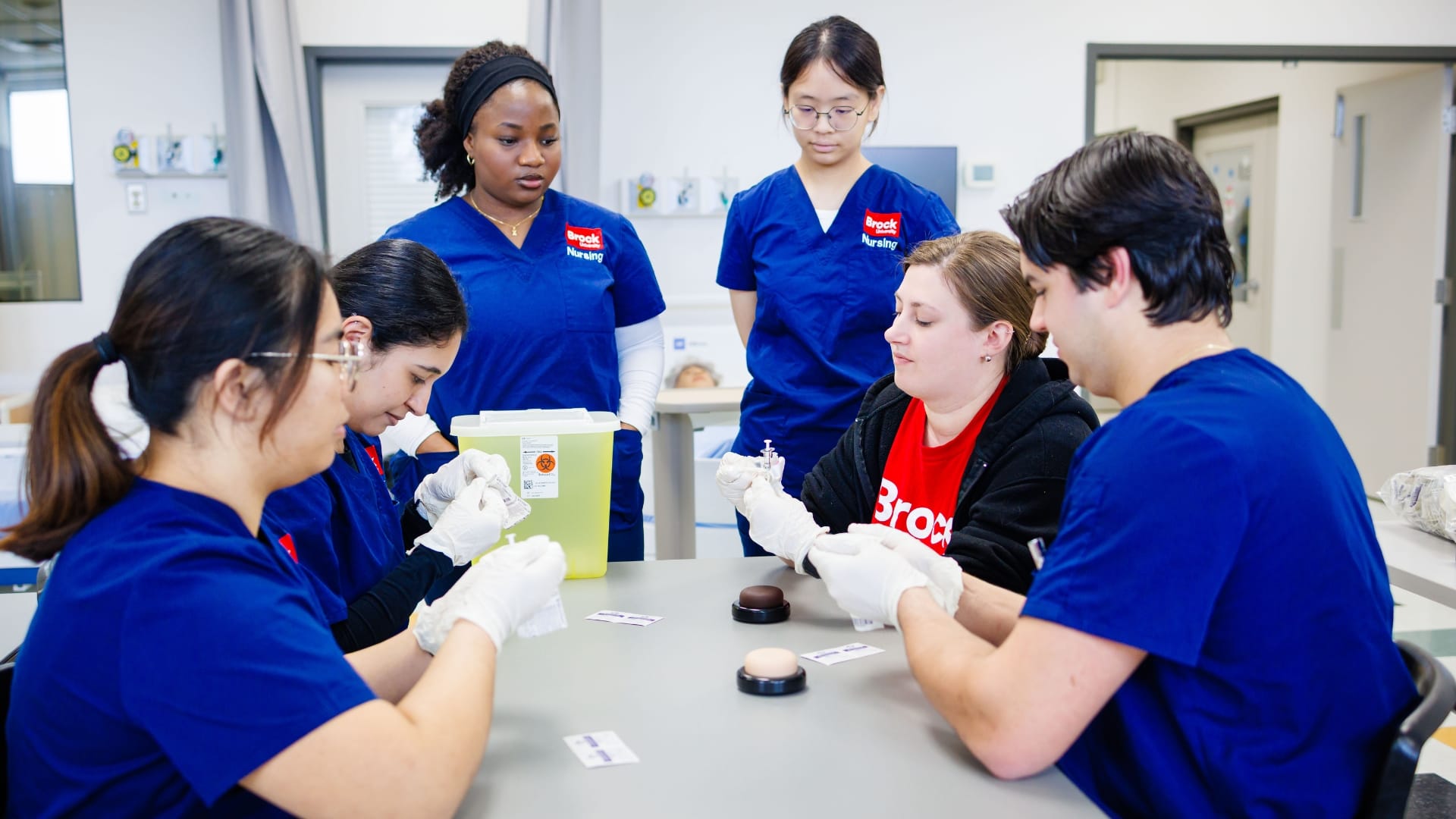
Brock’s concurrent BN/MN accelerated program enables graduates of a 4-year bachelor’s degree in a variety of fields to receive a combined bachelor’s and master’s degree within a unique, continuous, five-term, intensive curriculum configuration.
The only program of its kind in Canada, the BN/MN program works to educate students in five areas of competency:
- professional responsibility and accountability,
- knowledge-based practice,
- ethical practice,
- service to the public, and
- self-regulation.
The Brock University Concurrent Bachelor of Nursing/Master of Nursing (BN/MN) program is approved by the College of Nurses of Ontario (www.cno.org). Graduates from the program are eligible to apply for registration as a Registered Nurse in Ontario and are eligible to write the NCLEX-RN registration exam.

Message from the Graduate Program Director
The Concurrent Bachelor of Nursing/Master of Nursing (BN/MN) program, is the only program of its kind in Canada. Students will earn a bachelor’s and master’s degree in Nursing in just 20 continuous months.
Students will learn to apply theory to practice, from the onset of the program, through simulation laboratories and concentrated clinical experiences. They will also learn master’s level skills in leadership and relationship building through two mentored experiences in the final term of the program, helping to prepare them for nursing roles in education and administration, among other areas.
At the conclusion of the program, students will be prepared to write the NCLEX-RN exam and will be able to provide the exceptional care that is required of new nursing graduates.
As you consider your options for Nursing education, I encourage you to reach out to me with any questions you may have. While this program will be intensive, you will be well supported at every step of your journey. In under two years, you will be ready to start an exciting career that puts helping people at the forefront.
I look forward to being a part of your academic experience at Brock!
Sincerely,

About the BN/MN Program
The concurrent BN/MN program (BN/MN) is a full-time, 20-month (five-term) program that begins annually in May.
Graduates will be prepared to achieve the entry to practice competencies for registered nurses, as identified by the College of Nurses of Ontario (CNO) and will be able to write the National Council Licensure Examination RN (NCLEX-RN) and jurisprudence exams, which are required for licensure as a registered nurse.
The concurrent BN/MN program provides students who desire careers in education, and other nursing roles that require graduate education, with a more direct pathway to master’s preparation, and beyond.
Students accepted to the program already come with developed undergraduate skills in research and scholarship, as well as baseline knowledge in natural, behavioural, and social sciences. This knowledge provides a foundation for the acquisition of nursing specific knowledge and for development of graduate level research knowledge and skills.
Students consolidate learning, building confidence and organizational skills, with connections in the clinical setting. It is anticipated that our graduates will be prepared to enter practice with a solid knowledge base, and clinically integrated inquiry skills and relational skills.
Our graduates will be able to provide care that is strong in technical and clinical decision skills at the entry level competency expected of all new registered nursing graduates.
The graduate calendar may be viewed here.
Undergraduate Courses
Term 1
- Nursing Foundations: Care of Adults and Older Adults (theory, clinical practicum)
- Nursing Foundations: Assessment of Adults and Older Adults
- Pathophysiology and Therapeutics: Common Health Disorders
- Relational Care and Leadership: Basic Relational Skills
- Critical Analysis of Evidence for Nursing Practice
Term 2
- Nursing Foundations: Care of Families and Communities (theory, clinical practicum)
- Pathophysiology and Therapeutics: Health Concerns of Families and Communities
- Relational Care and Leadership: Promoting Change and Health
- Epidemiology in Nursing and Health Care
Term 3
- Nursing Foundations: Care of Persons with Chronic Health Concerns (theory, clinical practicum)
- Pathophysiology and Therapeutics: Mental Health Disorders
- Relational Care and Leadership: Working with and Leading Groups
- Qualitative Inquiry and Analysis
Graduate Courses
Term 4
- Advancing Nursing Practice: Care of Patients Experiencing Emergent and Critical Illnesses (theory, clinical practicum)
- Relational Care and Leadership: Understanding the Context
- Applied Research
- Basis of Nursing Practice and Inquiry
Term 5
- Practice of Relational Leadership and Management (theory, clinical practicum)
- Translating Research into Practice
- Preparation for Graduate Practice (clinical practicum)
- The program is unique (in Canada) in that graduates will receive a bachelor’s and a master’s degree in nursing upon successful completion of the program.
- Research, scholarship skills and nursing knowledge are taught and learned from the first term of the program. This learning culminates in graduate level research courses that emphasize aspects of research, including knowledge translation.
- The program focuses on integration of research skills, so that students are encouraged to see research as part of clinical practice, as opposed to a peripheral activity of nursing.
- Two mentored/preceptored experiences in the fifth term of the program will enable students to hone and gain insight, knowledge and experience in leadership and relational skills.
- Each term includes over 200 hours in a clinical practice setting.
The College of Nurses of Ontario (CNO) requires the achievement of the bachelor’s degree for graduates to be considered for licensing as registered nurses in Ontario.
Importantly, the CNO makes it clear in its registration requirements that a baccalaureate degree in an approved nursing program is required for entry-to-practice and registration as a Registered Nurse in Ontario. This program satisfies these requirements.
As a registered nurse you may work in :
- Acute care hospitals
- Public health
- Research
- Administration
- Policy Development
- Education
It is recommended that you review the Requisite Skills and Abilities for nursing practice document provided by the College of Nurses of Ontario, before you apply.
Admission Requirements
1. Applicants must have completed a four year (non-nursing) bachelor’s degree from an accredited university, or equivalent, with a minimum average of 75% over the final two years of study.
2. Applicants must also have completed the following university credit courses with a B grade or higher to be considered:
- Introductory psychology (full course equivalent = two semesters)
- Developmental psychology [infant to adolescent or infant to older adult] (half course equivalent)
- Human Anatomy (half course equivalent)
- Human Physiology (half course equivalent)
- Microbiology (half course equivalent)
- Statistics (half course equivalent)
- Research methods (half course equivalent)
3. You will need to submit your transcripts as well as the following program-specific materials:
- Prerequisites and Statement of Interest Form (please upload your completed PDF form during the documents upload step of the application process)
- BNMN Applicant Acknowledgment Form (please upload your completed PDF form during the documents upload step of the application process)
- Two academic references
- Proof of English language proficiency if required (IELTS overall score of 7 with no band below 6.5). Please note that this program does not grant English proficiency test waivers.
- Review the deadline dates and admission requirements here.
- Review the general application process information here.
- Complete the online application and submit the non-refundable application fee.
- Watch for an email with information about next steps, including uploading your documents.
- Upload the required documents.