Assistant Professor (PhD, OCT)
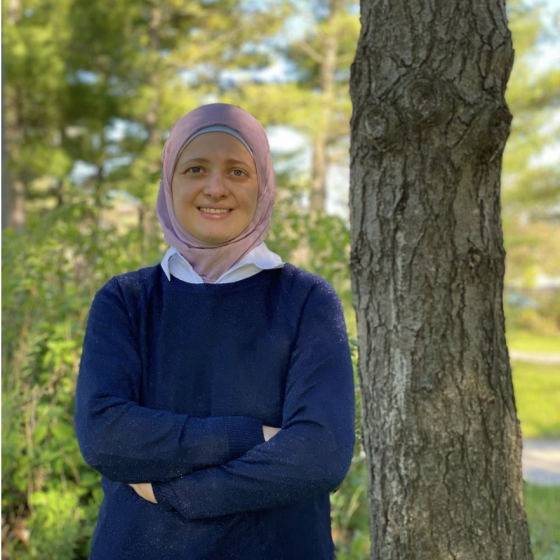
Dr. Mariam Takkouch is an Assistant Professor of Science Education in the Faculty of Education at Brock University. She holds a PhD (2025) in Curriculum Studies-Science and Environmental Education from the Faculty of Education, along with a Collaborative Graduate Specialization in Environment and Sustainability from the Faculty of Science at Western University. Dr. Takkouch is a certified biology and science teacher and has a Bachelor of Science degree in Biology. She has over 10 years of experience in education, where she has worked as a K–12 teacher, curriculum developer, professional learning facilitator, university instructor, and educational researcher.
Dr. Takkouch’s research focuses on how environmental and sustainability education is taught and learned across K–12 and post-secondary contexts. Her work examines the pedagogical potential of school gardens to support environmental literacy and stewardship, experiential and place-based learning, ecological citizenship, social justice, and community engagement. Additionally, Dr. Takkouch has held leadership roles in several large-scale research projects focused on science teacher education, interdisciplinary higher education programs, medical sciences education, inclusive laboratory learning environments, and digital technologies in STEM education.
Dr. Takkouch has collaborated with education and community partners, including the City of London, the Nature Conservancy of Canada, Let’s Talk Science, Links for Greener Learning, and United Way Niagara, to support community-engaged learning initiatives. She has presented her work at national and international conferences and serves as a reviewer and editorial board member for several science and environmental and sustainabilityjournals.
- Teaching and learning in science/ STEM education, emphasizing experiential, inquiry-based, and place-based approaches
- Environmental and sustainability education across K–12 and higher education contexts
- School gardens as experiential learning environments that foster environmental literacy, stewardship, and ecological citizenship
- Innovative technologies in school gardens (e.g., hydroponics, vertical and fogponics systems, automated irrigation, sensors, robotics, and 360° videos)
- Equity, diversity, inclusion, accessibility, and social justice in STEM education
- Teacher education and professional learning in science and environmental education
- Community-engaged research partnerships
- OCT – Ontario College of Teachers: Intermediate and Senior Divisions, Science and Biology
- WeCLISH – Western University Centre for Climate Change Sustainable Livelihoods and Health
- STAO – Science Teachers’ Association of Ontario
- Let’s Talk Science
- CSSE – Canadian Society for the Study of Education (includes CACS-Canadian Association for Curriculum Studies,
- SERG-Science Education Research Group, CATE-Canadian Association for Teacher Education, and Environmental and Sustainability Education in Teacher Education)
- SUSAN – Sustainability Academic Network
- AERA – American Educational Research Association
- NARST – National Association for Research in Science Teaching
- ASTE – Association for Science Teacher Education
- ESERA – European Science Education Research Association
Click here for an updated list.
- Takkouch M. & DeCoito, I. (in press, 2026). ‘We’re touching the earth’: Promoting elementary students’ conceptualization of environmental learning principles in school gardens. Canadian Journal of Science, Mathematics and Technology Education.
- Takkouch M. & DeCoito, I. (in press, 2026). Teaching science rooted in nature: School gardens as a pedagogical approach for promoting experiential learning. In A. Choudhary (Ed.), Pedagogy unpacked: Teaching impactful elementary education. de Sitter Publications.
- Takkouch, M. & DeCoito, I. (2025). Growing a solution: Support structures and integrating school gardens in science and environmental education. In K. Kiers & T. Buttler (Eds.), Outdoor experiential learning in Canada. Canadian Scholars. https://canadianscholars.ca/book/outdoor-experiential-learning-in-canada/
- DeCoito, I., Estaiteyeh, M., & Takkouch, M. (2025). Impacting STEM teacher candidates’ views and attitudes toward online teaching: A comparative analysis of two cohorts during the COVID-19 pandemic. International Journal of Science, Math, and Technology Learning, 33(1), 1-26. https://doi.org/10.18848/2327-7971/CGP/v33i01/1-26
- Campbell, N., Estaiteyeh, M., DeCoito, I., & Takkouch, M. (2025). Exploring students’ experiences in an innovative interdisciplinary medical sciences master’s program. The International Journal of Learning in Higher Education, 32(2), 67-88. https://doi.org/10.18848/2327-7955/CGP/v32i02/67-88
- Takkouch, M. & DeCoito, I. (2024). ‘Not Everyone has the privilege to have good food’: Promoting positive youth development and social justice values in school gardens. Journal of Environmental Studies and Sciences, 1-17. https://doi.org/10.1007/s13412-024-00983-5
- Takkouch, M. & DeCoito, I. (2024). Building strong roots: School-community partnerships for integrating school gardens in environmental and sustainability education. The International Journal of Sustainability Policy and Practice, 21(1), 101-122. https://doi.org/10.18848/2325-1166/CGP/v21i01/101-122
- Estaiteyeh, M., & DeCoito, I. & Takkouch, M. (2024). STEM teachers’ preparation for online teaching: Promoting technological and pedagogical knowledge. Canadian Journal of Learning and Technology, 50(4), 1-20. https://doi.org/10.21432/cjlt28594
- Takkouch, M., Zukowski, S. & Campbell, N. (2023). Students’ perspectives and experiences with equity, diversity, inclusion, and accessibility in online and in-person undergraduate science laboratory courses. Journal of Perspectives in Applied Academic Practice, 11(3), 33-50. https://doi.org/10.56433/jpaap.v11i3.581
- Estaiteyeh, M., Campbell, N., DeCoito, I., & Takkouch, M. (2023). Setting students up for success: Developing interdisciplinary skills in a medical sciences graduate program. GiLE Journal of Skills Development, 3(2), 66-84. https://doi.org/10.52398/gjsd.2023.v3.i2.pp66-84
- TD Friends of the Environment Foundation (TD FEF) Grant, April 2025-April 2027. ($8,000)
- Ontario Graduate Scholarship (OGS), May 2022-April 2023. ($15,000)
- EDBE 8P37: Science and Technology (Teacher Education Program, Primary/Junior Division)
- EDBE 8F80: Teaching Science – Science General- Year 1 (Teacher Education Program, Intermediate/Senior Division)
- EDBE 8P88: Teaching Science – Biology, Year 2 (Teacher Education Program, Intermediate/Senior Division)
- EDBE 8P89: Teaching Science – Science General, Year 2 (Teacher Education Program, Intermediate/Senior Division)