SSAS Student Contributor

  • Finding the green in our own backyard

    Blog Contributor: Shelby McFadden

    Everyone’s been there. Waking up to your alarm and knowing you have to get out of bed to go to work or school and dreading every moment of it. This is a rather normal occurrence for me as I am definitely not a morning person. But of course, I get up anyway, yawning and entering autopilot mode as I force myself to walk to work. I used to walk down Sir Isaac Boulevard North, staring at pavement and Zone 1 Parking lot, until I crossed Flora Egerter Way and up the grass to Theal House. But I never felt content taking this route, and so often switched it up a little bit each day, crossing at a different spot, walking across Lot V and U instead, or walking through the grass between the North and South boulevards. One day after crossing the intersection at Sir Isaac Brock Blvd and Merritville Highway, I decided to walk along the unpaved bit of grass and dirt beside the tree line framing Lots V, U, and T. Since then, this has become my morning ritual, and one of the best parts of my day.

    We often think about nature as this pristine, large-scale, and untouched wilderness, but the reality is that things are always changing and evolving, alongside other species, including humans. We need to start seeing these small patches of plants and animals as nature too, and to appreciate them just as much as the larger ecosystems. Walking through the shade, I feel myself slip back together like a completed puzzle, feeling alive and safe and revitalized as I breathe in and take in the sights. It’s so quiet and peaceful, listening to the occasional bird sing or the tall plants bend in the breeze, and it never fails to bring a smile to my face.

    One day as I was approaching Theal House, I noticed a plaque hidden amidst the greenery at the edge of the line of trees. Stopping for a moment to read the inscription, I learned that this line of trees I walk beside each day, is actually one of the remaining hedgerows of Osage orange trees on campus that predates the university, lining some of the historical property boundaries. The trees are native to Arkansas and Texas, but brought over by settlers and used as natural fences to keep livestock in fields. These trees are extremely rare to South-Western Ontario, and the ones at Brock represent one of the last known locations in South-Western Ontario. These trees are a living tribute to the Niagara Region’s cultural heritage and agricultural history, which makes them that much more of a special feature at Brock.

    But more than their history and rarity, they are lovely friends that give me strength in the mornings when I need it most. Being surrounded by the striking green and reaching trunks, hearing the soft crunch of dirt under my shoes, and having my focus taken by spots of colour in the form of wildflowers, gives me that extra bit of time I need in the morning to wake up and pull myself together. We can all benefit from spending a little bit of time outdoors, and Brock provides a perfect opportunity for this. There are little pockets of nature all around campus, from the Healing Garden, Pond Inlet, Jubilee Court, the Bruce Trail with different access points around campus, the courtyards with picnic tables and trees, to the hedgerows of Osage orange that have captured my heart. I encourage everyone to take a few minutes out of their day to explore the nature right here at Brock and to enjoy the small gems hidden in our own backyard!
    Categories: Blog, SSAS Student Contributor, Sustainability at Brock

  • NPC holds public sessions to showcase environmental stewardship efforts

    Blog Contributors: Alicia Goddard & Samantha Witkowski

    NPC Stewardship Event

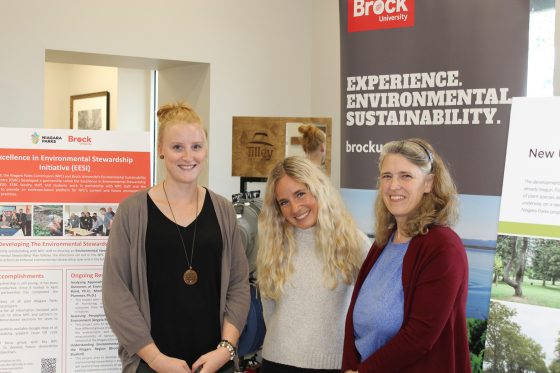
    Photo: Master of Sustainability students (left to right) Brooke Kapeller, Angela Mallette & Alicia Goddard.

    Have you heard? Brock University’s Environmental Sustainability Research Centre (ESRC) and the Niagara Parks Commission (NPC) have formed a partnership called the Excellence in Environmental Stewardship Initiative (EESI). On September 26th and 27th, the NPC held public information sessions to showcase environmental stewardship efforts in the Niagara Region, including the work of the EESI. The sessions proved to be a beneficial experience for graduate students involved in the EESI, and the public. Samantha Witkowski, a first-year student in the Masters of Sustainability program at the ESRC, said, “The experience was valuable for me as it was my first time meeting NPC staff, and my first public information session.  It was fascinating to see all the engagement taking place between collaborators and the public.”

    At the session, participants had the opportunity to learn about a variety of stewardship projects that are underway in the Niagara Region. For instance, the NPC has a two-year plan that aims to restore two kilometers of shoreline with native vegetation that will increase diversity while stabilizing the shoreline banks.  Alicia Goddard, another incoming graduate student with the Masters of Sustainability program stated, “I am impressed with the stewardship of the NPC. They are recycling hazardous trees that needed to be removed after they died from Emerald Ash Borer infestation by incorporating them into the Niagara River at select locations, increasing fish habitat.  That’s awesome!”

    Since the discovery of Emerald Ash Borer (EAB) beetle on NPC property in 2012, the park has lost a significant number of ash trees.  The park has responded by planting upwards of 20 different species of native trees, which will assist them in reaching their goal of having 75% of the species found in the park returned to the native condition.

    Another unique project began in 2004 when NPC partnered with Audubon Cooperative Sanctuary Program. Since that time, six hectares of turf grass on the Niagara Parks’ Legends on the Golf Complex is now returned to a more naturalized state.  An additional four hectares of previous agriculture fields are reforested.  The chemical use continues to be reduced, and water consumption by the golf course has significantly reduced, with 14 hectares removed from irrigation and annual upgrades occurring on the remaining infrastructure.  The Ussher’s Creek habitat is also improving with the addition of nest boxes and monitoring of water quality underway.  The golf course is now a certified Audubon Cooperative Sanctuary.

    Meanwhile at the Chippawa Grassland Bird Habitat management plans call for enhancing the existing grasslands by ensuring a variety of mixed native grasses that will not only increase habitat for grassland birds but other species including native pollinators, reptiles, and amphibians.

    In addition to these NPC-driven projects, the work of the joint partnership between the NPC and the ESRC was on display. ESRC students and faculty have been assisting the NPC with the development of a ten-year Environmental Stewardship Plan.  The ESRC has conducted an inventory of past stewardship projects allowing the NPC and partners to look back so informed discussions and decisions can be made within a common framework.  This framework has allowed for focus groups to meet and develop stewardship goals and objectives. Check out an interactive map of past and ongoing stewardship efforts.

    Additionally, 2nd year ESRC Master’s student Angela Mallette is currently studying how the public views the natural health of the Niagara Glen Nature Reserve, as compared to scientific data in the same area. Concurrently, 2nd year ESRC Master’s student Brooke Kapeller is investigating how the various parts of stewardship across the Niagara Region relate to positive outcomes and success.  As you can see, the EESI partnership between has many benefits, including giving graduate students the opportunity for hands-on work experience and unique research opportunities that further enhance the partnership.

    As the NPC works hard at preserving the Niagara Region corridor from Lake Erie to Lake Ontario we hope that you check out their projects and, if you have any suggestions or would like more information, reach out to them!  The initiatives underway will make up NPC plans from 2019 and beyond.


    Categories: Blog, Environmental Stewardship Initiative, Experiential Education, SSAS Student Contributor

  • Lessons in Economic Development with the BL-LL

    Blog Contributor: Ben House

    Benjamin House

    Photo: Ben House, current Master of Sustainability student and summer intern at the Town of Lincoln

    Over the past two months of our co-op placement with the Town of Lincoln, fellow co-worker Zach MacMillan and myself have been working on the preliminary stages of the Brock-Lincoln Living Lab Needs Assessment project focused on improving community-wide sustainability. While this project serves as the backbone and central focus of our co-op work term, Zach and I are lucky to be a part of several “side-projects” occurring throughout the office. Thus far, the projects have helped bring an enjoyable level of variety to the job and have given us a unique glimpse into the wide-range of disciplines and departments covered in municipal work.

    I have personally been lucky enough to work with Lincoln’s Economic Development Officer, Paul Di Ianni, on a variety of projects currently underway. I was first introduced to Paul during winter term in our “SSAS 5PO3” Project Management Course where we collaboratively worked to map some of the Town’s key economic assets and define their contribution to community sustainability. In this regard, the SSAS 5PO3 class has really served as a helpful transition into the work term for Zach and myself. The class provided us with a tremendous amount of foundational knowledge pertaining to the Town’s operational climate and helped to introduce us to some of the analytical tools we would be using on the job. Furthermore, it helped us establish relationships with some of our future colleagues and mentors working in Lincoln which has made for an enjoyable entrance into the workplace.

    With my recently established background knowledge of Lincoln’s economic climate, Paul has kindly taken me “under his wing” and has begun to include me in a variety of ongoing projects within his department. Most recently, I have been researching Community Energy Plans (CIP) which are essentially long-term plans aimed at improving energy efficiency, reducing greenhouse gas emissions and encouraging sustainable energy solutions on a community-wide scale. Specifically, I have been tasked with providing information regarding the policy development necessary to support such a plan, as well as potential financial tools and funding opportunities that will aid in its successful implementation. I recently presented this information to Paul and Gillian Harris, Manager of Environmental Services, and it is likely that continued discussions regarding the development of an energy plan will be taken to council.

    In addition to expanding my knowledge of economics, as well as improving my oral and written communication skills, these projects have reminded me of the strong interconnections between all realms of sustainability. Initiatives such as community energy planning can have profound impacts that extend far beyond financial gains and can contribute to the protection of environmental services and natural assets, amongst many other community-wide benefits. These projects help bridge the gap between economic growth and environmental protection and it is truly refreshing to see how key environmental considerations continue to be integrated into ongoing discussions of future economic development here at Lincoln.

    It is clearly an exciting time for the Town of Lincoln with an abundance of projects and long-term ambitions finally reaching stages of operationalization.  It has been a privilege to lend my support to these projects and I am looking forward to seeing what the remaining months here at Lincoln will have in store.

    Categories: Blog, Brock Lincoln Living Lab, Co-Op, Experiential Education, Innovative Partnership, SSAS Student Contributor

  • A Co-Op Placement with the Town of Lincoln

    Blog Contributor: Zach MacMillan

    Zach MacMilland and Carrie Beatty

    It is interesting to reflect on my first few weeks working for the Town of Lincoln having now recently passed the halfway point in my co-op position. As someone who has traditionally held customer service type roles in the past, being able to work on sustainability issues in Town Hall was a welcomed change that has since provided limitless learning opportunities and connects perfectly with what we study in the SSAS program.

    Despite my limited experience working in an office setting I was able to have a smooth and successful transition due to the constant support from my supervisor Carrie Beatty who values the unique perspectives of the SSAS students. To ensure that both my co-worker Ben and I were able to get a holistic understanding of the Town of Lincoln, Carrie began our first day by giving us a complete tour of the Town. Growing up in St. Catharines I thought I had a fairly good idea of the Town’s geographical reach as well as its history, although after beginning our tour I realized that was not the case. Carrie had such a wealth of information to share about the Town, from historical facts to the what types of tender fruit trees grew where, demonstrating the uniqueness of the Town which sets it apart from other municipalities of Niagara. This was something I was unable to appreciate before working for the Town. The tour continued once we returned to the office and it was incredibly interesting to see how many individual departments work together to make the Town run smoothly. A Municipality is a complex organization requiring many moving parts to operate successful, although much of this work goes unseen and underappreciated having this understanding has helped me connect with the Town.

    Equipped with a newly developed understanding of the Town, Ben and I have since settled into our work stations located in what has been affectionally named “the fort”. It has been here where we have been working on both our main Brock-Lincoln Living Lab project as well as providing support to other ongoing projects around the office. Currently, our primary project involves developing an environmental and sustainability needs assessment for the Town using the Official Plan, while additional projects include supporting Economic Development and the Town’s Transportation pilot uLinc. This summer has been an exciting learning opportunity and I am excited to see where it leads.

    Categories: Blog, Brock Lincoln Living Lab, Co-Op, Innovative Partnership, SSAS Student Contributor

  • Exploring the Niagara Glen Nature Reserve

    Blog Contributor: Angela Mallette

    Last week, myself and some fellow SSAS students that are still in the area for their co-ops/research, headed to the Niagara Glen Nature Reserve for a hike. My thesis research will be taking place in the Niagara Glen this coming summer, and we had met to go on a hike through a part of the Glen I hadn’t been to yet. Our hike had a productive purpose as well – I needed people to pilot my survey after hiking the trails. It was late in the afternoon, so the Glen wasn’t overly busy. We made our way down Eddy trail and then to Whirlpool trail, along the water and then up the Whirlpool staircase.

    The Niagara Glen is a hidden gem of the Niagara area. Despite living in the GTA my whole life, and visiting Niagara Falls almost annually, I had never even heard of it until this past year. The section of the river that runs along the Glen has bright turquoise-blue waters and intense rapids that are classified as class V rapids on a scale of 1-6. The whirlpool just upriver is class VI. Aside from the amazing sights of the river, I was also very excited to learn about the geology of the Glen (if you like fossils, potholes, or rocks in general, definitely go and check it out). Or, if you prefer plants, the Glen has hundreds of species, some of them rare or even unique to the Glen. If you prefer history, aside from evidence of a fascinating geological history, there is also a century old cobblestone path built when a railway used to run along the river about 100 years ago.

    The Glen is a site that is so unique geologically, ecologically, and historically. As I learn more about it, I’ve come to realize the significance of this site for my research. It is a significant and sensitive ecosystem but is also subject to hundreds of thousands of visitors every year. It is a perfect case study for sustainable ecotourism and its challenges. I am looking forward to beginning my research in the upcoming weeks and spending more time at the Glen. Thanks to Ben, Zach, Brooke, and Branden for coming out for an awesome hike and to pilot my survey!

    Categories: Applied Research, Blog, Environmental Stewardship Initiative, Innovative Partnership, SSAS Student Contributor

  • Reflections on the Ontario Envirothon

    Blog Contributor: Brooke Kapeller

    Last week, myself and another grad student, Angela, travelled to the University of Waterloo to help out with the Ontario high school Envirothon put on by Forests Ontario, and sponsored in part by Brock. These students had already been at Waterloo for two days, participating in a variety of activities, classes, and tests designed to further their knowledge of the environment. The portion of the Envirothon that Angela and I were volunteering for was judging their presentations. This was the final activity of the Envirothon; the students were divided into their class groups of 5 students each and were all given the same scenario. They were then given a few hours to prepare a presentation using only the materials given to them (no electronics) and presented their ideas to a panel of judges.

    I read through the scenario that was given to these students the night before their presentations. They were to act as consultants for a mid-sized Ontario city. The city’s goal was to reduce their emissions of CO2 equivalents 80% by 2050, aligned with the provincial goal. The students were to come up with two feasible actions that could be taken by this city to help attain this goal. In addition to addressing the issue, they also had to relate their ideas to the four core topics of the Envirothon: forestry, soils, aquatics, and wildlife. Reading through this scenario, I was completely astounded by the degree of complexity and depth of thought that would be required by these students to successfully develop a solution. I thought back to myself as a high school student, and how much I would struggle with this… I don’t even recall learning about climate change when I was in high school!

    I sat on a panel of judges with three other people who ranged from retired professors to sustainability professionals. We judged a total of three student presentations, and I must say, I was incredibly impressed with all of them! After reading the scenario the day before, I was skeptical at first of how in-depth the solutions would be that they came up with, but these students did great. Some of the ideas that I heard were to develop a municipal points system that would encourage citizens to collect points for using a bikeshare program, shopping at local farmers markets, or participating in other activities that would reduce emissions. Another idea was to develop a scholarship system to encourage university students in the city to develop innovative technologies to reduce emissions and research other possible opportunities. Another team planned to develop a survey that they would distribute to members of the community to further understand community opinions. Other ideas included a program to work with farmers in the area to lower their emissions while also benefitting economically, increasing forest corridors and green infrastructure, and establishing bylaws and mandates for large companies to reduce their greenhouse gas emissions.

    The ideas for solutions to reducing emissions that these students came up with were amazing. I was genuinely impressed with the depth of thought and evidence of knowledge that these students had on a range of environmental issues. Volunteering as a judge for this event made me so optimistic about what these students will accomplish in their future.

    Categories: Blog, SSAS Student Contributor

  • SSAS Students Take Stock of Sustainability Initiatives at Brock

    Blog Contributor: Lydia Collas

    SSAS 5P03 Group Photo 2018

    Photo: SSAS Student Presentations in SSAS 5P03 (from left to right) Salima Medouar, Leaya Amey, Zach MacMillan, Ben House, Yuka Kataoka, Quratulain Shahzad, and Sylvia Hussein

    Earlier this year, three Master of Sustainability students got a taste for project management providing a consultancy-type service to Facilities Management at Brock University. Project Manager, Leaya Amey, and her two teammates Sylvia Hussein and Qurat Shahzad, were tasked with carrying out a needs assessment of sustainability initiatives at Brock. The team spent a semester compiling an inventory of current sustainability initiatives whilst identifying areas for improvement. Based on best practices at other universities, the students provided guidance on how best to design initiatives to fill these gaps. In this blog post, Qurat shares how the project transpired and what the group learnt from the experience. Instalment

    1. Qurat, this sounds like quite a large project – how did you go about achieving your goals?

    During the first phase of the project, we held several meetings with our main clients Amanda Smits (ESRC) and Scott Jhonstone (Facilities Management), which were moderated by our Project Co-ordinator Bradley May. This allowed us to understand the needs of the clients and clarified any doubts that we had as a team going forward in the project. The second phase was research intensive and focused on compiling the inventory and identifying any gaps where Brock could be doing more. The third phase included coming up with key recommendations for Brock University; our action plan included targets which can be used to track Brock’s progress with their sustainability endeavors in the coming years. The final phase was to complete a project report and present our findings to our clients.

    2. This must be one of your first experiences of this sort of work – what did you learn about project management?

    This experience allowed us to understand the dynamics within a team project and what project management looks like in the real world. Often, it’s more about getting everyone on the same page and communicating the ideas clearly to avoid misunderstandings. We applied what we’d learnt in class out in the real world which saw us improve several key skills such as professional presentations, handling clients, communication skills, team work and time management. This made the course a really beneficial part of the Sustainability Science & Society (SSAS) Program. While all the other courses are mostly theoretical and research based, this course provided us with an opportunity to experience practical work and also showcase a possible career path in the future.

    3. What impact do you think your work will have?

    Our project is being used as the foundational work to be built on by two co-op positions, Special Project Assistant-Sustainability and Communications Assistant, in the ESRC this summer. These co-op students will work with the ESRC to continue this project in an effort to promote and enhance sustainability on campus.

    4. Is there a moment that stands out as a highlight of this experience?

    Scott was kind enough to take us on a tour of the Central Utilities Building which showed the inner workings of the Facilities Management Department and how they are working to incorporate sustainability into their daily operations. The highlight of the tour was getting to see the generators that produce enough electricity to make Brock energy independent and able to work off the grid.

    Many congratulations to the two groups of SSAS students that completed the Projects Course – you can read about the experience of the other group who worked with the Town of Lincoln here

    Categories: Blog, Experiential Education, Innovative Partnership, SSAS Student Contributor, Sustainability at Brock

  • ESRC Member Marcie Jacklin honoured with Librarian Emeritus status

    Blog Contributor: Lydia Collas

    Marcie Jacklin

    Following her retirement in June 2017, Marcie Jacklin has been awarded the status Librarian Emeritus following her outstanding contribution to the Brock University community over the past 25 years.

    Marcie has been a librarian at Brock for 25 years, and has been involved in the Environmental Sustainability Research Centre (ESRC) since its founding in 2011.

    Speaking on this honour, Marcie said, “I am honoured to receive the designation of Librarian Emeritus. I am grateful for the support I have received over the past 25 years from my colleagues in the library and the Environmental Sustainability Research Centre.”

    The learning experience of so many Brock students has been enhanced by Marcie’s dedication, passion and willingness to help others in their pursuit of knowledge. On this occasion – as on any other – Marcie was full of gratitude to those that have shared this journey, “I’d like to thank the thousands of students who helped me learn how to provide instruction in library research skills. By asking students through evaluation responses what they liked and didn’t like about library instruction, I was able to understand their preference for a collaborative learning environment. It turned my style of instruction and research in an entirely new direction.”

    Marcie’s interest in nature – specifically in birds – coupled with her passion to educate others, led to her becoming a member of the ESRC. Alongside Kerrie Pickering, Marcie established the ‘Wetlands of Sunset: Connecting Memories with Nature’ project to evidence the benefits of long-term care facilities being located in areas of natural beauty where nature is in abundance.

    Of this work, Marcie said “Becoming a member of ESRC in 2011 added a new dimension to my career. This opportunity fit perfectly with my personal experience as a field ornithologist, but more than that it, was an amazing experience to work in a multidisciplinary academic atmosphere where I was challenged, supported and nurtured. The collaborative nature of ESRC led to a new research area for me, and I am delighted to be able to continue with ESRC in the future.”

    Ryan Plummer, the ESRC’s Director, expressed his gratitude for Marcie’s contribution to the Centre. “Marcie Jacklin is the first individual to be awarded the designation of Librarian Emeritus at Brock University. This is a fitting honour and testament to her many successes in the field of library and information science, the high quality of her scholarly activities, and extensive service contributions. Marcie is a gifted person who has the rare ability to combine her personal passion for nature (especially birding) with her professional drive to engage people in meaningful ways with information about science and the environment. She has been integral to the development and functioning of the ESRC as well as environmental sustainability programs at Brock”.

    Marcie will be officially presented with this honour at the Convocation Ceremony on the 4th June 2018. Congratulations Marcie!

    Categories: Blog, SSAS Student Contributor

  • Master of Sustainability Students takes the lead in Brock-Lincoln Living Lab

    Blog Contributor: Lydia Collas

    Each year, Master of Sustainability enrolled in the co-op stream undertake a projects course where they work as a team to provide a consultancy-type service to an external business or an area of the Canadian Government. This year, Ben House, Yuka Kataoka, Zach MacMillan, and Salima Medouar worked with the Town of Lincoln in association with the Brock-Lincoln Living Lab that was set up last year. I met up with Zach to find out more about what his team had got up to and what they’d learnt from the experience.

    SSAS 5P03 Group Photo 2018

    Photo: SSAS Student Presentations in SSAS 5P03 (from left to right) Salima Medouar, Leaya Amey, Zach MacMillan, Ben House, Yuka Kataoka, Quratulain Shahzad, and Sylvia Hussein

     1. So working with the Town of Lincoln, what was the project you were tasked with?

    Our team worked to create a sustainability needs assessment for the Town. This document will be used to highlight focus areas for the subsequent stages of the Brock-Lincoln Living Lab. As we began communicating with the project sponsor, it became apparent that there would be more value in creating a detailed inventory of the Town’s assets relating to sustainability. Such assets are anything that contributes to achieving the Town’s long-term sustainability goals and include local policies, physical structures, natural resources, social resources, and economic institutions.

    2. How did you go about achieving that?

    The first step in the project was to create a framework that we could use to organize our data. We used the Town of Lincoln’s sustainability initiative to highlight four key asset areas that influence sustainability: Natural, Social, Economic, and Built. Each member of the team was in charge of one of the areas based on their interests and experiences. I was both the lead on built assets as well as the project manager for the team.

    Once we had an outlined framework and clear roles for the project we went to Town Hall to retrieve that data we needed. We were also fortunate enough to communicate with Town employees who had specific insights on the four asset areas, which helped us get multiple perspectives on the project. We then synthesized all the material and included it in a final report along with some recommendations for future work, which we presented to both members of Lincoln (including senior management) and the Brock University ESRC.

     3. What did you learn about project management as a result?

    This project demonstrated the importance of creating a detailed yet manageable timeline for projects, particularly when you’ve got multiple commitments to fulfil. I also learned the importance of forming a strong team and drawing on the strengths of each member. While I was the official project manager for the project we took a collaborative approach that allowed each of our skill sets to be utilized to the fullest – an approach I plan to use in future projects.

    4. So how did it go – did you achieve what you set out to?

    Yes, I believe we did achieve our project goals. By the end of the six weeks, we had created a 30-page document which outlined a wide variety of assets that are important to the Town’s sustainability goals. Combining all this information into one document will be very helpful for the next stage of the Brock-Lincoln Living lab.

    5. What do you think the impact of your work will be?

    In the municipal setting, sustainability is an important, though oft misunderstood, concept. This project will help to provide consensus on the topic. The integrated framework that we used will help the Town to move away from understanding sustainability in silos and move toward an integrated approach to sustainability planning. It also creates a strong foundation for future work on the Brock-Lincoln Living lab and the Town more generally. Mainly this project helps the Town to begin incorporating a new perspective on everyday tasks. It also demonstrated that sustainability in this context is more diverse than simply environmental planning.

    6. This course is a bit different to the others that you take as part of the program, how do you feel it has complemented your other studies?

    This course was a perfect complement to the program. Being given the opportunity to implement our knowledge of sustainability into a real organization as a core program requirement is invaluable. It helped me to learn and refine skills, such as project planning and communicating with community stakeholders, and provided an important network opportunity – all of which will help me to secure employment after completing my degree. I am particularly interested in municipal planning: my Major Research Paper will evaluate municipal planning documents and my future career goals lie in the planning profession, so I was very fortunate to work on this project.

    Finally, I’d like to thank some people that we would have been lost without. Carrie Beatty from the Town of Lincoln gave her time and advice during each stage of the project and her genuine interest in incorporating sustainability in the municipal setting was truly valuable. I would also like to thank Dr. Bradley May for offering project management expertise to the team.

    Congratulations to Zach, Yuka, Ben and Salima on completing an informative project that has paved the way for the future work undertaken as part of the Brock-Lincoln Living Lab.  To find out more about the Living Lab, visit brocku.ca/esrc/brock-lincoln-living-lab/. For more information about the Master of Sustainability degree program, visit brocku.ca/ssas.

    Categories: Blog, Experiential Education, Innovative Partnership, SSAS Student Contributor

  • Co-op with MTO inspires master of sustainability student to pursue career in environmental policy

    The next instalment in our series of blog posts about the co-op experiences of Sustainability Science & Society (SSAS) students, we hear from Nicholas Fischer, who will soon be graduating with his Master in Sustainability degree. Last summer, Nich worked for the Ontario Ministry of Transportation (MTO) in the Environmental Policy Office.

    Blog Contributor: Nicholas Fischer

    Nicholas Fischer

    In my role as an Assistant Policy Analyst at MTO, I provided support to the Senior Policy Analysts on a variety of projects related to transportation infrastructure and landscape remediation. My principle assignment involved generating a policy brief and supporting house notes to various members of senior management. These briefing materials were the product of background research and communication with various provincial ministries and governing bodies, outlining the impacts which changes to the Environmental Assessment Act of Canada would have on provincial infrastructure delivery and environmental assessments.

    Outside of this project, I supported staff with additional projects and policy amendments, including: pollinator health in provincial right-of-ways, provincial waste management, endangered species protection and best management practices, and biodiversity strategies used across Ontario’s provincial ministries.

    The most interesting project I worked on was developing policy solutions for environmental assessment procedures for Ontario. During the time I was with the MTO, the Federal Government of Canada was undergoing a review of federal environmental assessment legislation which would ultimately impact how infrastructure delivery took place at a federal and provincial level. My project focused on identifying the impacts these legislative changes would have for the Ontario provincial government and identifying avenues of possible policy reform to ensure that infrastructure development and design in the province could continue in a sustainable manner, fitting within the new regulatory framework proposed at the federal level.

    My co-op experience has definitely helped to solidify the idea that I would like to focus my career experiences in the realm of environmental policy. Prior to this experience, I was unsure of working in the policy sector, however working with the MTO has shown me that without policy development and analysis, no real environmental change can take place on a regional or provincial level. Policy creates the avenues for change within a government and within local populations, and without policy avenues, it is difficult to affect real change for the betterment of our shared natural environment.

    I would like to thank the entire Environmental Planning Office for allowing me a breadth of experience on a variety of projects which showed me exactly how the province upholds environmental protection and sustainability within an infrastructure-based ministry. Additionally, I would like to thank Melissa Beamer of the Brock Co-op Office for working continuously with the SSAS students to ensure we found appropriate, challenging and rewarding co-op experiences.

    The ESRC’s SSAS program offers students the option of completing either a major research project and a co-op experience, or a longer research project that culminates in a thesis. Undertaking a co-op provides students with firsthand experience of how important knowledge of sustainability is in creating policy, guiding business development and ultimately helping the community. Graduating students frequently cite their co-op experience as being influential in guiding their future career plans. To find out more about the SSAS program, visit brocku.ca/ssas.

    Categories: Blog, Co-Op, Experiential Education, SSAS Student Contributor