Articles from:October 2018

  • Meet Brock’s newest commitment to sustainability: The Brock University Environmental Sustainability Plan 2018

    Blog Contributor: Shelby McFadden

    Brock University - Campus LR

    The Environmental Sustainability Research Centre and Facilities Management signed a charter in February, which outlines their agreement to work together to support Sustainability at Brock. One of the major projects worked on this summer was the creation of the Brock University Environmental Sustainability Plan 2018, as required under the Greenhouse Gas Campus Retrofits Program (GGCRP). The completion of this plan has allowed Brock to receive $7.9 Million to put towards reducing greenhouse gas emissions on campus. The funding is being used to complete DEEP 2, which is a project replacing old equipment in Brock’s district energy plant with updated and efficient equipment that will allow Brock to produce 100% of its own energy, while also significantly reducing greenhouse gas emissions.

    The plan outlines the current initiatives working towards low emissions and an overall sustainable campus, identifying issues and setting priorities, goals, targets, and strategies to increase sustainability at Brock within the three following areas: 1) energy conservation and greenhouse gas emissions reductions, 2) environmental sustainability management, and 3) education for sustainability (green skills)/co-benefits.

    Along with these initiatives, the plan outlines a commitment to sustainability through Brock’s plans to pursue an emissions target of 20% below 2013 levels by 2023. These efforts will contribute to the provincial emission reduction targets of 37% by 2030 and 80% by 2050, based on 1990 baseline levels.

    The Sustainability plan builds on Brock’s 2016 Sustainability Policy and 2017 Draft Strategic Plan, further strengthening its commitment to uphold sustainability as one of the seven core values of the university.

    The plan is now posted to the Sustainability at Brock website and can be viewed at the following link.

    Categories: Blog, Experiential Education, Innovative Partnership, Sustainability at Brock

  • Meet the Faculty of the ESRC: Dr. Jessica Blythe

    Blog Contributor: Kaitlin James

    For our second instalment of this series, I had the pleasure of interviewing Jessica Blythe, an Assistant Professor at the Environmental Sustainability Research Centre (ESRC) to learn more about her new role at the Centre, and the journey she took to get to where she is today. Her research engages in issues related to resilience, climate change adaptation, and transformation. She is particularly interested in how societies both create and respond to change. Her numerous publications demonstrate her immense contributions to the field of sustainability science. It was a pleasure to interview her to learn more about all of the great research she does!

    Photo: Dr. Jessica Blythe, Assistant Professor, Environmental Sustainability Research Centre

    Q1: What excites you most about working at Brock University in the Environmental Sustainability Research Centre? 

    Everything!  But honestly, I’m really excited about two big things.  First, the research going on at Brock was the biggest draw for me.  Faculty within the Environmental Sustainability Research Centre are engaged in research at the frontiers of sustainability science.  It’s the kind of solution-oriented research that gets me out of bed in the morning.  Second, I find the applied, experiential nature of research and teaching at Brock really inspiring.  From the innovative partnerships with municipalities and parks in the area to the co-op options for students, Brock is leading the way building healthier, happier, and more sustainable futures.

    Q2: What are your research areas of focus? 

    Broadly, my research tries to understand how communities experience global environmental change and what explains their different capacities to respond to this change.  Specifically, I use a social-ecological systems perspective and resilience thinking to think critically about vulnerability, adaptation, and transformation.  I also examine how processes like decentralization and place attachment shape people’s relationship with their environment.

    Q3: What was your journey like in getting to your current research area of focus? 

    I grew up in Newfoundland during the collapse of the Northern cod stocks.  I think that watching how the moratorium impacted coastal communities around the province influenced my interest in becoming a researcher that focuses on coupled social-ecological systems.  It also sensitized me to that fact that vulnerable systems – that are close to a tipping point – can appear strong from the outside.  This experience drove home the fact that for me, sustainability has to be equally about healthy biosphere and thriving human communities.

    Q4: How are you complementing the existing strengths of ESRC faculty members?

    We all approach sustainability research through a social-ecological systems lens and draw on resilience thinking to frame our questions and analysis – so in that way the fit is really seamless.  My research explores adaptation in coastal systems and transformation in social-ecological systems, which will hopefully some new focal area to the ongoing research at the ESRC.

    Q5: As a sustainability scientist, how do you view the world? 

    For me, being a sustainability scientist and being a parent go hand in hand – I’m constantly thinking about what the future holds and how we can find sustainable pathways.  Fortunately, I get to work along side some of the world’s leading climate change and sustainability scientists and I am happy to report that for the most part, the scientists I know are optimistic.  The Paris Agreement was a huge step for us as a global community.  I draw comfort from the fact that so many engaged and innovative scientists and students are tackling our big sustainability challenges from so many different angles.  From where I’m sitting, the future of sustainability looks really bright!

    Categories: Applied Research, Blog, Faculty Contributor, Student Contributor

  • Finding the green in our own backyard

    Blog Contributor: Shelby McFadden

    Everyone’s been there. Waking up to your alarm and knowing you have to get out of bed to go to work or school and dreading every moment of it. This is a rather normal occurrence for me as I am definitely not a morning person. But of course, I get up anyway, yawning and entering autopilot mode as I force myself to walk to work. I used to walk down Sir Isaac Boulevard North, staring at pavement and Zone 1 Parking lot, until I crossed Flora Egerter Way and up the grass to Theal House. But I never felt content taking this route, and so often switched it up a little bit each day, crossing at a different spot, walking across Lot V and U instead, or walking through the grass between the North and South boulevards. One day after crossing the intersection at Sir Isaac Brock Blvd and Merritville Highway, I decided to walk along the unpaved bit of grass and dirt beside the tree line framing Lots V, U, and T. Since then, this has become my morning ritual, and one of the best parts of my day.

    We often think about nature as this pristine, large-scale, and untouched wilderness, but the reality is that things are always changing and evolving, alongside other species, including humans. We need to start seeing these small patches of plants and animals as nature too, and to appreciate them just as much as the larger ecosystems. Walking through the shade, I feel myself slip back together like a completed puzzle, feeling alive and safe and revitalized as I breathe in and take in the sights. It’s so quiet and peaceful, listening to the occasional bird sing or the tall plants bend in the breeze, and it never fails to bring a smile to my face.

    One day as I was approaching Theal House, I noticed a plaque hidden amidst the greenery at the edge of the line of trees. Stopping for a moment to read the inscription, I learned that this line of trees I walk beside each day, is actually one of the remaining hedgerows of Osage orange trees on campus that predates the university, lining some of the historical property boundaries. The trees are native to Arkansas and Texas, but brought over by settlers and used as natural fences to keep livestock in fields. These trees are extremely rare to South-Western Ontario, and the ones at Brock represent one of the last known locations in South-Western Ontario. These trees are a living tribute to the Niagara Region’s cultural heritage and agricultural history, which makes them that much more of a special feature at Brock.

    But more than their history and rarity, they are lovely friends that give me strength in the mornings when I need it most. Being surrounded by the striking green and reaching trunks, hearing the soft crunch of dirt under my shoes, and having my focus taken by spots of colour in the form of wildflowers, gives me that extra bit of time I need in the morning to wake up and pull myself together. We can all benefit from spending a little bit of time outdoors, and Brock provides a perfect opportunity for this. There are little pockets of nature all around campus, from the Healing Garden, Pond Inlet, Jubilee Court, the Bruce Trail with different access points around campus, the courtyards with picnic tables and trees, to the hedgerows of Osage orange that have captured my heart. I encourage everyone to take a few minutes out of their day to explore the nature right here at Brock and to enjoy the small gems hidden in our own backyard!

    Categories: Blog, SSAS Student Contributor, Sustainability at Brock

  • NPC holds public sessions to showcase environmental stewardship efforts

    Blog Contributors: Alicia Goddard & Samantha Witkowski

    NPC Stewardship Event

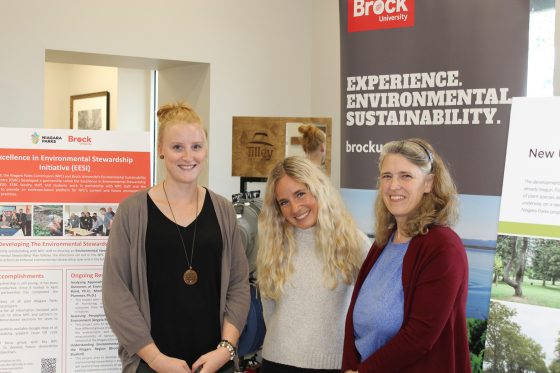
    Photo: Master of Sustainability students (left to right) Brooke Kapeller, Angela Mallette & Alicia Goddard.

    Have you heard? Brock University’s Environmental Sustainability Research Centre (ESRC) and the Niagara Parks Commission (NPC) have formed a partnership called the Excellence in Environmental Stewardship Initiative (EESI). On September 26th and 27th, the NPC held public information sessions to showcase environmental stewardship efforts in the Niagara Region, including the work of the EESI. The sessions proved to be a beneficial experience for graduate students involved in the EESI, and the public. Samantha Witkowski, a first-year student in the Masters of Sustainability program at the ESRC, said, “The experience was valuable for me as it was my first time meeting NPC staff, and my first public information session.  It was fascinating to see all the engagement taking place between collaborators and the public.”

    At the session, participants had the opportunity to learn about a variety of stewardship projects that are underway in the Niagara Region. For instance, the NPC has a two-year plan that aims to restore two kilometers of shoreline with native vegetation that will increase diversity while stabilizing the shoreline banks.  Alicia Goddard, another incoming graduate student with the Masters of Sustainability program stated, “I am impressed with the stewardship of the NPC. They are recycling hazardous trees that needed to be removed after they died from Emerald Ash Borer infestation by incorporating them into the Niagara River at select locations, increasing fish habitat.  That’s awesome!”

    Since the discovery of Emerald Ash Borer (EAB) beetle on NPC property in 2012, the park has lost a significant number of ash trees.  The park has responded by planting upwards of 20 different species of native trees, which will assist them in reaching their goal of having 75% of the species found in the park returned to the native condition.

    Another unique project began in 2004 when NPC partnered with Audubon Cooperative Sanctuary Program. Since that time, six hectares of turf grass on the Niagara Parks’ Legends on the Golf Complex is now returned to a more naturalized state.  An additional four hectares of previous agriculture fields are reforested.  The chemical use continues to be reduced, and water consumption by the golf course has significantly reduced, with 14 hectares removed from irrigation and annual upgrades occurring on the remaining infrastructure.  The Ussher’s Creek habitat is also improving with the addition of nest boxes and monitoring of water quality underway.  The golf course is now a certified Audubon Cooperative Sanctuary.

    Meanwhile at the Chippawa Grassland Bird Habitat management plans call for enhancing the existing grasslands by ensuring a variety of mixed native grasses that will not only increase habitat for grassland birds but other species including native pollinators, reptiles, and amphibians.

    In addition to these NPC-driven projects, the work of the joint partnership between the NPC and the ESRC was on display. ESRC students and faculty have been assisting the NPC with the development of a ten-year Environmental Stewardship Plan.  The ESRC has conducted an inventory of past stewardship projects allowing the NPC and partners to look back so informed discussions and decisions can be made within a common framework.  This framework has allowed for focus groups to meet and develop stewardship goals and objectives. Check out an interactive map of past and ongoing stewardship efforts.

    Additionally, 2nd year ESRC Master’s student Angela Mallette is currently studying how the public views the natural health of the Niagara Glen Nature Reserve, as compared to scientific data in the same area. Concurrently, 2nd year ESRC Master’s student Brooke Kapeller is investigating how the various parts of stewardship across the Niagara Region relate to positive outcomes and success.  As you can see, the EESI partnership between has many benefits, including giving graduate students the opportunity for hands-on work experience and unique research opportunities that further enhance the partnership.

    As the NPC works hard at preserving the Niagara Region corridor from Lake Erie to Lake Ontario we hope that you check out their projects and, if you have any suggestions or would like more information, reach out to them!  The initiatives underway will make up NPC plans from 2019 and beyond.


    Categories: Blog, Environmental Stewardship Initiative, Experiential Education, SSAS Student Contributor

  • Have an old textbook you can’t sell? Donate it instead!

    Blog Contributor: Shanen D’Souza

    Textbooks for Change is a global initiative that collects used university-level textbooks and transports them for reuse by students in several African countries. 50% of the textbooks are donated to campus libraries in East Africa, 20% are resold at affordable prices to students and the remaining 30% that are outdated or damaged are recycled. This is a sustainable, educational alternative to a question that many North American students face – how to get rid of my used textbooks?

    These textbooks are collected regularly and then deployed to countries where students cannot afford to pay the high costs of textbooks. They are reused or resold to students at reasonable prices, thus giving them an opportunity to learn and gain knowledge that they would otherwise not have a chance to. Some of the donated books that cannot be reused are recycled in a sustainable method, resulting in reduction of waste. This is a great opportunity for university students to discard textbooks they no longer need, in a sustainable and educational way. The saying really is true “what is one man’s trash is another man’s treasure”.

    Brock University has Textbooks for Change drop boxes across campus at 5 different locations. Click here for an interactive map of the locations. Below is a list of where the drop boxes can be found:

    • Mackenzie Chown A & Taro Hall Hallway
    • Walker Complex – Main Entrance
    • South Hall – 4th floor
    • IRC Library – Welch Hall 2nd floor
    • Entrance of Union Station (opposite Brock Press)

    To date, Brock University’s donations have accumulated to almost 12,000 textbooks, recycled 50,000 pounds of waste and saved 595 trees! As a campus, we can make a difference, even if it’s a small one, in the lives of students in Africa and help positively impact their educational experience!

    Categories: Blog, Student Contributor, Sustainability at Brock