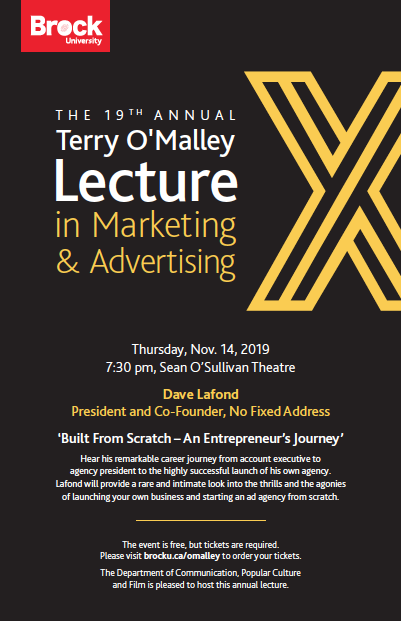
Tickets available here
Learn more about this event and the Dobson Case Competition here

In addition to captivating society and dominating news headlines, the #MeToo movement has earned its place in the history books.
Renowned German scholar Sabine Sielke will explore how #MeToo fits into a larger cultural context during the upcoming talk “Feminism Reloaded? The Serial Debate on Sexual Harassment and Sexual Violence, or: What’s New about #MeToo,” taking place Thursday, Sept. 12, 2:30 to 4 p.m. in Sankey Chamber at Brock.
Significant shifts in media culture since the 1990s, such as increased digitization, have intersected with important feminist methods, goals and conflicts. Sielke’s talk will situation the #MeToo moment within this broader context.
Her work on sexual violence in North American literature and culture brings a unique perspective to the topic of #MeToo.
As Director of the North American Studies program at Germany’s University of Bonn, Sielke’s research expertise spans 19th and 20th century American literature, modernist and postmodernist culture, as well as 20th century art and popular culture. She also works in literary and cultural theory, gender studies, African American studies and the dialogues between cultural studies and the natural sciences.
The free public talk was spearheaded by the Department of English Language and Literature with support from Social Justice and Equities Studies; Social Justice Research Institute; Department of History; Centre for Canadian Studies; Department of Political Science; Centre for Women’s and Gender Studies; Department of Communications, Popular Culture and Film; Office of Human Rights and Equity; and the President’s Advisory Committee on Human Rights, Equity and Decolonization.

Communication, Popular Culture and Film professors Anthony Kinik and Christie Milliken will be traveling to the University of British Columbia for the 2019 Film Studies Association of Canada (FSAC) annual conference.
They join Peter Lester, Program Chair and FSAC President who organized this year’s conference. The program includes featured speakers, roundtable discussions, screenings, lectures and panel discussions.
June 4
Indigenous Cinemas/Settler Cinemas panel
June 5
Industry and Ephemera panel
Eco-cinema and the Environment
June 6
Legacies of the NFB
Trauma and Torture in Contemporary Television

Earlier this year, Assistant Professor Anthony Kinik’s publication, The City Symphony Phenomenon: Cinema, Art, and Urban Modernity Between the Wars inspired a film series at Anthology Film Archives showcasing the city symphonies phenomenon from the 1920s-present. As close consultations with the organization’s curator wrapped, Dr. Kinik was invited to introduce four programs of films during the opening weekend of the series.
The highlight was Andre Sauvage’s Etudes Sur Paris (1928). Until now, Kinik had only ever seen the YouTube version. Thanks to Anthology Film Archives, a leading centre for the preservation, study and exhibition of film, he was able to view the newly restored 35mm version.
This weekend marks his return to New York City to introduce some expanded cinema films from Expo 67 at Anthology Film Archives’ “Films for the Fair: The World’s Fair & Cinema” series together with Guillaume Lafleur, Director of Programming at the Cinematheque Quebecois. Dr. Kinik contributed the essay “Celluloid City: Montreal and Multi-screen at Expo 67” to the anthology “Reimagining Cinema: Film at Expo 67” and was part of the research team for the project, Cinema Expo 67.
Film Notes – from Anthology Film Archives
Expo 67 was the most moving-image-saturated Exposition of them all. While the films and installations that attracted the most attention were those that experimented, often boldly, with the possibilities of multiple-screen cinema (and are therefore included in the two multi-screen programs elsewhere in this series), Expo 67’s moving-image works ran the gamut of styles and approaches. This program features some of the single-screen highlights, including William Brind’s city-symphony-like IMPRESSIONS OF EXPO 67, two films exploring the pavilions devoted to Canada’s indigenous culture (as well as the experiences of the Inuit artists and craftspeople who participated in the Fair), John & Faith Hubley’s experimental animation URBANISSIMO, and a section of Jud Yalkut’s film METAMEDIA that was shot at the Expo.
William Brind IMPRESSIONS OF EXPO 67 (1967, 8 min, 35mm-to-digital)
Eva Kolcze & Phil Hoffman BY THE TIME WE GOT TO EXPO (2015, 9 min, digital)
Marc Beaudet THE CANADIAN PAVILION, EXPO 67 (1967, 19 min, 35mm-to-digital)
David Millar AKI’NAME (ON THE WALL) (1968, 22 min, 35mm-to-digital)
Michel Régnier INDIAN MEMENTO (1967, 18 min, 35mm-to-digital)
Hubs Hagen EXPOSITION (1967, 10 min, 16mm. Collection print courtesy of the UCLA Film & Television Archive.)
John & Faith Hubley URBANISSIMO (1967, 6 min, 16mm)
Jud Yalkut EXPO ‘67 (1967, 2 min, 16mm-to-digital, silent)
Total running time: ca. 100 min.

The 24-hour Film Festival is back!
Contestants will have 24 hours to write, direct, film and render their film. All films will be screened on Friday, March 22 from 7 to 10 p.m. in AS 215.
Important dates
March 20 – registration deadline
March 21 – theme released at 8:00 a.m.
March 22 at 8:00 a.m. – film submission due
March 22 at 7:00 p.m. – film screening
For information on registering your team, submission deadlines, judges and prizes, visit the CPCFSS page

Communication, Popular Culture and Film professors Liz Clarke, Anthony Kinik and Sarah Matheson will be traveling to Seattle for the 60th anniversary of the Society for Cinema and Media Studies conference.
The annual conference includes panels, seminars, roundtables and workshops on diverse topics that encompass game studies, podcasts, animation, reality TV, sports media, contemporary film and early cinema.
On Thursday, March 14 Department Chair and Associate Professor Sarah Matheson will serve as Chair in a panel discussion on Transnational Ethnicities in Television
On Friday, March 15
Assistant Professor Liz Clarke will take part in a panel on Historical and Contemporary Approaches to Mediating War
and Assistant Professor Anthony Kinik will take part in a panel on Making Music Across Genres
On Sunday, March 17, Professor Kinik will take part in the Expanding and Reconsidering the City Symphony seminar.

RenderThis is BrockTV’s annual student film festival featuring short (2-15 minute) films written, directed, produced and edited by Brock University and Niagara College students. Entries will be judged by a panel of professors, instructors and industry experts with $1500 in prizes up for grabs.
Join us at 6:30 p.m. on Friday, March 8 in the Sean O’Sullivan Theatre.
Dress code: Semi-formal
6:30 – 7:00 p.m – Meet and greet the filmmakers: reception portion of the evening, including refreshments
7:00 p.m. – Screening
Following an intermission, door prizes will be awarded.
The evening concludes with the announcement of the judges’ and audience choice awards.
Founded in 2005 by a group of Communication and Film students, BrockTV is dedicated to providing student produced campus coverage, live sports and original content.



Recent Comments