Articles from:September 2024

  • Brock experts find wine is central to Niagara’s identity

    This story originally appeared in The Brock News
    by Amanda Bishop
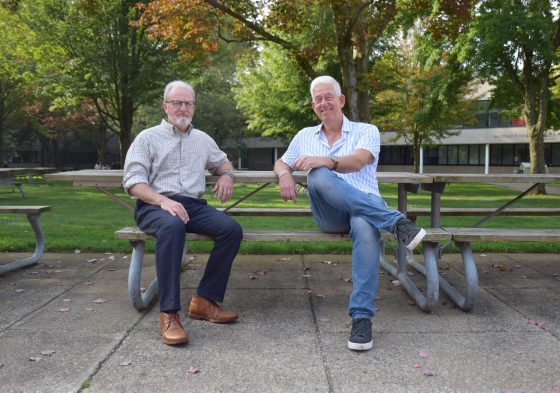

    Brock Associate Professor Russell Johnston and Professor Michael Ripmeester made a corker of a discovery when conducting surveys on how locals identify Niagara.

    As St. Catharines gears up for the annual Grape and Wine Festival, two Brock researchers have uncorked findings on how important wine really is to Niagara residents.

    For almost two decades, Russell Johnston, Associate Professor in the Department of Communication, Popular Culture and Film, and Michael Ripmeester, Professor in the Department of Geography and Tourism Studies, have studied how local residents identify the Niagara region.

    In their recently published book, Meaningful Pasts: Historical Narratives, Commemorative Landscapes, and Everyday Lives, Niagara’s wine culture is one of two in-depth case studies.

    Their research, beginning in the early 2000s, originally sought to determine if and how people engage with monuments in Niagara. With the celebrations of the War of 1812 bicentennial still on the horizon at that time, Johnston and Ripmeester started surveying St. Catharines residents on the street about what sprang to mind when they thought of Niagara.

    “We both had an interest in understanding what monuments actually did, apart from what they were supposed to do, so we specifically did not use words like ‘past’ or ‘history’ when talking to Niagara residents,” says Ripmeester. “We were very much interested in whether or not people would go there — and they didn’t, at all.”

    The researchers were surprised to find that wine was identified strongly as part of the region’s fabric — sometimes, even more than the iconic waterfall at Niagara Falls.

    Johnston says that once wine was established as a key identifier, subsequent surveys dug into whether people believed there was any historical connection with wine. Results confirmed that wine was viewed “as part of Niagara’s agricultural heritage, and not just a contemporary industry.”

    “As it developed, the wine industry did a great job of inserting itself into heritage narratives so that people were able to see it as part of a longer-term agricultural trajectory of Niagara, from small towns and family farms to wine and wineries,” says Ripmeester. “So, for all kinds of reasons, the wine industry is speaking to the people of Niagara in the sense that it gives them a positive identifier.”

    The researchers say the bicentennial of the War of 1812, which fell in the midst of their research, provided an interesting counterpoint to their findings on wine. Commemoration projects and events ran from 2011 to 2014, so when Ripmeester and Johnston conducted another survey about Niagara identifiers in 2016, they expected to be able to observe the impact of this substantial investment and the extensive local media coverage surrounding it.

    Almost no one mentioned it.

    “Out of everyone we surveyed, one or two people mentioned the War of 1812,” says Johnston. “In 2016, we had the lowest number of respondents naming the War of 1812 out of all of our surveys dating back to the early 2000s.”

    Ripmeester says they were shocked by this result.

    “The federal government, the Department of National Defence, local dignitaries and historians thought it was important to give people a sound knowledge of the War of 1812 and spent tens of millions of dollars,” he says. “Yet it didn’t create a lasting impression on local people.”

    Instead, wine culture, tourism, heritage and industry continued to top the survey responses throughout the project. Researchers say this is because people name what’s personally meaningful — not necessarily what officials who work to steer public memory hope to highlight.

    “Narratives come in and out of relevance for people living in a particular community,” says Johnston. “People are often reaching for what’s right now.”
  • CPCF Abroad

    This summer, CPCF Professor Dr. Marian Bredin presented original research at international conferences in the Netherlands and New Zealand.

    At Erasmus University in Rotterdam, she presented the paper ‘Popular Indigenous Television and Narratives of Colonial Violence in Canada’ to the conference on Representation of Diversity in Mediated Popular Culture. This project analyzed two recent TV drama series — Bones of Crows (2023) and Little Bird (2023) — created by Indigenous directors, producers and actors to tell the stories of the residential schools and the Sixties Scoop.

    In Christchurch, Dr. Bredin presented the paper ‘Indigenizing Media Policy and Practice, Decolonizing Media Spaces’ to the 2024 meeting of the International Association for Media and Communication Research. This project focused on the political economy of Indigenous media and analyzed how Indigenous peoples’ interventions in Canadian media policy and production have fostered the decolonization of media spaces.

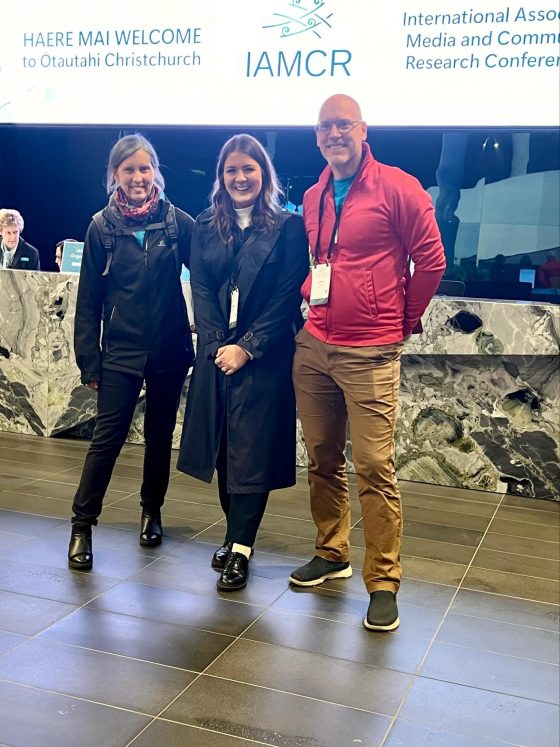
    Dr. Bredin is photographed here with CPCF colleague Derek Foster and CPCF graduate Sydney Forde who is currently completing her PhD at the Donald P. Bellisario College of Communications, Pennsylvania State University.

  • Brock expert studies public memory of Terry Fox via Instagram

    This story originally appeared in The Brock News
    By Amanda Bishop


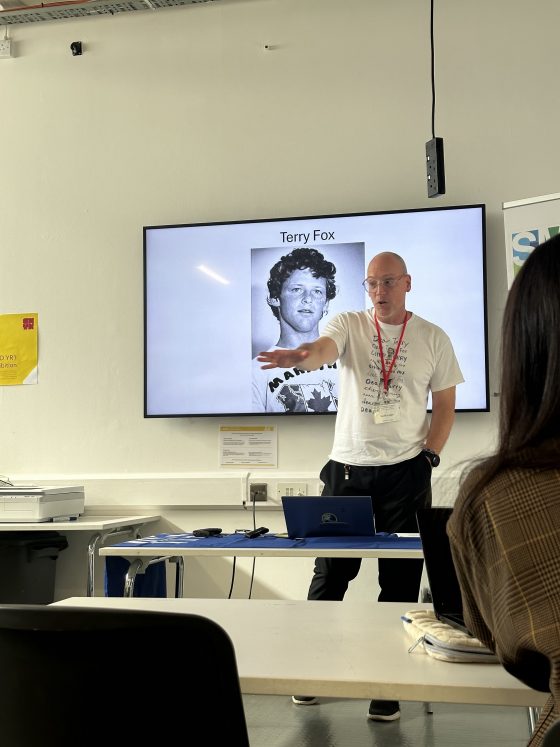
    Professor Foster presenting at the International Association for Media and Communication Research this summer.

    Forty-four years ago, Terry Fox captured the hearts of the nation by running across Canada on one leg to raise funds for cancer research. Although the beloved Canadian is no longer here to personally continue his Marathon of Hope, his legacy lives on through annual memorial runs and, according to Brock’s Derek Foster, through Instagram.

    Fox, who succumbed to his battle with cancer in 1981, is at the centre of Foster’s recent research involving public memory, social media and well-being.

    As part of his ongoing research into how the celebrated Canadian is remembered in popular culture, the Brock Associate Professor in the Department of Communication, Popular Culture and Film analyzed hundreds of Instagram posts created by people who visited Fox memorial sites.

    In the lead-up to this year’s Terry Fox Run, held annually in September, Foster says he wanted to see how user-generated content creates and shapes the public memory of Fox compared to the Terry Fox Foundation’s official messaging about runs and fundraising.

    “The public memory of Terry Fox is very much forward looking, in the sense that what he was pursuing in 1980 is still a collective endeavour for people motivated by finding a cure for cancer,” says Foster. “So, the memory isn’t just tied to the past through a lens of nostalgia, but rather, connected to our present and also a dream of a future.”

    Foster’s review showed about one third of his sample made clear references not only to emotional experiences, such as visitors being moved to tears, but also to what he calls “self-transcendent emotions” such as awe and gratitude.

    He also notes the posts don’t appear to be driven by a desire for engagement, as social media posts often are. In fact, only a small number of people liked or commented on the posts he reviewed. Foster says it’s significant that “the hashtag isn’t driving the discourse” because it shows a level of sincerity from the creators.

    “What we see is the vernacular memory — everyday people as they are deciding to create, produce and circulate these thoughts and experiences on their own, not organized in any way,” he says.

    Foster also says the way individuals are using social media to share their personal experiences with Fox memorials is an excellent case study on the legacies of public figures.

    “Most public memory involves looking back to build a sense of community or reinforce certain values that we can then use as we move forward,” says Foster. “That is far more explicit in the public memory around Terry Fox than other figures — the aim is not just to maintain him in memory but to continue to strive for the goal that he wasn’t able to reach.”