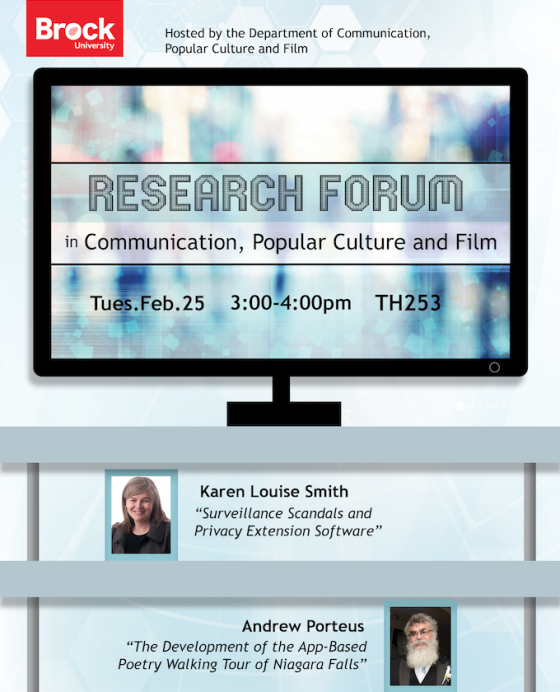
Another research forum will be held on March 10. Speakers will be announced shortly.
Tuesday, February 11, 2020 | By Milica Petkovic

Another research forum will be held on March 10. Speakers will be announced shortly.
Wednesday, January 29, 2020 | By Milica Petkovic
Additional research forums will be held on Feb. 25 and Mar. 10. Speakers will be announced shortly.
Monday, November 25, 2019 | By Milica Petkovic

Get crafty for a great cause! Join the Communication, Popular Culture and Film Student Society (CPCFSS) this Friday in Skybar Lounge in Isaac’s for a holiday crafting charity event. All crafts will be donated to kids staying in local hospitals over the holidays and raffle proceeds will go to Crafting for a Cure (CFC).
Wednesday, November 06, 2019 | By Milica Petkovic
Thursday, October 31, 2019 | By Milica Petkovic
Monday, September 09, 2019 | By Milica Petkovic
In addition to captivating society and dominating news headlines, the #MeToo movement has earned its place in the history books.
Renowned German scholar Sabine Sielke will explore how #MeToo fits into a larger cultural context during the upcoming talk “Feminism Reloaded? The Serial Debate on Sexual Harassment and Sexual Violence, or: What’s New about #MeToo,” taking place Thursday, Sept. 12, 2:30 to 4 p.m. in Sankey Chamber at Brock.
Significant shifts in media culture since the 1990s, such as increased digitization, have intersected with important feminist methods, goals and conflicts. Sielke’s talk will situation the #MeToo moment within this broader context.
Her work on sexual violence in North American literature and culture brings a unique perspective to the topic of #MeToo.
As Director of the North American Studies program at Germany’s University of Bonn, Sielke’s research expertise spans 19th and 20th century American literature, modernist and postmodernist culture, as well as 20th century art and popular culture. She also works in literary and cultural theory, gender studies, African American studies and the dialogues between cultural studies and the natural sciences.
The free public talk was spearheaded by the Department of English Language and Literature with support from Social Justice and Equities Studies; Social Justice Research Institute; Department of History; Centre for Canadian Studies; Department of Political Science; Centre for Women’s and Gender Studies; Department of Communications, Popular Culture and Film; Office of Human Rights and Equity; and the President’s Advisory Committee on Human Rights, Equity and Decolonization.
Monday, July 22, 2019 | By Milica Petkovic
Tuesday, May 21, 2019 | By Milica Petkovic
Communication, Popular Culture and Film professors Anthony Kinik and Christie Milliken will be traveling to the University of British Columbia for the 2019 Film Studies Association of Canada (FSAC) annual conference.
They join Peter Lester, Program Chair and FSAC President who organized this year’s conference. The program includes featured speakers, roundtable discussions, screenings, lectures and panel discussions.
June 4
Indigenous Cinemas/Settler Cinemas panel
June 5
Industry and Ephemera panel
Eco-cinema and the Environment
June 6
Legacies of the NFB
Trauma and Torture in Contemporary Television
Tuesday, May 07, 2019 | By Milica Petkovic
Earlier this year, Assistant Professor Anthony Kinik’s publication, The City Symphony Phenomenon: Cinema, Art, and Urban Modernity Between the Wars inspired a film series at Anthology Film Archives showcasing the city symphonies phenomenon from the 1920s-present. As close consultations with the organization’s curator wrapped, Dr. Kinik was invited to introduce four programs of films during the opening weekend of the series.
The highlight was Andre Sauvage’s Etudes Sur Paris (1928). Until now, Kinik had only ever seen the YouTube version. Thanks to Anthology Film Archives, a leading centre for the preservation, study and exhibition of film, he was able to view the newly restored 35mm version.
This weekend marks his return to New York City to introduce some expanded cinema films from Expo 67 at Anthology Film Archives’ “Films for the Fair: The World’s Fair & Cinema” series together with Guillaume Lafleur, Director of Programming at the Cinematheque Quebecois. Dr. Kinik contributed the essay “Celluloid City: Montreal and Multi-screen at Expo 67” to the anthology “Reimagining Cinema: Film at Expo 67” and was part of the research team for the project, Cinema Expo 67.
Film Notes – from Anthology Film Archives
Expo 67 was the most moving-image-saturated Exposition of them all. While the films and installations that attracted the most attention were those that experimented, often boldly, with the possibilities of multiple-screen cinema (and are therefore included in the two multi-screen programs elsewhere in this series), Expo 67’s moving-image works ran the gamut of styles and approaches. This program features some of the single-screen highlights, including William Brind’s city-symphony-like IMPRESSIONS OF EXPO 67, two films exploring the pavilions devoted to Canada’s indigenous culture (as well as the experiences of the Inuit artists and craftspeople who participated in the Fair), John & Faith Hubley’s experimental animation URBANISSIMO, and a section of Jud Yalkut’s film METAMEDIA that was shot at the Expo.
William Brind IMPRESSIONS OF EXPO 67 (1967, 8 min, 35mm-to-digital)
Eva Kolcze & Phil Hoffman BY THE TIME WE GOT TO EXPO (2015, 9 min, digital)
Marc Beaudet THE CANADIAN PAVILION, EXPO 67 (1967, 19 min, 35mm-to-digital)
David Millar AKI’NAME (ON THE WALL) (1968, 22 min, 35mm-to-digital)
Michel Régnier INDIAN MEMENTO (1967, 18 min, 35mm-to-digital)
Hubs Hagen EXPOSITION (1967, 10 min, 16mm. Collection print courtesy of the UCLA Film & Television Archive.)
John & Faith Hubley URBANISSIMO (1967, 6 min, 16mm)
Jud Yalkut EXPO ‘67 (1967, 2 min, 16mm-to-digital, silent)
Total running time: ca. 100 min.
Copyright © 2026
Brock University
Non-discrimination Policy
University policies
Privacy Accessibility
Niagara Region
1812 Sir Isaac Brock Way
St. Catharines, ON
L2S 3A1 Canada
+1 905-688-5550
We acknowledge the land on which Brock University was built is the traditional territory of the Haudenosaunee (ho-din-anish-shonee) and Anishinaabe (A-nish-shin-aaabee) people, many of whom continue to live and work here today. This territory is covered by the Upper Canada Treaties and is within the land protected by the Dish with One Spoon Wampum agreement. Today, this gathering place is home to many First Nations, Métis and Inuit, and acknowledging reminds us that our great standard of living is directly related to the resources and friendship of Indigenous people.
We use cookies to improve your overall web experience. By using our website you consent to our use of cookies in accordance with our Privacy Policy