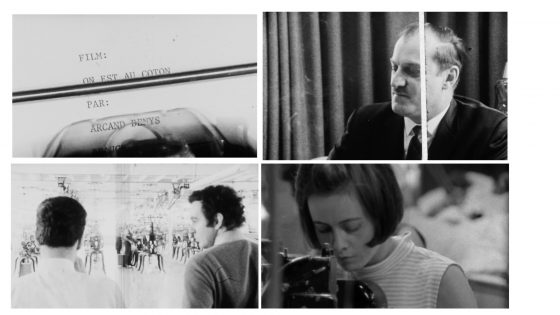
In late October, the Director of the Centre for Canadian Studies, Anthony Kinik, had the rare opportunity to interview the acclaimed Québécois director Denys Arcand about his films On est au coton (1970/1976) and Gina (1975), and the connections between them, in advance of this year’s edition of the Mighty Niagara Film Fest. This is what he had to say about his meeting with Arcand and the reasons behind it:
Arcand, of course, is one of the most famous and celebrated Canadian directors of all time, best known for his films The Decline of the American Empire (1986), Jesus of Montreal (1989), and The Barbarian Invasions (2003), his sequel to The Decline of the American Empire, which won the Academy Award for Best Foreign Language film in 2004 (still the only Canadian film to have been recognized in this category).
 Interviewing Arcand was a huge thrill and an enormous honour for me. I experienced my very first Denys Arcand film in 1986—40 years ago!—when I went to see The Decline of the American Empire at an art house theatre in Washington, D.C. as a teenager (and, yes, that title has become even more meaningful in recent years).
On est au coton (1970/1976), a.k.a. Cotton Mill, Treadmill, is one of the most hard-hitting and brilliant labour documentaries ever made. It’s a scathing study of the exploitation of Quebec’s working class at the hands of the textile industry in particular. The film was completed in 1970, the year of a highly contentious provincial election in Quebec. Already the executive class of the National Film Board of Canada (NFB), the film’s producer, was concerned that On est au coton (which plays on the word “cotton,” but translates as “We’re fed up!”) might be too incendiary, too dangerous for release. Then the October Crisis of 1970 broke out, where a series of brazen and ruthless terrorist acts by the Front de libération du Québec (the Quebec Liberation Front) were met with the imposition of the War Measures Act and the lifting of civil liberties in Quebec and across Canada. Within this highly charged climate, the NFB decided to suppress its own film, banning On est au coton in early 1971.
Officially, On est au coton remained a banned film for the next five years. However, videotape technology had entered the market by this point in time, and members of Arcand’s team at the NFB managed to bootleg the film. Over the next few years, the underground version of On est au coton managed to reach an estimated 20,000 viewers—very likely more than the film would have reached had it been given a limited release in theatres—most of whom were professors, instructors, staff, and students at Quebec’s universities and colleges.
Soon after Arcand completed his next documentary, Québec: Duplessis et après (1972) (Quebec: Duplessis and After)—his devastating account of the 1970 provincial election and the failure of the Quiet Revolution—he turned to making feature-length fictional films, beginning with his so-called “Crime Trilogy”: La Maudite galette (Dirty Money, 1972), Réjeanne Padovani (1973), and Gina (1975).
At the time that Arcand began work on Gina, On est au coton remained a banned film, and one that had reached a very limited audience, mostly of intellectuals. Gina is a classic Canuxploitation film of the period based on the true crime story of an exotic dancer from Montreal who was the victim of horrific sexual violence when she travelled to a small town in Quebec to perform. Here, in Arcand’s version, Gina gets her revenge on the rogue snowmobile gang who victimized her with the help of the Montreal mobsters who manage her career.
Frustrated by the ongoing ban on On est au coton, Arcand decided to add a subplot to Gina about a documentary film crew from the “Office National du Cinéma” (a parody of the “Office National du Film,” the French name for the NFB) who are in town to shoot a hard-hitting documentary about the exploitation of the local working class at the hands of the textile industry. Sound familiar? Doing so allowed Arcand to re-stage key scenes from On est au coton and slip them into Gina, ensuring that at least some of this material would reach a wider audience.
Arcand’s ploy worked. Though highly controversial, Gina was a box office success in Quebec in 1975—Arcand’s most successful film to date. By 1976, however, the tide had turned in Quebec. Under the leadership of René Lévesque, the Parti Québécois won a landslide victory in the provincial elections. That same year, the NFB finally released On est au coton, albeit in a censored version.
50 years later, as part of the Mighty Niagara Film Festival’s opening day festivities, On est au coton will be screened on Wednesday, November 11, 2026 at the Cineplex Odeon Seaway Mall in Welland, Ontario at 7:00 pm. Kinik will be in attendance to briefly introduce the film.
 More information about this screening can be found HERE.
And on Thursday, November 12, 2026, Gina will be screened at the Landmark Cinema Pen Centre in St. Catharines at 7:00 pm. Kinik will be in attendance here, too, to introduce the film.
More information about this screening can be found HERE.
Thank you to @niagaraartistscentre for making this interview possible.
And THANK YOU to Denys for his generosity and for his phenomenal films.
And while we’re at it, we’d like to thank the NFB for having turned On est au coton into a cause célèbre and an underground sensation.
And you can find Kinik’s interview with Denys Arcand HERE.