
Promote sustained, inclusive, and sustainable economic growth, full and productive employment, and decent work for all.
Goal 8 aims to promote sustained economic growth, higher levels of productivity and technological innovation. Encouraging entrepreneurship and job creation are key to this, as are effective measures to eradicate forced labour, slavery and human trafficking.
Taking Action
Initiatives at Brock University
Did you know that Brock was the second university in the province to become a fair-trade campus?
Employment at Brock
If you are looking for employment, Brock offers a lot of ways they can help.
You can apply to jobs on campus, where many different opportunities are available. The options include Recreation Services, Union Station, Starbucks, or Tim Hortons, Brock Library, Smart Start, aquatic staff, The Zone, welcome desks, intramurals and various food locations all throughout Brock’s campus.
#ShopBrock
#ShopBrock gave students who owned businesses opportunities to advertise their company name on campus. This initiative encouraged students and faculty to buy locally and improve Niagara Region’s economy while supporting Brock’s students.
Career Zone
The Career Zone will help you with your resume for applying for jobs outside of Brock and they have information about job fairs throughout the week.
Hamilton-Niagara’s Top Employer
Brock was named one of Hamilton-Niagara’s Top Employers for the fifth time and we have been selected every time we have applied. The organization recognizes Brock as an industry leader that fosters exceptional work environments.
THE IMPACT RANKINGS
As part of Brock’s 2022 submission to THE Impact Rankings, we shared information on how the university is working toward achieving decent work and economic growth. This information ranked us in the 54th spot out of 849 institutions around the world and gave us a score of 73.8/100.
Some key information we summitted includes:
- Brock has a Respectful Work and Learning Environment Policy which outlines that the university supports a work and learning culture that values diversity and inclusion, fosters respect, and does not tolerate prejudice, discrimination, harassment, and/or bullying.
- Brock has an Employment Equity Policy which outlines the university’s committed to principles of equity and diversity in the workplace and recognizes the value that diverse faculty and staff bring to activities and initiatives.
- Brock supported 17,006 students in finding work placement in 2019.

Initiatives in the Niagara Region
Niagara Region Economic Development Strategy
The Economic Development Team has gathered information in the Niagara Region to provide resources specifically targeted to local small businesses. This Strategy, published in 2023, is a 10 year plan looking forward to what the Niagara Region could look like.
Niagara Region Growth Strategy and Economic Development
The Growth Strategy and Economic Development Plan includes a list of available incentives for Niagara residents, including multiple dedicated to employment and business ownership.
Learn more information about living wage in Niagara
THE Evidence
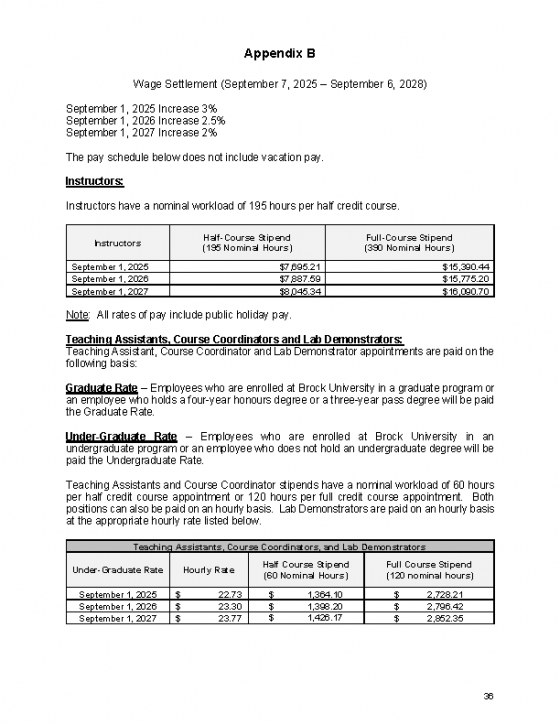
Brock University is committed to fair and equitable compensation through collectively negotiated wage structures, comprehensive employee benefits, and workplace protections. Employees across the University are covered by collective agreements that establish transparent salary scales, regular wage increases, and employment standards. These agreements help ensure that Brock employees receive compensation that supports financial security and quality of life.
The living wage for the Niagara Region is $21.40 per hour, representing the hourly rate required for a worker to meet basic living expenses within the region. Brock’s negotiated salary structures for eligible employee groups exceed this benchmark, demonstrating the University’s commitment to providing fair compensation and supporting the wellbeing of its workforce.
Examples of Brock’s living wage and fair employment practices include:
- Collective bargaining agreements covering faculty, librarians, professional and administrative staff, maintenance employees, trades employees, and academic workers.
- Established salary grids and wage schedules negotiated through collective agreements, providing transparent and equitable compensation structures.
- Employer-funded benefits and pension programs that enhance financial security beyond base wages.
- Workplace protections including grievance procedures, dispute resolution mechanisms, joint labour-management committees, occupational health and safety provisions, and anti-discrimination requirements.
- Relocation assistance programs available to eligible employees who move to the Niagara region in support of their employment at Brock.
Through these measures, Brock University supports decent work, fair compensation, and employment stability while ensuring its workforce benefits from compensation and workplace protections that exceed regional living wage expectations.
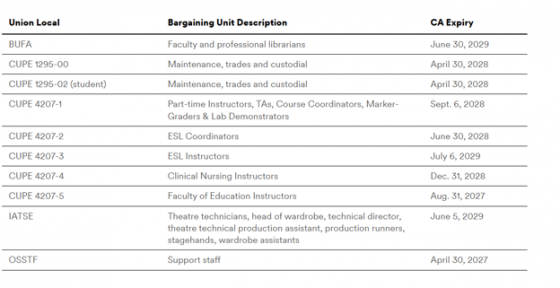
Brock University supports freedom of association and collective bargaining through the recognition of employee unions and the negotiation of collective agreements covering a broad range of employee groups across the institution. The University maintains formal labour relations processes and works collaboratively with bargaining units representing faculty, staff, instructors, librarians, and other employee groups.
Examples include:
- Union Representation: Brock employees are represented through multiple labour organizations, including Brock University Faculty Association (BUFA), Canadian Union of Public Employees (CUPE), Ontario Secondary School Teachers’ Federation (OSSTF), and International Alliance of Theatrical Stage Employees (IATSE).
- Collective Agreements: Brock maintains collective agreements covering faculty members, professional librarians, support staff, maintenance and custodial employees, teaching assistants, part-time instructors, ESL instructors, clinical nursing instructors, Faculty of Education instructors, and theatre production staff.
- Collective Bargaining Framework: The University’s Office of People & Culture publicly maintains collective agreements and labour relations resources, supporting transparent labour-management relations and employee rights.
- Ongoing Labour Relations: Brock regularly engages in collective bargaining and agreement renewals with its bargaining units. Recent agreements have been negotiated and ratified with groups including BUFA, CUPE, and IATSE.
Through union recognition, collective bargaining, and formal labour relations processes, Brock University supports employee representation and labour rights across the institution.
Brock University is committed to maintaining a diverse, inclusive, and respectful work and learning environment that is free from discrimination and harassment. The University supports this commitment through institutional policies, complaint-resolution procedures, training and education initiatives, dedicated support services, and ongoing monitoring of discrimination and harassment concerns.
Examples include:
- Discrimination and Harassment Policy: Brock University is committed to an inclusive and respectful work and learning environment, free from:
- Human rights Discrimination or Harassment;
- Workplace harassment;
- Sexual harassment; and
- Personal harassment, including bullying.
- Complaint Resolution Procedures: Brock’s Discrimination & Harassment Procedures establish formal processes for reporting, investigating, and resolving concerns related to discrimination and harassment. The procedures provide consultation, guidance, referral pathways, alternative dispute resolution options, and formal complaint mechanisms.
- Human Rights and Equity Office: Grounded in the Ontario Human Rights Code and guided by Brock’s Discrimination and Harassment Policy and Sexual Violence Policy, the HREO responds to concerns of harassment, discrimination, and identity-based harm through a trauma-informed, survivor– and complainant-centred approach.
- Student Code of Conduct: Brock University is a distinct community of Students, staff and faculty, engaged in learning, teaching, research, sport and other activities while fostering an environment of integrity, inclusivity, accessibility, reconciliation, decolonization and civic responsibility. To maintain these standards and privileges, Brock University has established community standards to promote and maintain respect for the rights, responsibilities and well-being of all members of our community and address Student behaviour that is contrary to these standards and that jeopardizes the welfare of the Brock Community, the good order and proper functioning of academic and non-academic programs, activities of the University, and/or those that adversely affects the property of the University.
- Sexual Violence Policy: Brock University (the “University”) recognizes that Sexual Violence is a serious and complex issue that adversely affects Brock Community Members. The University unequivocally prohibits and will not condone, tolerate, or ignore any form of Sexual Violence that falls within the University’s Jurisdiction.
- Training and Education: Brock delivers human rights, equity, anti-racism, accessibility, and harassment-prevention programming through the Human Rights and Equity Office. Annual reports document training, workshops, outreach activities, and educational initiatives designed to prevent discrimination and promote inclusion.
- Monitoring and Accountability: Brock publishes annual Human Rights and Equity reports and annual reports on human rights, harassment, discrimination, and hate incidents. These reports support transparency, accountability, trend monitoring, and continuous improvement.
Brock University is committed to preventing and reducing the risk of forced labour, child labour, and human rights abuses within its operations and supply chain. Through supplier standards, procurement practices, and annual reporting under Canada’s Fighting Against Forced Labour and Child Labour in Supply Chains Act (Bill S-211), Brock promotes ethical sourcing and responsible business conduct.
Examples include:
- Annual Report on Fighting Against Forced Labour and Child Labour in Supply Chains: Brock is committed to strengthening due diligence efforts to reduce the risk of modern slavery in our operations and supply chains.
Brock publishes an annual report outlining measures taken to prevent and reduce the risk of forced labour and child labour in its supply chain and procurement activities. The report affirms the University’s commitment to ethical sourcing, human dignity, and fair labour practices.
- Supplier Code of Conduct: Brock requires suppliers and subcontractors to operate in an ethical, legally compliant, and socially responsible manner. Suppliers must uphold human rights standards, protect workers, and comply with labour laws and internationally recognized practices.
- Prohibition of Child Labour: The University does not tolerate the use of forced, involuntary or indentured labour. The University expects Suppliers to abide by, at a minimum, the Fundamental standards of the International Labour Organization’s (ILO). Suppliers should not use forced, illegal, or prison labour including indentured or bonded labour or any form of compulsory labour to manufacture products. Suppliers shall not recruit or onboard employees in any way that contravenes applicable laws and regulations nor shall Suppliers retain employees’ identity papers or passports.
Brock’s Supplier Code of Conduct explicitly states that the University does not tolerate child labour and expects suppliers to comply with the fundamental standards of the International Labour Organization (ILO).
- Responsible Procurement Practices: Brock’s procurement framework requires purchasing activities to be conducted in a fair, transparent, accountable, and equitable manner, supporting responsible stewardship and ethical sourcing.
Through the Supplier Code of Conduct, Brock requires suppliers to uphold labour standards, prohibit child labour, respect human rights, and maintain safe working conditions throughout their operations and supply chains.
Brock’s Procurement Policy also states that All purchases of goods and services undertaken on behalf of the University shall be conducted in accordance with the Broader Public Sector Supply Chain Code of Ethics.
Brock University supports equitable compensation and employment practices through institution-wide employment equity policies, collective bargaining agreements, transparent salary structures, and formal employment equity processes. These measures help ensure that compensation, recruitment, and advancement practices are administered fairly and consistently across employee groups.
Examples include:
- Employment Equity Policy: Brock maintains an institutional Employment Equity Policy that applies to hiring, retention, promotion, leadership, and training processes while supporting equitable employment opportunities and the removal of systemic barriers for equity-seeking groups.
- Joint Committee on Employment Equity (JCEE): The BUFA collective agreement includes formal Employment Equity provisions, General Employment Equity Plans, and oversight through the Joint Committee on Employment Equity.
- Transparent Salary and Classification Structures: Collective agreements governing faculty, librarians, support staff, maintenance staff, trades staff, and academic workers establish negotiated wage scales, salary classifications, and compensation frameworks that promote consistency and transparency. Examples of published salary scales include the BUFA collective agreement and the Co-op Program Salary Survey results.
- Equitable Recruitment and Advancement Processes: Brock’s employment equity procedures provide guidance for recruitment, selection, and workforce planning to support fair access to employment and advancement opportunities.
Brock University supports workplace equity through the collection and analysis of workforce demographic data, employment equity planning, and institutional review processes designed to identify and address barriers affecting equity-seeking groups. The University uses workforce data and equity-focused assessments to inform decision-making and promote equitable employment practices.
Examples include:
- Equity Census Dashboard: Brock maintains an Equity Census Dashboard that provides demographic data on faculty, staff, and librarians and supports the identification of representation gaps and workforce trends.
- Employment Equity Policy: Brock’s Employment Equity Policy establishes institution-wide expectations related to equitable employment practices, representation, retention, promotion, and advancement opportunities.
- Equity Audits and Reviews: Brock and the Brock University Faculty Association (BUFA) have undertaken an equity audit of tenure and promotion processes to assess impacts on equity-seeking groups and support equitable career progression.
- Annual Equity Reporting: The University publishes Human Rights and Equity reports and maintains governance structures that support ongoing monitoring of employment equity initiatives and outcomes.
Brock University provides formal appeal and grievance mechanisms to ensure workplace concerns are addressed fairly and transparently. Under the Respectful Work & Learning Environment Policy, employees who are not satisfied with the outcome of a complaint or investigation may pursue further review through collective agreement grievance procedures or the Staff Grievance Procedure, ensuring due process and protection of employee rights.
Brock has multiple employee groups with some groups being represented by unions who engage in collective bargaining.
Labour rights also extend beyond Brock employees, with Brock’s Supplier Code of Conduct stating: Suppliers shall recognize and respect the rights of workers to form or join trade unions of their own choosing and to collectively bargain, in accordance with legislation in the applicable jurisdiction.
Canada’s Charter of Rights and Freedoms also states that everyone has the freedom of association.

Recent Comments