SSAS Student Contributor

  • First Year SSAS students impress with ambitious research proposals

    Blog Contributor: Lydia Collas

    SSAS 2017 Cohort

    Master of Sustainability 2017 Student Cohort, September 2017

    March 9th saw students in their first year of the Sustainability Science and Society (SSAS) program present preliminary proposals of the research that they will undertake in the coming months. Being in my second year of the program, I delighted in the opportunity to sit back and watch others undergo what I myself had done a year earlier. The ten students did not disappoint as they spoke with passion and excitement of the research questions they hope to answer.

    Sustainability is an interdisciplinary subject by nature: it brings together aspects from natural science, social science and economics. This was very much reflected in the students’ presentations which covered a vast portion of what can be considered sustainability science. No two students plan to study even remotely similar areas. Lyn Brown presented her plans to investigate invasive species – a major biological and financial issue – in the Niagara Region. Contrast that to Qurat Shahzad whose interest lies in the concept of a de-growth economy and presented her plans to investigate the factors driving consumer behavior across Canada.

    The students’ research was also impressively broad in terms of the geographical area covered. Sylvia Hussein plans to investigate water management in Lake Erie and identify the lessons learned which would help in the management of water resources in her own country, Ghana. Other students are looking closer to home: Leaya Amey plans to conduct her study right in Brock University. Leaya will build on her undergraduate degree in Communications Studies exploring the most effective way to inform Brock University students about sustainability initiatives on campus.

    One of the great strengths of the SSAS program is the variety of programs that students have studied at undergraduate level. This diversity allows students to learn from one another as they each hold their own unique knowledge and skill set. The questions asked by other students, as well as faculty, following the students’ presentations will hopefully have helped them to clarify their thoughts or identify alternative approaches to investigating their research questions.

    All students can be highly commended for their ambition and drive to push the bounds on what is known in sustainability science. Director of the SSAS program, Francine McCarthy, was somewhat lost for words as she spoke after the presentations, Francine said “I feel somewhat like a proud mum today, you’ve all come so far from where you started in September and I could not be more proud.”

    I too would like to add my congratulations to the students and I wish you all well as you set out to conduct this research. My one piece of advice, as a student one year down the line, is to think about scope. The time is going to fly. Think long and hard about whether you’ve got the time to do what you’re aiming to achieve. And then go for it – I can’t wait to hear about what you find!

    Categories: Blog, SSAS Student Contributor

  • Looking back on the SSAS program: Tyler Prince discusses his fiery thesis

    Interview conducted by: Lydia Collas

    Interviewee: Tyler Prince

    Lake in southwest Yukon

    Photo: Tyler’s study lake in southwest Yukon from which samples were taken to reconstruct the region’s fire history.

    Tyler Prince has become the latest Sustainability Science & Society student to successfully defend his thesis. On the 19th December, Tyler presented his thesis “Postglacial reconstruction of fire history from a small lake in southwest Yukon using sedimentary charcoal and pollen,” to a packed audience. It didn’t take long for the examiners to reach their decision and to deliver those words that instantly lift a boulder-sized weight off any students’ shoulders: “Congratulations, you’ve passed”.

    A few weeks after the defense, I met up with Tyler to find out more about his time working towards his Master of Sustainability over the last two years.

    Firstly, can you tell me a bit about your research?

    The aim of my research was to reconstruct the fire history of southwest Yukon over the entire Holocene, which began approximately 12,000 years ago. I completed this record by using charcoal and pollen preserved within lake sediments. Our current fire records are relatively short, especially in these Northern areas, therefore long-term records are necessary to understand how frequent fires were on the landscape in the past and how the fire regime may change in the future as a result of climate change.

    That sounds like a lot of exciting fieldwork, how was that?

    The fieldwork was definitely one of the highlights of my masters. I was fortunate to have two field seasons, travelling to the Yukon in 2016 and 2017 where I collected samples in Whitehorse, Dawson and Old Crow. These are memories I will never forget.

    Do you have a favourite moment from your time in the SSAS program?

    I don’t think I have a single favourite moment. The fieldwork is up there, as well as travelling to Boston to present my research at an international geography conference (AAG). My entire lab group traveled to Boston together as we all were presenting our Master’s research, so that was a great experience.

    Over the last two years, Tyler’s talent has been recognised with a staggering number of awards and scholarships. Tyler was awarded the Northern Scientific Training Program Grant, the Ontario Graduate Scholarship, the Dean of Graduate Studies Spring Research Fellowship, the Dean of Graduate Studies Entrance Scholarship and the Faculty of Social Sciences Student Travel Award.

    Tyler also has an exceptional record at conferences having been awarded the Best Master’s Presentation at the Annual Meeting of the American Association of Geographers (2017) in both the Biogeography category and in the Paleoenvironmental Change category. Tyler also won Best Master’s Poster at the Ontario-Quebec Paleolimnology Symposium.

    The SSAS program, established by Brock’s Environmental Sustainability Research Centre (ESRC) provides exceptional students with a transdisciplinary education of environmental sustainability. In the 24-month thesis stream, students pursue an in-depth, novel research project – as Tyler did with such great success. Alternatively, students can opt for an alternative, 16-month route, where they complete a Major Research Paper and a four-month coop. The equal consideration deadline for 2018 entry has now passed, but for more information on applying please visit https://brocku.ca/esrc/apply-today/.

    On behalf of the ESRC, I would like to once again congratulate Tyler for a stunningly successful time in the SSAS program and wish him the greatest success in the future.

    Categories: Blog, SSAS Student Contributor

  • Master of Sustainability student needs your help

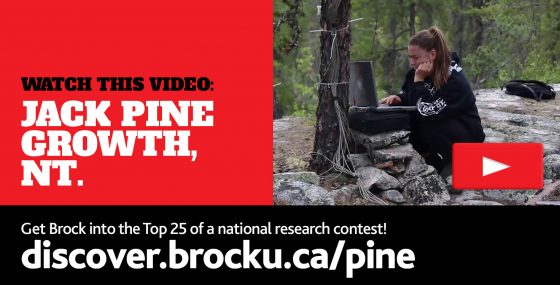
    Help our Master of Sustainability student, Dana Harris, move on to the next round of NSERC’s Science Action video competition! The 25 videos with the most views on March 2, 2018 will proceed to the judges’ panel, where they will compete for one of 15 cash prizes. Take a minute and click the photo below to view Dana’s video and learn more about Jack Pine growth.

    Jack Pine Video
    Categories: Blog, SSAS Student Contributor

  • Welcome to the ESRC’s Sustainability Blog!

    SSAS Student Scholarship Recipients

    By: Lydia Collas

    I’m delighted to write the first post for the new Brock Sustainability Blog. I’m currently a student in the Sustainability Science and Society (SSAS) graduate program and, since beginning my time at Brock in September 2016, I have fulfilled the role of Communications Assistant to the Environmental Sustainability Research Centre (ESRC).

    Over the past few months, the communications team has been developing and preparing for the launch of this blog. In this post, I hope to shed some light on what we hope this blog can be used to achieve, and encourage you to contribute material.

    Sustainability is an interdisciplinary subject by nature, and consequently sustainability research and initiatives are extremely diverse. The ESRC features researchers from many backgrounds, including Biological Sciences, Economics, Geography, Psychology, Health Sciences, and more.

    This diversity, in turn, leads to great variety in the research subjects of students in the SSAS program who are each supervised by members of the ESRC. In my year alone, topics of student projects includes climate change perception; public transport usage; perceptions and mitigation of flooding; and the impacts of the Green Belt in Niagara.

    Sustainability is becoming a hot topic at Brock University:

    • Undergraduate students are now able to study a Minor in Sustainability following the launch of online courses in September 2017 (ENSU 2P01 and 2P02).
    • The ESRC has entered into a partnership with the Town of Lincoln known as a “Living Lab” to allow research at Brock to guide policy development and decision-making.
    • Efforts are being taken to make the community live more sustainably with the opening of new cycle lanes to promote the use of active transportation to reach Brock.
    • Theal House is currently being developed into the ESRC offices and the building will showcase sustainability.

    With sustainability giving rise to such varied research areas and initiatives, it is highly interesting to share knowledge and ideas amongst one another. We hope that this blog will create a platform for doing just that. We hope to publish wide-ranging content: we are interested in hearing about your latest research projects, research partnerships, and conference presentations. We want to hear about sustainability efforts at Brock University and about your personal reflections on topical sustainability issues.

    We are accepting content from students (past and present), faculty, and others connected with Brock University. Send us your stories, and any suitable accompanying pictures, to the Communications team at [email protected]. You can read a full version of the guidelines for the Sustainability Blog at Sustainability Blog Guidelines.

    Categories: Blog, SSAS Student Contributor