Articles from:April 2021

  • Partnership for Freshwater Resilience Research Participant Webinar

    Blog Contributor: Jillian Booth
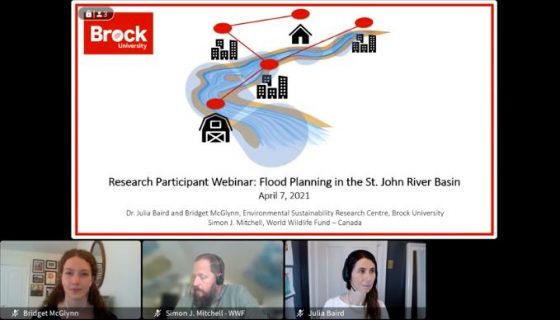
    The Brock-WWF Canada Partnership for Freshwater Resilience held a research participant webinar on Wednesday, April 7th, 2021 to present the results of the social network analysis performed on the flood planning network of the St. John River Basin.

    The research lead, Dr. Julia Baird, introduced the members of the partnership and the work that has been done in the St. John River Basin thus far. The participants were informed that the results presented in this webinar build off the preliminary results previously presented by the partnership during the summit they held this past June 2020. Due to COVID-19 restrictions, the webinar was held virtually through a live stream where participants remained anonymous to meet confidentiality requirements.

    The Vice President of Resilient Habitats at WWF-Canada and the co-lead of the partnership, Simon Mitchell, explained the importance of the partnership’s work in building freshwater resilience and stewardship in New Brunswick and across Canada. This highlighted the importance of how knowledge mobilization can improve governance of a watershed and the surrounding community and environment. Social network analysis is useful as it can identify opportunities to collaborate and catalyze thinking into action and how to facilitate this moving forward.

    The student research lead, Bridget McGlynn, presented the results of the study, explaining that social network analyses are used to study how people and organizations are connected and can identify the range and types of connection, in this case in communication, and collaboration. It was explained that understanding these structures can help add and transform decision-making systems to maximize the benefits received. Disclosing that the resulting network structures of the study do not capture the full picture as there were some non-respondents and discrepancies between respondents in terms of perspectives.

    The results from the social network analysis found that there is communication throughout the entire basin, however, municipalities tend to communicate with other government agencies, and similarly, non-government organizations (NGOs) and watershed organizations tend to communicate more with each other than with others. In terms of collaboration throughout the basin, it is often happening within parts of the basin (upper, middle, or lower) with less collaboration between different parts of the basin. Organizations that work across multiple parts of the basin are thus important to whole-basin collaboration. The results from key informant interviews were used to identify key tasks to improve flood planning on a watershed scale. It was found that there is a lot of assessment work, knowledge sharing, and communication, and less application of these efforts through projects on the ground.

    Moving forward, the connection between task engagement and effectiveness will be further analyzed due to the high interest expressed by participants during the webinar. Efforts to improve collaboration in flood planning in the St. John River Basin should focus on sharing the lessons learned between key actors to ensure long-term success. This includes addressing the current disconnects between upper, middle, and lower basin organizations that are further compounded by political boundaries especially between Maine, Quebec, and News Brunswick. Also, collaboration between upriver and down river organizations is needed, considering a good chunk of flooding comes from upriver. In addition, more support is needed for organizations to make stronger connections to the surrounding community through webinars and workshops. The findings from this study can be applied to build resilience across Canada against other climate change impacts, such as the increase in droughts.
    Categories: Blog, Innovative Partnership, SSAS Student Contributor

  • First-year SSAS Students Present Their Research Proposals

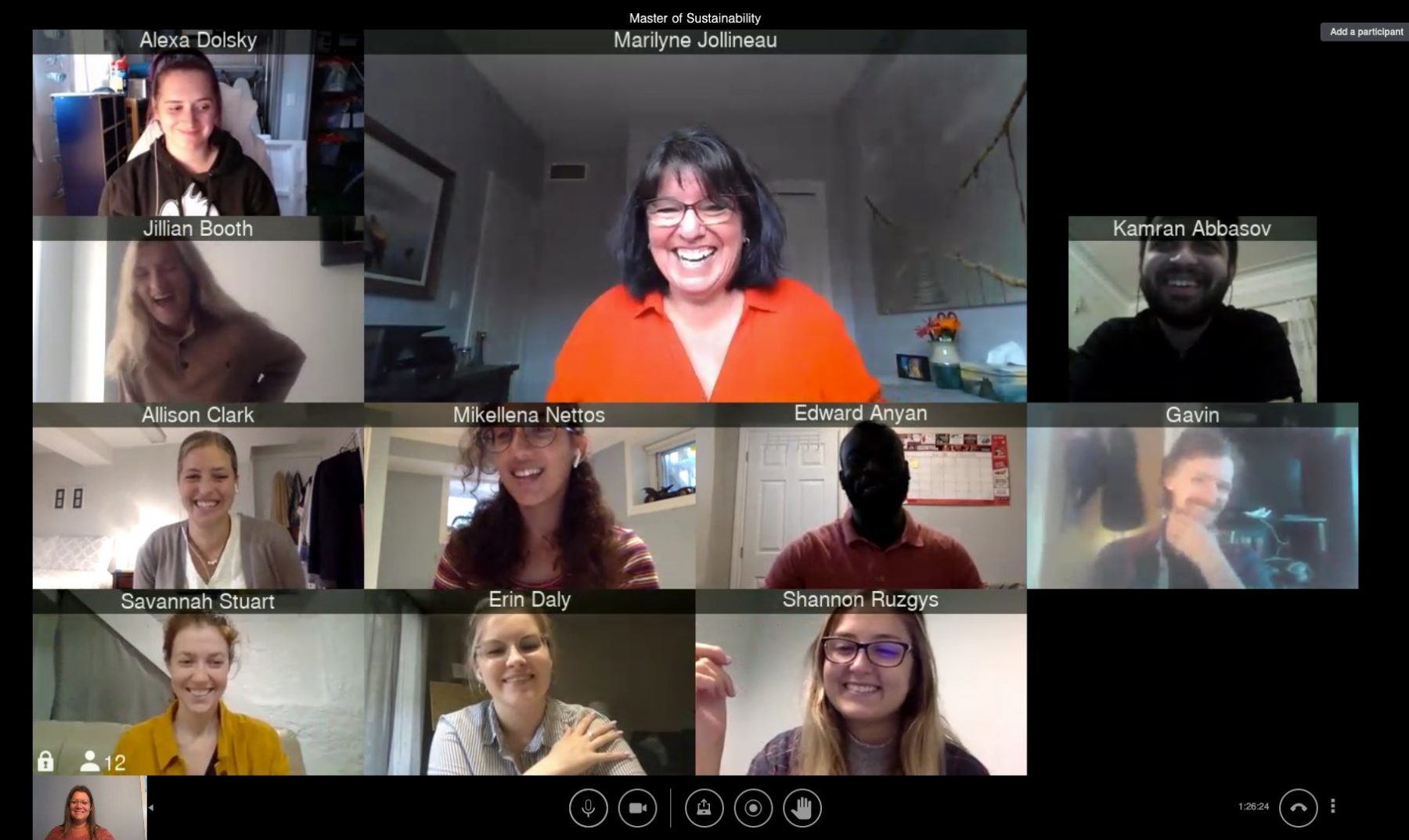
    As a truly unprecedented academic year comes to a close, it’s hard to believe that another cohort of SSAS students has successfully completed their first year in the program! With their course requirements now complete, these students will move on to co-op placements and beginning to work on their major research and thesis projects. On March 25th, these students made an important first step in the completion of their research by presenting their research proposals to their colleagues, including fellow cohort members and SSAS Faculty.

    This year’s cohort is taking on a variety of topics related to Sustainability Science, including Income Inequalities and Sustainable Development (Kamran Abbasov), Sustainable Diets (Shannon Ruzgys), Low Impact Development (Edward Anyan, Jillian Booth), Natural Climate Solutions (Gavin Esdale), Environmental Racism (Mikellena Nettos), Vegetation responses to Arctic Climates (Allison Clark), and Place Attachment and Well Being in the COVID-19 pandemic (Savannah Stuart).

    In addition to presenting their research proposals, the students also had the opportunity to answer questions from their fellow cohort members and SSAS faculty relating to their research topics. This was an excellent opportunity – particularly for students in Scheme B who will defend a thesis at the end of their time in the program – for the students to hear other insights on their work and demonstrate their understanding of their research topic. Scheme B student Shannon Ruzgys spoke about this experience, “I spent all year building the foundations of my research on my own and finally being able to share it with my peers and faculty was so rewarding!”

    Following the proposal presentations, Graduate Program Director Dr. Marilyne Jollineau commended the students for their efforts and expressed a keen interest in seeing the results for each individual project. Many of the students echoed this sentiment, including Mikellena Nettos who said, “the presentations were inspiring and uplifting.” Several students also spoke about the concerns they had beginning the program in an entirely online format, and how the process of developing their proposals was rewarding and exciting. Shannon Ruzgys mentioned that the virtual year meant that it was easy to feel “isolated during grad school but being able to gather online and present my research and hear about all the exciting research my peers are doing was such a wonderful experience”. Scheme A student Jillian Booth echoed these thoughts and said, “when I first started the SSAS program, I was nervous to start my MRP. However, my fears were quickly eliminated as I received immediate support from my supervisor in determining a topic that aligns with my research interests and career aspirations”.

    We are very proud of these students and are looking forward to following their research over the next few terms!

    Learn more about the 2020 SSAS Cohort on our website.

    Categories: Blog, SSAS Program

  • The Brock-WWF Partnership for Freshwater Resilience

    Blog Contributor: Jillian Booth

    The St. John River, the longest in Eastern Canada, flows through a variety of landscapes along its 700 km length with its headwaters located in the province of Quebec and state of Maine and empties into the Bay of Fundy located in the province of New Brunswick (CRI, 2011). It acts as an international boundary between Canada and the USA with a population of approximately 513,000 people that are evenly distributed between rural and urban areas (Plummer et al., 2016). The Wolastoqiyik or Maliseet people, Indigenous to the St. John River valley have named the area Wolastoq or W’aslustuk meaning “beautiful and bountiful river” in the Maliseet language (Currie et al.,2020). The river and its surrounding watershed act as the economic powerhouse for New Brunswick supporting local communities through their agriculture, forestry, fishing, and energy sectors (WWF-Canada, 2020). The basin has been classified as a priority region for the Government of Canada under the Pan-Canadian approach to transforming Species at Risk conservation in Canada, as it is home to multiple species at risk and acts as a nature-based solution to climate change with its ability to store carbon from its high levels of soil carbon and forest biomass (Arabian J et al., 2019).

    In New Brunswick, spring flooding is a common occurrence and every year the entire Wolastoq/St. John River is vulnerable to two types of flooding: ice-jam flooding and open-water flooding (Fraser, 2019). Ice – jam flooding usually occurs in the areas of Edmundston, Grand Fall, Perth-Andover, and the Woodstock from ice chunks getting stuck on something while flowing down the river causing water to build up behind the ice (Fraser, 2019). Whereas open water flooding typically occurs below the Mactquac Dam in the Fredericton, Maugerville, Jemseg, and Saint John areas when the river is overwhelmed by the excess water produced by snowmelt (Fraser, 2019). Recently, a record-setting open-water flood occurred in 2018 that resulted in millions of dollars in property damage specifically in the Fredericton and Saint John regions (Cox, 2021). Increasing water levels destroyed homes, cottages, and businesses displacing 1,600 residents for months in some cases (Fraser, 2019). This flooding reoccurred in the spring of 2019 damaging homes and restricting access to certain communities due to washed-out roads raising local concerns that action needed to be taken to reduce the impacts of flooding (Cox, 2021). 

    The 5-year Brock-WWF Canada partnership for freshwater resilience was initiated in June 2019, designed to better understand how to build resilience in Canada with the increasing threats and climate change impacts on our freshwater resources (Brock University, 2021). The partnership aims to advance our understanding and promote the application of freshwater resilience and stewardship by 1) encouraging the co-creation of knowledge between researchers and practitioners and 2) identifying innovative and evidence-based approaches for management and governance (Brock University, 2019). The partnership’s initial focus is working to address the lack of communication/collaboration among actors involved in flooding planning within the Wolastoq/St. John River basin. This will be achieved not only through research but also through community engagement and events to better inform evidence-based decisions (World Wildlife Fund Canada, 2020). The lessons learned can be applied to efforts across Canada, providing a foundation for evidence-based decisions, promoting opportunities for innovation, and encouraging the use of best practices (Brock University, 2019). 

    References:

    Arabian J., Currie j., and Snider J. (2019).Wildlife Protection Assessment: A national habitat crisis. World Wildlife Fund Canada. Toronto, Canada. https://wwf.ca/wp-content/uploads/2021/01/habitat-report-english-web-53019.pdf

    Brock and WWF-Canada partnership to Address Freshwater Challenges. (2020, June 17). World Wildlife Fund Canada. Retrieved March 23, 2021, from Brock and WWF-Canada Partnership to Address Freshwater Challenges – WWF.CA

    Canadian Rivers Institute (CRI). (2011, July). The Saint John River: A State of the Environment Report. University of New Brunswick. St.+John+river+report1-min.pdf (squarespace.com)

    Cox, A. (2021, March 11). New Brunswick launches flood monitoring platform ahead of spring melt. CBC News. New Brunswick launches flood monitoring platform ahead of spring melt | CBC News

    Fraser, E. (2019, March 23). What you need to know about possible flooding in New Brunswick. CBC News. https://www.cbc.ca/news/canada/new-brunswick/new-brunswick-flooding-st-john-river-basin-2018-1.5051577

    Memorandum of Understanding Between World Wildlife Fund Canada and Environmental Sustainability Research Centre Brock University. 2019. May 17th. Brock University. Retrieved March 23, 2020

    Partnership for freshwater resilience. Brock University. Retrieved March 23, 2021, from Partnership for Freshwater Resilience – Environmental Sustainability Research Centre (brocku.ca)

    Plummer, R., Baird, J., Krievins, K., & Mitchell, S. (2016). Improving river health: insights into initiating collaboration in a transboundary river basin. International Journal of River Basin Management, 14(1), 119–132. https://doi.org/10.1080/15715124.2015.1080717

    Categories: Blog, Innovative Partnership, SSAS Student Contributor