Articles from:June 2020

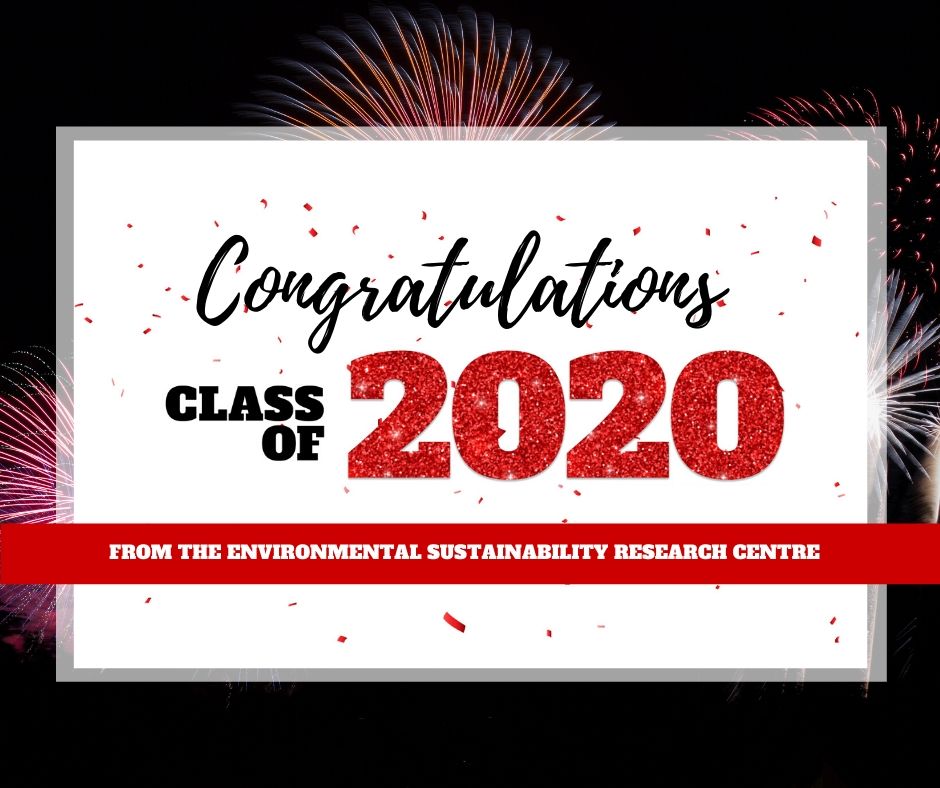
  • Congratulations to our Spring 2020 Graduates!

    The ESRC is very proud to announce that three students have officially completed the SSAS program and are graduating on June 19th, 2020. Jocelyn Baker, Qurat Shahzad, and Connor Thompson have all worked exceedingly hard throughout their time in the program, and we are so proud to have been a part of each of their academic journeys.

    Jocelyn Baker joined the SSAS program in 2018 and brought with her a number of previous degrees and certifications, including a BA in Geography and Fine Art (Guelph University), a certificate in Terrain and Water Resources (Sir Sanford Fleming College), and a certified Project Management Professional. Jocelyn’s research was supervised by Dr. Liette Vasseur and investigated Management in Canadian Ramsar sites and sustainability through adaptive governance. Jocelyn’s interest in Canadian Ramsar sites was also reflected in her co-op placement, where she worked as a Project Manager, Niagara River Ramsar Designation for the Niagara Restoration Council.

    Qurat Shahzad travelled to St. Catharines all the way from Dubai, UAE to join the SSAS program in 2017. Her research was supervised by Dr. Marcel Oestreich and built on the knowledge she had through her Bachelor of Science degree in Environmental Science from the American University of Sharjah, UAE. Qurat’s final research investigated the dynamics between the current economic system and sustainability goals.

    Connor Thompson joined the SSAS program in 2018 with an Honours Bachelor of Arts in Political Science (Western University). His research interests aligned with those of Dr. Todd Green, who supervised Connor’s MRP research about the attitude/behaviour gap in low-impact housing development. In addition to his work on his MRP research project and as a research assistant on the ESRC’s Charter with Facilities Management partnership, Connor spent his co-op placement working as an Educator with the Great Canadian Shoreline Cleanup.

    In addition to these three SSAS graduates, we would also like to congratulate our 10 undergraduate students who have completed the Minor in Sustainability. All 13 of our graduates have worked extremely hard to reach this important academic milestone, and we hope you’ll join us in expressing our heartfelt congratulations!

    Categories: Blog, Minor in Sustainability, SSAS Program

  • Student Research Highlight: Transdisciplinary Research in Action

    Blog Contributor: Bridget McGlynn

    Bridget McGlynn

    Sustainability science has three defining characteristics: it recognizes the interconnectedness of human and ecological systems, it asks solution-oriented questions, and uses a transdisciplinary approach. In reflecting on my research, I must say it is an absolute joy and a privilege to be a master’s student in a research centre that emphasis all three components of sustainability science, as it has allowed me to directly engage with all aspects for my thesis research 

    I am a student in the Advancing Environmental Stewardship research group working under the supervision of Dr. Ryan Plummer and Dr. Julia Baird and my thesis research is embedded in the Partnership for Freshwater Resilience to address climate change resilience and governance in the St. John River watershed in New Brunswick. My portion of the project is investigating the current collaborative governance arrangement at two geographic scales with the goal of forwarding system understanding and flood governance in the region. Since I began working within this research project, the entire process has been transdisciplinary. From Brock researchers attending flooding resilience and climate workshops in the St John River watershed to our WWF partners joining the discussion for my proposal presentation, joint goals have been prioritized.  

    As a master’s student preparing a thesis, there is an expectation my research will address a gap in the academic literature, and this gap provides the academic rationale and guides the research questions for the project. During my proposal presentation, I was asked to describe the tangible and practical contributions of my project. My response to this question was based within my perspective that after months of literature review and proposal writing has been heavily fixated on that research gap. While I spoke to the tangible outcomes and value of the proposed data collection, I only articulated a fraction of the value of the project. Following my response, our WWF partners elaborated and described how the entire research process, not only the end data collected or workshop, is providing great value to their colleagues. Simon Mitchell’s description of why this project is important on various levels reaffirmed the usefulness and importance of good sustainability science. Having the opportunity to participate in transdisciplinary research projects as a student is an invaluable experience that has already provided many lessons and I imagine will provide many more before I finish. 

    Categories: Blog, Innovative Partnership, SSAS Student Contributor, Student Contributor