Articles from:April 2020

  • Niagara Adapts Partnership Presentations at Brock University

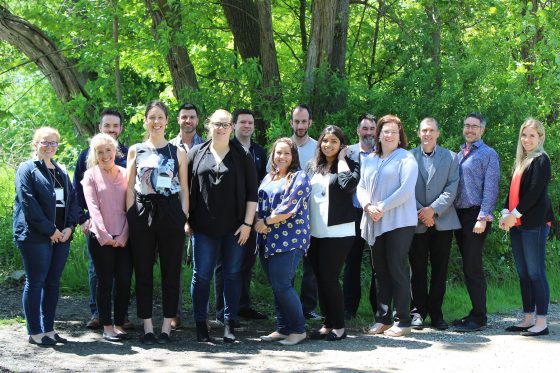
    Niagara Adapts Team Photo

    Niagara Adapts brings together seven municipalities within the Niagara Region of Ontario — Grimsby, Lincoln, Niagara Falls, Niagara-on-the-Lake, Pelham, St. Catharines and Welland, as well as the Environmental Sustainability Research Centre at Brock University, to tackle climate change in the Region.

    Blog Contributor: April Sorenson

    On February 25th, representatives from municipalities within the Niagara Region of Ontario came together to present to the current Master of Sustainability graduate students about an innovative partnership called Niagara Adapts. Niagara Adapts is a partnership that works to reduce the risks associated with climate change and increase resilience in the Niagara Region. On the 25th, a representative from each of seven municipalities gave a presentation on the specific climate change issues their municipality is facing along with their adaptation efforts.  

    Deanna Allen, the Climate Change Coordinator for the Town of Pelham, said that her municipality is predicting many challenges related to climate change. Some of these challenges include summer droughts leading to water supply shortages, more frequent episodes of rain resulting in severe washouts and flooding, a higher likelihood of experiencing heat stress, freezing rain events that could damage hydro lines, and an increased demand for municipal services. Many of the other municipal representatives presented similar concerns. Olivia Groff, the Climate Change Adaptation Coordinator for St. Catharines, said that there have been 56 extreme weather warnings in the past two years alone.  

    Fortunately, several municipalities have already taken steps to adapt to climate change. James Sticca, Manager of Environmental Services at the City of Niagara Falls, outlined the steps they’ve taken to adapt to climate change, including a Rain Barrel Purchasing Program, a Low Flow Toilet Rebate Program, and a Water Monitoring Device Rebate Program. Many of the presenters were hopeful that through continued collaboration with Niagara Adapts and local communities, real progress will be made in adapting to climate change.  

    Municipal governments are at the front lines of climate change. Many are stepping up to ensure the safety and wellbeing of their residents. The Town of Lincoln, the Town of Pelham, St. Catharines, Welland and The City of Niagara Falls have provided more information about their climate change adaptation efforts and their contribution to Niagara Adapts on their websites.  

    These presentations are available online via the ESRC YouTube Channel. 

    Links to the climate vulnerability fact sheets can be found on the Niagara Adapts Website

    Categories: Blog, Collaborations, Innovative Partnership, Niagara Adapts, SSAS Student Contributor

  • Interview with Shannon Fernandes, the Climate Change Coordinator at the Town of Lincoln, Ontario

    Shannon Fernandes – Climate Change Coordinator at the Town of Lincoln

    Blog Contributor: April Sorenson 

    I would like to introduce all of you to Shannon Fernandes, the Climate Change Coordinator at the Town of Lincoln. Shannon is helping Lincoln become a more resilient community by developing and implementing a climate change adaptation plan for the Town. Shannon graduated from the University of Waterloo with a Bachelor of Science in Biology and a Master of Environmental Studies in Sustainability Management. She has experience in environmental consulting, community outreach and sustainable supply chain management. She is passionate about social and environmental sustainability, community engagement and making a positive impact on the world. In the questions below, Shannon explains her goals for the Town of Lincoln, the challenges she faces in her role, and the climate change adaptation progress in the Town 

    What are your main responsibilities as the Climate Change Coordinator? 

    My main responsibility as the Climate Change Coordinator is to focus on the planning and implementation of municipal climate change priorities. Primarily, this involves working closely with staff to develop the Town’s climate adaptation plan. Additionally, I contribute to several projects such as developing Green Infrastructure / Low-Impact Development Design Standards, participating in Niagara Adapts, and conducting community outreach. 

    What is your primary goal for the Town of Lincoln? 

    My primary goal for the Town of Lincoln is to build the Town’s capacity to adapt to climate change and extreme weather and to continue Lincoln’s efforts to develop a sustainable and livable community. In order to strengthen our ability to adapt and respond, it is important that we collaborate on innovative approaches for climate change adaptation, ground those approaches in municipal and academic expertise, and build relationships across sectors.  

    What are some of the biggest challenges you face in your role?  

    The biggest challenge I face in my role is encouraging climate change literacy. It is important that staff and citizens understand the science, risks, vulnerabilities, and opportunities associated with climate change impacts in Lincoln.  

    To address this challenge, Lincoln partnered with Niagara municipalities and Brock University (through Niagara Adapts), which allows us to leverage resources and expertise, enable collaborative adaptation planning, reach out to residents and staff through surveys, and promote climate change awareness and action. It has been an incredible opportunity for Lincoln to be a part of this initiative and I look forward to continuing to work and learn alongside our communities, academic partners, and neighbours. 

    What are the greatest challenges Lincoln faces as a Town in regard to climate change? 

    Given the local nature of many climate impacts, like floods, extreme weather, heat alerts, or drought conditions, the Town’s greatest challenge is being the front line to manage risks, protect community safety, and promote economic, social, and environmental sustainability. To ensure the plan is robust enough to address the varied impacts of climate change, the climate adaptation plan will be primarily informed by diverse subject matter experts comprising the Adaptation Steering Committee. It is important that every department – Public Works, Community Services, Planning, Emergency Management, and Tourism and Economic Development is involved in the process. 

    What is the most important thing citizens of the Town can do to alleviate climate change? 

    There is a lot that Lincoln citizens can do to mitigate and adapt to climate change.  

    Firstly, installing green infrastructure to prevent stormwater from running down driveways and into storm drains is a great way to prevent flooding on your property; collecting water in rain barrels and water gardens also saves money on water bills. Disconnecting downspouts and planting rain gardens or trees are great ways to both mitigate and adapt to climate change. 

    Small actions include reducing singleuse plastics, conserving water, upgrading bulbs to LEDs, eating more plant-based meals, or taking public transit. In Niagara we have an abundance of growers and shopping locally is an excellent way to reduce environmental and water footprints. 

    Lastly, stay engaged! Talk to family members, friends, and neighbours about climate change, participate in community events, visit lincoln.ca to participate in surveys, public information nights, and council meetings about climate change. Elected officials need to know that climate change action is important to you. 

    Can you tell us more about the climate change adaptation plan that is underway at the Town of Lincoln? 

    The purpose of a climate adaptation plan is to prepare the Town of Lincoln to adapt to anticipated climatic change and extreme weather, thereby minimizing the severity of the resulting impacts. This will be achieved in the following manner: identification of the potential impacts related to climate change and extreme weather in Lincoln and the risk they pose to the Town, prioritized adaptation actions to reduce risk and vulnerability associated with climate change and extreme weather impacts, and the development of a detailed implementation plan.

    Input will be gathered from staff, Niagara Adapts, Council, the Stakeholder Advisory Group, and Lincoln citizens and businesses on an ongoing basis. 

    Categories: Blog, Brock Lincoln Living Lab, Innovative Partnership, SSAS Student Contributor

  • Learning to Learn Remotely

    Blog Contributor: Bridget McGlynn

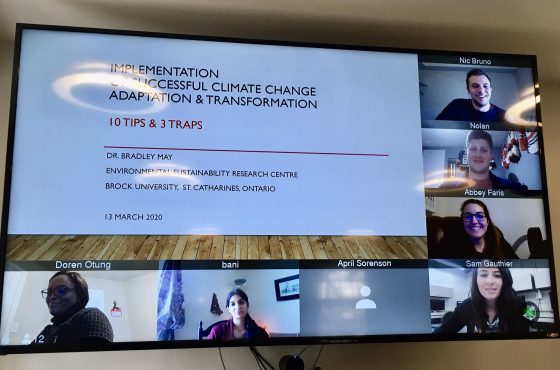
    Students adjust to SSAS 5P12 in an online format (credit: Jessica Blythe)

    Brock University suspended face-to-face classes Friday, March 13th in response to the ongoing COVID-19 pandemic. As such, the end of the second semester for SASS Year 1 students was transitioned to a remote learning format. As a student in Scheme B (the thesis stream), I experienced the transition of SSAS 5P12 and SSAS 5P04 to an online platform, both of which were incredibly smooth!  

    SSAS 5P12 is the Climate Change Adaptation & Transformation course is led by Dr. Jessica Blythe and her course heavily emphasises class discussion, both when reflecting on weekly reading assignments and completing adaptation planning workshops. Our weekly seminar was transitioned by using a remote platform and the nature of the small Master of Sustainability program led to productive classes. Dr. Blythe’s smooth transition to delivering the course remotely allowed us to finish our final weeks of climate change transformation discussions and receive guidance on our final deliverables. 

    SSAS 5P04 is our transdisciplinary seminar that normally culminates in Year 1 students presenting research proposals prior to their committee meetings in April. These proposal presentations offer the opportunity to share with your professors and peers the independent work of the previous 3 months and receive feedback. As a student, the exercise is not only valuable because of the feedback received but is also exciting to see how your peer’s project conceptualizations have morphed from the initial ideas presented during whiteboard talks in November. Transitioning these presentations to a remote format involved adding narration to PowerPoint slides. While speaking into headphones is less invigorating then presenting to a live audience and listening to your own recorded voice can be somewhat unpleasant, this transition to sharing recorded presentations was very effective! As questions and comments were communally added to feedback forms, students were able to receive extensive feedback on their presentations – perhaps even more than a normal question period would have allotted for.  

    As a student, these altered class formats have been incredibly helpful as they have allowed me to continue progressing towards my degree despite the immense uncertainty. 

    Categories: Blog, SSAS Program, SSAS Student Contributor