Articles from:May 2018

  • Co-op with MTO inspires master of sustainability student to pursue career in environmental policy

    The next instalment in our series of blog posts about the co-op experiences of Sustainability Science & Society (SSAS) students, we hear from Nicholas Fischer, who will soon be graduating with his Master in Sustainability degree. Last summer, Nich worked for the Ontario Ministry of Transportation (MTO) in the Environmental Policy Office.

    Blog Contributor: Nicholas Fischer

    Nicholas Fischer

    In my role as an Assistant Policy Analyst at MTO, I provided support to the Senior Policy Analysts on a variety of projects related to transportation infrastructure and landscape remediation. My principle assignment involved generating a policy brief and supporting house notes to various members of senior management. These briefing materials were the product of background research and communication with various provincial ministries and governing bodies, outlining the impacts which changes to the Environmental Assessment Act of Canada would have on provincial infrastructure delivery and environmental assessments.

    Outside of this project, I supported staff with additional projects and policy amendments, including: pollinator health in provincial right-of-ways, provincial waste management, endangered species protection and best management practices, and biodiversity strategies used across Ontario’s provincial ministries.

    The most interesting project I worked on was developing policy solutions for environmental assessment procedures for Ontario. During the time I was with the MTO, the Federal Government of Canada was undergoing a review of federal environmental assessment legislation which would ultimately impact how infrastructure delivery took place at a federal and provincial level. My project focused on identifying the impacts these legislative changes would have for the Ontario provincial government and identifying avenues of possible policy reform to ensure that infrastructure development and design in the province could continue in a sustainable manner, fitting within the new regulatory framework proposed at the federal level.

    My co-op experience has definitely helped to solidify the idea that I would like to focus my career experiences in the realm of environmental policy. Prior to this experience, I was unsure of working in the policy sector, however working with the MTO has shown me that without policy development and analysis, no real environmental change can take place on a regional or provincial level. Policy creates the avenues for change within a government and within local populations, and without policy avenues, it is difficult to affect real change for the betterment of our shared natural environment.

    I would like to thank the entire Environmental Planning Office for allowing me a breadth of experience on a variety of projects which showed me exactly how the province upholds environmental protection and sustainability within an infrastructure-based ministry. Additionally, I would like to thank Melissa Beamer of the Brock Co-op Office for working continuously with the SSAS students to ensure we found appropriate, challenging and rewarding co-op experiences.

    The ESRC’s SSAS program offers students the option of completing either a major research project and a co-op experience, or a longer research project that culminates in a thesis. Undertaking a co-op provides students with firsthand experience of how important knowledge of sustainability is in creating policy, guiding business development and ultimately helping the community. Graduating students frequently cite their co-op experience as being influential in guiding their future career plans. To find out more about the SSAS program, visit brocku.ca/ssas.
    Categories: Blog, Co-Op, Experiential Education, SSAS Student Contributor

  • In our backyard: ESRC playing a part in Brock’s Community Garden

    Blog Contributor: Shanen D’Souza

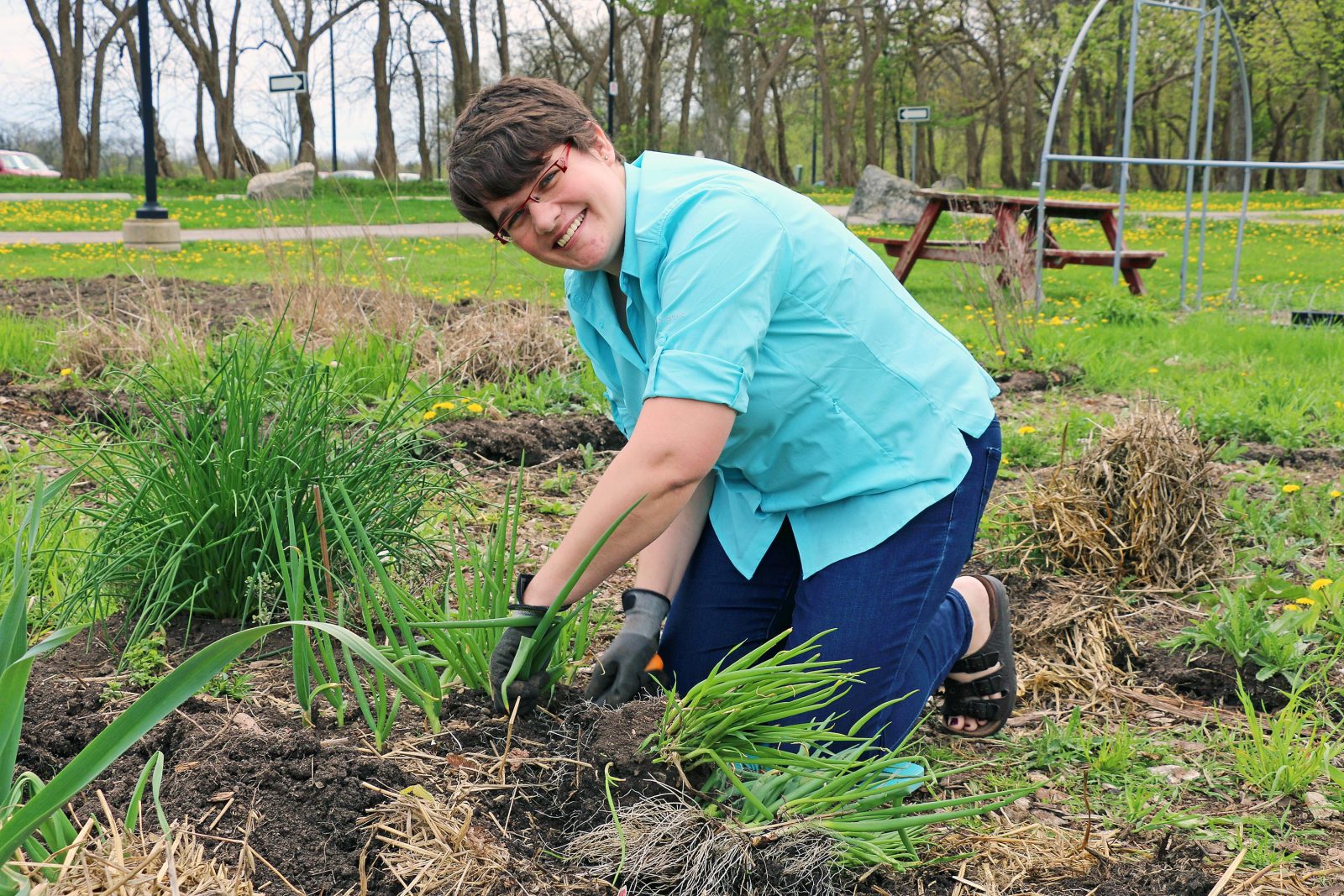
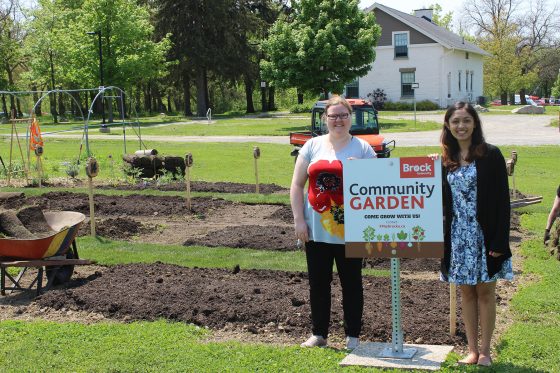
    Shelby and Shanen in the Brock community garden.

    Brock’s Community Garden, located opposite Theal House, has received tremendous support and involvement by the Niagara community in recent years. Every year people are encouraged to adopt a plot and grow different plants, whether it is colourful flowers or vegetables for supper. The 12 initial plots were so high in demand that the grounds crew had to make 8 additional plots, and now all 20 plots are assigned.

    The Environmental Sustainability Research Centre (ESRC) has adopted one plot and will be maintaining it over the summer months. I, along with the other summer interns as well as the staff at the centre, will be growing various plants this summer. Being an international student who grew up in a desert, I never had the opportunity to plant and watch flowers grow and bloom, so this is a very exciting opportunity for me.

    We will be planting cardinal flowers, a native red flower of the Niagara region. The Centre is working to promote sustainability on campus and aims to be an environmentally-friendly community member. Planting a native species promotes the unique flora of Niagara, and the red colour signifies the signature Brock red colour. We will also be planting some red vegetables like tomatoes and red peppers, and hopefully even some cucumbers.

    I am excited to watch these plants grow and bear fruit over the next couple of months. I have heard that deer and bunnies do feast upon fruits of the Brock Garden, but hopefully we will get to enjoy some too!

    Brock Community Gardens

    Categories: Blog, Innovative Partnership, Student Contributor

  • Brock student makes Top 20 in national science research photography contest

    Master of Sustainability Science student Dana Harris is wrapping up her degree program with a bang — or rather, a snap.

    She and 19 other researchers from across Canada are vying for the 2018 People’s Choice Award in a national research photography contest offered by the Natural Sciences and Engineering Research Council of Canada (NSERC).

    NSERC’s Science Exposed showcases images taken during scientific research being conducted in all fields by faculty and student researchers in post-secondary institutions and researchers in public and private research centres. Public voting to help determine the contest’s winners is now open on the Science Exposed website and continues throughout the summer.

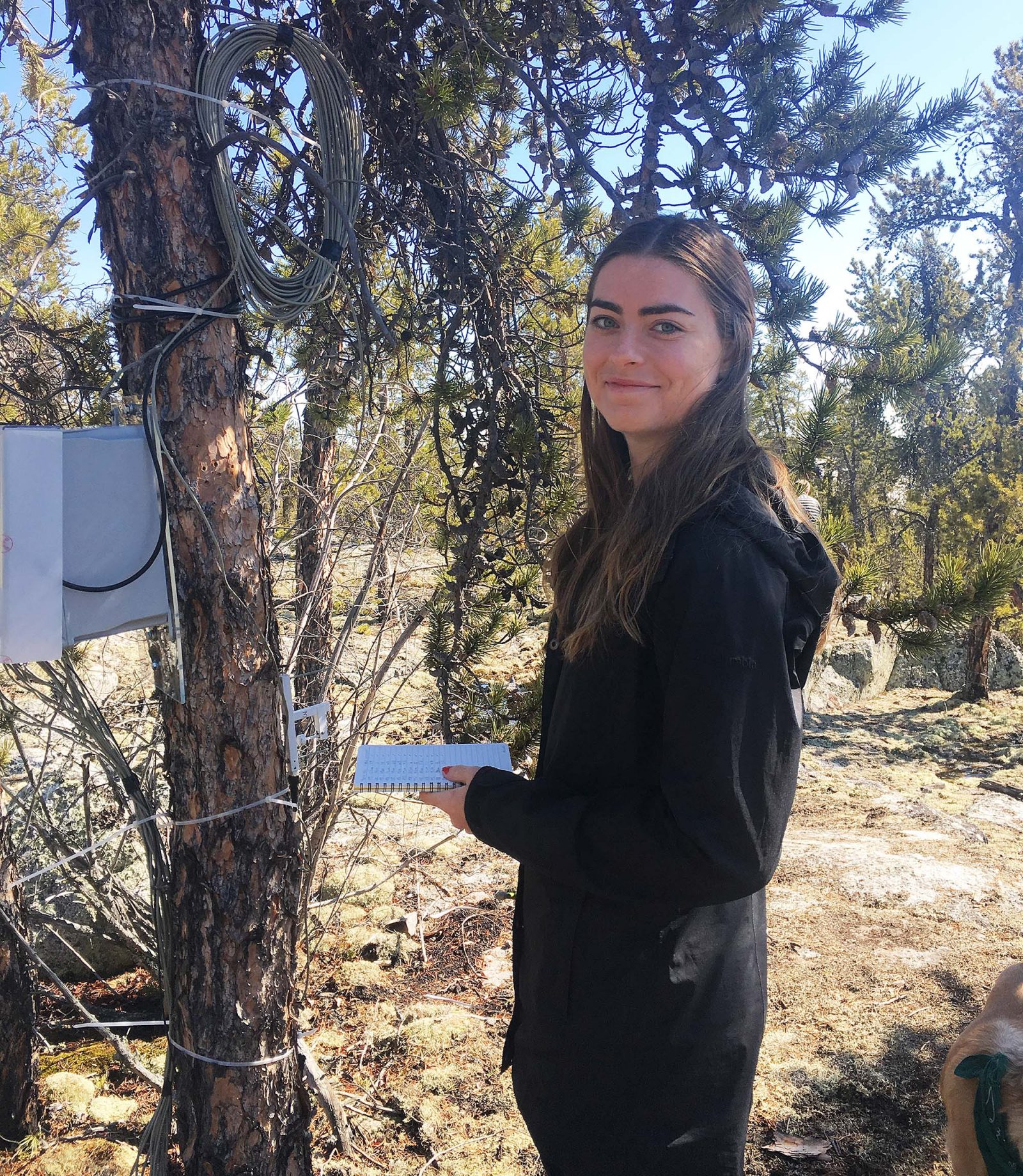
    Harris’ photo, titled “Exploring the Jack Pine Tight Knit Family Tree,” shows phases of developing xylem cells, stained in different colours, that are found in a wood sample cored from the outermost part of a jack pine tree in the Northwest Territories, where she is from.

    Dana Harris photo submission

    Dana Harris’ submission to the NSERC Science Exposed competition features cells of the jack pine tree.

    She says she uses the photo and others like it as a conversation starter to explain her research, which examines the impacts of climate change on sub-arctic ecosystems.

    “When I would show my friends and family pictures of what my jack pine cells look like, they would say, ‘oh, I thought that was a scarf or knitting or netting,’” she says. “That’s where I got the title of my photo.”

    The image, shot from a microscope, shows the jack pine tree’s phloem, cambial and xylem cells (blue dye) and mature xylem cells (red dye) in a thin slice of the wood.

    It is one of a series of images taken weekly over the past year to track the growth of the jack pine tree’s various cells.

    “Understanding these growth dynamics will help better estimate the impacts of climate on cell development and jack pine tree ring formation,” says Harris. “This type of information is useful for researchers who create climate reconstructions using tree rings as a source of historical climate data.”

    Canada’s far north is widely considered to be the ‘canary in the coalmine’ of climate change, as melting permafrost, changes in vegetation cover and shrinking ice caps are among highly-visible changes to the environment.

    Harris is presenting her research findings at the “Wood formation and tree adaptation to climate” conferencein Orleans, France from May 23 to 25.

    “Brock is very proud of our student researchers, who channel their knowledge, energy and curiosity into investigations that address key challenges in society,” says Brock’s Vice-President, Research Tim Kenyon.

    “The fact that our student’s photograph is among the stunning images of scientific research is testament to her skill and the training and research mentorship she received from Brock University faculty.”

    Making it to the Top 20 for the People’s Choice Award is a particularly sweet victory for Harris.

    She was also a competitor in NSERC’s Science, Action! research video contest, making the first cut of the three-round competition. Altogether, seven videos from Brock University were in the contest.

    Harris’ video, “Jack Pine Growth, NT,” has garnered more than 1,400 views.

    Following her conference presentation in France, Harris will head back to her hometown of Yellowknife to “continue developing the overall understanding of the ecological and environmental impacts of climate change on sub-arctic ecosystems,” she says.

    Categories: Applied Research

  • RECL 4P16 – Advanced Wilderness Program Planning

    Blog Contributor: Garrett Hutson

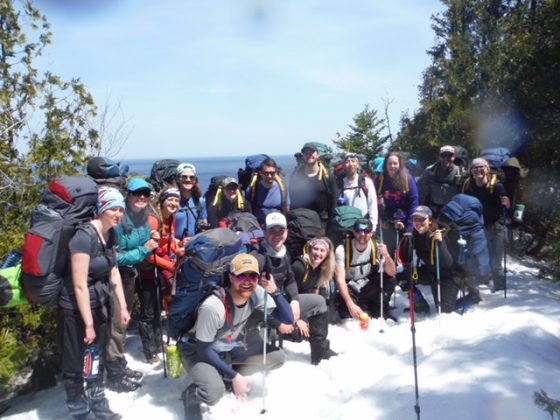
    RECL 4P16 Group Photo

    The RECL 4P16 (Advanced Wilderness Program Planning) 10-day wilderness backpacking trip returns from the Bruce Peninsula on a high note. The trip was co-led by an ESRC research assistant and RECL alumna (Liz Peredun, second from the left standing), an ESRC participating faculty member (Garrett Hutson, second from the right standing) and a RECL graduate student (Chris Falcioni, not pictured). From April 25 to May 5 the group hiked from the town of Lion’s Head, Ontario to the Bruce Peninsula National Park through deep snow and challenging terrain along the Bruce Trail. Fourth year RECL students worked in leadership teams and taught extensive environmental studies curricula while in the field. Completing the trip represented the final requirement for many of these students who will be graduating from Brock this coming June.

    Categories: Blog, Experiential Education, Faculty Contributor

  • First week at the ESRC: An introduction to what we’re working on this summer

    Blog Contributor: Shelby McFadden

    Summer Student Assistants 2018

    Summer student assistants (from left to right): Kaitlin, Shanen and Shelby working in Theal House.

    From the moment my parents and I pulled up to the quaint wonder that is Theal House during a tour of campus, I knew that I would get along perfectly at Brock. I immediately decided to accept my offer for the Masters of Sustainability program for fall 2018. I made the important decision in Swiss Chalet over lunch, as my family and I went over all the benefits of attending Brock.

    Little did I know then, but I would later be offered the Special Projects Assistant position within the Environmental Sustainability Research Centre (ESRC) for the summer. And so on the evening of May 6th, I moved to St. Catharines, and by the next morning, I was sitting in Theal House and starting training. Some of you may have a vague recollection of hearing about how the ESRC renovated and moved into Theal House back in February and how the Centre is partnering with Facilities Management on sustainability initiatives through a formal charter.  These milestones mark an exciting time for sustainability at Brock, and this summer is no exception, as we are working hard in the Centre on sustainability planning.

    To help carry out this new work on sustainability at Brock, three students, including myself, have been hired for the summer to work on both sustainability planning and communications. This is a really exciting opportunity for me, as I get to familiarize myself with Brock and the ESRC before I start my Masters in the fall. I will be able to gain valuable and relevant experience in the field of sustainability, and help contribute to something meaningful and positive in the Brock community.

    To be able to have a job you enjoy often feels rare to find, and so I am beyond thrilled to be joining the passionate and skilled staff dedicated to sustainability in the ESRC. I think the most amazing part is that staff, faculty, and students are all coming together to share their insights and skills, to engage with issues surrounding sustainability, and help to share Brock’s future directions.

    In the week and a half I’ve been at the Centre, I feel like I’ve gotten a good grasp on what’s currently happening at Brock in regard to sustainability, and I am optimistic for what is to come in the future. I am convinced there is a lot of good work being done at Brock, but that there is also a lot of room for growth and improvement. I want people to be aware that even though the Centre is tucked away in its own private space on campus, we are very much an active part of campus, and that there’s a lot of good and promising work being done here. I encourage faculty, staff, students, and visitors to pay attention to sustainability initiatives and efforts throughout the year, and to come visit us at Theal House and see what the ESRC is doing. We will be around all summer working hard on these exciting initiatives. Stay tuned to find out additional information and initiatives in our weekly summer blog series.

    Categories: Blog, Innovative Partnership, Student Contributor, Sustainability at Brock

  • Brock Master of Sustainability student heading to Cambridge University for PhD in Zoology this Fall

    Blog Contributor: Samantha Morris

    Lydia Collas - Cambridge University

    Lydia Collas graduating with a BA (Honours) Natural Sciences, University of Cambridge. Photo credit: Aiden Chan

    Master of Sustainability student, Lydia Collas, is headed back to Cambridge University to start her PhD in Zoology under the supervision of Dr. Andrew Balmford this September. Building off her master’s research, which focuses on decision-making in agriculture, Lydia’s PhD research will explore “reforming agricultural policy to safeguard biodiversity: Are farmers willing to adopt land sparing?”

    The Environmental Sustainability Research Centre (ESRC) is also pleased to announce that Lydia is the recipient of the ‘Cambridge International Scholarship’. This scholarship is awarded by the Cambridge Trust to the 250 highest ranked students undertaking PhD studies at Cambridge University. The ESRC would like to congratulate Lydia on this accomplishment and wish her all the best with her studies at Cambridge this Fall!

    Before heading back to the UK, Lydia will defend her Master’s thesis titled “Decision-making in agriculture: Why do farmers decide to adopt a new practice?” on May 23rd at 1pm. The defence will take place in the Cairns Building Room 209M (the Biolinc Boardroom), Brock University, and everyone is welcome to attend.

    Categories: Blog, Thesis Defense

  • Green thumbs needed to grow Brock Community Garden

    In addition to plants, the University is hopeful interest will grow in the Brock Community Garden.

    Brock’s grounds crew is busy tilling the soil, creating new grass aisles and enlarging the 12 garden plots located beside the entrance of the Zone 2 parking lot near Theal House.

    University staff, faculty and students looking to cultivate their green thumb are invited to use one of several free garden plots, assigned on a first-come, first-served basis.

    Six plots are available, with six already claimed. The Rosalind Blauer Centre for Child Care will use two plots for experiential learning; Biological Sciences Professor Liette Vasseur’s research team will use three plots to test different cover crops — plants grown for the protection and enrichment of the soil; and Brock employee Alison Innes (MA ’13) plans to tend one plot for her personal vegetable garden.

    Before learning about the community plots last year, Innes, the social media co-ordinator for the Faculty of Humanities, considered herself a ‘gardener without a garden’ and often resorted to container gardening in her apartment complex.

    “It’s just wonderful to have space to grow things,” she said of the University’s communal greenspace. “It’s easy to stop by the plot at the end of the day and pick some fresh veggies to take home for supper.”

    Last year, Innes grew radishes, lettuce, carrots, chard, cucumber, zucchini, onions, beans and garlic. This year, she looks forward to adding potatoes and trying some heirloom varieties of vegetables such as purple beans. She also has an assortment of herbs and pollinator plants.

    Unfortunately, butterflies and bees aren’t the only animals the plants attract.

    “I joke that the deer and bunnies on campus are really well fed,” she said. “They got all my sunflowers and most of my beans last year. It takes a little creativity to discourage them from munching, but that’s the case wherever you garden.”

    Garden plots are expected to be ready for use after Tuesday, May 22. Water will be available near the garden as well as some tools for sharing. Pesticides are not permitted and annual and non-invasive plants are preferred.

    “I can’t wait to get started,” said Innes. “I find working in the garden really calming and meditative. I like to garden in the evening when it’s a bit cooler and will sometimes see wildlife and birds.”

    Innes encourages first-time gardeners to consider getting a plot.

    “Try it. It’s not as difficult as it might seem, although your garden will need regular care like weeding and watering,” she said. “There are lots of easy-to-grow vegetable like potatoes, beans or summer squash, and lots of great online resources on how to layout your garden. Growing plants from seeds keeps costs down, too.”

    Staff, faculty and students interested in claiming a garden plot are asked to contact Grounds Manager John Dick at [email protected]

    Story originally published in The Brock News.

  • Brock-Lincoln Living Lab research project to examine Lake Ontario shoreline flooding

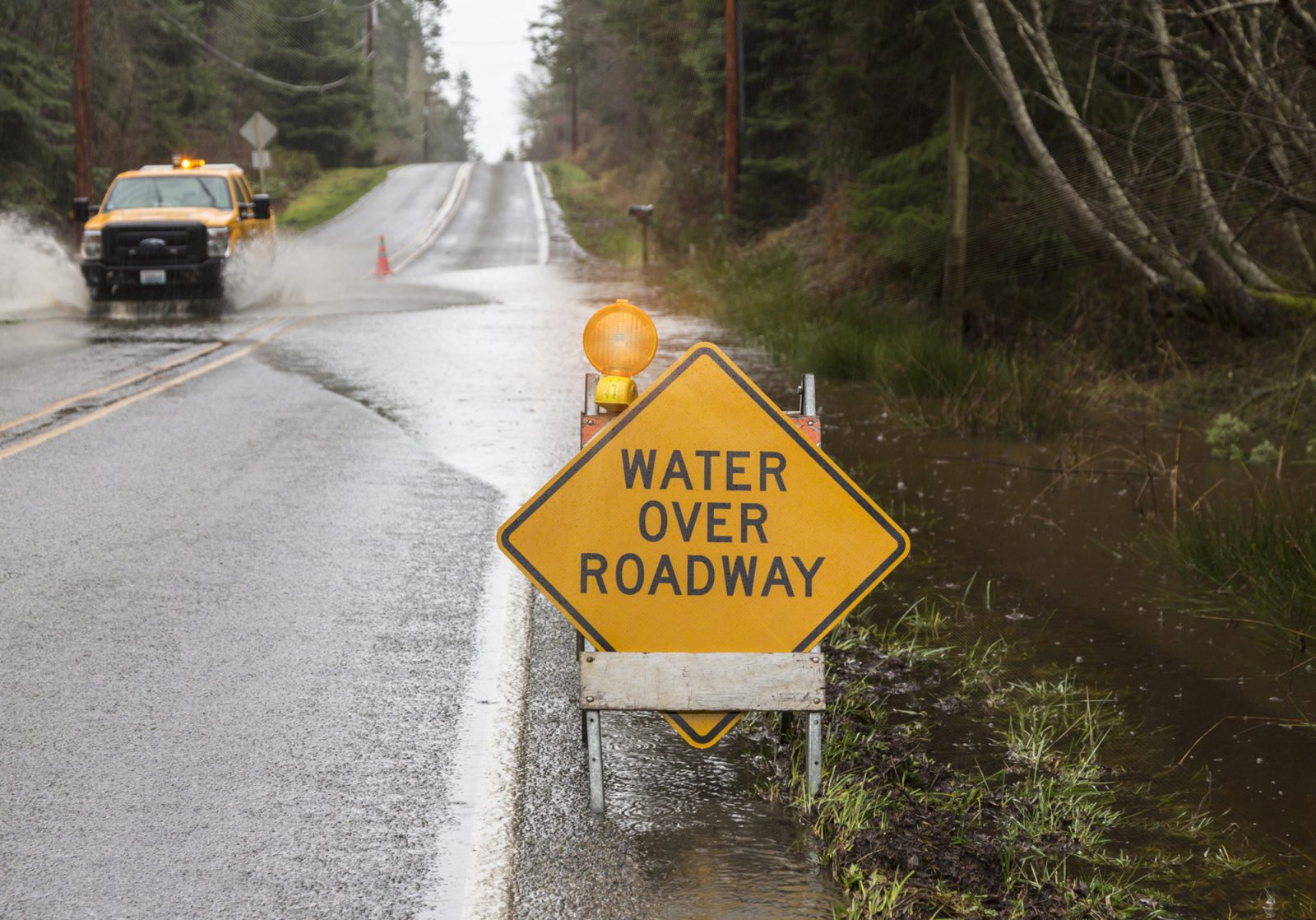
    The flooding of coastal communities along Lake Ontario last year caused major damage and made people realize that century floods aren’t nearly as rare as the name implies.

    A new research collaboration between Brock University and the Town of Lincoln is aimed at helping the community understand how to deal with the impacts of climate and environmental changes and examining potential avenues of solutions for future development along the shore. It’s the first externally funded project as part of the Brock-Lincoln Living Lab partnership announced in October 2017.

    Brock UNESCO Chair in Community Sustainability Liette Vasseur is leading the three-year research study for the Ontario component of a larger project by Université du Québec à Rimouski, which is examining how various coastal communities can deal with and share ideas on the impacts of climate and environmental changes.

    Brock UNESCO Chair in Community Sustainability Liette Vasseur

    “Communities are becoming more and more exposed to different hazards,” said Vasseur, who has been involved in similar research initiatives in other communities in Atlantic Canada and Ecuador. “With climate change, these types of events are coming faster and more often.”

    The project has received $280,000 in funding from the Marine Environmental Observation Prediction and Response Network (MEOPAR), with additional support from the Town of Lincoln and Brock. MEOPAR is an independent, not-for-profit organization funded by the federal government as a National Centre of Excellence that supports research and trains students in the area of marine risk and resilience.

    Lincoln suffered around $1 million in damage as a result of back-to-back spring storms in 2017 that caused massive flooding from Lake Ontario. The storms led to the Town’s first-ever voluntary evacuation notice for residents living near the Lake Ontario shoreline, and caused significant damage to Charles Daley Park and sewer systems in Jordan Station and Campden.

    Vasseur said climate change scenarios over the next decade are projecting continuous sea level rise and increases in extreme weather events. This will amplify the severity and frequency of flooding in coastal communities like Lincoln, which is continually growing with more people living near the Lake Ontario waterfront.

    “People were always talking about 100-year events. Now it’s more like one every five years,” she said. “It shows that we need to be more prepared. When we’re planning things like residential developments, we need to plan in a way that we’re going to survive with these types of events.”

    For the Town of Lincoln, the research will provide crucial information about current and future risks.

    “In 2017, Lincoln experienced the real and harsh effects of severe weather on critical infrastructure in our community,” said Lincoln CAO Mike Kirkopoulos. “As another benefit of the Brock-Lincoln Living Lab, this research is grassroots to our community, helping us better understand the conditions for collective ownership of adapting to climate change as an organization and community.”

    Vasseur said the research team will include a postdoctoral fellow and a master’s student, who will collect data in Lincoln, and share information and ideas with other researchers and communities along the St. Lawrence Seaway.

    “It will be a very good learning experience for the students, while helping the communities at the same time,” she said. “We’re hoping that by the end, the data we’re going to get can be used by communities all along the coastline.”

    Lincoln Mayor Sandra Easton said municipalities like hers are learning that more frequent smaller floods — not just rare major flooding events — can have a big impact on resources.

    “Climate change and the impact on municipal infrastructure is top of mind for our council,” Easton said. “With the growing municipal infrastructure funding gap, municipalities have a responsibility for long-term planning and mitigation of the effects of climate change. This research is critical for council to understand how we can better identify actions toward climate change adaptation.”

    Story originally published in The Brock News