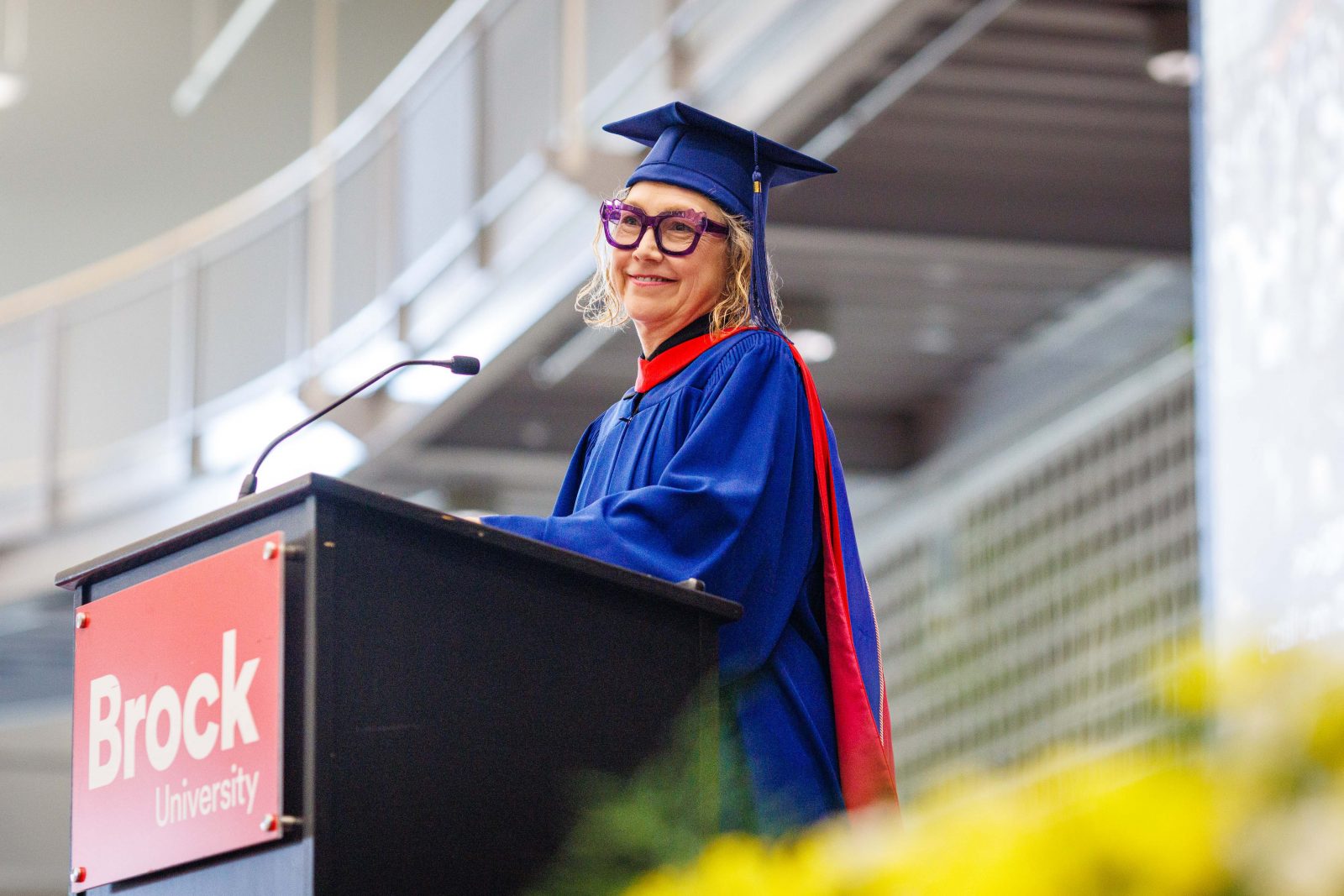
Image caption: Associate Professor of Visual Arts Donna Szőke delivered the Convocation address at the afternoon ceremony on Wednesday, June 10.
Wednesday, June 10, 2026 | by The Brock News
“I begin by not knowing what it is that I am doing.”
A perspective gained from years of creating art in the studio, these seemingly simple words are the “secret engine” that drives Associate Professor of Visual Arts Donna Szőke.
The Faculty of Humanities 2026 Excellence in Teaching Award recipient was sure to relay this comforting but motivating message to graduates during her Convocation address on Wednesday, June 10.
“We don’t arrive in a class, attempt to conduct research, show up for homework or be present in the art studio to learn what we already know,” Szőke said. “As lifelong students of our fields, we learn to embrace the unknown, as the unknown is where learning, discovery and invention are not only possible but irresistible.”
She told the Class of 2026 that Convocation marks a significant change in their lives. With this new step into the unknown, she said, “you are at the brink of next creating the most important and insightful invention, and that, my friends, is the next version of you.”
Szőke took her own leap into the unknown as a university student, designing on four films by Canadian filmmaker Guy Maddin. Three of the films were recently recognized and transferred to 4K by the Toronto International Film Festival, Telefilm Canada and Zeitgeist Films.
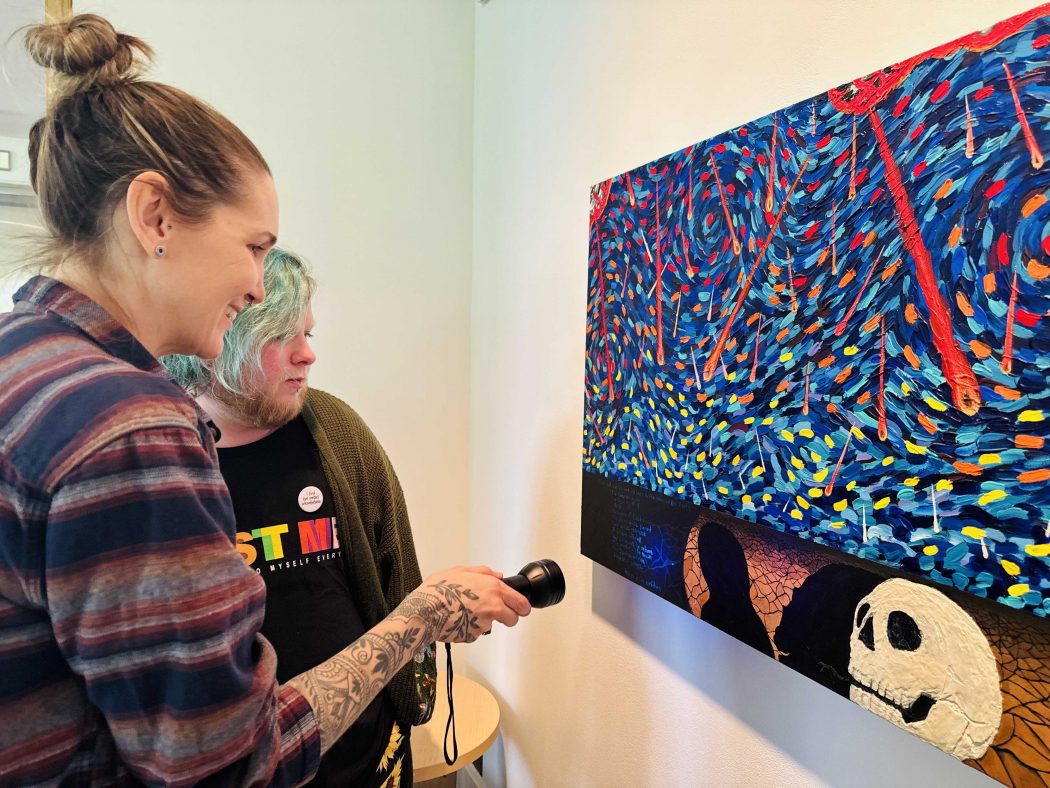
As an established visual artist, her practice includes video art, installation, animation, drawing, writing and printmaking exploring themes of human connection and social justice. One of her most recent video works, The Invisible Hippo of Grief: An Adoption Story, examines the baby adoption mandate era following the Second World War when almost 600,000 infants born to unmarried women in Canada recorded as “illegitimate births” were surrendered for adoption.
Szőke’s entire body of video artworks was recently picked up for distribution by Vtape, Canada’s biggest video art distributor. A lifetime accomplishment, the project will make her work accessible in an online archive once complete.
For Szőke, it’s an affirmation that the practice of embracing the unknown can lead to opportunities not yet dreamed of.
“Facing the unknown is met by our own curiosity, our desire to discover, and these forces meet with an almost a magnetic affinity,” she said. “Not knowing is an opportunity to forge a pathway to where we can discover and recognize our own unique insights, our own unique contributions.”
Associate Professor of Communication, Popular Culture and Film Karen Louise Smith, who received Brock’s 2025 Chancellor’s Chair for Teaching Excellence last fall for her work on ethical educational technology, empowered graduates to mark out their own milestones and celebrate their successes during her Convocation address at Wednesday’s morning ceremony.
Smith shared insights into the process of building a career based on passions, values and finding a creative spark. She also drew parallels to hiking, a favourite hobby, and reminded the audience that looking out for milestones can help a wanderer find the right path.
“I hope you can reflect on how you can find your own milestones,” Smith told graduates. “Think about the people and the communities that matter to you. You may find milestones reveal themselves through the relationships that are important to you.”
A full collection of Convocation photos by ceremony will be available on Brock University’s official Flickr galleries. View recordings and livestreams of each Convocation ceremony at brocku.ca/livestream
For more information and the full schedule of Brock’s Spring Convocation, visit brocku.ca/convocation