They’re Back! Mathise, Geo, and Trig Return to the Niagara Region!
The Niagara Falls and Welland Canal Math Trails – Freshly Updated for 2025!
 The Niagara Falls Math Trail and Welland Canal Math Trail, originally created by Dr. Eric Muller back in 1997, have made their exciting return. Now with updated content, activities, and the same fun-filled exploration through mathematics, history, and local geography, all experienced on foot as students walk that actual sites and engage with their surroundings. Updated by Melina Fingado, Dr. Eric Muller, and Dr. Chantal Buteau in 2025, and in collaboration with Niagara Parks, both trails invite students in Grades 5 to 7 to take math off the page and into real life in the Niagara region!
Through the voices of Mathise Phun, Geo Metry, and their always-curious dog Trig, students are guided through problems that ask them to estimate, model, calculate, and reflect. Whether it’s estimating the erosion of Niagara Falls, the width of the Welland Canal, or the volume of a shipping lock, these trails are designed to connect mathematics to the real world.

The Niagara Falls Math Trail begins at the Niagara Parks Power Station and journeys past the Horseshoe and American Falls, the Rainbow Bridge, and Victoria Park. Along the way, students explore geometry, measurement, estimation, slope, symmetry, and patterns. The trail includes engaging narratives, historical context, and math challenges based on iconic landmarks. Plan for 3–4 hours on-site or choose a shorter trail of 1–2 hours by completing Scenes 2–5. Note: Power Station admission fees apply.
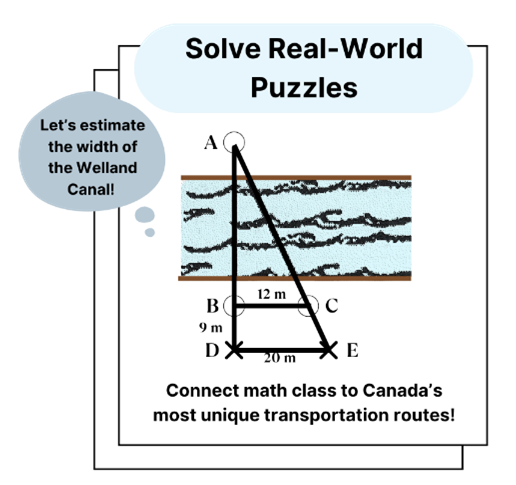
The Welland Canal Math Trail occurs at the St. Catherines Museum and Lock 3 which focuses on the mathematics connected to ship locks, flow rates, and ship transits. Students measure, estimate, compare historical data, and analyze real traffic along the canal. This trail also takes about 3–4 hours, or 1–2 hours with saving some activities for the classroom.
Both trails also include an optional follow-up coding activity that can be completed in the classroom after the trail. These Scratch-based coding activities connect the real-world mathematics explored on the trail to coding, a key component of Ontario’s modern math curriculum.
Ready to bring math to life?
Download the pilot versions (the finalized versions planned for early 2026):
- Niagara Falls Math Trail: LINK (to download pdf)
- Niagara Falls Math Trail Student Worksheet: LINK (to download pdf)
- Niagara Falls Math Trail Teacher Guidelines: LINK (to download pdf)
- Complementary post-trail activity (using Scratch coding): LINK (to download pdf)
- Complementary post-trail activity answer key: LINK (to download pdf)
- Welland Canal Math Trail: LINK (to download pdf)
- Welland Canal Math Trail Student Worksheet: LINK (to download pdf)
- Welland Canal Math Trail Teacher Guidelines: LINK (to download pdf)
- Complementary post-trail activity (using Scratch coding): LINK (to download pdf)
- Complementary post-trail activity answer key: LINK (to download pdf)
Have you already completed the trails? – Feel free to give us some feedback!
Niagara Falls Teacher Survey: https://forms.gle/UDqkBPtC2ZJMLT8G7
Niagara Falls Student Survey: https://forms.gle/drGWkNRhM32KSfhd9
Welland Canal Teacher Survey: https://forms.gle/NhBm32uYBYWrrfFU7
Welland Canal Student Survey: https://forms.gle/FmmuQamtYeQkJWx77