Professor of Mathematics
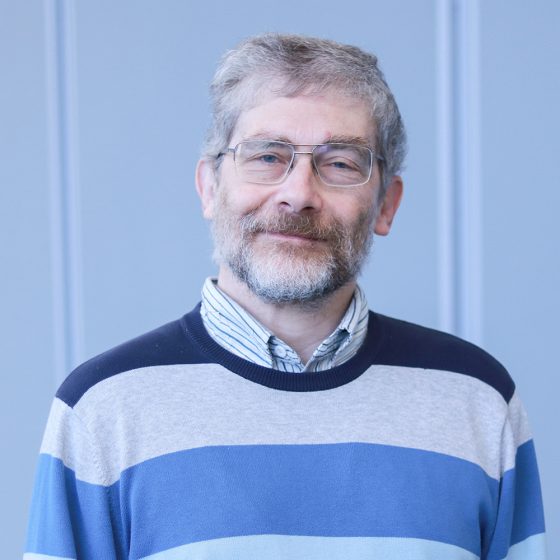
My main research interests are in Mathematical Physics in the sense of Mathematics inspired by ideas that come from Theoretical Physics. More precisely, I am interested in algebraic and geometric structures which come from quantum field theory, statistical mechanics and the theory of integrable systems.
Academic Journal Papers, refereed
[1] M. Kontsevich, A. Odesskii, Multiplication kernels, Lett. Math. Phys. 111 (2021), no. 6, Paper No. 152, 59 pp.,
[2] M. Kontsevich, A. Odesskii, p-Determinants and monodromy of differential operators, Selecta Math. (N.S.) 28 (2022), no. 3, Paper No. 52,
[3] A. Odesskii, V. Sokolov, Nonabelian elliptic Poisson structures on projective spaces, J. Geom. Phys. 169 (2021), Paper No. 104330, 15 pp.,
[4] A. Odesskii, Poisson structures on loop spaces of CP^n and an r-matrix associated with the universal elliptic curve, Journal of Geometry and Physics Volume 140, June 2019, Pages 152-160,
[5] A. Odesskii, B. Feigin, “Flat deformations of algebras and functional equations”, Journal of Combinatorial Algebra, Швейцария. 2019. Vol. 3. No. 3. P. 215-236,
[6] A. Odesskii, “Poisson structures on loop spaces of CP^n and an r-matrix associated with the universal elliptic curve”, Journal of Geometry and Physics, Volume 140, June 2019, pp 152-160,
[7] A. Odesskii, “K-projectors”, Journal of Algebra, Volume 511, 1 October 2018, pp 1-15,
[8] A. V. Odesskii, “Integrable structures of dispersionless systems and differential geometry”, Theoretical and Mathematical Physics, May 2017, Volume 191, Issue 2, pp 692-709,
[9] M. Babela, A. Odesskii, “A family of integrable evolution equations of third order”, J. Nonlinear Math. Phys. 24 (2017), no. 1, 73-78
[10] A. Odesskii, “A simple construction of integrable Whitham type hierarchies”, Geometric methods in physics, 195-208, Trends Math., Birkhauser/Springer, Cham, 2014
[11] V. E. Zakharov, A. V. Odesskii, A. V., M. Cisternino, M. Onorato, “Five-wave classical scattering matrix and integrable equations”, Theoret. and Math. Phys. 180 (2014), no. 1, 759-764
[12] A. V. Odesskii, V. N. Rubtsov, V. V. Sokolov, “Parameter-dependent associative Yang-Baxter equations and Poisson brackets”, Int. J. Geom. Methods Mod. Phys. 11 (2014), no. 9
[13] A. V. Odesskii, V. N. Rubtsov, V. V. Sokolov, “Double Poisson brackets on free associative algebras”, Noncommutative birational geometry, representations and combinatorics, 225-239, Contemp. Math., 592, Amer. Math. Soc., Providence, RI, 2013
[14] A. Odesskii, V. Sokolov, “Non-homogeneous systems of hydrodynamic type possessing Lax representations”, Comm. Math. Phys. 324 (2013), no. 1, 47-62
[15] A. Odesskii, T. Wolf, “Compatible quadratic Poisson brackets related to a family of elliptic curves”, J. Geom. And Physics (63), 2013, 107-117
[16] A. V. Odesskii, V. N. Rubtsov, V. V. Sokolov, “Bi-Hamiltonian ordinary differential equations with matrix variables”, Teoret. Mat. Fiz., 171:1 (2012), 26-32
[17] E.V. Ferapontov, Alexander Odesskii, and N.M. Stoilov, Classification of integrable two-component Hamiltonian systems of hydrodynamic type in 2+1 dimensions, Journal of Mathematical Physics 52, 2011
[18] A. Odesskii, V. Sokolov, Integrable (2+1)-dimensional systems of hydrodynamic type, Theoretical and Mathematical Physics, 163:2 (2010), 179-221
[19] A. Odesskii, V. Sokolov, Integrable pseudopotentials related to generalized hypergeometric functions, Selecta Mathematica (2010) 16:145.
[20] E. V. Ferapontov, A. V. Odesskii, Integrable Lagrangians and modular forms, Journal of Geometry and Physics 60 (2010) 896-906.
[21] A. Odesskii, V. Sokolov, Classification of integrable hydrodynamic chains, Journal of Physics A: Math. Theor. 43(2010) 434027 (15pp.).
[22] A. Odesskii, V. Sokolov, Integrable elliptic pseudopotentials, Theoretical and Mathematical Physics, 161(1): 1338-1350 (2009).
[23] Odesskii, Alexander; Rubtsov, Vladimir, Integrable systems associated with elliptic algebras. Quantum groups, 81-105, IRMA Lect. Math. Theor. Phys., 12, Eur. Math. Soc., Zurich, 2008.
[24] Odesskii, A. V.; Sokolov, V. V., On (2+1)-dimensional systems of hydrodynamic type possessing a pseudopotential with movable singularities. (Russian) Funktsional. Anal. i Prilozhen. 42 (2008), no. 3, 53–62, 96; translation in Funct. Anal. Appl. 42 (2008), no. 3, 205–212
[25] Odesskii, A. V.; Pavlov, M. V.; Sokolov, V. V., Classification of integrable Vlasov-type equations. (Russian) Teoret. Mat. Fiz. 154 (2008), no. 2, 249–260. (Reviewer: Yuri B. Suris)
[26] Odesskii, Alexander, A family of (2+1)-dimensional hydrodynamic type systems possessing a pseudopotential. Selecta Math. (N.S.) 13 (2008), no. 4, 727–742. (Reviewer: Ian A. B. Strachan)
[27] Odesskii, Alexander; Sokolov, Vladimir, Pairs of compatible associative algebras, classical Yang-Baxter equation and quiver representations. Comm. Math. Phys. 278 (2008), no. 1, 83–99. (Reviewer: Zhong Qi Ma) 17B62 (81R12)
[28] Odesskii, Alexander; Sokolov, Vladimir, Algebraic structures connected with pairs of compatible associative algebras. Int. Math. Res. Not. 2006, Art. ID 43734, 35 pp. (Reviewer: Thierry Dana-Picard)
[29] Odesskii, A. V.; Sokolov, V. V., Integrable matrix equations related to pairs of compatible associative algebras. J. Phys. A 39 (2006), no. 40, 12447–12456. (Reviewer: Stanislav Z. Pakuliak)
[30] Odesskii, A. V.; Sokolov, V. V., Compatible Lie brackets related to elliptic curve, J. Math. Phys. 47 (2006), no. 1, 013506, 14 pp. (Reviewer: Olivier G. Schiffmann)
[31] Odesskii, Alexander, Bihamiltonian elliptic structures. Mosc. Math. J. 4 (2004), no. 4, 941–946, 982.
[32] Odesskii, Alexander, Set-theoretical solutions to the Yang-Baxter relation from factorization of matrix polynomials and $\theta$-functions. Mosc. Math. J. 3 (2003), no. 1, 97–103, 259. (Reviewer: Gigel Militaru)
[33] Odesskii, A. V.; Rubtsov, V. N., Polynomial Poisson algebras with a regular structure of symplectic leaves. (Russian) Teoret. Mat. Fiz. 133 (2002), no. 1, 3–23; translation in Theoret. and Math. Phys. 133 (2002), no. 1, 1321–1337 (Reviewer: Zakaria Giunashvili)
[34] Enriquez, B.; Odesskii, A., Quantization of canonical cones of algebraic curves. Ann. Inst. Fourier (Grenoble) 52 (2002), no. 6, 1629–1663. (Reviewer: Olivier G. Schiffmann)
[35] Belavin, A. A.; Odesskii, A. V.; Usmanov, R. A., New relations in the algebra of the Baxter $Q$-operators. (Russian) Teoret. Mat. Fiz. 130 (2002), no. 3, 383–413; translation in Theoret. and Math. Phys. 130 (2002), no. 3, 323–350 (Reviewer: Andrey V. Tsiganov)
[36] Braden, H. W.; Gorsky, A.; Odesskii, A.; Rubtsov, V., Double-elliptic dynamical systems from generalized Mukai-Sklyanin algebras. Nuclear Phys. B 633 (2002), no. 3, 414–442. (Reviewer: Alexander V. Shapovalov)
[37] Odesskii, A. V., Belavin elliptic R-matrices and exchange algebras. (Russian) Funktsional. Anal. i Prilozhen. 36 (2002), no. 1, 59–74, 96; translation in Funct. Anal. Appl. 36 (2002), no. 1, 49–61 32G34
[38] Feigin, B. L.; Odesskii, A. V., Quantized moduli spaces of the bundles on the elliptic curve and their applications. Integrable structures of exactly solvable two-dimensional models of quantum field theory (Kiev, 2000), 123–137, NATO Sci. Ser. II Math. Phys. Chem., 35, Kluwer Acad. Publ., Dordrecht, 2001. (Reviewer: Zhenbo Qin)
[39] Feigin, B. L.; Odesskii, A. V., Functional realization of some elliptic Hamiltonian structures and bosonization of the corresponding quantum algebras. Integrable structures of exactly solvable two-dimensional models of quantum field theory (Kiev, 2000), 109–122, NATO Sci. Ser. II Math. Phys. Chem., 35, Kluwer Acad. Publ., Dordrecht, 2001. (Reviewer: Shao-Ming Fei)
[40] Feigin, B. L.; Odesskii, A. V., Vector bundles on an elliptic curve and Sklyanin algebras. Topics in quantum groups and finite-type invariants, 65–84, Amer. Math. Soc. Transl. Ser. 2, 185, Amer. Math. Soc., Providence, RI, 1998. (Reviewer: Michel Van den Bergh)
[41] Feigin, B. L.; Odesskii, A. V., Coordinate ring of the quantum Grassmannian and intertwiners for the representations of Sklyanin algebras. Topics in quantum groups and finite-type invariants, 55–64, Amer. Math. Soc. Transl. Ser. 2, 185, Amer. Math. Soc., Providence, RI, 1998. (Reviewer: Michel Van den Bergh)
[42] Feigin, Boris; Jimbo, Michio; Miwa, Tetsuji; Odesskii, Alexandr; Pugai, Yaroslav, Algebra of screening operators for the deformed $W\sb n$ algebra. Comm. Math. Phys. 191 (1998), no. 3, 501–541. (Reviewer: Jun’ichi Shiraishi)
[43] Odesskii, A. V.; Feigin, B. L., Elliptic deformations of current algebras and their representations by difference operators. (Russian) Funktsional. Anal. i Prilozhen. 31 (1997), no. 3, 57–70, 96; translation in Funct. Anal. Appl. 31 (1997), no. 3, 193–203 (1998) (Reviewer: V. Leksin)
[44] Feigin, Boris; Odesskii, Alexander, A family of elliptic algebras. Internat. Math. Res. Notices 1997, no. 11, 531–539. (Reviewer: Michel Van den Bergh)
[45] Odesskii, A. V.; Feigin, B. L., Sklyanin’s elliptic algebras. The case of a point of finite order. (Russian) Funktsional. Anal. i Prilozhen. 29 (1995), no. 2, 9–21, 95; translation in Funct. Anal. Appl. 29 (1995), no. 2, 81–90
[46] Odesskii, A. V.; Feigin, B. L., Constructions of elliptic Sklyanin algebras and of quantum $R$-matrices. (Russian) Funktsional. Anal. i Prilozhen. 27 (1993), no. 1, 37–45; translation in Funct. Anal. Appl. 27 (1993), no. 1, 31–38 (Reviewer: Tomasz Brzeziiski)
[47] Odesski, Aleksandr V., Rational degeneration of elliptic quadratic algebras. Infinite analysis, Part A, B (Kyoto, 1991), 773–779, Adv. Ser. Math. Phys., 16, World Sci. Publ., River Edge, NJ, 1992. (Reviewer: Michel Van den Bergh)
[48] Odesskii, A. V.; Feigin, B. L., Sklyanin’s elliptic algebras. (Russian) Funktsional. Anal. i Prilozhen. 23 (1989), no. 3, 45–54, 96; translation in Funct. Anal. Appl. 23 (1989), no. 3, 207–214 (1990) (Reviewer: S. Paul Smith)
[49] Odesskii, A. V., An analogue of the Sklyanin algebra. (Russian) Funktsional. Anal. i Prilozhen. 20 (1986), no. 2, 78–79
Review Articles, refereed
[50] Odesskii, A. V., Elliptic algebras. (Russian) Uspekhi Mat. Nauk 57 (2002), no. 6(348), 87–122; translation in Russian Math. Surveys 57 (2002), no. 6, 1127–1162 (Reviewer: Dmitriy A. Rumynin)
Conference contributions, refereed
[51] A.V.Odesskii and B.L.Feigin, Quantized moduli spaces of the bundles on the elliptic curve and their applications. Integrable structures of exactly solvable two-dimensional models of quantum field theory (Kiev, 2000), 123–137, NATO Sci. Ser. II Math. Phys. Chem., 35, Kluwer Acad. Publ., Dordrecht , 2001. (Reviewer: Zhenbo Qin), math.QA/9812059
[52] A.V.Odesskii and B.L.Feigin, Functional realization of some elliptic Hamiltonian structures and bosonization of the corresponding quantum algebras. Integrable structures of exactly solvable two-dimensional models of quantum field theory ( Kiev , 2000), 109–122, NATO Sci. Ser. II Math. Phys. Chem., 35, Kluwer Acad. Publ., Dordrecht , 2001. (Reviewer: Shao-Ming Fei), math.QA/9912037
- MATH 3P09 Partial Differential Equations
- MATH 2P08 Ordinary Differential Equations
- MATH 3P08 Advanced Differential Equations
Mathematicians, Gold Prospectors, and AI
Imagine gold prospectors who have spent their lives searching for gold by hand along a beautiful river. They love their work, have developed remarkable skills, and take pride in their discoveries. And suddenly, heavy mining machinery arrives. The prospectors may love the river, but the gold does not care who discovers it.
I think something similar may be happening to mathematics. Will AI agents eventually become the main creators of new mathematical theories, leaving human mathematicians primarily to study and understand what AI has discovered? And would that really be the end of mathematics?
I have written a short essay on anthropocentrism, artificial intelligence, and the possible future of mathematical research.
I would like to begin with a few thoughts about anthropocentrism — the tendency to regard human beings as the centre of the universe, or as having some fundamentally privileged position in nature.
I am not going to discuss its moral aspects. But as a way of understanding objective reality, anthropocentrism has a rather poor historical record. For example, for centuries people believed that the Earth occupied the centre of the universe. Copernicus challenged this view. Later, Darwin challenged the belief that humans occupied a fundamentally separate position from other living organisms. Again and again, science has challenged our beliefs about human exceptionalism. Such beliefs often seem to be motivated more by human pride than by a desire to understand reality.
I think we are witnessing another example of this in discussions about artificial intelligence.
The human brain is a physical system that developed through biological evolution, using the materials available — cells, proteins, electrochemical processes. It is a remarkable product of evolution, but why should we assume that it is an optimal instrument for learning and reasoning? Or that comparable, perhaps superior, intelligence cannot be realized using completely different materials, such as chips and transistors?
After all, the human brain did not evolve for doing mathematics.
Another common argument is that AI may prove theorems, but it cannot really understand mathematics, appreciate mathematical beauty, or possess genuine intuition. But what exactly do these statements mean? Do we have precise definitions of these concepts, even for humans? And why should we assume that whatever they mean, they must be exclusive to biological intelligence?
I am not claiming that AI necessarily possesses these qualities. I am questioning the grounds on which we declare that it cannot. More generally, why should we assume that human mathematical thinking is the ultimate, or even a particularly natural, way of discovering mathematical truths?
Perhaps the most interesting possibility is not that AI will eventually learn to do mathematics as humans do, but that it will discover ways of doing mathematics that we would never have imagined.
This brings me to an analogy.
I sometimes think that the situation of mathematicians today resembles that of gold prospectors who have spent their lives searching for gold by hand along a beautiful river. They enjoy their work, they have developed remarkable skills, and they take pride in their discoveries.
And suddenly, heavy mining machinery arrives.
Naturally, they may have mixed feelings about this development. But arguing that the machines cannot really appreciate the beauty of the river, or experience the joy of finding gold, seems rather beside the point.
Of course, the arrival of machinery raises very serious questions. Who owns the machines? Who controls them? What will happen to the prospectors? How will the gold be distributed?
These are important economic, social, and institutional questions. But they should not be confused with the question of whether the machines can find gold.
From this perspective, I see initiatives such as assembling groups of mathematicians at Princeton to respond to the AI revolution as a fairly conventional institutional strategy for managing technological disruption. Such initiatives may be useful, but they should not be confused with understanding the deeper nature of the transformation.
And there is one final point about this analogy.
The prospectors may love the river, but the gold does not care who discovers it.
Similarly, mathematical truths do not depend on who discovers them, or whether the discoverer is human.
Perhaps we have become accustomed to identifying mathematics with the activity of mathematicians. But these are not necessarily the same thing.
And perhaps the most interesting question is not how to preserve mathematics as a human profession in its present form, but what mathematics itself might become when mathematical intelligence is no longer exclusively human.
My personal expectation is that, in the not-too-distant future, AI agents will become the main driving force of mathematical research. They will not simply solve problems formulated by humans, but develop entirely new theories, mathematical languages, and conceptual frameworks.
The role of human mathematicians, even at the highest level, may change fundamentally. Instead of being the primary creators of new mathematics, we may increasingly find ourselves trying to understand, organize, and master mathematics discovered by AI. And it is quite possible that our ability to understand this mathematics will fall progressively behind the speed at which AI produces it.
But I do not see this as the end of mathematics, or even necessarily as the end of mathematics as a human intellectual activity.
After all, biologists do not create life (yet?). They study life, which exists independently of them, and their subject is no less fascinating because of that.
Perhaps mathematics will undergo a similar transformation. Instead of primarily creating mathematical theories ourselves, we may increasingly study a vast mathematical world
explored and developed by other forms of intelligence.
Perhaps the future role of mathematicians will be not so much to discover mathematics as to understand mathematics that has already been discovered.
And I am not sure that this would make mathematics any less interesting.